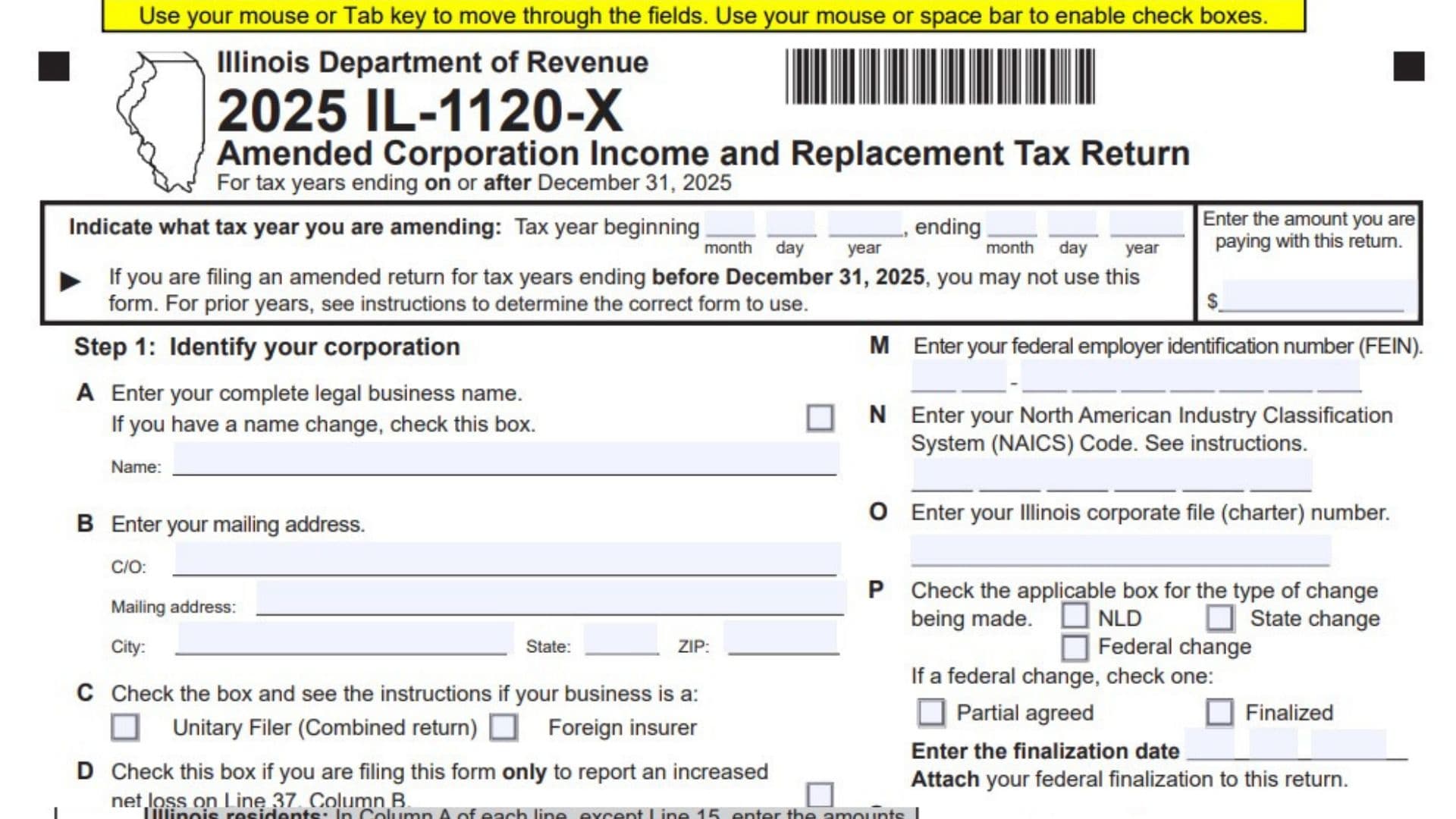
Form IL-1120-X, titled the Amended Corporation Income and Replacement Tax Return, is the official state tax document used by corporations to correct, update, or adjust previously filed Illinois corporate income tax returns for tax years ending on or after December 31, 2025. Corporate entities file this form whenever adjustments occur at the federal level—such as an audit, Revenue Agent Report, or amended federal return—or when state-specific adjustments arise, including updates to apportionment factors, net loss deductions, tax additions, subtractions, or available statutory credits. The return collects extensive financial data, spanning federal taxable income adjustments, statutory state addition and subtraction modifications, multistate business income apportionment formulas, replacement and income tax computations, tax credits, and prior payments. Accurately preparing this form ensures that businesses maintain good standing with the Illinois Department of Revenue, claim legitimate refunds, properly record net loss carryforwards, and avoid steep penalties and statutory interest resulting from underreported liabilities.
How To File Form IL-1120-X
Filing Form IL-1120-X requires careful compilation of supporting documentation, accurate mathematical reconciliation, and adherence to state submission requirements.
Where And How To Submit
Completed returns that include a tax balance due should be accompanied by Form IL-1120-X-V, the payment voucher. If paying by check or money order, make the instrument payable to the Illinois Department of Revenue, write your Federal Employer Identification Number, the ending tax year date, and “IL-1120-X-V” directly on the payment, and staple the voucher and check to the front page of the return.
Mail the completed return, payment voucher, and all required supporting schedules to:
Illinois Department of Revenue
P.O. Box 19016
Springfield, IL 62794-9016
Essential Attachments And Schedules
Depending on the specific lines amended, taxpayers must attach supporting forms to prevent the state from disallowing adjustments:
- Federal Changes: A complete copy of federal Form 1120-X, federal Form 1139, or the Internal Revenue Service Revenue Agent Report, along with finalization proof such as an audit agreement or federal refund notification.
- Unitary Filers: Illinois Schedule UB and the Subgroup Schedule when filing a combined return.
- Foreign Insurers: Schedule INS or Schedule UB/INS for insurance tax reductions.
- State Modifications: Form IL-4562 for special depreciation adjustments, Schedule 80/20 for related-party transaction modifications, Schedule M for other additions and subtractions, Schedule J for foreign dividend deductions, and Schedule 1299-B for enterprise zone deductions.
- Multistate Apportionment: Schedule NB for nonbusiness income allocations, alongside copies of all returns filed in other states if sales factors changed.
- Loss Deductions And Credits: Schedule NLD or UB/NLD for net operating loss deductions, federal Form 982 for discharge of indebtedness adjustments, Form IL-477 for replacement tax investment credits, Schedule 1299-D for income tax credits, and Schedule 4255 for credit recapture.
- Withholding And Passthrough Documentation: All federal and state Schedules K-1-P or K-1-T documenting distributive shares, passthrough entity withholding, or passthrough entity tax credits, along with Form W-2G copies.
Preparatory Records
Before beginning the form, gather your originally filed or most recently adjusted Form IL-1120, your final amended federal corporate return, updated apportionment workpapers, records of all tax payments previously remitted for the tax period, and notices of prior refunds or credited amounts.

How To Complete Form IL-1120-X
Form IL-1120-X features two numeric columns across Steps 2 through 8. Column A requires the figures as most recently reported, assessed, or adjusted by previous amendments or audits. Column B requires the newly corrected whole-dollar figures.
Tax Year Information
Tax Year Period
Indicate the specific tax year covered by this amended filing by entering the beginning month, day, and year, along with the ending month, day, and year. This form is strictly for periods ending on or after December 31, 2025. Prior tax years require earlier historical revisions of the form.
Step 1: Identify Your Corporation
Line A: Legal Business Name and Name Change Checkbox
Enter the corporation’s complete legal business name. If the business name has legally changed since the last return was submitted, mark the corresponding checkbox.
Line B: Mailing Address
Provide the full mailing address of the corporate entity, including any in-care-of designation, street address or post office box, city, state, and postal zip code.
Line C: Unitary Filer and Foreign Insurer Checkboxes
Mark the first box if the corporation files as part of an Illinois combined unitary group. Mark the second box if the company qualifies as a foreign insurer. If both apply, check both boxes.
Line D: Increased Net Loss Only Checkbox
Check this box if this amended return is filed exclusively to report an increased net operating loss on Line 37, Column B.
Line E: Reportable Transaction Attachments Checkbox
Mark this box and attach federal Form 8886 or federal Schedule M-3, Part II, Line 12, if you were required to complete those forms federally and have not previously submitted them to the department.
Line F: Illinois Schedule UB Checkbox
Check this box if you have attached Illinois Schedule UB to report combined unitary group information.
Line G: Subgroup Schedule Checkbox
Mark this box if your combined filing includes an attached Subgroup Schedule.
Line H: Illinois Schedule 1299-D Checkbox
Check this box if you are claiming corporate income tax credits and have attached Illinois Schedule 1299-D.
Line I: Form IL-4562 Checkbox
Mark this box if you have attached Form IL-4562 to document bonus depreciation additions or subtractions.
Line J: Illinois Schedule M Checkbox
Check this box if you have attached Illinois Schedule M to report other business additions or subtractions.
Line K: Schedule 80/20 Checkbox
Mark this box if you have attached Schedule 80/20 to account for related-party intercompany expenses.
Line L: 52/53-Week Filer Checkbox
Check this box if your corporation uses a 52/53-week accounting fiscal tax year.
Payment Enclosed Box
Enter the exact dollar amount of the payment submitted alongside this amended return.
Line M: Federal Employer Identification Number (FEIN)
Enter the nine-digit federal employer identification number assigned by the Internal Revenue Service.
Line N: NAICS Code
Provide the six-digit North American Industry Classification System code representing your principal business activity.
Line O: Illinois Corporate File Number
Enter the corporate charter or file number assigned to your business by the Illinois Secretary of State.
Line P: Type of Change Checkboxes
Indicate the reason for filing this amended return by marking the box for Net Loss Deduction, State change, or Federal change. If marking a federal change, indicate whether it is partially agreed or finalized, enter the official finalization date, and attach federal documentation.
Line Q: Nonbusiness Income Election Checkbox
Check this box if you are submitting this amended filing on or before the extended filing deadline and elect to treat all nonbusiness income as apportionable business income.
Line R: Discharge of Indebtedness Checkbox
Mark this box and attach federal Form 982 if you are reporting a discharge of indebtedness adjustment on Schedule NLD, Schedule UB/NLD, or Line 36 of this form.
Line S: Schedule INL Checkbox
Check this box if you have completed and attached Schedule INL.
Line T: Annualized Income Checkbox
Mark this box if you calculated underpayment penalties using the annualized income installment method on Form IL-2220.
Line U: Public Law 86-272 Checkbox
Check this box if your operational business activities within Illinois are entirely protected from state net income taxation under federal Public Law 86-272.
Line V: Throwback Adjustment Checkbox
Mark this box if you are making adjustments to your sales factor regarding throwback rules.
Line W: Double Throwback Adjustment Checkbox
Check this box if your filing reflects double throwback adjustments in the sales apportionment computation.
Explanation of Changes Box
Provide a clear, detailed written explanation of all modifications made on this return. If additional room is needed, attach a separate narrative sheet.
Step 2: Figure Your Income Or Loss
Line 1: Federal Taxable Income
Enter the federal taxable income or loss before net operating loss deductions and special deductions from federal Form 1120. If this figure changed, attach official proof of federal finalization.
Line 2: Federal Net Operating Loss Deduction
Enter the federal net operating loss deduction reported on your federal Form 1120.
Line 3: State, Municipal, and Other Exempt Interest Income
Enter the total interest received from state, municipal, and other public obligations that was exempt from federal taxable income on Line 1.
Line 4: Illinois Taxes Deducted Federally
Record the total amount of Illinois income and replacement taxes, as well as surcharges, that were deducted on your federal return when computing Line 1.
Line 5: Illinois Special Depreciation Addition
Enter the bonus depreciation addition calculated on Form IL-4562, which must be attached to the return.
Line 6: Related-Party Expenses Addition
Provide the intercompany intangible and interest expense addition figured on Schedule 80/20, and attach the schedule.
Line 7: Distributive Share of Additions
Enter your distributive share of addition modifications passed through from partnerships, trusts, or estates as reported on Schedules K-1-P or K-1-T.
Line 8: Other Additions
Enter any remaining statutory additions required under Illinois law from Schedule M, and attach Schedule M.
Line 9: Total Income or Loss
Add Lines 1 through 8 for both columns. This figure represents your total gross income or loss before state subtraction adjustments.
Step 3: Figure Your Base Income Or Loss
Line 10: Federal Obligation Interest Subtraction
Enter the total interest income earned from United States Treasury bonds and other federal obligations exempt from state taxation by federal statute.
Line 11: River Edge Redevelopment Zone Dividend Subtraction
Record the dividend subtraction amount originating from River Edge Redevelopment Zones, as calculated on Schedule 1299-B.
Line 12: River Edge Redevelopment Zone Interest Subtraction
Enter the qualifying financial interest subtraction from River Edge Redevelopment Zones from Schedule 1299-B.
Line 13: High Impact Business Dividend Subtraction
Provide the deductible dividend total earned from certified High Impact Businesses located in designated foreign trade zones from Schedule 1299-B.
Line 14: High Impact Business Interest Subtraction
Record the deductible loan interest income received from certified High Impact Businesses from Schedule 1299-B.
Line 15: Contribution Subtraction
Enter qualifying charitable or development contribution deductions figured on Schedule 1299-B.
Line 16: Job Training Project Contributions
Enter the allowable subtraction for qualified corporate contributions made to approved state job training programs.
Line 17: Foreign Dividend Subtraction
Record the statutory foreign dividend subtraction calculated on Illinois Schedule J, and attach Schedule J alongside federal Form 1120, Schedule C.
Line 18: Illinois Special Depreciation Subtraction
Enter the allowable depreciation recovery subtraction calculated on Form IL-4562.
Line 19: Related-Party Expenses Subtraction
Enter the allowable subtraction for related-party expenses reported on Schedule 80/20.
Line 20: Distributive Share of Subtractions
Provide the total subtraction modifications reported to you on Schedules K-1-P or K-1-T from passthrough entities.
Line 21: Other Subtractions
Enter the sum of any additional authorized state subtractions detailed on Schedule M, and attach the schedule.
Line 22: Total Subtractions
Sum Lines 10 through 21. This represents your aggregate state subtraction modifications.
Line 23: Base Income or Loss
Subtract Line 22 from Line 9. This represents your base income or loss before interstate apportionment.
Geographic Income Allocation Election
Before proceeding past Step 3, choose the applicable geographic allocation method:
- Box A: Mark this box if all corporate income on Line 23 was earned solely within Illinois. Carry the amount from Line 23 directly to Step 5, Line 35, and leave Step 4 entirely blank. Unitary filers cannot select Box A.
- Box B: Mark this box if any portion of the base income was earned outside Illinois, or if you are filing as a unitary group. You must complete every line of Step 4.
Step 4: Figure Your Income Allocable To Illinois
Complete this step only if you checked Box B.
Line 24: Nonbusiness Income or Loss
Enter the total net nonbusiness income or loss everywhere from Schedule NB, Line 1, and attach Schedule NB.
Line 25: Passthrough Entity Business Income or Loss
Enter the total business income or loss included in Line 23 that was received from non-unitary partnerships, partnerships included on Schedule UB, S corporations, trusts, or estates.
Line 26: Total Income Excluded from Apportionment
Add Lines 24 and 25.
Line 27: Business Income or Loss
Subtract Line 26 from Line 23 to isolate the business earnings subject to statutory sales apportionment.
Line 28: Total Sales Everywhere
Enter gross sales receipts everywhere across all jurisdictions. This entry cannot be negative.
Line 29: Total Sales Inside Illinois
Enter gross sales receipts generated within Illinois, applying statutory market sourcing rules. This amount cannot be negative.
Line 30: Apportionment Factor
Divide Line 29 by Line 28. Calculate and record the decimal to six decimal places.
Line 31: Apportioned Business Income or Loss
Multiply Line 27 by the apportionment factor on Line 30.
Line 32: Nonbusiness Income or Loss Allocable to Illinois
Enter the net nonbusiness income or loss directly sourced to Illinois from Schedule NB, Line 2.
Line 33: Passthrough Business Income Apportioned to Illinois
Enter the business income or loss apportionable to Illinois received from non-unitary partnerships, partnerships on Schedule UB, S corporations, trusts, or estates.
Line 34: Base Income or Loss Allocable to Illinois
Add Lines 31, 32, and 33. This represents your total modified base earnings attributable to Illinois.
Step 5: Figure Your Net Income
Line 35: Base Income or Net Loss
Enter the figure from Step 3, Line 23 if you marked Box A, or the figure from Step 4, Line 34 if you completed Step 4.
Line 36: Discharge of Indebtedness Adjustment
Enter the reduction amount for income excluded under bankruptcy or debt forgiveness rules from federal Form 982.
Line 37: Adjusted Base Income or Net Loss
Add Lines 35 and 36. If this amended return is filed solely to report an increased net loss on this line, ensure Step 1, Line D is checked.
Line 38: Illinois Net Loss Deduction
Enter your available net loss deduction from Schedule NLD or Schedule UB/NLD. If Line 37 is zero or negative, enter zero. Check the adjacent box and attach an explanatory statement if you are utilizing merged corporate losses.
Line 39: Net Income
Subtract Line 38 from Line 37. This is the net corporate income subject to state taxation.
Step 6: Figure Your Replacement Tax After Credits
Line 40: Replacement Tax
Multiply the net income on Line 39 by the statutory 2.5% replacement tax rate (0.025).
Line 41: Recapture of Investment Credits
Enter any recaptured replacement tax investment credit from Schedule 4255.
Line 42: Replacement Tax Before Credits
Add Lines 40 and 41.
Line 43: Investment Credits
Enter the allowable replacement tax investment credits from Form IL-477, and attach the form.
Line 44: Replacement Tax After Credits
Subtract Line 43 from Line 42. If the calculation produces a negative number, enter zero.
Step 7: Figure Your Income Tax After Credits
Line 45: Income Tax
Multiply the net income on Line 39 by the corporate income tax rate of 7.0% (0.07).
Line 46: Recapture of Investment Credits
Enter the income tax credit recapture amount calculated on Schedule 4255.
Line 47: Income Tax Before Credits
Add Lines 45 and 46.
Line 48: Income Tax Credits
Enter allowable income tax credits from Schedule 1299-D, and attach the schedule.
Line 49: Income Tax After Credits
Subtract Line 48 from Line 47. If the resulting balance is negative, enter zero.
Step 8: Figure Your Refund Or Balance Due
Line 50: Replacement Tax Before Reductions
Carry forward the replacement tax balance from Line 44.
Line 51: Foreign Insurer Replacement Tax Reduction
Enter the reduction amount calculated on Schedule INS or Schedule UB/INS, if applicable.
Line 52: Net Replacement Tax
Subtract Line 51 from Line 50.
Line 53: Net Income Tax Before Reductions
Carry forward the income tax amount from Line 49.
Line 54: Foreign Insurer Income Tax Reduction
Enter the income tax reduction amount from Schedule INS or Schedule UB/INS.
Line 55: Net Income Tax
Subtract Line 54 from Line 53.
Line 56: Compassionate Use of Medical Cannabis Surcharge
Enter the statutory surcharge assessed on designated medical cannabis business activities.
Line 57: Gaming Licensee Asset Sale Surcharge
Enter the statutory surcharge owed on the sale or exchange of assets held by licensed gaming enterprises.
Line 58: Total Net Taxes and Surcharges
Add Lines 52, 55, 56, and 57. This is your total revised state tax obligation.
Line 59a: Credit From Previous Overpayments
Enter the credit balance applied from prior tax periods or earlier filings.
Line 59b: Payments Made Prior to Filing
Enter the total tax payments remitted for this tax year before the date this amended return is filed, including estimated payments and extension remittances.
Line 59c: Pass-Through Withholding Reported
Enter the total passthrough withholding reported to your company on Schedules K-1-P or K-1-T, and attach the schedules.
Line 59d: Pass-Through Entity Tax Credit
Enter the passthrough entity tax credits allocated to your business on Schedules K-1-P or K-1-T, and attach copies.
Line 59e: Illinois Income Tax Withholding
Enter gambling or prize withholding documented on attached Forms W-2G.
Line 60: Total Payments
Sum Lines 59a through 59e.
Line 61: Previously Paid Penalty and Interest
Enter the cumulative penalty and interest amounts paid previously for the tax year being amended.
Line 62: Prior Overpayments
Enter the total amount of all overpayments previously refunded or credited forward to subsequent tax years for this amended filing period.
Line 63: Total Adjustments to Payments
Add Lines 61 and 62.
Line 64: Net Tax Paid
Subtract Line 63 from Line 60. This reflects the net tax remitted to the state for this tax year.
Line 65: Overpayment
If Line 64 exceeds Line 58, subtract Line 58 from Line 64 to determine the total overpayment.
Line 66: Credit Forward Allocation
Enter the portion of the overpayment on Line 65 that you elect to apply as a credit toward your subsequent tax year. If transferring this credit to a different corporate FEIN, check the adjacent box and attach a detailed explanatory statement.
Line 67: Refund Amount
Subtract Line 66 from Line 65. This is your net refundable cash overpayment.
Line 68: Tax Due
If Line 58 exceeds Line 64, subtract Line 64 from Line 58. This is the balance due with your amended filing. The state will issue a separate billing notice for any applicable penalty and interest charges.
Step 9: Signature And Preparer Authorization
Corporate Officer Signature
An authorized corporate officer—such as the President, Vice President, Treasurer, or Chief Financial Officer—must provide an original signature, corporate title, contact telephone number, and the signing date.
Paid Preparer Information
If an outside tax practitioner prepared the return, the preparer must sign, date the document, enter their Preparer Tax Identification Number, provide their firm’s name, federal identification number, address, and phone number, and indicate whether they are self-employed.
Preparer Discussion Checkbox
Mark the checkbox in Step 9 if the corporation authorizes the Illinois Department of Revenue to communicate directly with the paid preparer regarding questions about this return.
Final Review Before Filing
Before sending Form IL-1120-X to the Illinois Department of Revenue, review this quality assurance checklist:
- Confirm that both Column A and Column B contain entries across all relevant calculation rows and that whole dollars are used throughout.
- Check that the tax year beginning and ending dates correspond to periods ending on or after December 31, 2025.
- Verify that the nine-digit FEIN and Illinois corporate file number are entered accurately on every page.
- Ensure that the primary reason for filing in Step 1, Line P is selected, including federal finalization dates when applicable.
- Confirm that Box A or Box B is marked beneath Step 3 to establish whether interstate apportionment in Step 4 is required.
- Double-check that your apportionment percentage on Line 30 is rounded out to six decimal places.
- Verify that every schedule referenced in Step 1 and across individual line items—including Schedules UB, NLD, 80/20, M, 1299-D, or federal Form 1120-X—is firmly attached to the back of the return.
- Confirm that an authorized corporate officer has signed and dated the return in ink in Step 9.
- If Line 68 shows a tax liability due, verify that Form IL-1120-X-V is completed, the payment is attached to the front of the return, and the payment amount is entered on page 1.