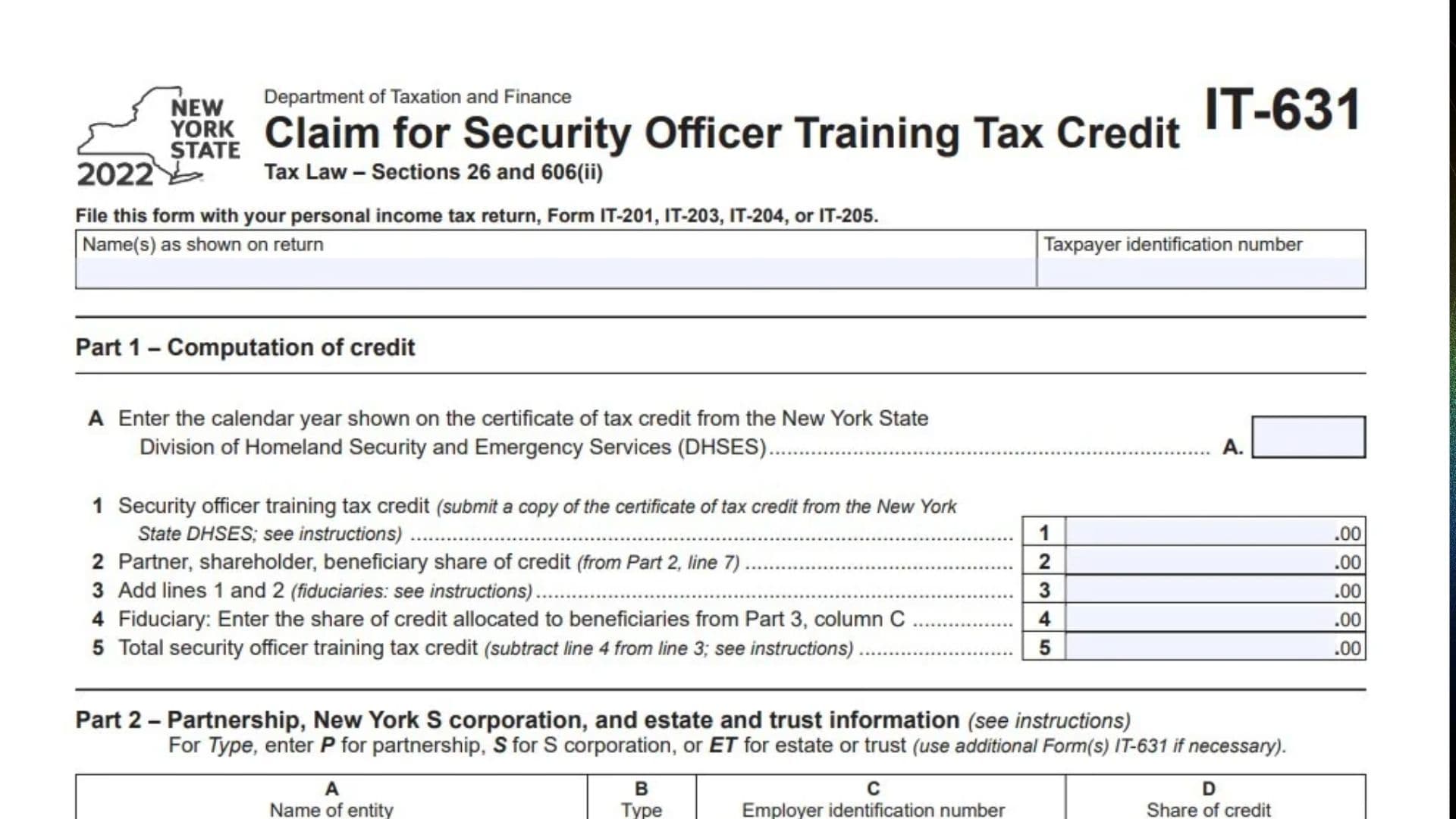
New York Form IT-631, officially known as the Claim for Security Officer Training Tax Credit, is a tax form used by eligible taxpayers to claim a credit for employing qualified security officers. The credit is established under Sections 26 and 606(ii) of the New York State Tax Law. It is available for tax years beginning on or after January 1, 2005, to qualifying building owners who employ security officers to protect their buildings. The credit is designed to help eligible property owners reduce their state tax liability by providing financial relief for the cost of employing qualified security personnel.
The amount of the credit is generally calculated by multiplying $3,000 by the number of qualified security officers employed to provide protection for one or more buildings owned by the taxpayer. If a qualified security officer works for less than a full year, the credit is adjusted based on the period of employment. The New York State Division of Homeland Security and Emergency Services (DHSES) determines the amount of credit allowed and issues a certificate of tax credit to eligible taxpayers. Form IT-631 collects information about the taxpayer, the tax credit certificate, and any credit received through a partnership, New York S corporation, estate, or trust. It also allows fiduciaries to report how the credit is divided between beneficiaries and the estate or trust itself. Individuals, sole proprietors, partners, shareholders, beneficiaries, and fiduciaries may use this form when they meet the applicable eligibility requirements and are subject to New York State personal income tax under Article 22. Completing the form correctly is important because it ensures that the credit is calculated, allocated, and reported properly on the taxpayer’s income tax return.
How To File Form IT-631
Form IT-631 must be filed with the taxpayer’s applicable New York State income tax return. It is not a standalone tax return. Depending on the taxpayer’s filing situation, the form must accompany one of the following returns:
- Form IT-201 – Resident Income Tax Return.
- Form IT-203 – Nonresident and Part-Year Resident Income Tax Return.
- Form IT-204 – Partnership Return.
- Form IT-205 – Fiduciary Income Tax Return.
The correct filing method depends on the taxpayer’s classification and the type of income tax return being submitted.
Who Qualifies for the Security Officer Training Tax Credit?
A taxpayer may qualify to claim this credit if they meet the applicable requirements:
- They have received a certificate of tax credit from the New York State Division of Homeland Security and Emergency Services (DHSES).
- They are subject to New York State personal income tax under Article 22.
- They fall into one of the eligible taxpayer categories.
The eligible taxpayer categories include:
- Individual: An individual taxpayer, including a sole proprietor.
- Fiduciary: A fiduciary responsible for an estate or trust.
- Partnership Member: A partner in a partnership, including an LLC member when the LLC is treated as a partnership for federal tax purposes.
- S Corporation Shareholder: A shareholder of a New York S corporation.
- Beneficiary: A beneficiary receiving a share of the security officer training tax credit from an estate or trust.
Taxpayers subject to New York corporation tax under Article 9, Article 9-A, or Article 33 must use Form CT-631 instead of Form IT-631.
Information To Prepare Before Filing
Gather the necessary information before completing the form to avoid calculation and reporting errors.
Prepare the following:
- The taxpayer’s name as shown on the income tax return.
- The taxpayer’s Social Security Number or other applicable taxpayer identification number.
- The calendar year shown on the DHSES certificate of tax credit.
- A copy of the security officer training tax credit certificate.
- The amount of credit shown on the certificate.
- Information about any credit received from partnerships, S corporations, estates, or trusts.
- Employer Identification Numbers (EINs) of applicable entities.
- The names and identifying numbers of beneficiaries, if the credit is allocated by an estate or trust.
- The amount of credit assigned to each beneficiary.
- Additional Form IT-631 copies if more space is required.
Which Parts Should You Complete?
The required sections depend on the taxpayer’s filing category.
Individual Taxpayers and Sole Proprietors
Complete Part 1, line A, and lines 1 through 5.
Partnerships
Complete Part 1, line A, and lines 1 through 5.
Married Couples Filing Jointly With an IRC Section 761(f) Election
If a married couple operating a business makes an IRC Section 761(f) election to file two federal Schedule C forms instead of a partnership return, calculate the credit as though one federal Schedule C were filed. Complete Part 1, line A, and lines 1 through 5.
Partners, New York S Corporation Shareholders, and Estate or Trust Beneficiaries
Complete Part 1, lines 2 through 5, and Part 2.
Fiduciaries of Estates and Trusts
Complete Part 1, line A, and lines 1 through 5, along with Part 3. If the estate or trust distributes the credit between itself and its beneficiaries, submit all required Form IT-631 copies with Form IT-205.

How To Complete Form IT-631
Form IT-631 contains three main parts. Each part collects different information about the taxpayer’s credit eligibility, credit amount, and allocation of the credit.
Taxpayer Identification Information
The first section identifies the taxpayer claiming the Security Officer Training Tax Credit. Enter the information exactly as it appears on the applicable income tax return.
Name(s) as Shown on Return
Enter the taxpayer’s full name or names exactly as shown on the New York State income tax return.
For an individual filing separately, enter the individual’s name. For a joint return, enter the names of both spouses as they appear on the return.
For an estate or trust, enter the applicable fiduciary or entity name as shown on the tax return.
Taxpayer Identification Number
Enter the taxpayer identification number associated with the income tax return.
For an individual, this is generally the Social Security Number (SSN). For an estate, trust, or other applicable entity, enter the appropriate identification number.
Make sure the number matches the taxpayer information reported on the accompanying return.
Part 1: Computation of Credit
Part 1 calculates the total Security Officer Training Tax Credit available to the taxpayer for the tax year. It includes the certificate amount, credit received through other entities, and any portion allocated to beneficiaries.
Calendar Year Information
Line A: Calendar Year on Tax Credit Certificate
Enter the calendar year printed on the tax credit certificate issued by the New York State Division of Homeland Security and Emergency Services (DHSES).
Use the year shown on the certificate rather than automatically entering the year in which you are preparing the tax return.
This information connects the tax credit claim to the appropriate DHSES certificate.
Security Officer Training Tax Credit Calculation
Line 1: Security Officer Training Tax Credit
Enter the credit amount shown on the certificate issued by the New York State DHSES.
Use the amount provided on the certificate rather than calculating a separate amount from the number of security officers.
You must submit a copy of the tax credit certificate with Form IT-631. A separate Form IT-631 must be completed for each certificate.
If you have multiple certificates, calculate the credit separately for each one. After completing the forms, add the amounts reported on line 5 of all applicable forms and enter the combined amount on the appropriate line of your income tax return.
Line 2: Partner, Shareholder, Beneficiary Share of Credit
Enter the taxpayer’s share of the Security Officer Training Tax Credit received through a partnership, New York S corporation, or estate or trust.
Take this amount from Part 2, line 7.
If you received a credit through more than one qualifying entity, include the applicable amounts reported in Part 2.
If you are not claiming credit received through these entities, enter zero where applicable.
Line 3: Total Credit Before Beneficiary Allocation
Add the amounts reported on line 1 and line 2.
Enter the combined amount on line 3.
For fiduciaries, this amount must also be entered on the Total line in Part 3, column C. Complete Part 3 before proceeding to lines 4 and 5.
Line 4: Credit Allocated to Beneficiaries
This line applies to fiduciaries of estates and trusts.
Enter the portion of the credit assigned to beneficiaries from Part 3, column C.
Use the total amount allocated to beneficiaries when completing this line. The amount must match the beneficiary allocations reported in Part 3.
Individual taxpayers, partners, and shareholders who are not filing as fiduciaries generally do not complete this allocation calculation.
Line 5: Total Security Officer Training Tax Credit
Subtract the amount on line 4 from the amount on line 3.
The calculation is:
Line 3 − Line 4 = Line 5
Enter the remaining credit amount on line 5. For an estate or trust, this represents the portion of the credit retained by the fiduciary after allocating the applicable amounts to beneficiaries.
The amount reported on this line must be transferred to the appropriate tax return.
For partnerships, enter the line 5 amount and code 631 on Form IT-204, line 147.
For other applicable taxpayers, enter the line 5 amount and code 631 on the appropriate return:
- Form IT-201-ATT, line 12.
- Form IT-203-ATT, line 12.
- Form IT-205, line 33.
If the credit exceeds the tax owed for the tax year, the excess amount is treated as an overpayment that may be credited or refunded without interest.
Part 2: Partnership, New York S Corporation, and Estate and Trust Information
Part 2 collects information about the partnerships, New York S corporations, estates, or trusts from which the taxpayer received a share of the Security Officer Training Tax Credit.
Complete this section if you received a credit through one or more of these entities.
The section contains four columns:
- Column A: Name of entity.
- Column B: Type.
- Column C: Employer identification number.
- Column D: Share of credit.
The form provides space for three entities. If you have more entities to report, use additional Form IT-631 copies.
Entity Information
Column A: Name of Entity
Enter the full legal name of the partnership, New York S corporation, estate, or trust from which you received the tax credit.
Use the entity’s official name as shown in its tax and business records.
If you received credits from multiple entities, enter each entity separately on a different row.
Column B: Type
Enter the appropriate code to identify the type of entity providing the credit.
Use one of the following codes:
- P: Partnership.
- S: New York S corporation.
- ET: Estate or trust.
Select the code that correctly identifies each entity.
Column C: Employer Identification Number
Enter the nine-digit Employer Identification Number (EIN) of the partnership, S corporation, estate, or trust.
Use the EIN associated with the entity listed in column A. Do not enter your personal Social Security Number in this column.
Column D: Share of Credit
Enter the amount of Security Officer Training Tax Credit received from the corresponding entity.
Use the credit amount allocated to you by the partnership, S corporation, estate, or trust.
Report each entity’s credit separately in its respective row. Make sure the amounts agree with the information provided by the entities.
Additional Entity Information and Credit Calculation
Line 6: Total Column D Amounts From Additional Forms IT-631
Use this line if you need additional space to report credit received from more partnerships, S corporations, estates, or trusts.
Complete additional copies of Form IT-631, entering your name and taxpayer identification number on each additional form.
Complete only Part 2 on the additional forms.
Enter the total of all amounts reported in column D on those additional forms on line 6 of the first Form IT-631.
Place the additional forms behind the first Form IT-631 when submitting the documents.
If you do not use additional forms, this line will generally be zero.
Line 7: Total Credit From All Entities
Add all amounts reported in column D, including any additional amount entered on line 6.
Enter the combined amount on line 7.
This is the total credit received through partnerships, New York S corporations, estates, and trusts.
Transfer the amount from line 7 to Part 1, line 2.
Check the calculation carefully because this amount becomes part of the taxpayer’s total credit computation.
Part 3 is used by fiduciaries of estates and trusts that allocate or assign the Security Officer Training Tax Credit between beneficiaries and the estate or trust itself.
The credit must be divided based on each beneficiary’s proportionate share of the income of the estate or trust.
Enter the total credit from Part 1, line 3, on the Total line in column C. Then report the appropriate share for each beneficiary and the fiduciary.
This section contains three columns:
- Column A: Beneficiary’s name.
- Column B: Identifying number.
- Column C: Share of credit.
Beneficiary and Fiduciary Information
Column A: Beneficiary’s Name
Enter the full name of each beneficiary receiving a share of the Security Officer Training Tax Credit.
The beneficiary’s name must match the name reported on Form IT-205, Schedule C.
If multiple beneficiaries receive portions of the credit, list each beneficiary separately.
Column B: Identifying Number
Enter the applicable taxpayer identification number for each beneficiary.
Use the identifying number associated with the beneficiary’s tax records. Make sure the information matches the beneficiary details reported on Form IT-205, Schedule C.
Column C: Share of Credit
Enter the amount of the Security Officer Training Tax Credit allocated to each beneficiary.
The allocation must be based on the beneficiary’s proportionate share of the estate or trust income.
Calculate the applicable share for each beneficiary and enter the corresponding credit amount in column C.
The fiduciary should ensure that the amounts assigned to beneficiaries and the portion retained by the estate or trust are properly accounted for.
Total and Fiduciary Credit Allocation
Total Row: Total Security Officer Training Tax Credit
Enter the total amount from Part 1, line 3, in the Total row of column C.
This amount represents the credit available before dividing it between beneficiaries and the fiduciary.
Use this figure as the starting point for the allocation in Part 3.
Beneficiary Rows: Individual Credit Allocations
Enter each beneficiary’s name, identifying number, and allocated credit amount in the available rows.
The allocation must reflect each beneficiary’s proportionate share of the estate or trust income.
If there are more beneficiaries than the available rows, additional space may be needed to provide complete beneficiary information.
Fiduciary Row: Credit Retained by the Estate or Trust
Enter the portion of the Security Officer Training Tax Credit allocated to the fiduciary in the final row.
This represents the share retained by the estate or trust rather than assigned to beneficiaries.
Make sure the beneficiary allocations and fiduciary share are properly accounted for against the total credit reported in the Total row.
After completing Part 3, enter the total beneficiary allocation from column C on Part 1, line 4. Then complete the calculation on Part 1, line 5.
How the Security Officer Training Tax Credit Is Calculated
The amount of the Security Officer Training Tax Credit is based on the number of qualified security officers employed to protect buildings owned by the taxpayer.
The general calculation is:
$3,000 × Number of Qualified Security Officers = Security Officer Training Tax Credit
For example, if a qualified taxpayer employs two qualified security officers for a full year, the basic calculation would be:
$3,000 × 2 = $6,000
If a qualified security officer is not employed for a full year, the credit is prorated to reflect the length of employment.
The New York State Division of Homeland Security and Emergency Services (DHSES) determines the credit allowed for the current tax year and issues the certificate used to support the claim.
Use the amount shown on the certificate when completing Part 1, line 1.
Additional Filing Rules and Important Considerations
Separate Form IT-631 for Each Tax Credit Certificate
A separate Form IT-631 must be completed for each tax credit certificate issued by the New York State DHSES.
Submit a copy of the corresponding certificate with each form.
If multiple forms are required, add the amounts reported on line 5 of all forms and enter the combined credit on the appropriate tax return.
Credit Allocation for Estates and Trusts
An estate or trust that distributes the credit among its beneficiaries must calculate each beneficiary’s share based on their proportionate share of the estate or trust income.
The fiduciary must complete Part 3 and report the allocated amounts correctly.
All required Form IT-631 copies must be submitted with Form IT-205 when the estate or trust divides the credit between itself and its beneficiaries.
Additional Forms for More Space
If Part 2 does not provide enough room to list all entities, complete additional copies of Form IT-631.
Enter the taxpayer’s name and identification number on each additional form and complete only Part 2.
Place the additional forms behind the original form and report the combined column D amounts on line 6 of the first form.
Credit Exceeding Tax Liability
If the Security Officer Training Tax Credit is greater than the taxpayer’s tax liability for the year, the excess amount is treated as an overpayment.
The excess may be credited or refunded without interest.
Additional Tax Guidance
For further information about the rules and regulations governing this credit, taxpayers can consult the New York State Division of Homeland Security and Emergency Services.
For questions about the income tax return, privacy notification, or contacting the New York State Tax Department, refer to the instructions for the applicable tax return.
Final Review Before Filing
Before submitting Form IT-631, review every section and calculation to make sure the information is complete and accurate.
Use the following checklist:
- The taxpayer’s name matches the applicable income tax return.
- The taxpayer identification number is correct.
- The calendar year from the DHSES tax credit certificate is entered on line A.
- The credit amount from the certificate is entered on line 1.
- A copy of the tax credit certificate is attached.
- Any credit received from partnerships, S corporations, estates, or trusts is reported correctly.
- Line 2 agrees with Part 2, line 7.
- Line 3 correctly adds lines 1 and 2.
- Fiduciaries have entered the line 3 amount in Part 3, column C.
- Beneficiary allocations are based on their proportionate shares of estate or trust income.
- Line 4 includes the total credit allocated to beneficiaries.
- Line 5 correctly subtracts line 4 from line 3.
- The correct entity type is entered in Part 2: P, S, or ET.
- Each entity’s name and EIN are correct.
- Additional Form IT-631 copies are included if needed.
- Line 6 includes the applicable totals from additional forms.
- Line 7 correctly adds the reported entity credit amounts.
- Beneficiary names match Form IT-205, Schedule C, when applicable.
- Beneficiary identifying numbers and credit allocations are accurate.
- The fiduciary’s retained credit is properly reported.
- The final credit amount is transferred to the correct income tax return and line.
- Form IT-631 is included with the appropriate New York State tax return.
Properly completing Form IT-631 helps taxpayers report the Security Officer Training Tax Credit and claim the amount allocated to them. Review the certificate, entity information, beneficiary allocations, and credit calculations before filing to reduce errors and ensure that the credit is reported on the correct New York State income tax return.