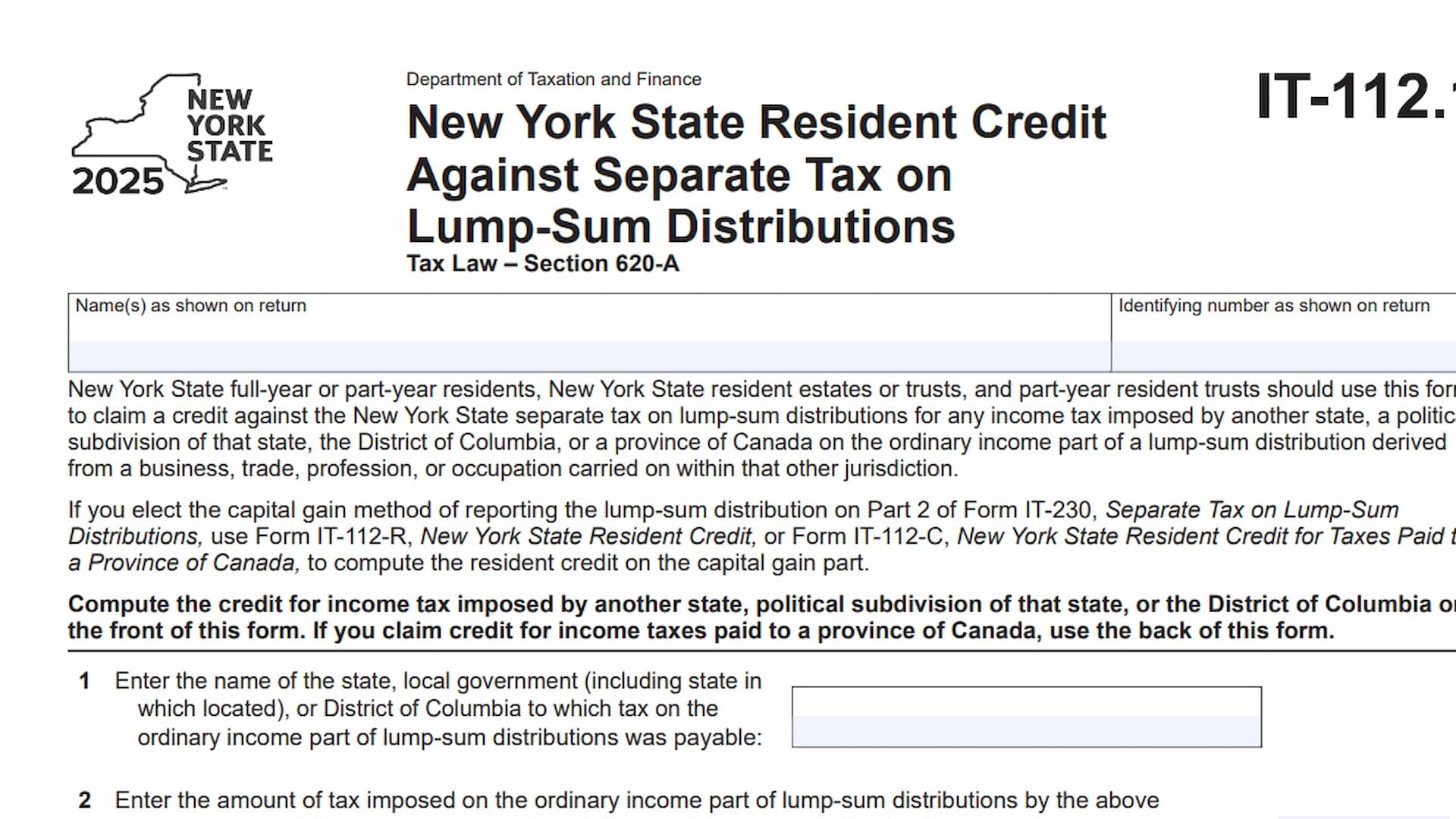
Form IT-112.1, New York State Resident Credit Against Separate Tax on Lump-Sum Distributions, is a New York State tax form used by eligible residents, estates, and trusts to claim a credit for income taxes paid to another jurisdiction on the ordinary income portion of a lump-sum distribution. The credit is authorized under Section 620-A of the New York State Tax Law. It is intended to prevent taxpayers from paying New York State separate tax on income that has also been taxed by another state, a political subdivision of that state, the District of Columbia, or a province of Canada.
Form IT-112.1 applies to New York State full-year and part-year residents, New York State resident estates or trusts, and part-year resident trusts.
The form is specifically designed for the ordinary income portion of a lump-sum distribution. Taxpayers who elect the capital gain method of reporting their lump-sum distribution on Part 2 of Form IT-230 must use Form IT-112-R or Form IT-112-C, as applicable, to calculate the resident credit on the capital gain portion instead.
The 2025 Form IT-112.1 contains two pages. Page 1 calculates the resident credit for taxes paid to another state, a political subdivision, or the District of Columbia. Page 2 calculates the credit for separate taxes paid to a province of Canada.
The first page contains Lines 1 through 4, which identify the other taxing jurisdiction, determine the tax imposed on the ordinary income portion, calculate the maximum allowable credit, and establish the final resident credit.
The second page contains Lines 5 through 10, which calculate the credit for Canadian provincial taxes. This section also accounts for the portion of Canadian provincial tax claimed as a federal foreign tax credit.
Completing Form IT-112.1 correctly is important because the resident credit is subject to limitations. The credit cannot exceed the applicable New York State separate tax attributable to income taxed by both jurisdictions. Taxpayers must also submit the required federal documentation with their New York income tax return.
How To File Form IT-112.1
Form IT-112.1 must be submitted with the applicable New York income tax return.
The form identifies three possible returns:
- Form IT-201: New York State Resident Income Tax Return.
- Form IT-203: New York State Nonresident and Part-Year Resident Income Tax Return.
- Form IT-205: New York State Fiduciary Income Tax Return.
The supporting documents depend on the type of foreign or out-of-state tax for which you are claiming the credit.
Taxes Paid to Another State, Local Government, or the District of Columbia
If you are claiming a credit for income taxes paid to another state, a political subdivision of another state, or the District of Columbia, complete the front page of Form IT-112.1.
You must submit:
- Completed Form IT-112.1.
- A copy of federal Form 4972.
- Your applicable New York income tax return.
Taxes Paid to a Province of Canada
If you are claiming a credit for income taxes paid to a Canadian province, complete the back page of Form IT-112.1.
You must submit:
- Completed Form IT-112.1.
- A copy of federal Form 1116.
- A copy of federal Form 4972.
- Your applicable New York income tax return.
The form specifically requires the federal Form 1116 attachment for Canadian provincial tax claims.
Important Filing Considerations
Before completing Form IT-112.1, gather the following information:
- Your applicable New York income tax return.
- Your name as shown on the return.
- Your taxpayer identification number.
- Your completed federal Form 4972.
- The name of the other state, local government, or District of Columbia that imposed the tax, if applicable.
- The amount of separate tax imposed on the ordinary income portion of the lump-sum distribution.
- The amount of income subject to tax in both jurisdictions.
- The total income subject to tax by the other jurisdiction.
- The total tax payable to the other jurisdiction after applicable credits.
- The amount from Form IT-230, Lines 3 and 24.
- Federal Form 1116, Part II, Line 8, if claiming a Canadian provincial tax credit.
- The amount of Canadian provincial tax claimed as a federal foreign tax credit.
Make sure the amounts used in the calculation correspond to the same lump-sum distribution and applicable tax period.

How To Complete Form IT-112.1
The 2025 Form IT-112.1 is a two-page tax form divided into two main sections.
- Page 1: Calculates the resident credit for taxes paid to another state, political subdivision, or the District of Columbia.
- Page 2: Calculates the resident credit for separate taxes paid to a province of Canada.
Complete the taxpayer identification information first, then follow the instructions for the applicable jurisdiction.
Taxpayer Information
At the top of page 1, enter the identifying information associated with your New York income tax return.
Name(s) as Shown on Return
Enter your name exactly as it appears on your applicable New York income tax return.
If you are filing jointly, use the names shown on the return.
Estates and trusts should use the appropriate identifying name associated with their fiduciary return.
Identifying Number as Shown on Return
Enter your taxpayer identification number.
Individuals generally provide their Social Security Number (SSN), while estates and trusts use the applicable Employer Identification Number (EIN).
Make sure the identifying number matches the information reported on your associated New York income tax return.
Page 1: Resident Credit for Taxes Paid to Another State or Jurisdiction
The first page calculates the resident credit against New York State separate tax on lump-sum distributions for income taxes imposed by another state, a political subdivision of that state, or the District of Columbia.
Complete this page if the ordinary income portion of your lump-sum distribution was subject to tax in another eligible jurisdiction.
Line 1: Name of the Other Taxing Jurisdiction
Enter the name of the state, local government, or District of Columbia to which tax on the ordinary income portion of the lump-sum distribution was payable.
If the tax was imposed by a local government, include the name of the state in which that local government is located.
For example, if a city or county imposed the applicable income tax, identify both the local government and its state.
Make sure the jurisdiction listed is the same one that imposed the tax reported on Line 2.
Line 2: Tax Imposed on the Ordinary Income Portion
Enter the amount of tax imposed on the ordinary income portion of the lump-sum distribution by the jurisdiction identified on Line 1.
Include the tax on the capital gain portion if you elected to treat that amount as ordinary income.
The amount must represent the separate tax required to be paid after subtracting any credits against the separate tax.
Do not subtract prepayments made through withholding or estimated tax payments when determining this amount.
When the Other Jurisdiction Does Not Impose a Separate Tax
The form provides an alternative calculation for situations in which the ordinary income portion of the lump-sum distribution is not subject to a separate tax in the other jurisdiction but is included in income under that jurisdiction’s regular income tax.
In this situation, calculate the amount attributable to the lump-sum distribution using the formula provided on the form:
Amount from federal Form 4972, Line 8, subject to tax by the other jurisdiction ÷ Total income subject to tax by the other jurisdiction × Total tax payable to that jurisdiction
Use the total tax payable after applicable credits but before prepayments made through withholding or estimated tax.
The result represents the amount of tax attributable to the ordinary income portion of the lump-sum distribution.
Enter this calculated amount on Line 2.
Make sure the income and tax figures used in the formula relate to the same jurisdiction and reporting period.
Line 3: Maximum Allowable Resident Credit
Line 3 determines the maximum resident credit that can be claimed against New York State separate tax on lump-sum distributions.
The form establishes two limitations.
Line 3(a): Credit Based on Income Taxed by Both Jurisdictions
Calculate the proportion of the lump-sum distribution subject to tax by both New York State and the other jurisdiction.
The form provides the following formula:
Amount from Form IT-230, Line 3, subject to tax by both jurisdictions ÷ Total amount from Form IT-230, Line 3 × Amount from Form IT-230, Line 24
Enter the resulting amount as the allowable credit under Line 3(a).
The calculation determines the portion of the New York State separate tax attributable to income also taxed by the other jurisdiction.
Use the figures from Form IT-230 and make sure the numerator represents only the amount subject to tax by both jurisdictions.
Line 3(b): Additional Tax Limitation
The credit cannot reduce the New York State separate tax on the ordinary income portion of the lump-sum distribution below the amount that would be due if the income taxed by both jurisdictions were excluded from New York State separate tax.
In other words, the allowable credit must not reduce the remaining New York State separate tax below the amount that would apply to the income not subject to the overlapping taxation.
This limitation applies in addition to the calculation in Line 3(a).
Consult the applicable New York tax calculations when determining whether this additional restriction affects the credit.
Line 4: Resident Credit Claimed Against New York State Separate Tax
Enter the smaller of Line 2 or Line 3.
Compare the tax imposed by the other jurisdiction on Line 2 with the maximum allowable credit calculated on Line 3.
Enter whichever amount is lower.
The calculation is:
Line 4 = Lesser of Line 2 or Line 3
This is the final resident credit against New York State separate tax on the ordinary income portion of the lump-sum distribution.
Where to Report the Line 4 Amount
The form provides different reporting instructions for individuals and fiduciaries.
Individuals
Enter the Line 4 amount on:
- Form IT-201-ATT, Line 27.
- Form IT-203-ATT, Line 26.
Use the attachment corresponding to your New York income tax return.
Fiduciaries
Subtract the Line 4 amount from the separate tax on lump-sum distributions calculated on Form IT-230.
Include the resulting net amount on Form IT-205, Line 12.
Required Attachments for Page 1
Submit the completed Form IT-112.1 and a copy of federal Form 4972 with your applicable New York income tax return.
The form warns that failure to include the required documents can delay a refund or result in late filing penalties if taxes are owed.
Page 2: Resident Credit for Taxes Paid to a Province of Canada
The second page calculates the resident credit against New York State separate tax on lump-sum distributions for taxes paid to a Canadian province.
This section contains Lines 5 through 10.
Unlike the first page, the Canadian provincial tax calculation also accounts for the amount of tax claimed as a foreign tax credit on federal Form 1116.
Complete this page if you paid a separate tax on the ordinary income portion of a lump-sum distribution to a province of Canada.
Line 5: Name of the Canadian Province
Enter the name of the Canadian province where the tax was paid.
Use the province responsible for imposing the tax on the ordinary income portion of the lump-sum distribution.
Make sure the province identified on Line 5 matches the tax information used in the subsequent calculations.
Line 6: Separate Tax Paid to the Canadian Province
Enter the amount of separate tax on lump-sum distributions paid to the Canadian province.
Report the amount in U.S. dollars.
Include the tax on the capital gain portion of the distribution if you elected to treat that amount as ordinary income.
The amount entered must represent the separate tax required to be paid after subtracting any credits against the separate tax.
Do not subtract prepayments made through withholding or estimated tax payments.
When the Canadian Province Does Not Impose a Separate Tax
The form provides an alternative calculation when the ordinary income portion of the lump-sum distribution is not subject to a separate tax by the Canadian province but is included as income under the province’s regular income tax.
In this situation, calculate the amount attributable to the lump-sum distribution using the formula printed on the form:
Amount from federal Form 4972, Line 8, subject to tax by the Canadian province ÷ Total income subject to tax by the Canadian province × Total tax payable to the Canadian province
Use the total tax payable after applicable credits but before prepayments.
Enter the resulting amount on Line 6.
All amounts must be expressed in U.S. dollars.
Line 7: Federal Foreign Tax Credit on Canadian Provincial Tax
Enter the amount from federal Form 1116, Part II, Line 8, that relates to the separate tax on lump-sum distributions paid to the Canadian province identified on Line 5.
Use only the portion of the federal foreign tax credit attributable to the applicable lump-sum distribution tax.
Do not automatically enter the entire amount from Form 1116, Part II, Line 8, if it includes foreign taxes unrelated to the lump-sum distribution.
Make sure the amount corresponds to the Canadian provincial tax reported on Line 6.
Line 8: Canadian Provincial Tax Not Claimed as a Federal Credit
Subtract the amount on Line 7 from the amount on Line 6.
Enter the resulting amount on Line 8.
The calculation is:
Line 6 − Line 7 = Line 8
This amount represents the portion of Canadian provincial tax on the lump-sum distribution that was not claimed as a credit for federal income tax purposes.
The amount on Line 8 is used in the subsequent New York resident credit calculation.
Line 9: Maximum Allowable Resident Credit
Line 9 determines the maximum New York State resident credit available for taxes paid to the Canadian province.
The form establishes two limitations.
Line 9(a): Credit Based on Income Taxed by Both Jurisdictions
Calculate the proportion of the lump-sum distribution subject to tax by both New York State and the Canadian province.
The form provides the following formula:
Amount from Form IT-230, Line 3, subject to tax by both jurisdictions ÷ Total amount from Form IT-230, Line 3 × Amount from Form IT-230, Line 24
Enter the resulting amount as the allowable credit under Line 9(a).
This calculation determines the portion of the New York State separate tax attributable to income also taxed by the Canadian province.
Use the applicable figures from Form IT-230.
Line 9(b): Additional Tax Limitation
The credit cannot reduce the New York State separate tax on the ordinary income portion of the lump-sum distribution below the amount that would be due if the income subject to taxation by both New York State and the Canadian province were excluded from New York State separate tax.
This limitation ensures that the resident credit does not exceed the New York State tax attributable to the overlapping income.
Consider this restriction when determining the maximum allowable credit.
Line 10: Resident Credit Claimed Against New York State Separate Tax
Enter the smaller of Line 8 or Line 9.
Compare the Canadian provincial tax not claimed as a federal credit on Line 8 with the maximum allowable New York resident credit on Line 9.
Enter whichever amount is lower.
The calculation is:
Line 10 = Lesser of Line 8 or Line 9
This represents the final New York State resident credit for the Canadian provincial tax.
Where to Report the Line 10 Amount
The form provides separate reporting instructions for individuals and fiduciaries.
Individuals
Enter the Line 10 amount on:
- Form IT-201-ATT, Line 27.
- Form IT-203-ATT, Line 26.
Use the applicable attachment based on your New York income tax return.
Fiduciaries
Subtract the Line 10 amount from the separate tax on lump-sum distributions calculated on Form IT-230.
Include the resulting net amount on Form IT-205, Line 12.
Additional Rule for Canadian Provincial Tax Credits
The form includes an important rule concerning future federal foreign tax credits.
If any portion of the Canadian provincial income tax that qualified for a New York State resident credit is claimed as a foreign tax credit on a federal return in a succeeding tax year, the amount claimed as a credit against New York State tax must be added back to your New York State tax liability for that succeeding year.
Keep records of the Canadian provincial tax amounts and the corresponding federal foreign tax credits.
Required Attachments for Page 2
When claiming a credit for taxes paid to a Canadian province, submit the following documents with your New York income tax return:
- Completed Form IT-112.1.
- A copy of federal Form 1116.
- A copy of federal Form 4972.
The form warns that failure to submit the required documents can delay refunds or result in late filing penalties when taxes are owed.
Additional Form Instructions and Important Credit Restrictions
The 2025 Form IT-112.1 includes several important rules concerning eligibility, tax calculations, credit limitations, and supporting documents.
Eligible Taxpayers
The form is intended for:
- New York State full-year residents.
- New York State part-year residents.
- New York State resident estates or trusts.
- Part-year resident trusts.
The credit applies to eligible income taxes imposed on the ordinary income portion of a lump-sum distribution by another qualifying jurisdiction.
Ordinary Income and Capital Gain Treatment
Form IT-112.1 is used to claim a resident credit on the ordinary income portion of a lump-sum distribution.
If you elect the capital gain method of reporting the distribution on Part 2 of Form IT-230, use the appropriate alternative form:
- Form IT-112-R: New York State Resident Credit.
- Form IT-112-C: New York State Resident Credit for Taxes Paid to a Province of Canada.
These forms are used to calculate the resident credit on the capital gain portion.
Taxes Paid to Different Jurisdictions
The form separates the calculations based on where the tax was imposed.
- Use page 1 for taxes paid to another state, a political subdivision of another state, or the District of Columbia.
- Use page 2 for taxes paid to a province of Canada.
Follow the appropriate calculation and attachment requirements for the jurisdiction involved.
Credit Limitations
The resident credit cannot exceed the portion of New York State separate tax attributable to income taxed by both jurisdictions.
The form also establishes an additional limitation to ensure the credit does not reduce the New York State separate tax below the amount that would be due if the overlapping income were excluded from the New York calculation.
Treatment of Canadian Provincial Taxes
When claiming a Canadian provincial tax credit, subtract the portion claimed as a federal foreign tax credit from the provincial tax reported on Line 6.
Only the remaining amount on Line 8 is considered when calculating the New York resident credit.
If the same Canadian provincial tax later qualifies for a federal foreign tax credit in a succeeding tax year, the corresponding New York credit must be added back to New York State tax liability for that year.
Federal Supporting Documents
The required federal attachments differ depending on the jurisdiction:
| Credit claimed | Required federal attachments |
|---|---|
| Another state, local government, or District of Columbia | Form 4972 |
| Province of Canada | Forms 1116 and 4972 |
Make sure the appropriate federal forms accompany your New York income tax return.
Final Review Before Filing
Before submitting Form IT-112.1 with your New York income tax return, review the following checklist to ensure that all required information and calculations are complete.
- Correct tax year: Confirm that you are using the 2025 Form IT-112.1.
- Taxpayer information: Verify that your name matches your New York income tax return.
- Identifying number: Check that your SSN or EIN is correct.
- Eligibility: Confirm that you are an eligible New York full-year or part-year resident, resident estate or trust, or part-year resident trust.
- Ordinary income: Make sure the credit relates to the ordinary income portion of a lump-sum distribution.
- Capital gain method: If you elected the capital gain method on Form IT-230, use Form IT-112-R or IT-112-C instead.
- Correct page: Use page 1 for taxes paid to another state, local government, or the District of Columbia, and page 2 for Canadian provincial taxes.
- Page 1, Line 1: Enter the name of the other taxing jurisdiction, including the state for local governments.
- Line 2: Verify the separate tax imposed on the ordinary income portion, after applicable credits but before prepayments.
- Line 2 alternative calculation: If the other jurisdiction does not impose a separate tax, use the formula provided on the form.
- Line 3(a): Calculate the portion of New York State separate tax attributable to income taxed by both jurisdictions.
- Line 3(b): Check the additional limitation on the allowable credit.
- Line 4: Enter the smaller of Line 2 or Line 3.
- Line 4 transfer: Report the amount on Form IT-201-ATT, Line 27, Form IT-203-ATT, Line 26, or Form IT-205, Line 12, as applicable.
- Page 2, Line 5: Enter the name of the Canadian province.
- Line 6: Enter the separate tax paid to the Canadian province in U.S. dollars.
- Line 6 alternative calculation: If the province does not impose a separate tax, use the formula provided on the form.
- Line 7: Enter the applicable amount from federal Form 1116, Part II, Line 8.
- Line 8: Subtract Line 7 from Line 6.
- Line 9(a): Calculate the portion of New York State separate tax attributable to income taxed by both jurisdictions.
- Line 9(b): Check the additional limitation on the allowable credit.
- Line 10: Enter the smaller of Line 8 or Line 9.
- Line 10 transfer: Report the amount on Form IT-201-ATT, Line 27, Form IT-203-ATT, Line 26, or Form IT-205, Line 12, as applicable.
- Future federal credit: Keep records of Canadian provincial taxes claimed as a federal foreign tax credit in subsequent years and make the required New York tax addback when applicable.
- Federal Form 4972: Attach a copy when submitting Form IT-112.1.
- Federal Form 1116: Attach a copy when claiming the Canadian provincial tax credit.
- Final review: Verify all jurisdiction details, tax amounts, credit limitations, calculations, and transferred figures before filing.
Review the applicable page carefully before submitting Form IT-112.1. The first page covers taxes paid to other states, local governments, and the District of Columbia, while the second page addresses Canadian provincial taxes and accounts for federal foreign tax credits. Make sure the credit does not exceed the applicable New York State tax limitation and include all required federal supporting documents with your return.