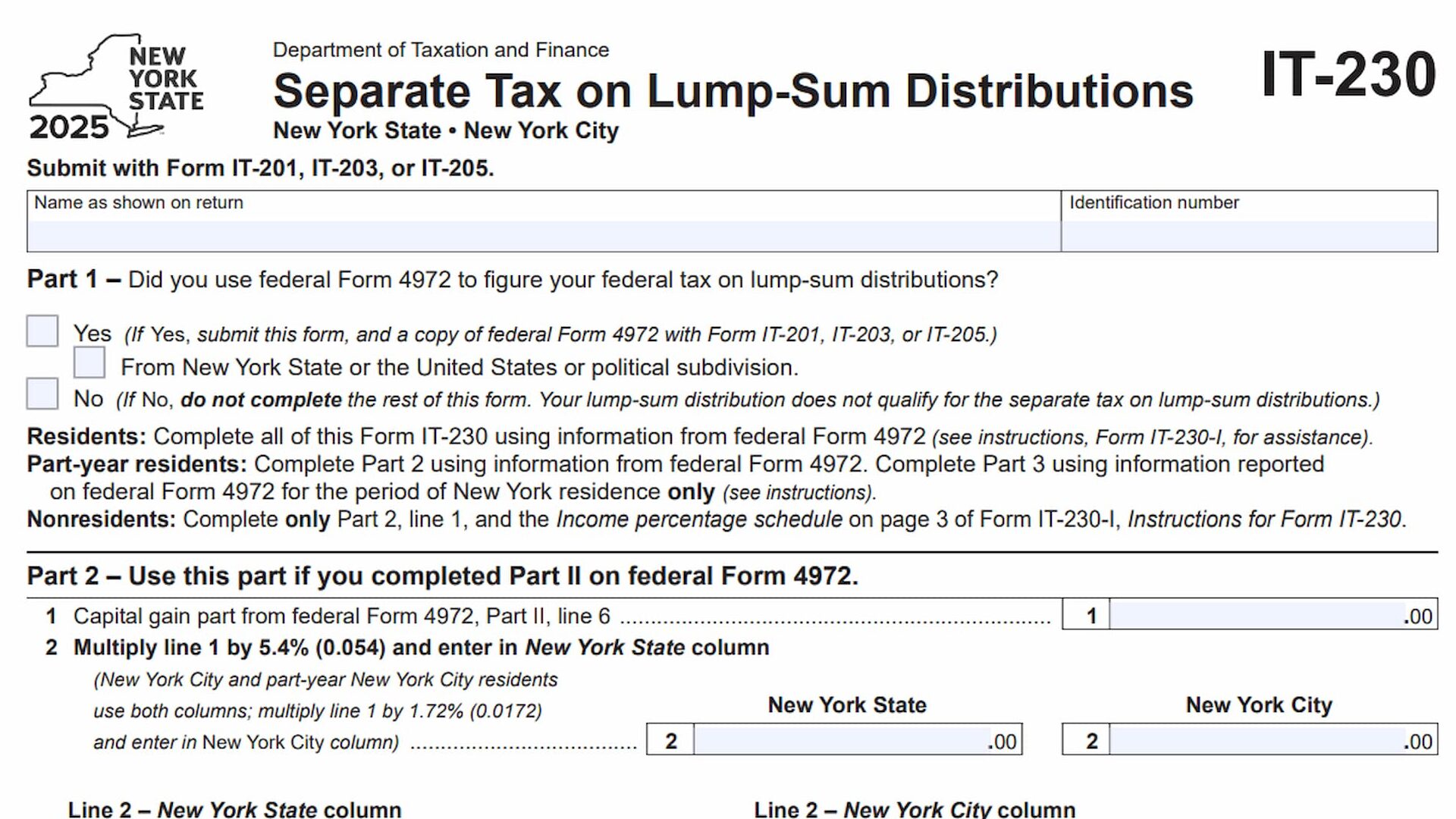
Form IT-230, Separate Tax on Lump-Sum Distributions, is a New York State tax form used by individuals, estates, and trusts to calculate the separate tax applicable to certain lump-sum distributions reported on federal Form 4972. The form applies to taxpayers who use federal Form 4972 to calculate their federal tax on lump-sum distributions. It helps determine the corresponding New York State and, when applicable, New York City tax amounts.
Form IT-230 collects the taxpayer’s identifying information and uses figures from federal Form 4972 to calculate the applicable tax. Depending on the taxpayer’s residency status and the information reported on the federal form, different parts of the schedule must be completed.
The 2025 Form IT-230 contains three main parts. Part 1 determines whether the taxpayer qualifies to use the separate tax calculation. Part 2 calculates the New York State and New York City tax on the capital gain portion of the distribution. Part 3 calculates the taxable amount, minimum distribution allowance, and tax under the 10-year option.
The form also includes a multiple recipients worksheet for situations in which more than one person received a portion of the lump-sum distribution.
Completing Form IT-230 correctly is important because the resulting tax amounts must be transferred to the appropriate New York income tax return or attachment. The calculation also differs depending on whether the taxpayer is a full-year resident, part-year resident, or nonresident.
How To File Form IT-230
Form IT-230 must be submitted with one of the following New York income tax returns:
- Form IT-201: New York State Resident Income Tax Return.
- Form IT-203: New York State Nonresident and Part-Year Resident Income Tax Return.
- Form IT-205: New York State Fiduciary Income Tax Return.
Taxpayers who answer Yes in Part 1 must submit Form IT-230 together with a copy of federal Form 4972.
If you answer No, do not complete the remaining sections of the form. Your lump-sum distribution does not qualify for the separate tax on lump-sum distributions.
Which Parts Must You Complete?
The sections you need to complete depend on your New York residency status and the parts of federal Form 4972 you used.
Full-Year Residents
Residents must complete all applicable parts of Form IT-230 using information from federal Form 4972.
Part-Year Residents
Part-year residents must:
- Complete Part 2 using information from federal Form 4972.
- Complete Part 3 using information reported on federal Form 4972 for the period of New York residence only.
Nonresidents
Nonresidents must complete only:
- Part 2, Line 1.
- The Income Percentage Schedule on page 3 of Form IT-230-I, Instructions for Form IT-230.
The income percentage schedule is used to calculate the percentage entered on the applicable New York tax return and supporting worksheets.
Information to Prepare Before Completing Form IT-230
Before filling out the form, gather the following information:
- Your completed federal Form 4972.
- Your applicable New York income tax return.
- Your name as shown on the return.
- Your Social Security Number (SSN) or Employer Identification Number (EIN).
- Your New York residency classification.
- The capital gain portion reported on federal Form 4972, Part II, line 6.
- The taxable amount reported on federal Form 4972, Part III, line 8.
- Any applicable death benefit exclusion.
- The current actuarial value of the annuity reported on federal Form 4972, Part III, line 11.
- Federal estate tax attributable to the lump-sum distribution, if applicable.
- Information about the percentage of the total distribution received if multiple recipients are involved.
You may also need Form IT-230-I, Instructions for Form IT-230, which provides additional guidance and the tax rate schedules referenced in the form.

How To Complete Form IT-230
The 2025 Form IT-230 is a two-page schedule divided into three main parts.
Part 1 establishes whether the taxpayer qualifies for the separate tax treatment. Part 2 calculates the tax on the capital gain portion of the distribution, while Part 3 calculates the taxable amount and tax using the 10-year option.
Complete the taxpayer identification information first, then follow the instructions for your residency classification.
Taxpayer Information
At the top of the first page, enter the identifying information associated with your New York income tax return.
Name as Shown on Return
Enter your full name exactly as it appears on your applicable New York income tax return.
If you are filing a joint return, use the names shown on the return.
Identification Number
Enter your identifying number.
Individuals generally provide their Social Security Number (SSN), while estates and trusts use the applicable Employer Identification Number (EIN).
Make sure the number matches the information reported on your associated income tax return.
Filing Notice
The form includes the following filing instruction:
Submit with Form IT-201, IT-203, or IT-205.
Attach the completed Form IT-230 and the required copy of federal Form 4972 to the applicable New York income tax return.
Part 1: Did You Use Federal Form 4972?
Part 1 determines whether you used federal Form 4972 to calculate your federal tax on lump-sum distributions.
Your answer determines whether you can continue completing Form IT-230.
Yes
Check Yes if you used federal Form 4972 to calculate your federal tax on lump-sum distributions.
If you select Yes, submit Form IT-230 and a copy of federal Form 4972 with your applicable New York income tax return.
The form also provides an additional checkbox labeled:
From New York State or the United States or Political Subdivision
Mark this box when the applicable distribution is from New York State, the United States, or a political subdivision, as indicated on the form.
No
Check No if you did not use federal Form 4972 to calculate your federal tax on lump-sum distributions.
If you select No, do not complete the remaining sections of Form IT-230.
The form explicitly states that your lump-sum distribution does not qualify for the separate tax on lump-sum distributions in this situation.
Residency Instructions
Below the Yes and No options, Part 1 provides separate completion instructions for residents, part-year residents, and nonresidents.
- Residents: Complete all applicable parts of Form IT-230 using information from federal Form 4972.
- Part-year residents: Complete Part 2 using federal Form 4972 information and Part 3 using information for the period of New York residence only.
- Nonresidents: Complete only Part 2, Line 1, and the Income Percentage Schedule on page 3 of Form IT-230-I.
Follow the applicable residency instructions before proceeding to the calculations.
Part 2: Capital Gain Portion of the Lump-Sum Distribution
Part 2 is used when you completed Part II on federal Form 4972.
This section calculates the New York tax on the capital gain portion of the lump-sum distribution.
The calculation uses the capital gain amount reported on federal Form 4972 and applies separate tax rates for New York State and New York City.
New York City and part-year New York City residents must use both columns.
Line 1: Capital Gain Part from Federal Form 4972
Enter the capital gain portion of the lump-sum distribution reported on federal Form 4972, Part II, line 6.
Use the amount shown on the federal form.
Enter the figure in the designated field on Line 1.
Line 2: Calculate New York State and New York City Tax
Line 2 calculates the applicable tax on the capital gain portion reported on Line 1.
The form provides two separate columns:
- New York State.
- New York City.
New York State Column
Multiply the amount on Line 1 by 5.4%, or 0.054.
Enter the resulting amount in the New York State column.
New York City Column
New York City and part-year New York City residents must also calculate the New York City amount.
Multiply the amount on Line 1 by 1.72%, or 0.0172.
Enter the resulting amount in the New York City column.
Full-year New York State residents who do not fall into the New York City categories use the New York State column as applicable.
Where to Report the Line 2 Amount
The form provides separate instructions depending on the type of income tax return being filed.
New York State Column
- Form IT-201 filers: Enter the Line 2 New York State amount on Form IT-230-I, Worksheet A, Line 1.
- Form IT-203 filers: Enter the amount on Form IT-230-I, Worksheet C, Line 1.
- Full-year resident estates or trusts: Enter the amount on Form IT-205, Line 7.
- Nonresident estates or trusts or part-year resident trusts: Include the amount on Form IT-205-A, Line 11.
New York City Column
- Full-year New York City residents: Enter the amount on Form IT-230-I, Worksheet B, Line 1.
- Part-year New York City residents: Enter the amount on Form IT-230-I, Worksheet D, Line 1.
- Form IT-205 filers: Enter the amount on Form IT-205, Line 16.
Income Percentage Schedule for Nonresidents and Part-Year Residents
The form includes an additional instruction for New York State nonresidents, part-year residents, nonresident estates or trusts, and part-year resident trusts.
These taxpayers must complete the Income Percentage Schedule on page 3 of Form IT-230-I.
The resulting income percentage is entered in the applicable locations:
- Form IT-203, Line 45.
- Form IT-230-I, Worksheet C, Line 6.
- Form IT-205-A, Schedule 1, Line 12.
Use the instructions in Form IT-230-I to determine the applicable income percentage.
Part 3: Taxable Amount and 10-Year Tax Option
Part 3 is used if you were a New York resident or part-year resident and completed Part III on federal Form 4972.
This section calculates the taxable amount of the distribution, applies the minimum distribution allowance, accounts for federal estate tax attributable to the distribution, and determines the separate tax using the 10-year option.
Part-year residents must use the amounts reported on federal Form 4972 for the period of New York residence only.
Lines 3 Through 7: Calculate the Adjusted Total Taxable Amount
The first five lines of Part 3 establish the amount used in the subsequent tax calculations.
Line 3: Amount from Federal Form 4972, Part III, Line 8
Enter the amount reported on federal Form 4972, Part III, line 8.
Consult Form IT-230-I for additional instructions on determining the applicable amount.
Line 4: Death Benefit Exclusion
Enter the applicable death benefit exclusion.
Use the amount determined under the instructions for Form IT-230-I.
Line 5: Total Taxable Amount
Subtract the amount on Line 4 from the amount on Line 3.
Enter the resulting taxable amount on Line 5.
The calculation is:
Line 3 − Line 4 = Line 5
Line 6: Current Actuarial Value of Annuity
Enter the current actuarial value of the annuity reported on federal Form 4972, Part III, line 11.
Use the amount from the corresponding federal form.
Line 7: Adjusted Total Taxable Amount
Add the amounts reported on Lines 5 and 6.
Enter the resulting adjusted total taxable amount on Line 7.
The calculation is:
Line 5 + Line 6 = Line 7
If the amount on Line 7 is $70,000 or more, skip Lines 8 through 11 and enter the amount from Line 7 directly on Line 12.
If the amount is less than $70,000, continue with Lines 8 through 11.
Lines 8 Through 11: Minimum Distribution Allowance
These lines calculate the minimum distribution allowance that may be subtracted from the adjusted total taxable amount.
The calculation uses the amount on Line 7 and applies the percentages and limits specified on the form.
Line 8: 50% of Line 7
Multiply the amount on Line 7 by 50%, or 0.50.
However, do not enter more than $10,000.
If the calculation exceeds $10,000, enter $10,000 instead.
Line 9: Subtract $20,000 from Line 7
Subtract $20,000 from the amount on Line 7.
If Line 7 is $20,000 or less, leave Line 9 blank.
Enter the resulting amount when applicable.
Line 10: 20% of Line 9
Multiply the amount on Line 9 by 20%, or 0.20.
Enter the resulting amount on Line 10.
If Line 9 is blank, follow the applicable instructions for the calculation.
Line 11: Minimum Distribution Allowance
Subtract the amount on Line 10 from the amount on Line 8.
Enter the resulting amount on Line 11.
This represents the minimum distribution allowance used to determine the taxable amount on Line 12.
Lines 12 Through 14: Calculate the Amount Subject to the 10-Year Option
These lines determine the amount remaining after applying the minimum distribution allowance and accounting for federal estate tax attributable to the lump-sum distribution.
Line 12: Taxable Amount After Allowance
Subtract the amount on Line 11 from the amount on Line 7.
Enter the resulting amount on Line 12.
If Line 7 was $70,000 or more, enter the amount from Line 7 directly, as instructed.
Line 13: Federal Estate Tax Attributable to Lump-Sum Distribution
Enter the federal estate tax attributable to the lump-sum distribution.
Use the applicable amount from your federal tax calculations and supporting records.
Line 14: Adjusted Amount After Federal Estate Tax
Subtract the amount on Line 13 from the amount on Line 12.
Enter the resulting amount on Line 14.
This amount is used in the subsequent 10-year tax option calculation.
Lines 15 Through 17: Calculate the New York Allocation
Lines 15 through 17 determine the portion of the minimum distribution allowance allocated to New York State and New York City.
New York City and part-year New York City residents must use both columns.
If Line 6 is blank, skip Lines 15 through 17 and continue directly to Line 18.
Line 15: Actuarial Value Ratio
Divide the amount on Line 6 by the amount on Line 7.
Round the result to four decimal places.
Enter the resulting decimal amount in the applicable column.
If Line 6 is zero, leave Line 15 blank.
Line 16: Allocated Minimum Distribution Allowance
Multiply the amount on Line 11 by the decimal amount on Line 15.
Enter the resulting amount in the applicable column.
If Line 15 is zero, leave Line 16 blank.
Line 17: Remaining Amount
Subtract the amount on Line 16 from the amount on Line 6.
Enter the resulting amount in the applicable column.
The calculation determines the remaining actuarial value after accounting for the allocated minimum distribution allowance.
10-Year Tax Option: Lines 18 Through 24
The 10-year tax option calculates the separate tax on the lump-sum distribution using the amounts determined in the preceding lines.
New York State and New York City calculations are performed separately when both columns apply.
For the tax calculations on Lines 19 and 22, the form directs taxpayers to use the New York State and New York City tax rate schedules on page 4 of Form IT-230-I.
Line 18: 10% of Line 14
Multiply the amount on Line 14 by 10%, or 0.10.
Enter the resulting amount in the applicable New York State and New York City columns.
Line 19: Tax on Line 18 Amount
Calculate the tax on the amount reported on Line 18.
Use the New York State tax rate schedule on page 4 of Form IT-230-I.
New York City and part-year New York City residents must also use the New York City tax rate schedule on page 4 of the instructions.
Enter the applicable tax amount in each column.
Line 20: Multiply Line 19 by Ten
Multiply the amount on Line 19 by ten.
Enter the resulting amount on Line 20.
If Line 6 is blank, skip Lines 21 through 23 and enter the amount from Line 20 directly on Line 24.
Line 21: 10% of Line 17
Multiply the amount on Line 17 by 10%, or 0.10.
Enter the resulting amount in the applicable column.
This calculation is used when Line 6 is not blank.
Line 22: Tax on Line 21 Amount
Calculate the tax on the amount reported on Line 21.
Use the New York State tax rate schedule on page 4 of Form IT-230-I.
New York City and part-year New York City residents must also use the New York City tax rate schedule.
Enter the resulting tax amount in the applicable column.
Line 23: Multiply Line 22 by Ten
Multiply the amount on Line 22 by ten.
Enter the resulting amount on Line 23.
Line 24: Tax on Lump-Sum Distribution Using the 10-Year Option
Subtract the amount on Line 23 from the amount on Line 20.
Enter the resulting amount on Line 24.
If Line 6 was blank, use the amount from Line 20 directly, as instructed.
Line 24 represents the final tax on the lump-sum distribution using the 10-year option.
Where to Report the Line 24 Amount
The form provides separate reporting instructions for New York State and New York City amounts.
Line 24 – New York State Column
- Individuals: Enter the amount on Form IT-201-ATT, Line 26, or Form IT-203-ATT, Line 25.
- Fiduciaries: Include the amount on Form IT-205, Line 12.
- Multiple recipients: If applicable, complete the Multiple Recipients of Lump-Sum Distribution Worksheet before transferring the amount.
Line 24 – New York City Column
- Full-year New York City residents: Enter the amount on Form IT-201-ATT, Line 32.
- Part-year New York City residents: Enter the amount on Form IT-360.1, Line 51.
- Estates or trusts: Enter the amount on Form IT-205, Line 20.
Make sure the amount is transferred to the correct return or attachment based on your filing status.
Multiple Recipients of Lump-Sum Distribution Worksheet
The second page of Form IT-230 includes a separate worksheet for situations in which multiple recipients received portions of the same lump-sum distribution.
The worksheet calculates the recipient’s share of the tax amount reported on Line 24.
It contains three entries, labeled a, b, and c, with separate New York State and New York City columns.
New York City and part-year New York City residents must use both columns.
Entry a: Amount from Line 24
Enter the amount reported on Line 24.
Use the New York State column and, when applicable, the New York City column.
Entry b: Percentage of the Total Distribution
Enter your percentage of the total lump-sum distribution.
Use the applicable percentage representing your share of the total distribution.
Entry c: Allocated Tax Amount
Multiply the amount on Entry a by the percentage on Entry b.
Enter the resulting amount on Entry c.
This calculation determines your allocated share of the tax on the lump-sum distribution.
Where to Report Entry c
The form provides the following instructions for transferring the amount calculated on Entry c.
New York State Column
- Individuals: Enter the amount on Form IT-201-ATT, Line 26, or Form IT-203-ATT, Line 25.
- Fiduciaries: Include the amount on Form IT-205, Line 12.
New York City Column
- Full-year New York City residents: Enter the amount on Form IT-201-ATT, Line 32, or Form IT-205, Line 20.
- Part-year New York City residents: Enter the amount on Form IT-360.1, Line 51, or Form IT-205, Line 20.
Use the applicable column and transfer the allocated amount to the correct tax return.
Additional Form Instructions and Requirements
The 2025 Form IT-230 includes several additional requirements concerning federal Form 4972, residency classification, and the use of the 10-year tax option.
Federal Form 4972 Requirement
Taxpayers must have used federal Form 4972 to calculate their federal tax on lump-sum distributions to qualify for the separate New York tax calculation.
If you did not use federal Form 4972, do not complete the remaining sections of Form IT-230.
Federal Form 4972 Attachment
Taxpayers answering Yes in Part 1 must submit a copy of federal Form 4972 with Form IT-230 and their applicable New York income tax return.
Part-Year Residency
Part-year residents must use information relating only to their period of New York residence when completing Part 3.
Part 2 is completed using information from federal Form 4972.
Nonresident Filing Requirements
Nonresidents complete only Part 2, Line 1, and the Income Percentage Schedule on page 3 of Form IT-230-I.
Tax Rate Schedules
The tax calculations on Lines 19 and 22 require the applicable New York State and New York City tax rate schedules.
These schedules are provided on page 4 of Form IT-230-I, not on the two-page IT-230 form.
Multiple Recipients
When multiple recipients share a lump-sum distribution, use the worksheet on the second page to calculate the amount attributable to your percentage of the total distribution.
Final Review Before Filing
Before submitting Form IT-230 with your New York income tax return, review the following checklist to ensure that all required information and calculations are complete.
- Correct tax year: Confirm that you are using the 2025 Form IT-230.
- Taxpayer information: Verify that your name matches your New York income tax return.
- Identification number: Check that your SSN or EIN is correct.
- Federal Form 4972: Confirm that you used federal Form 4972 to calculate your federal tax on lump-sum distributions.
- Part 1: Select Yes or No as applicable.
- Distribution source: Review the additional checkbox concerning distributions from New York State, the United States, or a political subdivision.
- Federal attachment: If you answered Yes, attach a copy of federal Form 4972.
- Residency classification: Determine whether you are a full-year resident, part-year resident, or nonresident.
- Part 2, Line 1: Verify that the capital gain amount matches federal Form 4972, Part II, line 6.
- Part 2, New York State: Multiply Line 1 by 5.4%.
- Part 2, New York City: If applicable, multiply Line 1 by 1.72%.
- Line 2 transfers: Enter the applicable amounts on the required worksheets or income tax return lines.
- Income percentage schedule: If you are a nonresident or part-year resident, complete the applicable schedule in Form IT-230-I.
- Part 3, Line 3: Verify the amount from federal Form 4972, Part III, line 8.
- Line 4: Enter the applicable death benefit exclusion.
- Line 5: Subtract Line 4 from Line 3.
- Line 6: Enter the current actuarial value of the annuity from federal Form 4972, Part III, line 11.
- Line 7: Add Lines 5 and 6. If the result is $70,000 or more, skip Lines 8 through 11.
- Line 8: Multiply Line 7 by 50%, subject to the $10,000 maximum.
- Line 9: Subtract $20,000 from Line 7 when applicable.
- Line 10: Multiply Line 9 by 20%.
- Line 11: Subtract Line 10 from Line 8.
- Line 12: Subtract Line 11 from Line 7.
- Line 13: Enter federal estate tax attributable to the lump-sum distribution.
- Line 14: Subtract Line 13 from Line 12.
- Lines 15 through 17: Complete the applicable actuarial value and allowance calculations. If Line 6 is blank, skip these lines.
- Line 18: Multiply Line 14 by 10%.
- Line 19: Calculate the applicable tax using the tax rate schedules in Form IT-230-I.
- Line 20: Multiply Line 19 by ten.
- Line 21: Multiply Line 17 by 10%, when applicable.
- Line 22: Calculate the tax on Line 21 using the applicable tax rate schedules.
- Line 23: Multiply Line 22 by ten.
- Line 24: Subtract Line 23 from Line 20 to determine the tax using the 10-year option.
- Multiple recipients: If applicable, complete the worksheet on page 2.
- Entry a: Enter the applicable amount from Line 24.
- Entry b: Enter your percentage of the total distribution.
- Entry c: Multiply Entries a and b to determine your allocated tax amount.
- Return transfer: Report the applicable amounts on Form IT-201-ATT, Form IT-203-ATT, Form IT-205, or Form IT-360.1 as instructed.
- Final review: Check all calculations, residency requirements, supporting documents, and transferred amounts before filing.
Review each section carefully and make sure you follow the instructions applicable to your residency status. Form IT-230 requires different calculations for New York State and New York City residents, while nonresidents have more limited filing requirements. Attach federal Form 4972 when required and use Form IT-230-I for the additional worksheets and tax rate schedules referenced throughout the form.