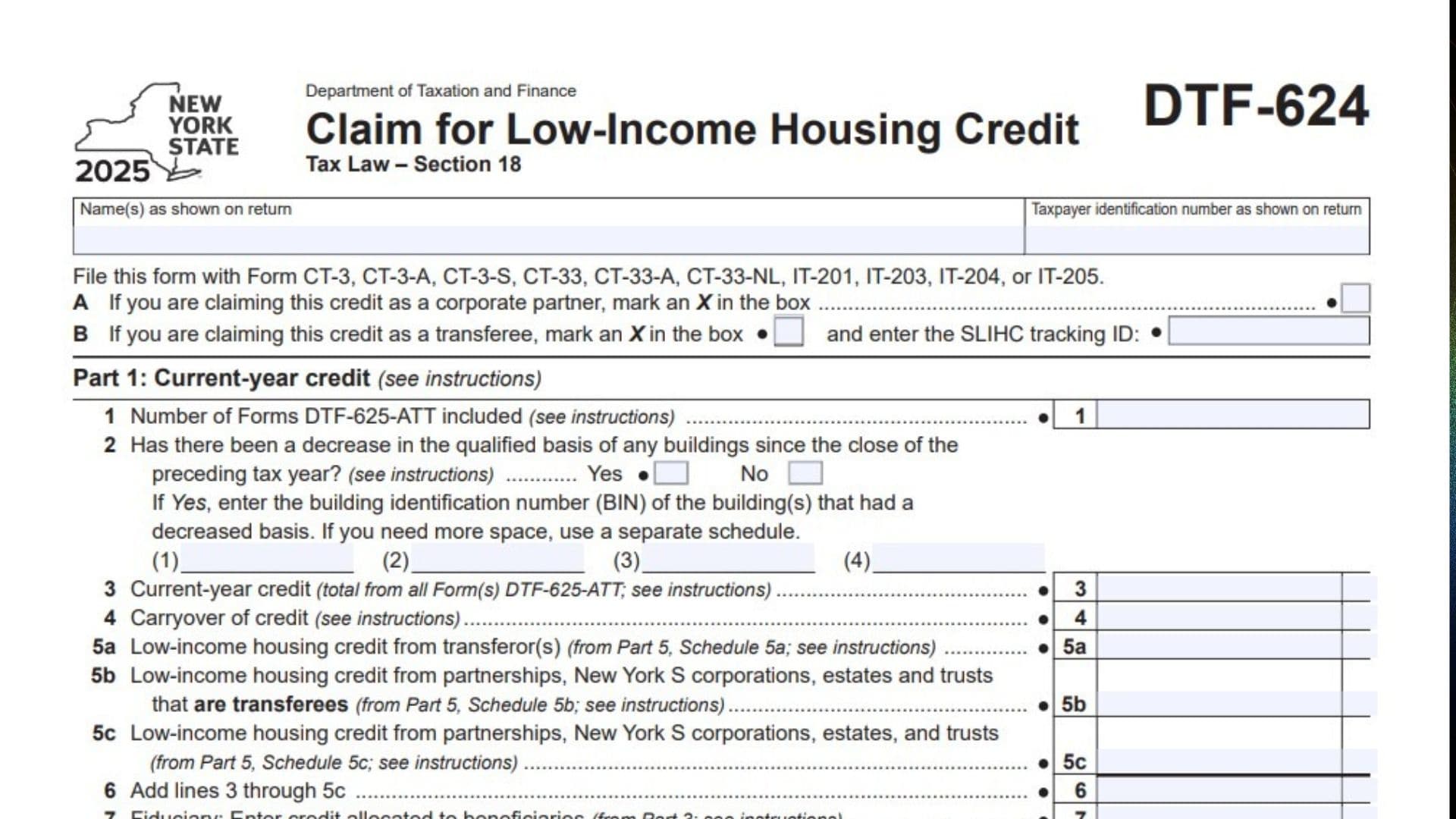
New York Form DTF-624, Claim for Low-Income Housing Credit, is a tax form used by eligible taxpayers to claim the Low-Income Housing Credit under New York Tax Law Section 18. The credit is associated with qualifying low-income housing projects and may be claimed by individuals, partnerships, New York S corporations, C corporations, fiduciaries, and eligible transferees, depending on their involvement with the credit. The form allows taxpayers to report current-year credits, previously unused credit amounts carried forward from earlier years, credits received through transfers, and credits allocated by partnerships, S corporations, estates, and trusts. It also provides calculations for determining how much credit can be used during the current tax year and how much can be carried forward. The form collects information about the taxpayer, the credit-generating buildings, building identification numbers (BINs), transferors, flow-through entities, beneficiaries, and applicable credit allocations. Different sections apply depending on the taxpayer’s legal and tax classification. For example, individuals generally complete Part 6, fiduciaries complete Parts 3 and 6, and C corporations complete Part 2 to calculate the credit available against their franchise tax liability. Partnerships and New York S corporations also have specific reporting requirements, while taxpayers receiving transferred credits must complete Part 5. Completing Form DTF-624 accurately is important because the allowable credit depends on the available credit balance, applicable tax limitations, previous credit usage, credit transfers, and any required allocations among beneficiaries or other entities. The form also helps prevent incorrect credit claims by requiring taxpayers to identify the buildings associated with the credit and report the appropriate amounts received from each source. If more than one section applies to a taxpayer, all applicable parts must be completed on the same Form DTF-624.
How To File Form DTF-624
Form DTF-624 must be filed with the appropriate New York State income tax or franchise tax return. The applicable return depends on the taxpayer’s legal classification and filing situation.
The form can be filed with one of the following returns:
- Form CT-3 – General Business Corporation Franchise Tax Return.
- Form CT-3-A – General Business Corporation Combined Franchise Tax Return.
- Form CT-3-S – New York S Corporation Franchise Tax Return.
- Form CT-33 – Life Insurance Corporation Franchise Tax Return.
- Form CT-33-A – Life Insurance Corporation Combined Franchise Tax Return.
- Form CT-33-NL – Non-Life Insurance Corporation Franchise Tax Return.
- Form IT-201 – Resident Income Tax Return.
- Form IT-203 – Nonresident and Part-Year Resident Income Tax Return.
- Form IT-204 – Partnership Return.
- Form IT-205 – Fiduciary Income Tax Return.
Before completing Form DTF-624, prepare the following information:
- Your name as shown on the applicable tax return.
- Your taxpayer identification number.
- Information about the low-income housing project and associated buildings.
- Building Identification Numbers (BINs).
- Current-year credit information from Form DTF-625-ATT.
- Previous-year credit carryover information, if applicable.
- Information about any decrease in the qualified basis of buildings.
- Credit transfer documentation and SLIHC tracking ID, if applicable.
- Information about partnerships, New York S corporations, estates, and trusts from which you received credit.
- Information about beneficiaries and credit allocations, if applicable.
- Recapture information from Form DTF-626, when required.
- Tax liability and other credit information for calculating the allowable credit.
Important: If more than one taxpayer category or filing situation applies, complete all relevant parts on one Form DTF-624. Do not prepare separate forms merely because multiple sections apply to your situation.
Which Parts of Form DTF-624 Must You Complete?
The required sections depend on the taxpayer’s classification and how the credit was obtained.
- Individuals: Complete Part 6.
- Partnerships: Enter the amount from Line 8 and code 624 on Form IT-204, Line 147. Complete Part 4 if applicable.
- Married couples making an IRC 761(f) election: Follow the applicable instructions.
- Fiduciaries: Complete Parts 3 and 6.
- Partners, New York S corporation shareholders, and beneficiaries of an estate or trust: Complete Parts 5 and 6.
- New York S corporations: Enter the Line 8 amount on the appropriate line of Form CT-34-SH. Complete Part 4 if applicable.
- C corporations, including corporate partners: Complete Part 2 to calculate the amount of credit transferred to the franchise tax return.
- Transferees: Complete Part 5 and all other applicable parts based on the taxpayer’s entity classification.
New York S corporations do not complete Part 2.

How To Complete Form DTF-624
Form DTF-624 contains six main parts, with Part 5 divided into three schedules: Schedule 5a, Schedule 5b, and Schedule 5c.
Follow the instructions below in the order the form presents them.
Taxpayer Identification Information
The top section identifies the taxpayer claiming the Low-Income Housing Credit.
Name(s) as Shown on Return
Enter the taxpayer’s name exactly as it appears on the applicable New York State tax return.
If the return includes multiple taxpayers, enter the names as shown on that return.
Taxpayer Identification Number as Shown on Return
Enter the taxpayer identification number associated with the return.
Use the appropriate identification number, such as a Social Security number or Federal Employer Identification Number, depending on the taxpayer’s classification.
File Form DTF-624 With the Appropriate Tax Return
Submit Form DTF-624 with the applicable tax return identified in the filing instructions.
Choose the return that corresponds to your taxpayer classification and filing requirements.
Additional Filing Status Information
Two additional checkboxes appear before Part 1.
Corporate Partner Checkbox
Mark an X in this box if you are claiming the Low-Income Housing Credit as a corporate partner.
This designation identifies a corporate partner claiming a share of the credit through a partnership.
Transferee Checkbox
Mark an X in this box if you are claiming the credit as a transferee.
A transferee is a taxpayer who receives the Low-Income Housing Credit through a transfer from another eligible party.
SLIHC Tracking ID
If you are claiming the credit as a transferee, enter the SLIHC tracking ID in the space provided.
Use the tracking identification associated with the transferred credit.
Part 1: Current-Year Credit
Part 1 calculates the total Low-Income Housing Credit available for the current tax year. It includes credits generated during the current year, carryover amounts, and credits received through transfers or flow-through entities.
Line 1: Number of Forms DTF-625-ATT Included
Enter the total number of Forms DTF-625-ATT included with your claim.
Use the applicable supporting forms associated with the current-year Low-Income Housing Credit.
Line 2: Decrease in Qualified Basis of Buildings
Indicate whether the qualified basis of any buildings decreased since the end of the preceding tax year.
- Select Yes if the qualified basis of one or more buildings decreased.
- Select No if there was no decrease.
If you select Yes, enter the Building Identification Number (BIN) of each building whose qualified basis decreased.
The form provides four spaces for reporting building identification numbers. If you need additional space, attach a separate schedule containing the required information.
Follow the applicable instructions to determine the effect of the decrease on your credit.
Line 3: Current-Year Credit
Enter the total current-year Low-Income Housing Credit from all Forms DTF-625-ATT.
If multiple supporting forms are included, add the applicable credit amounts and report the combined total.
Line 4: Carryover of Credit
Enter any unused Low-Income Housing Credit carried forward from a previous tax year.
Use the carryover amount determined under the applicable instructions.
Do not include amounts already used or otherwise unavailable for the current year.
Line 5a: Low-Income Housing Credit From Transferors
Enter the amount of Low-Income Housing Credit received directly from transferors.
Use the total from Part 5, Schedule 5a.
This line applies when you received the credit as a transferee through a direct transfer.
Line 5b: Low-Income Housing Credit From Flow-Through Entities That Are Transferees
Enter the Low-Income Housing Credit received from partnerships, New York S corporations, estates, or trusts that received the credit as transferees.
Use the total from Part 5, Schedule 5b.
This line applies when the entity distributing the credit originally received it through a transfer.
Line 5c: Low-Income Housing Credit From Other Flow-Through Entities
Enter the Low-Income Housing Credit received from partnerships, New York S corporations, estates, or trusts that are not transferees.
Use the total from Part 5, Schedule 5c.
This line applies when the credit comes from a flow-through entity that did not receive the credit as a transferee.
Line 6: Total Credit Available
Add the amounts reported on Lines 3, 4, 5a, 5b, and 5c.
The calculation is:
Line 3 + Line 4 + Line 5a + Line 5b + Line 5c = Line 6
Enter the combined amount on Line 6.
This represents the total credit available before accounting for any amount allocated to beneficiaries.
Line 7: Credit Allocated to Beneficiaries
This line applies to fiduciaries.
Enter the amount of Low-Income Housing Credit allocated to beneficiaries from Part 3.
Use the total credit allocation reported in Part 3, as determined under the applicable instructions.
Line 8: Total Current-Year Credit
Subtract Line 7 from Line 6.
The calculation is:
Line 6 − Line 7 = Line 8
Enter the remaining amount on Line 8.
This represents the current-year credit available after accounting for the amount allocated to beneficiaries.
Use this amount according to your taxpayer classification and the applicable filing instructions.
Part 2: Calculation of Credit
Part 2 is completed by Article 9-A and Article 33 corporations, including corporate partners.
New York S corporations do not complete this part.
This section calculates the amount of Low-Income Housing Credit that can be used against the corporation’s current-year tax liability and the amount that can be carried forward.
Line 9: Total Credit Available for the Current Tax Year
Enter the amount from Part 1, Line 8.
This is the total current-year credit available before applying the recapture and tax limitations.
Line 10: Total Recapture
Enter the total recapture amount from all Forms DTF-626, Line 14.
If multiple Forms DTF-626 apply, add the amounts reported on Line 14 of each form.
Follow the applicable instructions to determine the correct recapture amount.
Line 11: Total Credit Available for the Current Tax Year After Recapture
Enter the total credit available after accounting for the applicable recapture.
Use the calculation method provided in the instructions for determining the amount remaining after recapture.
Line 12: Tax Before Credits
Enter the corporation’s tax amount before applying credits.
Use the applicable tax calculation from the franchise tax return and follow the instructions for determining the correct figure.
Line 13: Other Credits Used
Enter the amount of other tax credits used before applying the Low-Income Housing Credit.
Follow the applicable instructions to determine which credits must be included.
Line 14: Net Tax
Subtract Line 13 from Line 12.
The calculation is:
Line 12 − Line 13 = Line 14
Enter the resulting net tax amount.
This figure is used to determine the tax limitation for the Low-Income Housing Credit.
Line 15: Tax Limitation
Enter the appropriate minimum tax amount based on the corporation’s tax article.
For Article 9-A corporations, enter the fixed dollar minimum tax from Form CT-3.
For designated agents filing Form CT-3-A, enter the designated agent’s fixed dollar minimum tax.
For Article 33 corporations, enter $250.
Combined filers must follow the applicable instructions to determine the correct amount.
Line 16: Tax Credit Limitation
Subtract Line 15 from Line 14.
The calculation is:
Line 14 − Line 15 = Line 16
If Line 15 is greater than Line 14, enter zero instead of a negative amount.
This amount represents the tax limitation available for applying the credit.
Line 17: Tax Credit Used for the Current Tax Year
Compare the amounts on Lines 11 and 16.
Enter whichever amount is smaller.
The calculation is:
Smaller of Line 11 or Line 16 = Line 17
This is the amount of Low-Income Housing Credit that can be used during the current tax year.
Line 18: Tax Credit Carried Forward
Subtract Line 17 from Line 11.
The calculation is:
Line 11 − Line 17 = Line 18
Enter the remaining amount on Line 18.
This represents the credit available to be carried forward to a future tax year under the applicable instructions.
Part 3 is completed by fiduciaries to report the allocation of the Low-Income Housing Credit between beneficiaries and the fiduciary.
The schedule contains four columns.
Column A: Beneficiary’s Name
Enter the name of each beneficiary receiving a share of the Low-Income Housing Credit.
The beneficiary’s name must match the name reported on Form IT-205, Schedule C.
Column B: Taxpayer Identification Number
Enter the taxpayer identification number associated with each beneficiary.
Use the correct identifying number for the beneficiary listed in Column A.
Column C: BIN of Building
Enter the Building Identification Number (BIN) associated with the building that generated the credit allocated to the beneficiary.
Use the applicable building identification information.
Column D: Share of Credit
Enter the amount of Low-Income Housing Credit allocated to each beneficiary.
Use the allocation amount determined under the applicable instructions.
Total: Beneficiary Credit Allocation
Enter the total share of credit allocated to beneficiaries.
Add the applicable beneficiary allocations and report the total according to the form instructions.
This amount is used on Part 1, Line 7.
Fiduciary
Enter the fiduciary’s own share of the Low-Income Housing Credit in the applicable row.
Report the amount retained by the fiduciary separately from the beneficiary allocations.
Part 4 applies to a partnership or New York S corporation when its Line 3 credit is attributable to more than one building.
The schedule identifies the partners or shareholders receiving credit and the buildings associated with their allocations.
Column A: Partner’s or Shareholder’s Name
Enter the name of each partner or shareholder receiving a share of the Low-Income Housing Credit.
Use the name associated with the applicable partnership or New York S corporation records.
Column B: Taxpayer Identification Number
Enter the taxpayer identification number of each partner or shareholder.
Verify the identification number before completing the schedule.
Column C: BIN of Building
Enter the Building Identification Number associated with the building generating the credit.
If credit is attributable to multiple buildings, identify the appropriate building for each allocation.
Column D: Share of Low-Income Housing Credit
Enter the amount of credit allocated to each partner or shareholder for the identified building.
Use the amount supported by the applicable credit allocation records.
Total Amounts From Any Additional Forms DTF-624
Enter the total amounts reported on additional Forms DTF-624, if additional forms are used to provide the required building and allocation information.
Combine the applicable amounts as required by the instructions.
Part 5: Partnership, New York S Corporation, Estate and Trust, and Transferor Information
Part 5 identifies the entities or transferors from which the taxpayer received the Low-Income Housing Credit.
Complete this section if you:
- Were a partner in a partnership and received a share of the credit.
- Were a shareholder of a New York S corporation and received a share of the credit.
- Were a beneficiary of an estate or trust and received a share of the credit.
- Received the credit as a transferee.
Provide the required information for each applicable partnership, New York S corporation, estate, trust, or transferor.
Entity Name
Enter the complete name of the partnership, New York S corporation, estate, trust, or transferor from which you received the credit.
Entity Type
Enter the appropriate entity classification code.
Use the following codes:
- P – Partnership.
- S – New York S corporation.
- ET – Estate or trust.
- TR – Transferor.
If the partnership, New York S corporation, or estate or trust from which you received the credit is itself a transferee, use the following special codes:
- PTE – Partnership that is a transferee.
- STE – New York S corporation that is a transferee.
- ETTE – Estate or trust that is a transferee.
Select the code that accurately identifies the entity’s classification and transfer status.
Taxpayer Identification Number
Enter the taxpayer identification number associated with the entity or transferor.
Use the applicable identification number from the entity’s tax records.
BIN of Building
Enter the Building Identification Number associated with the building that generated the credit.
Use the appropriate BIN for the transferred or allocated credit.
Amount of Low-Income Housing Credit
Enter the amount of credit received from the identified entity or transferor.
The exact column and reporting method depend on whether you are completing Schedule 5a, 5b, or 5c.
Schedule 5a: Direct Transfers
Schedule 5a applies when you received the Low-Income Housing Credit directly as a transferee.
Identify each transferor and provide the relevant entity and building information.
Column A: Name of Entity
Enter the name of the transferor from whom you received the Low-Income Housing Credit.
Column B: Type
Enter the appropriate entity type code.
Use TR when identifying a transferor, or the applicable entity classification code as required by the instructions.
Column C: Taxpayer Identification Number
Enter the taxpayer identification number associated with the transferor.
Column D: BIN of Building
Enter the Building Identification Number associated with the building that generated the transferred credit.
Column E: Amount of Low-Income Housing Credit
Enter the amount of credit transferred to you by the identified transferor.
Use the amount supported by the transfer documentation and applicable tracking information.
Total Amounts From Any Additional Forms DTF-624
If additional Forms DTF-624 were used to report more transferors or buildings, enter the combined amounts from those additional forms.
Schedule 5a: Total
Add all amounts reported in Column E.
Enter the total in the designated total field.
Transfer this amount to Part 1, Line 5a.
Schedule 5b: Credit From Flow-Through Entities That Are Transferees
Schedule 5b applies when you received the Low-Income Housing Credit as a partner, New York S corporation shareholder, or beneficiary of an estate or trust, and the entity distributing the credit originally received it as a transferee.
Identify the flow-through entity from which you received the credit.
Column A: Name of Entity
Enter the name of the partnership, New York S corporation, estate, or trust that distributed the credit to you.
Column B: Type
Enter the applicable entity type code.
Use the special transferee codes:
- PTE for a partnership that is a transferee.
- STE for a New York S corporation that is a transferee.
- ETTE for an estate or trust that is a transferee.
Column C: Taxpayer Identification Number
Enter the taxpayer identification number associated with the flow-through entity.
Column D: BIN of Building
Enter the Building Identification Number associated with the building that generated the credit.
Column E: Share of Low-Income Housing Credit
Enter your share of the credit received from the flow-through entity.
Use the amount allocated to you by the entity.
Total Amounts From Any Additional Forms DTF-624
Enter the combined amounts from additional Forms DTF-624, if applicable.
Schedule 5b: Total
Add all amounts reported in Column E.
Enter the total in the designated total field.
Transfer this amount to Part 1, Line 5b.
Schedule 5c: Credit From Flow-Through Entities That Are Not Transferees
Schedule 5c applies when you received a share of the Low-Income Housing Credit through a partnership, New York S corporation, estate, or trust that did not receive the credit as a transferee.
Identify each applicable entity and the credit amount allocated to you.
Column A: Name of Entity
Enter the name of the partnership, New York S corporation, estate, or trust from which you received the credit.
Column B: Type
Enter the appropriate entity classification code:
- P for Partnership.
- S for New York S corporation.
- ET for Estate or Trust.
Use the regular entity classification codes because the distributing entity is not a transferee.
Column C: Taxpayer Identification Number
Enter the taxpayer identification number of the flow-through entity.
Column D: BIN of Building
Enter the Building Identification Number associated with the building generating the credit.
Column E: Share of Low-Income Housing Credit
Enter your share of the Low-Income Housing Credit received from the identified entity.
Use the amount allocated to you.
Total Amounts From Any Additional Forms DTF-624
Enter the combined amounts from any additional Forms DTF-624 used to report credit information.
Schedule 5c: Total
Add all amounts reported in Column E.
Enter the total in the designated total field.
Transfer this amount to Part 1, Line 5c.
Part 6: Application of Credit and Calculation of Carryover
Part 6 applies to taxpayers claiming the Low-Income Housing Credit under Article 22.
It is used to calculate how much of the available credit can be applied against the current-year tax liability and how much can be carried forward.
Line 19: Tax Due Before Credits
Enter your tax due before applying tax credits.
Use the applicable tax calculation and follow the Form DTF-624 instructions to determine the correct amount.
Line 20: Tax Credits Applied Before This Credit
Enter the total tax credits applied before the Low-Income Housing Credit.
Use the amount determined under the applicable instructions.
Line 21: Tax Remaining After Previous Credits
Subtract Line 20 from Line 19.
The calculation is:
Line 19 − Line 20 = Line 21
Enter the remaining amount on Line 21.
This represents the tax liability available before applying the Low-Income Housing Credit.
Line 22: Credit Used for the Current Tax Year
Compare the amount on Part 1, Line 8, with the amount on Line 21.
Enter whichever amount is smaller.
The calculation is:
Smaller of Line 8 or Line 21 = Line 22
This is the amount of Low-Income Housing Credit used for the current tax year.
Line 23: Amount of Credit Available for Carryover to Next Year
Subtract Line 22 from Line 8.
The calculation is:
Line 8 − Line 22 = Line 23
Enter the remaining credit amount on Line 23.
This represents the credit available to carry forward to the next tax year under the applicable instructions.
Final Review Before Filing
Before submitting Form DTF-624, review the following checklist to make sure the taxpayer information, credit calculations, entity allocations, and supporting schedules are complete.
Taxpayer Information
- Enter the correct taxpayer name.
- Verify the taxpayer identification number.
- Confirm the applicable tax return.
- Mark the corporate partner checkbox if applicable.
- Mark the transferee checkbox if applicable.
- Enter the SLIHC tracking ID when claiming transferred credit.
Part 1: Current-Year Credit
- Report the number of Forms DTF-625-ATT included.
- Answer the qualified basis decrease question.
- List the BINs of buildings with decreased qualified basis when applicable.
- Enter the current-year credit on Line 3.
- Verify the credit carryover on Line 4.
- Complete Line 5a for direct transfers.
- Complete Line 5b for credits from flow-through transferees.
- Complete Line 5c for credits from other flow-through entities.
- Calculate total available credit on Line 6.
- Complete Line 7 if credit is allocated to beneficiaries.
- Calculate total current-year credit on Line 8.
Part 2: Corporate Credit Calculation
- Complete Part 2 if you are an applicable Article 9-A or Article 33 corporation, including a corporate partner.
- Verify the credit available on Line 9.
- Include applicable recapture amounts on Line 10.
- Calculate the credit available after recapture on Line 11.
- Enter tax before credits on Line 12.
- Report other credits on Line 13.
- Calculate net tax on Line 14.
- Enter the correct tax limitation on Line 15.
- Calculate the tax credit limitation on Line 16.
- Determine the current-year credit used on Line 17.
- Calculate the credit carryforward on Line 18.
Parts 3 and 4: Credit Allocation
- Complete Part 3 if you are a fiduciary allocating credit to beneficiaries.
- Verify beneficiary names against Form IT-205, Schedule C.
- Enter beneficiary identification numbers.
- Report the correct building identification numbers.
- Verify each beneficiary’s share of credit.
- Complete Part 4 if a partnership or New York S corporation has a Line 3 credit attributable to multiple buildings.
- Check partner or shareholder names and identification numbers.
- Verify building identification numbers and credit allocations.
Part 5: Entity and Transfer Information
- Complete Schedule 5a for direct transfers.
- Complete Schedule 5b for credit received from flow-through entities that are transferees.
- Complete Schedule 5c for credit received from flow-through entities that are not transferees.
- Use the correct entity type codes.
- Verify taxpayer identification numbers.
- Enter the correct BIN for each building.
- Check all transferred or allocated credit amounts.
- Add additional Form DTF-624 amounts where applicable.
- Transfer the Schedule 5a, 5b, and 5c totals to the corresponding lines in Part 1.
Part 6: Credit Application and Carryover
- Complete Part 6 if claiming the credit under Article 22.
- Verify tax due before credits on Line 19.
- Report credits applied before this credit on Line 20.
- Calculate the remaining tax on Line 21.
- Determine the credit used on Line 22.
- Calculate the available carryover on Line 23.
Final Filing Checks
- Complete all applicable parts based on your taxpayer classification.
- Verify all calculations and transferred amounts.
- Include all required supporting forms and schedules.
- Attach Form DTF-624 to the appropriate New York State tax return.
- Make sure the credit is reported on the correct return and line.
- Retain supporting records for the credit claimed and any transfers or allocations.
Final Filing Reminder: New York Form DTF-624 is used to claim and report the Low-Income Housing Credit under Tax Law Section 18. The required sections depend on whether you are an individual, partnership, S corporation, C corporation, fiduciary, or transferee. Complete every applicable schedule, verify the credit amounts received or transferred, and calculate the allowable current-year credit and carryover using the appropriate tax rules. Always consult the applicable Form DTF-624 instructions when determining eligibility, credit limitations, recapture, and carryforward treatment.