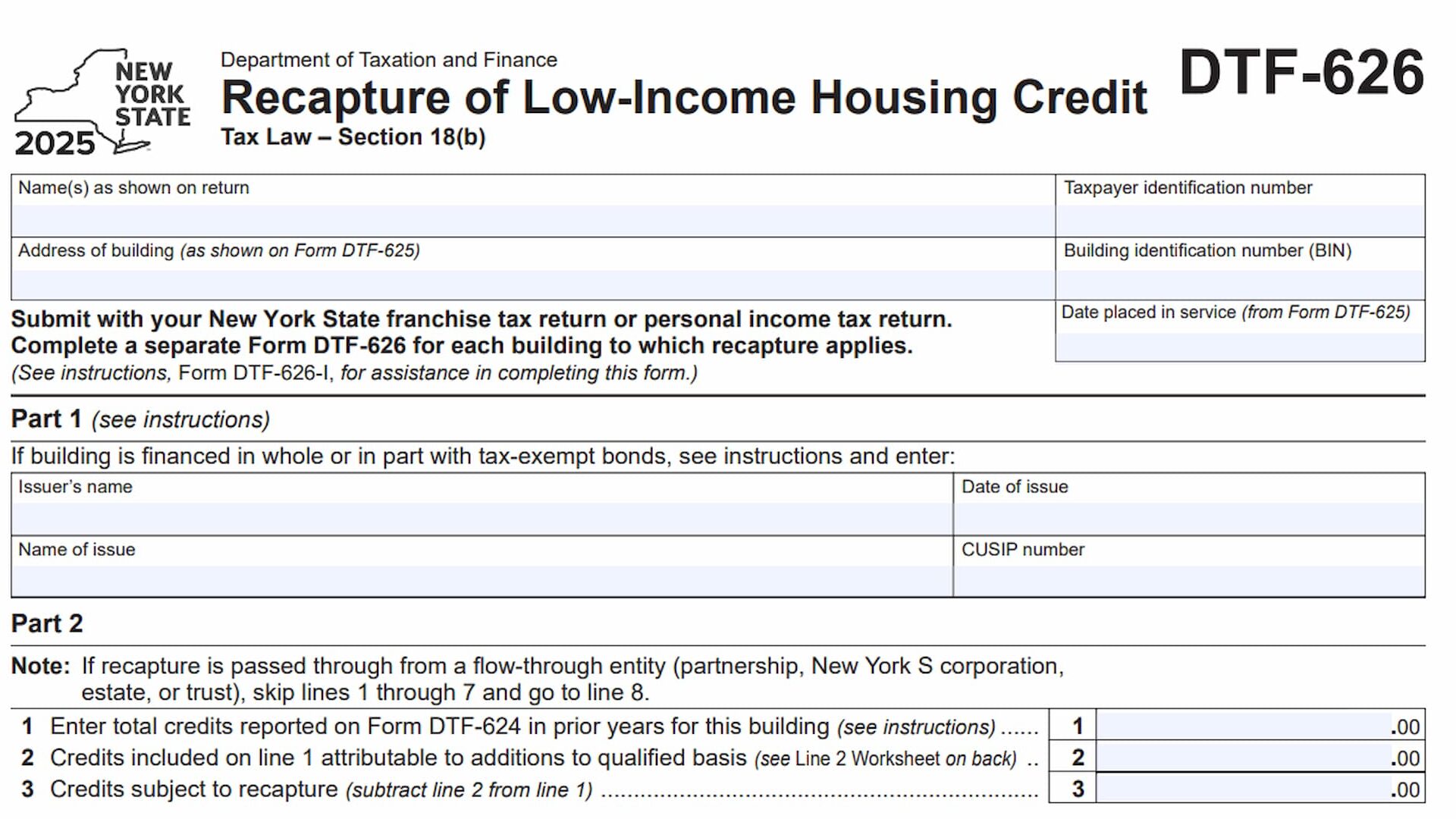
Form DTF-626, Recapture of Low-Income Housing Credit, is a New York State tax form used to calculate and report the recapture of previously claimed Low-Income Housing Credits when certain conditions affecting a qualified low-income housing building occur. The form is authorized under Section 18(b) of the New York State Tax Law and is associated with the Low-Income Housing Credit reported on Form DTF-624.
Form DTF-626 is used by taxpayers who must recapture previously claimed credits because of changes affecting a building’s qualified basis. It also applies when a recapture amount is passed through from a flow-through entity, such as a partnership, New York S corporation, estate, or trust.
The form collects information about the taxpayer, the building, its Building Identification Number (BIN), the date it was placed in service, and previously reported credit amounts. When a building is financed in whole or in part with tax-exempt bonds, additional information about the bond issue must also be provided.
The 2025 Form DTF-626 contains three main parts. Part 1 collects information about tax-exempt bond financing when applicable. Part 2 calculates the recapture amount, related interest, remaining credits, and potential carryforward. Part 3 is reserved exclusively for partnerships subject to Internal Revenue Code Section 42(j)(5).
The form also includes two supporting worksheets on its second page. The Line 2 Worksheet calculates credits attributable to additions to qualified basis, while the Line 9 Worksheet determines the accelerated portion of unused credit carryover attributable to the building.
Completing Form DTF-626 correctly is important because the recapture amount must be reported on the appropriate New York franchise tax or personal income tax return. A separate Form DTF-626 must be completed for each building to which recapture applies.
How To File Form DTF-626
Form DTF-626 must be submitted with the applicable New York State franchise tax return or personal income tax return.
The form is used by taxpayers who must report the recapture of previously claimed Low-Income Housing Credits attributable to a particular building.
If the recapture applies to multiple buildings, complete a separate Form DTF-626 for each building.
The form also distinguishes between taxpayers calculating the recapture themselves and those receiving a recapture amount through a flow-through entity.
Recapture Passed Through From a Flow-Through Entity
If the recapture is passed through from a partnership, New York S corporation, estate, or trust, the form instructs taxpayers to skip Lines 1 through 7 in Part 2 and proceed directly to Line 8.
The applicable treatment depends on the type of flow-through entity:
- Partnerships and New York S corporations: The form provides specific instructions for reporting recapture amounts passed through to other taxpayers.
- Estates and trusts: Enter on Line 8 only the share of the recapture amount attributable to the credit amount reported on the estate’s or trust’s Form DTF-624.
- IRC Section 42(j)(5) partnerships: Complete Part 3, including Lines 16 and 17.
- Other flow-through entities: The form generally instructs entities other than electing large partnerships to report the Line 7 amount on Form IT-204 or Form CT-34-SH, as applicable, and stop there.
Information to Prepare Before Completing Form DTF-626
Before filling out the form, gather the following information:
- Your applicable New York franchise tax or personal income tax return.
- Your name as shown on the return.
- Your taxpayer identification number.
- The building’s address as shown on Form DTF-625.
- The building’s identification number (BIN).
- The date the building was placed in service, as reported on Form DTF-625.
- Previous-year Form DTF-624 records for the building.
- Information about credits attributable to additions to qualified basis.
- The applicable credit recapture percentage.
- The percentage decrease in qualified basis.
- Information about unused credit carryforwards.
- Any recapture amount passed through from a flow-through entity.
- Interest information required for the applicable recapture calculation.
- Tax-exempt bond information, if the building was financed in whole or in part with tax-exempt bonds.
- Form DTF-625-ATT and applicable supporting calculations for the Line 2 Worksheet.
You should also consult Form DTF-626-I, Instructions for Form DTF-626, for additional guidance on determining the applicable recapture percentages, interest, and other calculations.

How To Complete Form DTF-626
The 2025 Form DTF-626 is a two-page tax form. The first page contains taxpayer and building identification fields, Part 1, Part 2, and Part 3. The second page contains the Line 2 Worksheet and Line 9 Worksheet.
Complete the identification information first, then follow the applicable calculations in order.
Taxpayer and Building Information
At the top of the form, enter the identifying information associated with your New York tax return and the building subject to credit recapture.
Name(s) as Shown on Return
Enter your name exactly as it appears on your applicable New York tax return.
Use the appropriate taxpayer or entity name associated with the return.
Taxpayer Identification Number
Enter the taxpayer identification number associated with the income or franchise tax return.
Make sure the number matches the information reported on the applicable return.
Address of Building
Enter the address of the building subject to credit recapture.
The form specifically instructs taxpayers to use the building address as shown on Form DTF-625.
Building Identification Number (BIN)
Enter the Building Identification Number assigned to the building.
Use the BIN associated with the building reported on Form DTF-625.
Date Placed in Service
Enter the date the building was placed in service.
Use the date reported on Form DTF-625.
Filing Instructions
The form includes two important filing requirements:
- Submit Form DTF-626 with your New York State franchise tax return or personal income tax return.
- Complete a separate Form DTF-626 for each building to which recapture applies.
The form also directs taxpayers to consult Form DTF-626-I for assistance with completing the calculations.
Part 1: Tax-Exempt Bond Information
Part 1 applies when the building is financed in whole or in part with tax-exempt bonds.
If this financing arrangement applies, provide the bond issuer and issue information requested in the four fields.
If the building is not financed with tax-exempt bonds, the applicable bond information fields are not required.
Issuer’s Name
Enter the name of the organization or governmental entity that issued the tax-exempt bonds used to finance the building.
Use the issuer information associated with the applicable bond issue.
Date of Issue
Enter the date the tax-exempt bonds were issued.
Use the date associated with the financing arrangement.
Name of Issue
Enter the name assigned to the bond issue.
Use the official issue name shown in the bond documentation.
CUSIP Number
Enter the CUSIP number associated with the tax-exempt bond issue.
Use the applicable identifier from the bond records.
Make sure all four fields correspond to the same bond issue used to finance the building.
Part 2: Recapture Calculation
Part 2 contains Lines 1 through 15 and calculates the amount of Low-Income Housing Credit that must be recaptured.
The calculation considers previously claimed credits, credits attributable to additions to qualified basis, the applicable recapture percentage, the decrease in qualified basis, interest, and unused credit carryforwards.
Important: If the recapture is passed through from a partnership, New York S corporation, estate, or trust, skip Lines 1 through 7 and proceed directly to Line 8.
Line 1: Total Credits Reported on Form DTF-624 in Prior Years
Enter the total amount of credits reported on Form DTF-624 in previous years for the building.
Use the historical credit information associated with the specific building being reported.
The amount should reflect the credits previously reported for that building, as instructed on the form.
Line 2: Credits Included on Line 1 Attributable to Additions to Qualified Basis
Enter the portion of the amount on Line 1 attributable to additions to qualified basis.
The form provides a separate Line 2 Worksheet on page 2 to calculate this amount.
Complete the worksheet using the applicable information from Form DTF-625-ATT and the related instructions.
Transfer the resulting amount from Line 2 Worksheet, entry i, to Part 2, Line 2.
If more than one Line 2 Worksheet is completed, add all amounts from entry i and enter the combined total on Line 2.
Line 3: Credits Subject to Recapture
Subtract the amount on Line 2 from the amount on Line 1.
Enter the resulting amount on Line 3.
The calculation is:
Line 1 − Line 2 = Line 3
This amount represents the credits subject to recapture after excluding the credits attributable to additions to qualified basis.
Line 4: Credit Recapture Percentage
Enter the applicable credit recapture percentage.
Use the percentage determined under the instructions for Form DTF-626-I.
The percentage is applied to Line 3 to calculate the accelerated portion of the credit.
The specific percentage determination is not provided in the uploaded Form DTF-626 itself. Consult the separate instructions when completing this line.
Line 5: Accelerated Portion of Credit
Multiply the amount on Line 3 by the percentage on Line 4.
Enter the resulting amount on Line 5.
The calculation is:
Line 3 × Line 4 = Line 5
This amount represents the accelerated portion of the credit before applying the percentage decrease in qualified basis.
Line 6: Percentage Decrease in Qualified Basis
Enter the percentage decrease in the building’s qualified basis.
Use the applicable calculation and instructions in Form DTF-626-I.
This percentage is applied to the accelerated portion of the credit to determine the amount subject to recapture.
Line 7: Amount of Accelerated Portion Recaptured
Multiply the amount on Line 5 by the percentage on Line 6.
Enter the resulting amount on Line 7.
The calculation is:
Line 5 × Line 6 = Line 7
This amount represents the accelerated portion of the credit subject to recapture.
The form provides additional instructions depending on the type of taxpayer:
- IRC Section 42(j)(5) partnerships: Proceed to Line 16 in Part 3.
- Other flow-through entities, except electing large partnerships: Enter the result on the appropriate line of Form IT-204 or Form CT-34-SH, as applicable. These entities generally stop at this point.
- Estates and trusts: When reporting an amount passed through, enter on Line 8 only the share attributable to the credit amount reported on the estate’s or trust’s Form DTF-624.
The form also instructs taxpayers to consult its separate instructions if there has been a previous recapture on the building.
Line 8: Recapture Amount From Flow-Through Entity
Enter the recapture amount passed through from a flow-through entity.
This line is used when the taxpayer receives a recapture amount from a partnership, New York S corporation, estate, or trust.
If you are calculating the recapture directly rather than receiving it through a flow-through entity, use the applicable amount from Line 7 as directed by the form.
Estates and trusts must report only their share of the recapture attributable to the credit amount reported on their Form DTF-624.
Line 9: Unused Portion of the Accelerated Amount From Line 7
Enter the unused portion of the accelerated credit amount from Line 7.
The form provides a separate Line 9 Worksheet on page 2 to calculate this figure.
Complete the worksheet using the unused credit carryforward, credit recapture percentage, and percentage decrease in qualified basis.
Transfer the amount from entry n of the Line 9 Worksheet to Line 9.
The worksheet determines the accelerated portion of unused carryforward attributable to the building.
Line 10: Net Recapture
Subtract the amount on Line 9 from the applicable recapture amount on Line 7 or Line 8.
Enter the resulting amount on Line 10.
The calculation is:
Line 7 or Line 8 − Line 9 = Line 10
Use the appropriate starting amount depending on whether you calculated the recapture directly or received it from a flow-through entity.
If the result is less than zero, leave Line 10 blank.
Line 11: Interest on the Line 10 Recapture Amount
Enter the interest attributable to the recapture amount reported on Line 10.
Use the applicable interest calculation and instructions in Form DTF-626-I.
The uploaded form does not specify the interest rate or calculation period. Consult the separate instructions when determining the amount.
Line 12: Total Amount Subject to Recapture
Add the amounts reported on Lines 10 and 11.
Enter the resulting amount on Line 12.
The calculation is:
Line 10 + Line 11 = Line 12
This amount represents the net recapture and associated interest before accounting for unused credits attributable to the building.
Line 13: Unused Credits Attributable to This Building
Enter the unused credits attributable to the building, reduced by the accelerated portion included on Line 9.
Use the applicable credit carryforward records and supporting calculations to determine the amount.
Make sure the amount accounts for the reduction required by the form.
Line 14: Recapture Tax
Subtract the amount on Line 13 from the amount on Line 12.
Enter the resulting amount on Line 14.
The calculation is:
Line 12 − Line 13 = Line 14
If the result is zero or less, leave Line 14 blank.
The amount on Line 14 represents the recapture tax to be reported on the appropriate line of the applicable New York tax return.
If more than one Form DTF-626 is being filed, add the amounts reported on Line 14 of all applicable forms and enter the combined total on the appropriate line of the tax return.
Electing large partnerships must consult the separate instructions for the applicable reporting requirements.
Line 15: Carryover of the Low-Income Housing Credit Attributable to This Building
Subtract the amount on Line 12 from the amount on Line 13.
Enter the resulting amount on Line 15.
The calculation is:
Line 13 − Line 12 = Line 15
If the result is zero or less, leave Line 15 blank.
This amount represents the remaining Low-Income Housing Credit carryforward attributable to the building after accounting for the recapture calculation.
Part 3: Additional Recapture for IRC Section 42(j)(5) Partnerships
Part 3 is reserved exclusively for partnerships subject to Internal Revenue Code Section 42(j)(5).
Only these partnerships need to complete Lines 16 and 17.
The section calculates additional interest on the recapture amount reported on Line 7 and determines the total recapture.
Line 16: Interest on the Line 7 Recapture Amount
Enter the interest attributable to the recapture amount reported on Line 7.
Use the applicable interest calculation and instructions in Form DTF-626-I.
This line applies specifically to IRC Section 42(j)(5) partnerships.
Line 17: Total Recapture
Add the amounts reported on Lines 7 and 16.
Enter the resulting amount on Line 17.
The calculation is:
Line 7 + Line 16 = Line 17
This represents the total recapture amount for partnerships subject to IRC Section 42(j)(5).
Line 2 Worksheet: Calculating Credits Attributable to Additions to Qualified Basis
The first worksheet on page 2 calculates the portion of previously reported credits attributable to additions to qualified basis.
The resulting amount is transferred to Part 2, Line 2.
The worksheet contains entries a through i.
Entry a: Form DTF-625-ATT, Line 10
Enter the amount reported on Form DTF-625-ATT, Line 10.
Use the corresponding amount from the applicable supporting form.
Entry b: Multiply Entry a by Two
Multiply the amount on entry a by two.
Enter the resulting amount on entry b.
Entry c: Form DTF-625-ATT, Line 11
Enter the amount reported on Form DTF-625-ATT, Line 11.
Entry d: Subtract Entry c From Entry b
Subtract the amount on entry c from the amount on entry b.
Enter the resulting amount on entry d.
Entry e: Applicable Decimal Amount
Enter the decimal amount calculated on Form DTF-625-ATT-I, Line 15, Step 1.
If Line 15 does not apply to you, enter zero.
Entry f: Multiply Entry d by Entry e
Multiply the amount on entry d by the decimal amount on entry e.
Enter the resulting amount on entry f.
Entry g: Subtract Entry f From Entry d
Subtract the amount on entry f from the amount on entry d.
Enter the resulting amount on entry g.
Entry h: Form DTF-625-ATT Ratio
Divide the amount on Form DTF-625-ATT, Line 17, by the amount on Form DTF-625-ATT, Line 16.
Enter the resulting amount on entry h.
Entry i: Final Worksheet Amount
Multiply the amount on entry g by the amount on entry h.
Enter the resulting amount on entry i.
Transfer this amount to Part 2, Line 2.
If you complete more than one Line 2 Worksheet, add the amounts reported on entry i of all worksheets and enter the combined total on Line 2.
Line 9 Worksheet: Calculating the Accelerated Portion of Unused Carryover
The second worksheet on page 2 calculates the accelerated portion of unused credit carryover attributable to the building.
The resulting amount is transferred to Part 2, Line 9.
The worksheet contains entries j through n.
Entry j: Total Unused Carryover From Previous Tax Years
Enter the total amount of unused carryover from previous tax years included in Part 2, Line 3.
Use the applicable credit carryforward records for the building.
Entry k: Credit Recapture Percentage
Enter the credit recapture percentage reported on Form DTF-626, Line 4.
Use the same percentage entered in Part 2.
Entry l: Accelerated Portion of Unused Carryover
Multiply the amount on entry j by the percentage on entry k.
Enter the resulting amount on entry l.
The calculation is:
Entry j × Entry k = Entry l
Entry m: Percentage Decrease in Qualified Basis
Enter the percentage decrease in qualified basis reported on Form DTF-626, Line 6.
Use the same percentage entered in Part 2.
Entry n: Unused Accelerated Amount
Multiply the amount on entry l by the percentage on entry m.
Enter the resulting amount on entry n.
The calculation is:
Entry l × Entry m = Entry n
Transfer the amount from entry n to Part 2, Line 9.
Additional Form Instructions and Important Requirements
The 2025 Form DTF-626 includes several important filing and calculation requirements.
Separate Form for Each Building
A separate Form DTF-626 must be completed for each building to which recapture applies.
Use the building’s address and Building Identification Number (BIN) from Form DTF-625.
Flow-Through Entity Reporting
If the recapture amount is passed through from a partnership, New York S corporation, estate, or trust, skip Lines 1 through 7 and proceed to Line 8.
The form provides additional reporting instructions for different types of flow-through entities.
Tax-Exempt Bond Financing
If the building is financed in whole or in part with tax-exempt bonds, complete the applicable fields in Part 1.
Provide the issuer’s name, date of issue, name of issue, and CUSIP number.
Previous Recapture on the Building
The instructions for Line 7 specifically refer taxpayers to Form DTF-626-I when there has been a previous recapture on the building.
Consult the separate instructions before calculating the applicable amount.
Electing Large Partnerships
The form provides a specific exception for electing large partnerships.
These entities should consult Form DTF-626-I for the applicable reporting requirements rather than automatically following the general instructions for other flow-through entities.
Supporting Worksheets
The form contains two worksheets on page 2:
- Line 2 Worksheet: Calculates credits attributable to additions to qualified basis.
- Line 9 Worksheet: Calculates the accelerated portion of unused credit carryover attributable to the building.
Complete the applicable worksheets before entering their results on Lines 2 and 9.
Final Review Before Filing
Before submitting Form DTF-626 with your New York tax return, review the following checklist to make sure all required information and calculations are complete.
- Correct tax year: Confirm that you are using the 2025 Form DTF-626.
- Separate forms: Complete a separate Form DTF-626 for each building subject to recapture.
- Taxpayer information: Verify that your name matches the applicable tax return.
- Identification number: Check that your taxpayer identification number is correct.
- Building address: Confirm that the address matches Form DTF-625.
- Building Identification Number: Verify the BIN.
- Date placed in service: Confirm that the date matches Form DTF-625.
- Part 1: If the building was financed with tax-exempt bonds, provide the issuer’s name, issue date, issue name, and CUSIP number.
- Flow-through entity: If the recapture was passed through from a flow-through entity, skip Lines 1 through 7 and proceed to Line 8.
- Line 1: Verify the total credits reported on previous years’ Forms DTF-624 for the building.
- Line 2: Calculate credits attributable to additions to qualified basis using the Line 2 Worksheet.
- Line 3: Subtract Line 2 from Line 1.
- Line 4: Enter the applicable credit recapture percentage.
- Line 5: Multiply Line 3 by Line 4.
- Line 6: Enter the percentage decrease in qualified basis.
- Line 7: Multiply Line 5 by Line 6.
- Line 8: Enter the recapture amount received from a flow-through entity, when applicable.
- Line 9: Calculate the unused accelerated amount using the Line 9 Worksheet.
- Line 10: Subtract Line 9 from the applicable amount on Line 7 or Line 8.
- Line 11: Enter the applicable interest on the Line 10 recapture amount.
- Line 12: Add Lines 10 and 11.
- Line 13: Enter the unused credits attributable to the building, reduced by the accelerated portion included on Line 9.
- Line 14: Subtract Line 13 from Line 12. Leave blank if the result is zero or less.
- Line 15: Subtract Line 12 from Line 13. Leave blank if the result is zero or less.
- Part 3 eligibility: Complete Lines 16 and 17 only if you are an IRC Section 42(j)(5) partnership.
- Line 16: Enter the applicable interest on the Line 7 recapture amount.
- Line 17: Add Lines 7 and 16.
- Line 2 Worksheet: Verify all calculations from entries a through i.
- Line 9 Worksheet: Verify all calculations from entries j through n.
- Multiple buildings: If more than one Form DTF-626 is filed, add the applicable Line 14 amounts as instructed.
- Return transfer: Report the recapture amount on the appropriate line of the applicable New York tax return.
- Final review: Check all percentages, credit amounts, supporting calculations, and reporting requirements before filing.
Review the applicable instructions carefully before finalizing the recapture calculation. Make sure the correct building information is reported, the qualified basis calculations are supported, and the applicable interest amounts are determined using Form DTF-626-I. Keep the supporting credit records and completed worksheets with your tax documents.