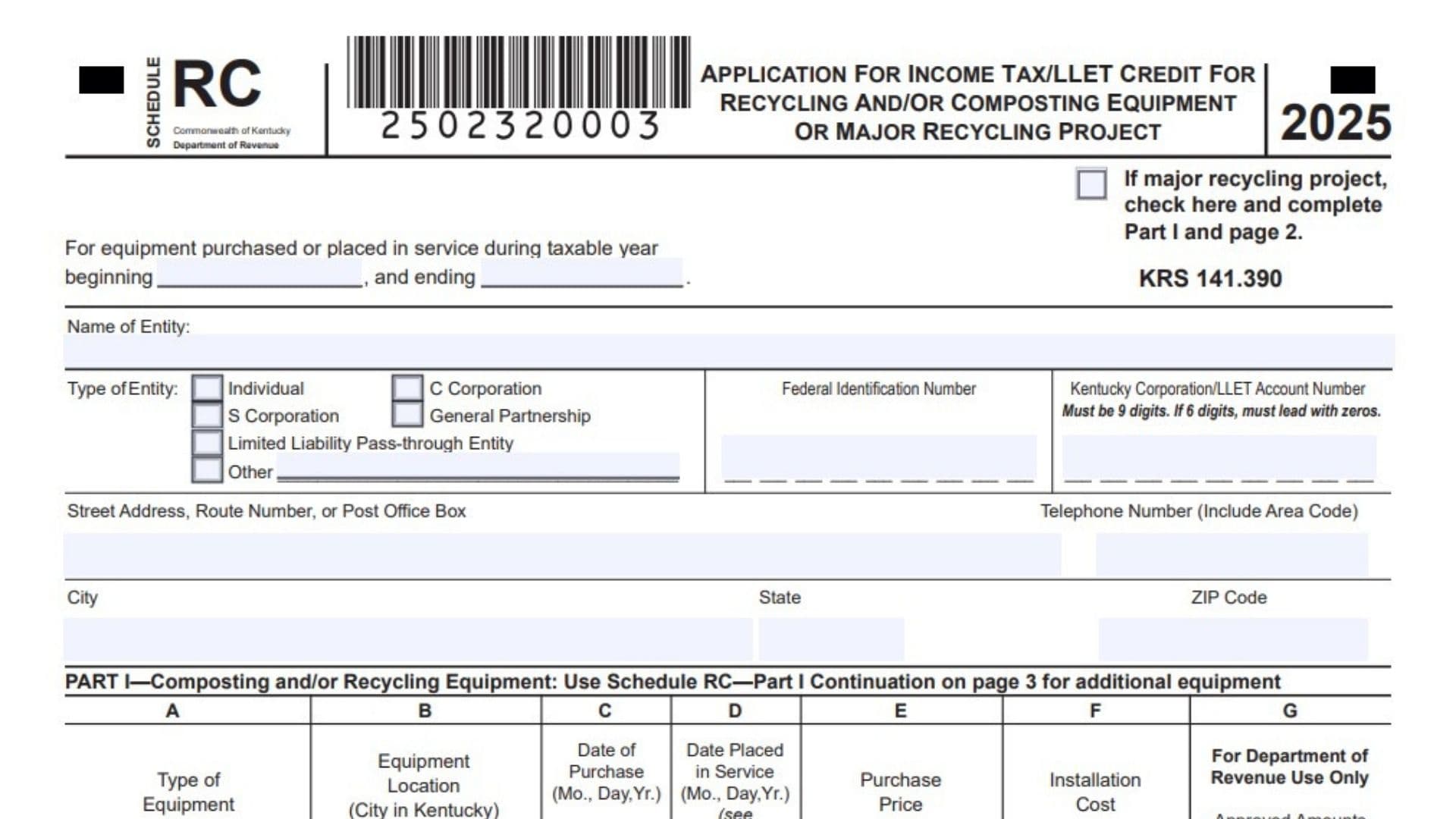
Kentucky Schedule RC is an application and credit-tracking schedule used by taxpayers that purchase and place qualifying recycling or composting equipment in service for exclusive use in Kentucky. It may also be used for a project that meets Kentucky’s requirements for a Major Recycling Project. The schedule serves two purposes. First, it allows the taxpayer to request approval from the Kentucky Department of Revenue for the amount of recycling or composting equipment credit available against Kentucky income tax and the Limited Liability Entity Tax, commonly called LLET. Second, after the application is approved, it provides a record of the credit claimed against each tax during every applicable tax year. Qualifying equipment generally includes machinery or apparatus used exclusively to process postconsumer waste, manufacturing machinery used exclusively to produce finished products containing substantial postconsumer waste, and equipment used to conduct controlled aerobic composting of organic solid waste. For a regular recycling or composting equipment project, the approved credit generally equals 50 percent of qualifying equipment purchase and installation costs. A separate set of rules applies to a Major Recycling Project, including investment, employee, wage, and total plant and equipment requirements. The taxpayer must obtain approval before claiming the credit, maintain separate balances for income tax and LLET, attach the approved application to each return on which credit is claimed, and follow the annual credit limitations that apply to the project.
Who May Qualify For The Kentucky Recycling Credit?
A taxpayer may qualify by purchasing and placing recycling or composting equipment in service for exclusive use in Kentucky.
Eligible taxpayers may include:
- Individuals
- C corporations
- S corporations
- General partnerships
- Limited liability pass-through entities
- Other qualifying taxpayer classifications
When a pass-through entity purchases qualifying equipment, the approved credit may generally be distributed to its partners, members, or shareholders according to their pro rata or distributive shares.
What Is Qualifying Recycling Equipment?
Qualifying recycling equipment generally includes machinery or apparatus used exclusively to process postconsumer waste material.
It may also include manufacturing machinery used exclusively to produce finished products composed of substantial postconsumer waste material. For this purpose, the finished product generally must contain at least 50 percent postconsumer waste.
Examples of equipment that may qualify when all requirements are met include:
- Balers
- Briquetters
- Bobcats
- Compactors
- Containers used in the qualifying process
- Conveyors and conveyor systems
- Cranes with grappling hooks
- Crushers
- Densifiers
- End loaders
- Exhaust fans
- Fluffers
- Forklifts
- Granulators
- Lift gates
- Magnetic separators
- Material recovery facility equipment
- Pallet jacks
- Perforators
- Pumps with oil
- Scales
- Screeners
- Shears
- Shredders
- Tractors
- Trailers
- Trucks and roll-offs
- Two-wheel carts
- Vacuum systems
An item appearing in this list does not automatically qualify. It must be used exclusively in Kentucky for an eligible recycling or composting process.
What Is Qualifying Composting Equipment?
Qualifying composting equipment is equipment used in a controlled aerobic process that biologically decomposes organic solid waste and stabilizes the organic material so it can be safely stored, handled, and used.
A self-contained backyard composter may qualify.
Lawn tractors, lawn mowers, mulching attachments, bagging attachments, and similar equipment used mainly to gather organic waste generally do not qualify as composting equipment.
What Costs Do Not Qualify?
Do not include expenses that fail to meet the equipment and use requirements.
Nonqualifying amounts generally include:
- Repairs
- Major repairs that are capitalized and depreciated
- Equipment leases required to be capitalized by the lessee
- Equipment used outside Kentucky
- Equipment used partly for nonrecycling purposes
- Home trash containers
- Ordinary trash collection bins
- Items used only to collect or separate waste before the qualifying recycling process
- Manufacturing equipment producing goods with less than 50 percent postconsumer waste
- Lawn equipment used to gather organic materials
- General operating expenses
- Labor unrelated to equipment installation
- Equipment that was not purchased and placed in service as required
Replacement, repair, and collection equipment should not be included merely because it is connected with a recycling business.
What Is A Major Recycling Project?
A Major Recycling Project is a qualifying Kentucky recycling or composting project that satisfies all three statutory requirements.
The project must:
- Include an investment of more than $10 million in recycling or composting equipment used exclusively in Kentucky.
- Employ at least 400 full-time employees whose average hourly wage is more than 300 percent of the federal minimum wage.
- Include plant and equipment with a combined total cost of more than $500 million.
The taxpayer must answer Yes to all three requirements to qualify for the Major Recycling Project Credit.
If any answer is No, the project does not qualify as a Major Recycling Project.
How Much Is The Regular Recycling Or Composting Equipment Credit?
For a project that is not a Major Recycling Project, the total allowable credit generally equals 50 percent of the combined approved purchase price and installation cost of qualifying equipment.
Use this general calculation:
Qualifying equipment cost + qualifying installation cost = approved qualifying cost
Approved qualifying cost × 50% = total allowable credit
The Kentucky Department of Revenue determines the approved qualifying amounts and enters the approved credit in Part II.
Annual Limitation For A Regular Recycling Credit
During the tax year in which the equipment is purchased or placed in service, the credit claimed is limited to the lesser of:
- 10 percent of the total approved credit, or
- 25 percent of the applicable tax liability that would otherwise be due
For later years, the credit is limited to 25 percent of the applicable tax liability.
Separate calculations must be completed for LLET and income tax.
A credit balance available for income tax cannot be used against LLET. A credit balance available for LLET cannot be used against income tax.
The credit also cannot reduce LLET below the required $175 minimum.
How Much Is The Major Recycling Project Credit?
For Major Recycling Project credits approved for taxable years beginning after December 31, 2019, the total allowable credit generally equals 25 percent of the installed cost of qualifying recycling or composting equipment.
The annual credit claimed for all Major Recycling Projects is generally limited to 75 percent of each applicable tax liability that would otherwise be due.
The credit period is limited to 30 years beginning with the approval of the application.
Different rules apply to Major Recycling Project credits approved for taxable years beginning before January 1, 2020. Those credits may equal 50 percent of installed cost and may be subject to a limitation based on 50 percent of the excess tax liability over the taxpayer’s baseline liability, with a maximum annual amount of $2.5 million. The carryforward period for those older credits is generally 10 years.
When To File Kentucky Schedule RC
File the application on or before the first day of the seventh month following the close of the taxable year in which the equipment was purchased or placed in service.
For example, if the taxable year ends December 31, the filing deadline is generally July 1 of the following year.
Applications postmarked after the applicable deadline will not be approved.
Prior approval must be received before the credit is claimed.
Only one application should be filed for all qualifying purchases made during the taxable period covered by the application.
Where To File Kentucky Schedule RC
Mail the completed application and supporting documentation to:
Department of Revenue
Division of Corporation Tax
Station 52
501 High Street
Frankfort, KY 40601
The approved original application is returned to the purchaser.
Documents To Submit With The Application
Submit sufficient documentation to verify the purchase and installation cost of every item listed.
Supporting documents should include:
- Vendor invoices
- Purchase contracts
- Installation contracts
- Shipping invoices
- Proof of payment
- Equipment descriptions
- Placed-in-service records
- Equipment location records
- A reconciliation spreadsheet
- Documentation explaining how each item is used exclusively for recycling or composting
The supporting spreadsheet should identify the cost of each equipment item and reconcile the amounts to Columns E and F.
An application may remain unapproved until the Department can match every listed amount with the supporting invoices and other records.
How To Complete Kentucky Schedule RC
Application Period And Major Project Election
Taxable Year Beginning: Enter the first date of the taxable year during which the equipment was purchased or placed in service.
Taxable Year Ending: Enter the final date of the taxable year covered by the application.
The dates should agree with the taxable period used on the taxpayer’s Kentucky return.
Major Recycling Project Checkbox: Check this box when the application concerns a Major Recycling Project. A taxpayer checking this box must complete Part I and the Major Recycling Project sections on Page 2.
Leave the box blank when applying only for the regular recycling or composting equipment credit.
Entity Identification Section
Name Of Entity: Enter the complete legal name of the taxpayer purchasing and placing the equipment in service.
Use the same name reported on the taxpayer’s Kentucky tax return.
Type Of Entity, Individual: Check this box when the applicant is an individual.
Type Of Entity, C Corporation: Check this box when the applicant is taxed as a C corporation.
Type Of Entity, S Corporation: Check this box when the applicant is an S corporation.
Type Of Entity, General Partnership: Check this box when the applicant is a general partnership.
Type Of Entity, Limited Liability Pass-Through Entity: Check this box when the applicant is a limited liability entity treated as a pass-through entity for Kentucky tax purposes.
Type Of Entity, Other: Check this box when none of the listed categories applies. Write the taxpayer’s classification on the line provided.
Federal Identification Number: Enter the taxpayer’s federal employer identification number. An individual should enter the identifying number used on the applicable Kentucky tax return.
Kentucky Corporation/LLET Account Number: Enter the Kentucky Corporation or LLET account number when applicable.
The number must contain nine digits. If the assigned number contains six digits, add three zeros at the beginning. For example, enter 123456 as 000123456.
Street Address, Route Number, Or Post Office Box: Enter the taxpayer’s complete mailing address.
Telephone Number: Enter a daytime telephone number, including the area code.
City: Enter the city for the taxpayer’s mailing address.
State: Enter the two-letter state abbreviation.
ZIP Code: Enter the complete ZIP code.
Part I, Composting And Recycling Equipment
Complete Part I for every equipment item purchased or placed in service during the taxable year.
The main page provides space for two equipment entries. Use the Part I Continuation page when more entries are needed.
Part I Column Instructions
Column A, Type Of Equipment: Enter the specific name of the machinery, apparatus, or equipment.
Use a precise description such as industrial cardboard baler, magnetic separator, conveyor system, recycling shredder, or self-contained composting unit.
Do not use vague terms such as machine, equipment, system, or miscellaneous property.
Identify The Equipment And Use: Beneath each equipment entry, explain how the item is used exclusively in recycling or composting postconsumer waste.
The description should identify:
- The waste material processed
- The equipment’s function
- The stage of the recycling or composting process
- How the equipment is used exclusively for the qualifying activity
- Whether it produces a finished product containing substantial postconsumer waste
For example, explain that a baler compresses postconsumer cardboard into transportable bales as part of the taxpayer’s Kentucky recycling operation.
Column B, Equipment Location: Enter the Kentucky city where the equipment is physically located.
When the location is outside an incorporated city, enter the Kentucky county.
The equipment must be used exclusively within Kentucky.
Column C, Date Of Purchase: Enter the month, day, and year the taxpayer purchased the equipment.
Use the purchase date shown on the invoice, sales agreement, or other acquisition record.
Column D, Date Placed In Service: Enter the month, day, and year the equipment became installed, operational, and ready for its intended recycling or composting use.
When installation is required, use the date installation was completed and the equipment was ready for use.
Equipment requiring installation must be fully installed and placed in service during the first taxable year for which the credit is claimed.
Column E, Purchase Price: Enter the purchase or contract price of the qualifying equipment.
Round the amount to the nearest whole dollar.
Do not include installation expenses in this column.
Column F, Installation Cost: Enter the cost of installing the equipment and making it ready for use.
Qualifying installation costs may include shipping charges incurred and paid by the purchaser.
Round the amount to the nearest whole dollar.
The combined total of Columns E and F will generally equal the equipment’s Kentucky depreciation basis.
Column G, Approved Amounts: Do not complete this column.
The Kentucky Department of Revenue uses Column G to enter the approved amount based on the qualifying costs reported in Columns E and F.
Part I First Equipment Entry
First Equipment, Column A: Enter the specific name of the first qualifying equipment item.
First Equipment, Column B: Enter the Kentucky city or county where the item is located.
First Equipment, Column C: Enter its purchase date.
First Equipment, Column D: Enter its placed-in-service date.
First Equipment, Column E: Enter its purchase price.
First Equipment, Column F: Enter its installation cost.
First Equipment, Use Description: Explain clearly how the item is used exclusively in the recycling or composting process.
First Equipment, Column G: Leave blank for Department use.
Part I Second Equipment Entry
Second Equipment, Column A: Enter the specific name of the second qualifying equipment item.
Second Equipment, Column B: Enter its Kentucky location.
Second Equipment, Column C: Enter its purchase date.
Second Equipment, Column D: Enter its placed-in-service date.
Second Equipment, Column E: Enter its purchase price.
Second Equipment, Column F: Enter its installation cost.
Second Equipment, Use Description: Explain the item’s exclusive qualifying use.
Second Equipment, Column G: Leave blank for Department use.
Part I Continuation Instructions
Use the Schedule RC Part I Continuation page when more than two types of equipment were purchased or placed in service during the taxable year.
Continuation Page Identification
Page Number: Enter the current continuation page number.
Total Pages: Enter the total number of continuation pages included.
Taxable Year Beginning: Enter the beginning date of the taxable period covered by the application.
Taxable Year Ending: Enter the ending date of the taxable period.
Name Of Entity: Enter the applicant’s legal name.
Federal Identification Number: Enter the applicant’s FEIN or other required identifying number.
Kentucky Corporation/LLET Account Number: Enter the nine-digit Kentucky account number when applicable.
Continuation Equipment Entries
For each additional equipment item, complete Columns A through F and the equipment use description.
Continuation Column A: Enter the specific equipment name.
Continuation Column B: Enter the Kentucky city or county where the equipment is located.
Continuation Column C: Enter the date of purchase.
Continuation Column D: Enter the date placed in service.
Continuation Column E: Enter the purchase price.
Continuation Column F: Enter the installation cost.
Continuation Equipment And Use Description: Explain how the item is used exclusively in the qualifying recycling or composting process.
Continuation Column G: Leave blank for the Department of Revenue.
Repeat these instructions for every additional item listed on the continuation page.
Page Total: Do not enter the Department’s approved total unless instructed after review. The Department uses this area to total the approved amounts shown in Column G.
Attach as many continuation pages as necessary to report all qualifying equipment.
Part II, Credit Approved
Part II is completed by the Kentucky Department of Revenue.
The taxpayer should not enter amounts in Part II when submitting the application.
Part II, Line 1: The Department enters the total of the approved amounts from Column G of Part I and all continuation pages.
Part II, Line 2: The Department enters the total credit approved for the applicant.
For a regular recycling or composting equipment project, the approved credit generally reflects 50 percent of the approved qualifying purchase and installation costs.
Pass-through entities use the approved credit according to the allocation rules applicable to their partners, members, or shareholders.
Part III, Amount Of Credit Claimed
Complete Part III after the application has been approved and as the credit is used.
Do not record Major Recycling Project Credit amounts in Part III. Major Recycling Project amounts are tracked in Parts V and VI.
Entities subject to LLET enter the credit claimed against LLET in the LLET column.
Individuals and entities other than pass-through entities enter the credit claimed against income tax in the Income Tax column.
Attach a copy of the approved application, updated with all entries made through the current year, to every Kentucky return on which the credit is claimed.
Part III Annual Limitation
In the year of purchase or placement in service, the maximum credit is the lesser of:
- 10 percent of Part II, Line 2, or
- 25 percent of the applicable tax liability
For later years, the credit is limited to 25 percent of the applicable tax liability.
The LLET credit cannot reduce LLET below $175.
Part III Row Instructions
Part III, Row 1, Tax Year Ended: Enter the ending date of the first tax year in which approved credit is used.
Part III, Row 1, LLET: Enter the approved credit claimed against LLET for that year.
Part III, Row 1, Income Tax: Enter the approved credit claimed against income tax for that year.
Part III, Row 2, Tax Year Ended: Enter the ending date of the second tax year in which credit is used.
Part III, Row 2, LLET: Enter the second-year amount claimed against LLET.
Part III, Row 2, Income Tax: Enter the second-year amount claimed against income tax.
Part III, Row 3, Tax Year Ended: Enter the ending date of the third tax year in which credit is used.
Part III, Row 3, LLET: Enter the third-year LLET credit claimed.
Part III, Row 3, Income Tax: Enter the third-year income tax credit claimed.
Part III, Row 4, Tax Year Ended: Enter the ending date of the fourth tax year in which credit is used.
Part III, Row 4, LLET: Enter the fourth-year LLET credit claimed.
Part III, Row 4, Income Tax: Enter the fourth-year income tax credit claimed.
Part III, Row 5, Tax Year Ended: Enter the ending date of the fifth tax year in which credit is used.
Part III, Row 5, LLET: Enter the fifth-year LLET credit claimed.
Part III, Row 5, Income Tax: Enter the fifth-year income tax credit claimed.
When additional years are needed, maintain a supporting schedule using the same format and continue attaching the updated approved application to the return.
Reporting Part III Credits
Report recycling or composting equipment credits claimed against LLET or corporation income tax on the appropriate line of Schedule TCS, Part II.
For Form PTE, enter the LLET credit in Schedule TCS, Part II, Column E.
Pass-through entities should report the approved income tax credit on Schedule K and allocate it through the applicable Kentucky Schedules K-1.
Signature And Certification
The application must be signed before submission.
Unsigned applications will be returned.
Signature: The applicant or an authorized representative must sign the application.
Title: Enter the signer’s business title when applicable.
Date: Enter the date the application is signed.
Printed Name: Print the signer’s full name.
Email Address: Enter an email address where the Department may contact the applicant.
By signing, the applicant declares under penalties of perjury that the application and all attached schedules provide a complete and accurate listing of equipment used exclusively in Kentucky for recycling or composting.
Reviewed By, Department Representative: Leave these fields blank. They are completed by Kentucky Department of Revenue representatives.
Major Recycling Project Information For Pass-Through Owners
The top section of Page 2 applies to a partner, member, or shareholder of a pass-through entity that received approval for a Major Recycling Project.
Name Of Pass-Through Entity: Enter the complete legal name of the pass-through entity that received the Major Recycling Project approval.
Federal Identification Number: Enter the pass-through entity’s FEIN.
Each partner, member, or shareholder completes the applicable credit calculation using their allocated share and their own tax information.
Part IV, Major Recycling Project Requirements Questionnaire
Answer every question in Part IV.
The project qualifies only when all three questions are answered Yes.
Part IV, Line 1: Indicate whether the investment in recycling or composting equipment exceeded $10 million and whether the equipment is used exclusively in Kentucky.
Check Yes only when both conditions are satisfied.
Check No when the investment was $10 million or less or the equipment was not used exclusively in Kentucky.
Part IV, Line 2: Indicate whether the project employed at least 400 full-time employees and whether their average hourly wage exceeded 300 percent of the federal minimum wage.
Both the employee count and wage requirement must be satisfied to check Yes.
Part IV, Line 2(a): Enter the average hourly wage paid to the qualifying full-time employees.
Use payroll records and a consistent calculation that supports the amount.
Part IV, Line 2(b): Enter the number of employees earning the wage reported for purposes of the qualification test.
Confirm that the qualifying full-time employee count is at least 400.
Part IV, Line 3: Indicate whether the project’s plant and equipment had a total cost exceeding $500 million.
Check Yes only when the total is more than $500 million.
Part IV, Line 3(a): Enter the total cost of the plant and equipment.
Maintain supporting fixed-asset, construction, and accounting records for the amount.
If Lines 1, 2, and 3 are all answered Yes, continue to Part V.
If any answer is No, the project is not eligible for the Major Recycling Project Credit.
Part V, Major Recycling Project Credit Calculation
Complete Part V after the Department of Revenue approves the application.
Partners, members, and shareholders of an approved pass-through entity complete Part V using their specific tax liabilities and their allocated shares of the approved credit.
Maintain separate calculations for LLET and income tax.
Part V Line-By-Line Instructions
Part V, Line 1: Enter the LLET liability from the applicable Form 720, Form 720U, Form PTE, or Form 725.
Use the LLET liability before applying the Major Recycling Project Credit.
Enter the amount only in the LLET column.
Part V, Line 2: Enter the income tax liability from the applicable Form 720, Form 720U, Form 740, Form 740-NP, or Form 741.
Use the income tax liability before applying the Major Recycling Project Credit.
Enter the amount only in the Income Tax column.
Part V, Line 3, LLET: Multiply the LLET liability on Line 1 by 75 percent.
Use this calculation:
Line 1 × 0.75 = LLET limitation
Part V, Line 3, Income Tax: Multiply the income tax liability on Line 2 by 75 percent.
Use this calculation:
Line 2 × 0.75 = income tax limitation
For an older project approved for a taxable year beginning before January 1, 2020, apply the older project limitation instead of the 75 percent rule.
Part V, Line 4: Enter the Major Recycling Project Credit claimed against LLET.
The amount cannot exceed:
- The remaining LLET project credit balance
- The applicable annual LLET limitation
- The amount that would reduce LLET only to the $175 minimum
Enter the same amount in Part VI, Column C, LLET.
Combine this amount with any regular recycling credit claimed in Part III and report the total LLET credit on Schedule TCS, Part II, Column E.
Part V, Line 5: Enter the Major Recycling Project Credit claimed against corporation income tax.
The amount cannot exceed the remaining income tax credit balance or the annual income tax limitation.
Enter the same amount in Part VI, Column C, Income Tax.
Combine this amount with any regular recycling credit claimed in Part III and report the total corporation income tax credit on Schedule TCS, Part II, Column F.
Part V, Line 6: Enter the Major Recycling Project Credit claimed against individual income tax.
Report the amount on the applicable Form 740, Form 740-NP, or Form 741.
Enter the same amount in Part VI, Column C, Income Tax.
Part VI, Amount Of Major Recycling Project Credit Claimed
Part VI records the approved Major Recycling Project Credit, the balance remaining, and the amount used each year.
Individuals and entities other than general partnerships complete this part.
Enter zero when no credit is claimed for a particular tax during a year.
For projects approved for taxable years beginning on or after January 1, 2020, the credit period is generally 30 years beginning with approval.
For projects approved for taxable years beginning before January 1, 2020, the credit period is generally 10 years.
Part VI Column Instructions
Column A, Taxable Year Credit Taken: Enter the month and year for each taxable year in which project credit is claimed.
Column B, LLET Balance: In the year of approval, enter the full Major Recycling Project Credit approved by the Department as the beginning LLET balance.
For each later year, subtract the prior year’s LLET credit used in Column C from the prior year’s LLET balance in Column B.
Column B, Income Tax Balance: In the approval year, enter the same approved project credit as the beginning income tax balance.
For each later year, subtract the prior year’s income tax credit used in Column C from the prior year’s income tax balance in Column B.
Although both balances begin with the same approved amount, they must be tracked separately.
Column C, LLET Amount Used: Enter the credit claimed against LLET for the year. This amount should agree with Part V, Line 4.
Column C, Income Tax Amount Used: Enter the credit claimed against corporation or individual income tax. This amount should agree with Part V, Line 5 or Line 6.
Part VI Row-By-Row Instructions
Part VI, Row 1: Enter the month and year of the first taxable year in Column A. Enter the approved project credit in both Column B balance fields. Enter the first-year LLET and income tax credits used in Column C.
Part VI, Row 2: Enter the second taxable year. Enter the balances remaining after subtracting the Row 1 credits used. Enter the second-year credit used against each tax.
Part VI, Row 3: Enter the third taxable year. Carry forward the remaining LLET and income tax balances separately and enter the third-year amounts used.
Part VI, Row 4: Enter the fourth taxable year. Subtract the prior-year credit used from each separate balance and report the current-year credit.
Part VI, Row 5: Enter the fifth taxable year and the remaining balances. Enter zero for a tax category when no credit is used.
Part VI, Row 6: Enter the sixth taxable year. Continue tracking the LLET and income tax balances independently.
Part VI, Row 7: Enter the seventh taxable year. Report the balance available and the amount used for each tax.
Part VI, Row 8: Enter the eighth taxable year. Confirm that neither amount claimed exceeds its available balance or annual limitation.
Part VI, Row 9: Enter the ninth taxable year. Carry forward only the unused credit remaining for each tax.
Part VI, Row 10: Enter the tenth taxable year and the applicable balances and credit used.
When the project remains within a 30-year credit period after the listed rows are filled, attach a continuation schedule using the same Column A, Column B, and Column C format.
How To Maintain Separate Credit Balances
The approved amount is initially available separately against both income tax and LLET, subject to applicable limitations.
Each balance must be reduced only by the credit claimed against that same tax.
Use these calculations:
Prior-year LLET balance minus LLET credit used equals next-year LLET balance.
Prior-year income tax balance minus income tax credit used equals next-year income tax balance.
Do not transfer unused income tax credit to LLET.
Do not transfer unused LLET credit to income tax.
When one balance reaches zero, no further credit may be claimed against that tax, even when a balance remains for the other tax.
Pass-Through Entity Reporting
A pass-through entity must report the total approved recycling, composting, or Major Recycling Project Credit on Form PTE, Schedule K.
The entity should distribute the approved income tax credit to partners, members, or shareholders based on the applicable pro rata or distributive share.
Each recipient’s share should be reported on Kentucky Schedule K-1.
For a Major Recycling Project, each partner, member, or shareholder calculates the credit limitation using their own tax liability.
Maintain a supporting allocation schedule showing:
- Recipient name
- FEIN or SSN
- Ownership or distributive share percentage
- Share of the approved credit
- Amount claimed against income tax
- Amount claimed against LLET, when applicable
- Remaining credit balance
Common Kentucky Schedule RC Mistakes
Do not claim the credit before receiving Department approval.
Do not file the application after the applicable deadline.
Do not submit an unsigned application.
Do not include equipment used partly outside Kentucky.
Do not include equipment used for both qualifying and nonqualifying purposes.
Do not claim repair costs, capitalized repairs, or disallowed leases.
Do not treat ordinary trash collection equipment as qualifying recycling machinery.
Do not include installation costs in Column E.
Do not include the purchase price in Column F.
Do not complete Column G or Part II because they are reserved for the Department.
Do not omit the date placed in service.
Do not list equipment without explaining its specific recycling or composting use.
Do not submit totals that cannot be reconciled to vendor invoices.
Do not report Major Recycling Project Credit in Part III.
Do not combine LLET and income tax credit balances.
Do not reduce LLET below $175.
Do not omit the approved application from a return on which the credit is claimed.
Do not answer Yes to the Major Recycling Project questionnaire unless every stated condition is met.
Kentucky Schedule RC Filing Checklist
Before submitting the application, confirm that:
- The taxable year beginning and ending dates are complete
- The Major Recycling Project box is checked when applicable
- The entity’s legal name is entered
- The correct entity type is checked
- The FEIN or required identifying number is entered
- The Kentucky account number contains nine digits
- The mailing address and telephone number are complete
- Every equipment item is specifically identified
- Every equipment item is located in Kentucky
- Purchase dates are entered
- Placed-in-service dates are entered
- Purchase prices are reported in Column E
- Installation and shipping costs are reported in Column F
- Column G is left blank
- The exclusive recycling or composting use is explained
- Continuation pages are included when needed
- Vendor invoices and contracts are attached
- A reconciliation spreadsheet is attached
- The application is signed and dated
- The application is mailed by the deadline
- Approval is received before the credit is claimed
- The approved application is attached to each applicable tax return
- LLET and income tax balances are maintained separately
- Pass-through allocations are reported on Schedule K and Schedule K-1
- Major Recycling Project calculations comply with the applicable annual and carryforward limitations