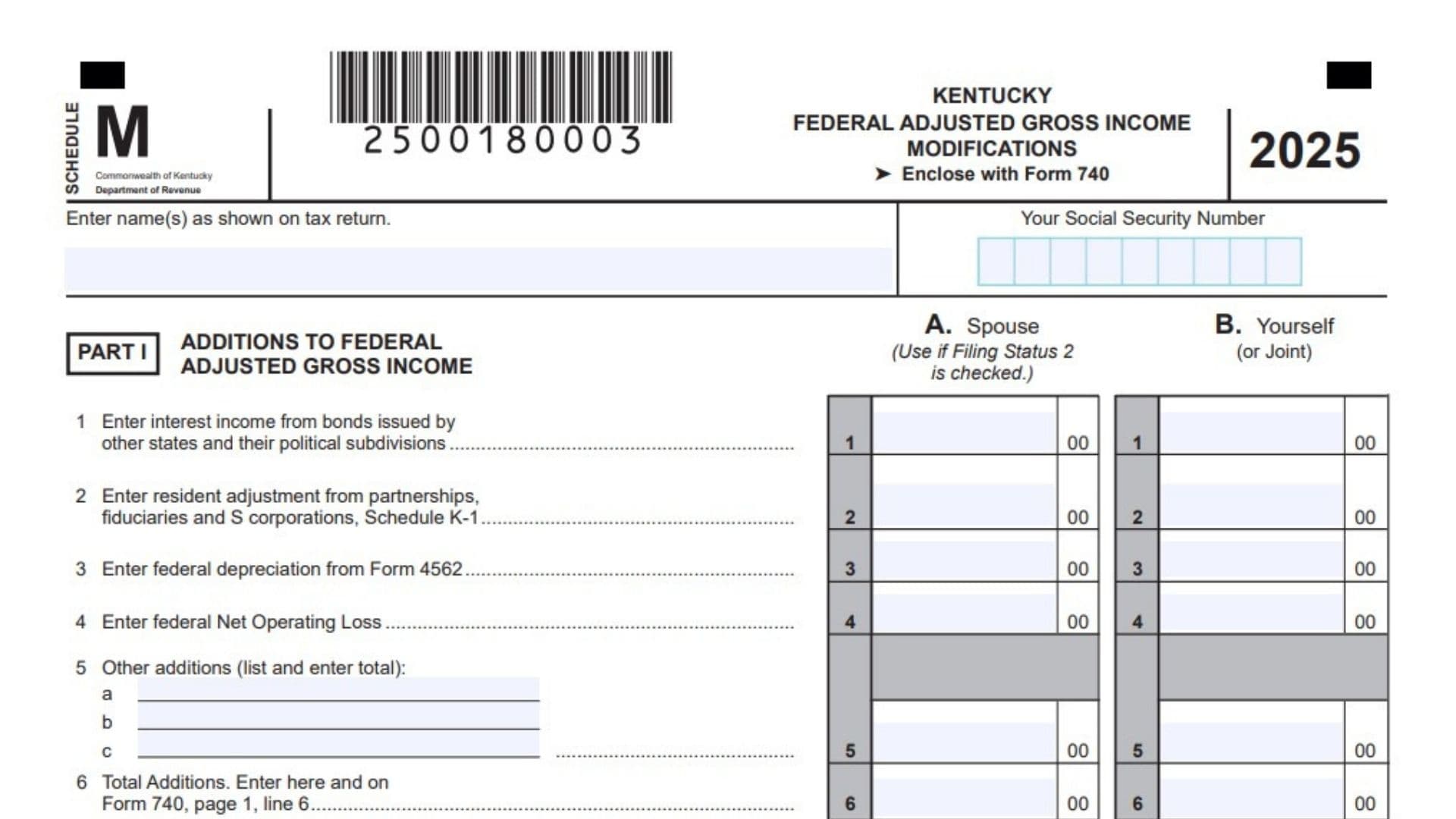
Kentucky Schedule M is the state worksheet used to adjust your federal adjusted gross income so it matches Kentucky income tax rules. It is attached to Form 740 and is used when certain items are treated differently for Kentucky purposes than they are on your federal return. In other words, Schedule M is where you add back income that Kentucky taxes even if federal treatment is different, and where you subtract income that Kentucky allows you to exclude. It also covers special Kentucky adjustments involving pension income, Social Security, military pay, depreciation differences, Section 179 deduction differences, asset disposition differences, resident adjustments from Schedule K-1, net operating loss deductions, and other state-specific additions or subtractions. If your Kentucky return requires any of these changes, Schedule M is the form that brings those adjustments together and carries the final totals to the proper lines on Form 740.
Who Needs To File Kentucky Schedule M
You generally need to file Kentucky Schedule M if your federal adjusted gross income must be changed for Kentucky tax purposes. This often applies to taxpayers with out-of-state municipal bond interest, taxable state tax refunds, U.S. government interest, pension exclusions, Social Security benefits included in federal income, military pay exclusions, depreciation and Section 179 differences, pass-through entity adjustments, or Kentucky net operating loss deductions. If none of those Kentucky-specific changes apply to you, you may not need Schedule M. But if even one of these items affects your return, complete the schedule carefully and carry the totals to the matching lines on Form 740.
How To File Kentucky Schedule M
Complete Schedule M and attach it to your Kentucky Form 740 when you file your state return. Any supporting schedules or calculations required for certain lines should also be included with the return. That can include detailed statements for other additions or other subtractions, Kentucky versions of federal forms used to calculate depreciation or gains and losses, pension exclusion calculations when needed, Schedule K-1 related information, Form 461-K for excess business loss, Form 8582-K for passive activity loss adjustments, and Schedule KNOL for a Kentucky net operating loss deduction. The key is to complete each line that applies to you, total the additions and subtractions properly, then transfer those totals to the designated lines on Form 740.
Before You Start
Before filling out Schedule M, gather your completed federal return, Form 740, and any supporting tax forms that affect Kentucky adjustments. You may need federal Form 4562, Schedule 1, Form 4797, Schedule D, Form 6198, Form 8582-K, Form 461-K, Schedule K-1, Schedule P, Form 4972-K, and Schedule KNOL depending on your situation. It also helps to separate your records into two categories, additions and subtractions, so you can complete the form in order without missing anything.

How To Complete Kentucky Schedule M
Additions To Federal Adjusted Gross Income
Line 1: Enter interest from securities issued by other states and their political subdivisions if that interest is taxable to Kentucky. Also include taxable dividends from regulated investment companies, such as mutual funds, to the extent they are taxable for Kentucky purposes. Do not include interest from Kentucky state or local securities because Kentucky exempts that income.
Line 2: Enter the resident adjustment amount from Kentucky Schedule K-1. This line applies to partners, beneficiaries of estates or trusts, and S corporation shareholders who received a Kentucky Schedule K-1 showing a resident adjustment.
Line 3: Enter total depreciation from federal Form 4562 if you claimed the 30 percent or 50 percent special depreciation allowance, or the increased Section 179 deduction, for property placed in service after September 10, 2001. This line works together with Line 12, where the Kentucky depreciation amount is reported.
Line 4: Enter the federal net operating loss that was reported on Schedule 1, Line 8 of your 2025 federal Form 1040 or 1040-SR.
Line 5: Enter any other additions to federal adjusted gross income that are not already listed on Lines 1 through 4. Attach a detailed schedule showing what makes up this amount. Items that may belong here include reservist and National Guard expenses claimed on the federal return, the portion of a lump sum distribution taxed at the 20 percent capital gains rate for federal purposes, passive activity loss adjustments, differences in pension basis or IRA basis, differences in gains or losses from certain intangible assets, differences in gains or losses from sale of depreciable property placed in service after September 10, 2001, moving expenses for certain Armed Forces members, and the Kentucky excess business loss limitation. If you are reporting an excess business loss, complete Form 461-K and enter the amount from that form. Label that addition clearly as excess business loss. Also remember that any at-risk limitation adjustments must be considered before entering a difference on this line.
Line 6: Add Lines 1 through 5. Enter the total here, then carry the same amount to Form 740, Page 1, Line 6.
Subtractions From Federal Adjusted Gross Income
Line 7: Enter any taxable state income tax refund or state tax credit that was included as income on your federal return and also included on Form 740, Page 1, Line 5.
Line 8: Enter interest income from U.S. government bonds and securities. Do not include interest from securities that are only guaranteed by the federal government, such as Fannie Mae, Ginnie Mae, or Freddie Mac obligations.
Line 9: Enter your Kentucky pension income exclusion. For 2025, the exclusion is the smaller of 100 percent of taxable retirement benefits or $31,110. This exclusion applies to each taxpayer separately. Eligible retirement income can include pensions, annuities, IRA distributions, 401(k) and similar deferred compensation plan distributions, Roth IRA conversion income, death benefits, disability retirement benefits, and similar retirement plan income paid under a written retirement plan. If you are filing jointly, each spouse must compute the exclusion separately, then combine the allowable amounts and enter the total in the proper column. If your retirement income exceeds the limit and includes qualifying government retirement income or supplemental U.S. Railroad Retirement Board benefits, complete the required pension calculation before entering the exclusion.
Line 10: Enter Social Security benefits and Social Security equivalent U.S. Railroad Retirement Board benefits that were included as income on Form 740, Page 1, Line 5. Use the amount that was taxable on your federal return.
Line 11: Enter the resident adjustment from Kentucky Schedule K-1 if you are instructed to subtract it here. This includes the distributive share of net income from an S corporation that is subject to the applicable franchise tax or capital stock tax rules. Partners, beneficiaries, and S corporation shareholders should review their Kentucky Schedule K-1 information carefully before completing this line.
Line 12: Enter Kentucky depreciation from the Kentucky version of Form 4562 if federal special depreciation or the increased Section 179 deduction created a difference between federal and Kentucky treatment. Use this line only if you claimed the 30 percent or 50 percent special depreciation allowance or the increased Section 179 deduction for qualifying property placed in service after September 10, 2001. To calculate the Kentucky amount, prepare a Kentucky version of federal Form 4562. Write Kentucky at the top and compute depreciation and Section 179 under Kentucky rules. For property placed in service from September 10, 2001 through December 31, 2019, use a Kentucky Section 179 limit of $25,000 and a phaseout amount of $200,000. For property placed in service on or after January 1, 2020, use a Kentucky Section 179 limit of $100,000 and do not apply a phaseout threshold for Kentucky depreciation purposes. If the property was placed in service between September 10, 2001 and December 31, 2019, reduce the Kentucky Section 179 deduction dollar for dollar when qualifying property costs exceed the threshold. For those same years, determine the income limitation using Kentucky net income before the Section 179 deduction, not federal taxable income. Ignore the special depreciation allowance line in Part II of the federal depreciation form when preparing the Kentucky version. Then enter the Kentucky depreciation amount from the Kentucky form on this line and include that form with your return. If no Kentucky adjustment is needed, keep records showing why.
Line 13: Enter active duty military pay that was included on Form 740, Page 1, Line 5. All military pay received while serving on active duty may be excluded if it meets the Kentucky definition of active duty.
Line 14: Enter other subtractions from federal adjusted gross income that are not listed on the previous lines. Attach a detailed schedule showing the calculation. Examples include precinct worker income for election training or work at election booths, capital gains from property taken by eminent domain, passive activity loss adjustments, income of a child reported on a parent’s return, artistic charitable contributions if you do not itemize, at-risk limitation differences, qualified farm networking project differences, certain differences in gains or losses from intangible assets, differences in gains or losses from assets purchased after September 10, 2001, and income of military personnel killed in the line of duty. If you disposed of assets placed in service after September 10, 2001 and federal depreciation rules caused a gain or loss difference, prepare Kentucky versions of the applicable federal gain or loss forms, compute the Kentucky basis, and enter the difference on the proper line. If at-risk limitations created a different allowable loss for Kentucky than for federal purposes, recompute using Kentucky amounts. For passive activities, use the Kentucky allowable loss to complete Form 8582-K. For nonpassive activities, enter the resulting difference here as an other subtraction, or on Line 5 if it is an addition.
Line 15: Enter the subtotal of subtractions before the Kentucky net operating loss deduction. This line is the total of Lines 7 through 14.
Line 16: Enter the Kentucky net operating loss deduction from Schedule KNOL, Part II, Section A, Line 8. If you are claiming this deduction, Schedule KNOL must be completed and attached. Kentucky net operating losses generated on or after January 1, 2018 are generally limited to 80 percent of Kentucky taxable income before the net operating loss deduction, with unused amounts carried forward indefinitely. If your net operating loss arose in 2025, complete Part I of Schedule KNOL to determine the amount available for future carryforward and keep a copy with your records.
Line 17: Add Lines 15 and 16. Enter the total here, then carry the same amount to Form 740, Page 1, Line 8.
Pension Exclusion Worksheet Help For Line 9
If you need help figuring the pension exclusion for Line 9, start by entering taxable pension income reported on the relevant pension or annuity lines of your federal return. Next, add any disability retirement benefits reported as wages, then add deferred compensation reported as wages. Total those amounts. If the result is $31,110 or less, that amount is your Schedule M Line 9 exclusion. If the result is more than $31,110, determine whether you have retirement income from the federal government, the Commonwealth of Kentucky, a Kentucky local government, or supplemental U.S. Railroad Retirement Board benefits. If not, your exclusion is limited to $31,110. If yes, you will need the additional Kentucky pension calculation before finalizing the amount for Line 9.
Depreciation And Asset Difference Rules
The depreciation and gain or loss rules are often the most confusing part of Schedule M, so it helps to think of them in two stages. First, if federal law gave you bonus depreciation or a larger Section 179 deduction than Kentucky allows, the federal amount goes into the additions section and the Kentucky amount goes into the subtractions section. Second, if you later sell or dispose of that same property, you may also have a different gain or loss for Kentucky because the Kentucky basis is not the same as the federal basis. In that case, prepare Kentucky versions of the relevant forms, compute the Kentucky gain or loss, and report the difference as another adjustment.
Common Filing Tips
Review each line in order before moving totals to Form 740. If a line does not apply, leave it blank rather than guessing. Attach detailed schedules whenever the form calls for them, especially for other additions and other subtractions. Keep copies of all Kentucky-specific worksheets and supporting schedules for your records. Double-check that the additions total goes to Form 740, Line 6, and the subtractions total goes to Form 740, Line 8. If you are dealing with pension income, depreciation, excess business loss, passive activity limits, or net operating loss carryforwards, take extra time to verify the calculations because those are the areas where errors are most likely.
Final Checklist
Before filing, make sure you have completed every applicable line on Schedule M, attached all required supporting forms, transferred the totals correctly to Form 740, and retained copies of any Kentucky-specific calculations. A careful review at the end can save you from notices, amended returns, and delays in processing.