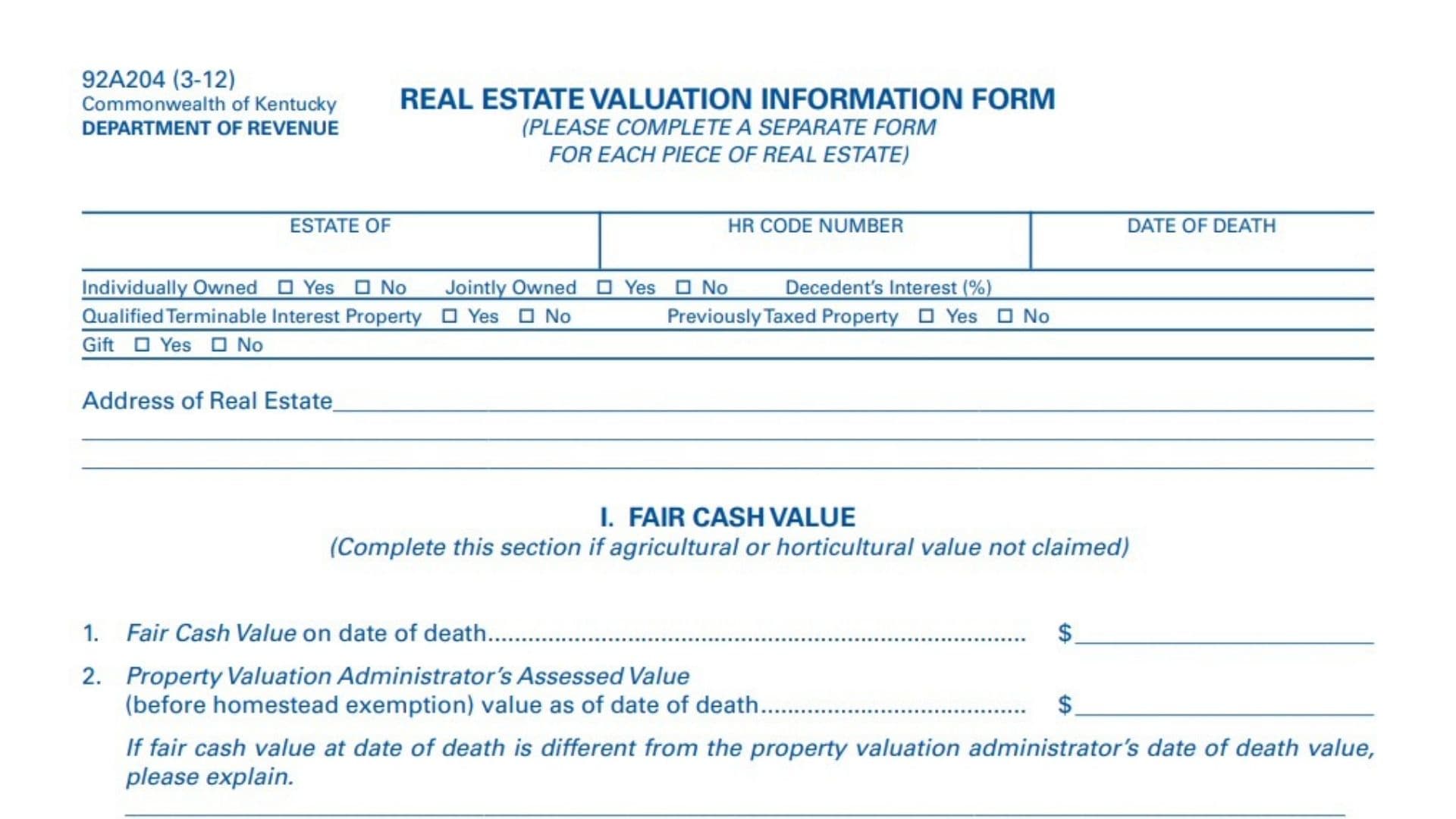
The Kentucky Real Estate Valuation Information Form, Form 92A204, provides detailed information about a parcel of real estate reported as part of a decedent’s estate for Kentucky inheritance tax purposes. A separate form must be completed for each piece or parcel of real estate, which means multiple properties cannot be combined on a single form even when they have the same owners or pass to the same beneficiaries. The form identifies the estate, the decedent’s date of death, the property’s address, the type of ownership, the percentage owned by the decedent, and whether the property is associated with qualified terminable interest property, previously taxed property, or a reportable gift. It also establishes the property’s value as of the date of death. For most property, the filer completes the fair cash value section and reports the property’s date-of-death value, the local Property Valuation Administrator’s assessed value before any homestead exemption, and the sale price when the property was bought or sold within five years. Differences among these values must be explained. A separate section is available when an election is made to report qualifying agricultural or horticultural property using its agricultural or horticultural value. That section separates the value of the land from the value of any residence located on it and asks for information about the number and type of acres. When the special agricultural or horticultural value is claimed, the filer must also provide a legal description of the land and the names and addresses of all heirs receiving the agricultural property. Because the information reported on this form affects the estate’s gross value, beneficiary distributions, and potential inheritance tax, the estate should use reliable valuation records and report the ownership arrangement accurately.
Who Should Complete This Form?
Complete this form when real estate must be reported as part of a Kentucky inheritance tax filing.
Prepare a separate form for each:
- House or residential parcel.
- Farm.
- Commercial building.
- Vacant lot.
- Rental property.
- Timber property.
- Agricultural or horticultural tract.
- Partial interest in real estate.
- Jointly owned parcel.
- Parcel reported as qualified terminable interest property.
- Parcel reported as previously taxed property.
- Parcel connected with a taxable gift or transfer.
Do not combine separate parcels on one form merely because they are next to each other. When properties have separate deeds, parcel numbers, legal descriptions, tax bills, or valuation records, prepare a separate form for each parcel unless the Department of Revenue directs otherwise.
How To File The Kentucky Real Estate Valuation Information Form
Complete the form after collecting ownership and valuation information for the property. Attach it to the Kentucky inheritance tax return on which the real estate is reported.
Before completing the form, gather:
- The decedent’s full legal name.
- The decedent’s date of death.
- The estate’s HR code number, when available.
- The property’s complete street address.
- The property’s legal description.
- The deed or other ownership document.
- The decedent’s ownership percentage.
- The names of any joint owners.
- The date-of-death property tax assessment.
- The Property Valuation Administrator’s assessment.
- A real estate appraisal, when available.
- Records of a sale or purchase within five years.
- Agricultural or horticultural assessment records, when applicable.
- Acreage information.
- The names and addresses of heirs receiving agricultural property.
Use a supported value as of the decedent’s date of death. Keep appraisals, comparable-sales information, tax assessments, deeds, closing statements, and other valuation records with the estate’s files.
When agricultural or horticultural value is claimed, attach the property’s legal description and a list of every heir receiving an interest in the agricultural property. Include each heir’s full name and mailing address.
Review the completed form for consistency with the inheritance tax return. The value reported for the parcel should agree with the amount included on the applicable estate property schedule.

How To Complete The Kentucky Real Estate Valuation Information Form
Form Identification
Line 1: Separate Form For Each Piece Of Real Estate: Complete one form for each individual parcel. Do not list several unrelated properties on the same form.
A parcel may generally be treated as separate when it has its own deed, legal description, tax parcel number, assessment, or address.
Estate Information
Line 2: Estate Of: Enter the decedent’s complete legal name.
Use the same name reported on the Kentucky inheritance tax return. Include the first name, middle name or initial, last name, and suffix when applicable.
Line 3: HR Code Number: Enter the estate’s Kentucky HR code number when it has been assigned.
The HR code may appear on correspondence from the Kentucky Department of Revenue. Leave the space blank when the number is not known or has not been assigned.
Line 4: Date Of Death: Enter the decedent’s complete date of death.
Use the month, day, and year shown on the death certificate and inheritance tax return.
Ownership Classification
Complete every ownership question by checking either “Yes” or “No.” Do not leave the ownership classification uncertain.
Line 5: Individually Owned, Yes Or No: Check “Yes” when the decedent owned the property alone.
Check “No” when another person or entity held an ownership interest in the property.
When “Yes” is selected, the decedent’s interest will generally be 100 percent unless another legal interest limits the decedent’s ownership.
Line 6: Jointly Owned, Yes Or No: Check “Yes” when the decedent owned the property with one or more other people or entities.
Check “No” when the property was not jointly owned.
Review the deed to determine whether the ownership was held as joint tenants, tenants in common, tenants by the entirety, or under another arrangement. The related inheritance tax return may require additional information about the co-owners and survivorship rights.
Line 7: Decedent’s Interest Percentage: Enter the percentage of the property owned by the decedent.
Examples include:
- Enter 100% when the decedent owned the entire parcel.
- Enter 50% when the decedent owned one-half.
- Enter 33.33% when the decedent owned one-third.
- Enter 25% when the decedent owned one-fourth.
Use the deed, purchase records, contribution records, court orders, or other ownership documents to support the percentage.
Do not automatically assume that the decedent owned one-half merely because two names appear on the deed. Determine the legal and beneficial ownership interest that must be reported for Kentucky inheritance tax purposes.
Special Property Classifications
Line 8: Qualified Terminable Interest Property, Yes Or No: Check “Yes” when the parcel is included because it is qualified terminable interest property associated with a prior spousal election.
Check “No” when the property is not being reported under that classification.
When “Yes” is checked, make sure the parcel is also reported in the appropriate qualified terminable interest property section of the inheritance tax return.
Line 9: Previously Taxed Property, Yes Or No: Check “Yes” when the parcel qualifies as previously taxed property received from a prior decedent and is being reported under the applicable previously taxed property provisions.
Check “No” when the property is not claimed as previously taxed property.
When “Yes” is selected, retain documentation showing:
- The prior decedent’s name.
- The prior decedent’s date of death.
- How the present decedent received the property.
- The Kentucky inheritance tax previously paid.
- The connection between the property reported now and the property taxed in the prior estate.
Line 10: Gift, Yes Or No: Check “Yes” when the real estate is connected with a gift or transfer that must be included in the decedent’s estate.
Check “No” when the property was not a reportable gift or transfer.
A “Yes” response may apply when the decedent transferred the property before death but the transfer remains reportable, such as a transfer involving a retained life interest or another taxable arrangement. Make sure the property is also entered in the appropriate gift or transfer section of the inheritance tax return.
Property Address
Line 11: Address Of Real Estate: Enter the property’s complete physical address.
Include:
- Street number.
- Street name.
- Apartment, unit, or building number.
- City.
- State.
- ZIP code.
- County, when useful for identification.
For rural property without a standard street address, provide the road name, route number, county, nearby landmark, parcel number, or another clear location.
For vacant property, provide the parcel address or location used by the local Property Valuation Administrator.
Line 12: Additional Address Line: Use the second line to continue a long address or add identifying information.
This line may include the county, subdivision, lot number, parcel identification number, farm name, or a brief legal description.
Line 13: Additional Property Identification Line: Use the third line for any remaining location details needed to identify the parcel.
Do not use these address lines as a replacement for the full legal description required when agricultural or horticultural value is claimed.
Section I, Fair Cash Value Instructions
Complete Section I when the estate is not electing to report the property at an agricultural or horticultural value.
This section compares the estate’s fair cash value with the local assessment and any recent sale price. Differences should be clearly explained.
Fair Cash Value Line
Line 14: Fair Cash Value On Date Of Death: Enter the property’s fair cash value as of the decedent’s date of death.
The value should represent the property’s supported market value on that specific date. Do not use the value on the filing date, appraisal date, distribution date, or current date unless it accurately establishes the date-of-death value.
Evidence supporting the amount may include:
- A qualified appraisal.
- Comparable property sales.
- A broker’s valuation.
- A recent arm’s-length sale.
- Local assessment information.
- Income and expense information for rental property.
- Business records for commercial property.
- Court-approved valuation information.
When the decedent owned less than the entire property, enter the value required by this form and report the decedent’s percentage separately in the ownership section. Coordinate the final amount with the property schedule on the inheritance tax return.
Property Valuation Administrator Assessment
Line 15: Property Valuation Administrator’s Assessed Value: Enter the local Property Valuation Administrator’s assessed value as of the decedent’s date of death.
Use the assessed value before applying a homestead exemption.
The amount may be obtained from:
- The property tax bill.
- The county assessment record.
- The Property Valuation Administrator’s office.
- An online county property record.
- A certified assessment statement.
Do not reduce the amount by a homestead exemption, disability exemption, or similar assessment reduction.
Line 16: Assessment Date Requirement: Confirm that the assessment relates to the date of death.
When the available assessment is for a different year, obtain information showing the assessment that applied on or nearest to the date of death and explain any necessary adjustment.
Explanation Of Difference From Assessed Value
Line 17: Explanation When Fair Cash Value Differs From Assessed Value: Complete the explanation area when the fair cash value entered on Line 14 differs from the Property Valuation Administrator’s assessed value entered on Line 15.
State the reason for the difference clearly.
Possible explanations include:
- A professional appraisal established a different date-of-death value.
- The assessment had not been updated after construction or renovation.
- The property was in poor condition.
- The property suffered fire, storm, flood, or structural damage.
- The assessed value did not reflect a recent arm’s-length sale.
- The property included unusual restrictions or easements.
- The assessment included or omitted improvements.
- The property had environmental or access problems.
- The value was based on income-producing use.
- The property contained multiple ownership interests.
Line 18: First Explanation Line: Briefly describe why the fair cash value differs from the assessment.
Include the date and type of valuation evidence when possible.
Line 19: Second Explanation Line: Continue the explanation when more space is needed.
Attach a separate statement when the available space is insufficient. Label the statement with the estate name, property address, and the line being explained.
Recent Sale Or Purchase Price
Line 20: Sale Price If Sold Or Purchased Within Five Years: Enter the property’s sale or purchase price when the parcel was sold or purchased during the five-year period relevant to the form.
Use the actual transaction price shown on the deed, closing statement, settlement statement, contract, or other reliable record.
This line may apply when:
- The decedent purchased the property within five years.
- The decedent sold or contracted to sell the property before death.
- The estate sold the property after death within the relevant period.
- Another transaction involving the parcel provides useful valuation evidence.
When no sale or purchase occurred within the applicable five-year period, enter “N/A,” “None,” or leave the field blank as appropriate.
Do not enter the outstanding mortgage balance as the sale price.
Explanation Of Difference From Sale Price
Line 21: Explanation When Fair Cash Value Differs From Sale Price: Complete the explanation area when the date-of-death fair cash value differs from the recent sale or purchase price.
A difference does not automatically mean the reported value is incorrect, but the estate must explain why the transaction price does not equal the date-of-death value.
Possible explanations include:
- The sale occurred several years before death.
- Market conditions changed.
- The property was improved after purchase.
- The property deteriorated after purchase.
- The transaction was not conducted at arm’s length.
- The sale involved relatives.
- The price included personal property.
- The transaction covered more than one parcel.
- The estate sold the property under time pressure.
- The property was sold subject to unusual restrictions.
- The condition of the property changed between the valuation date and sale date.
Line 22: First Sale Price Explanation Line: Explain the main reason for the difference.
Identify the sale date, valuation date, and any major change in the property or market.
Line 23: Second Sale Price Explanation Line: Continue the explanation or identify attached supporting documents.
Attach additional pages when necessary.
Section II, Agricultural Or Horticultural Value Instructions
Complete Section II only when the estate makes an election to report qualifying real estate at its agricultural or horticultural value.
Do not complete Section I as the primary valuation section when the special agricultural or horticultural election is being used, unless additional information is required for comparison or the Department of Revenue requests it.
The form notes that the election is advantageous only when the property passes to a son-in-law or daughter-in-law. Review the beneficiary and tax consequences before making the election.
Agricultural Or Horticultural Assessment
Line A: Agricultural Or Horticultural Assessment Of The Land: Enter the local Property Valuation Administrator’s agricultural or horticultural assessment of the land as of the decedent’s date of death.
This amount should cover the land itself and should not include the separately valued residence.
Obtain a record from the local Property Valuation Administrator that clearly identifies:
- The parcel.
- The date or assessment year.
- The acreage.
- The agricultural or horticultural assessment.
- The assessed property classification.
Residence Assessment
Line B: Fair Cash Value Assessment Of The Residence: Enter the local Property Valuation Administrator’s fair cash value assessment of the residence located on the land as of the date of death.
Report only the residence portion on this line. Do not include the agricultural land value again.
When more than one residence or residential improvement is located on the parcel, obtain sufficient information to identify what is included in the assessment.
Agricultural Or Horticultural Value Of Land
Line C: Agricultural Or Horticultural Value Of Land Only: Enter the agricultural or horticultural value of the land as of the date of death.
Do not include the fair cash value of the residence on this line.
Support the amount with the local assessment, appraisal information, land-use records, soil and acreage information, or other documents used to establish the special value.
Fair Cash Value Of Residence
Line D: Fair Cash Value Of Residence: Enter the fair cash value of the residence located on the property as of the decedent’s date of death.
The special agricultural or horticultural valuation generally applies to the qualifying land, not to the residence. Therefore, report the residence separately at fair cash value.
Use an appraisal, assessment, comparable sales, or other reliable information to support the residential value.
Combined Agricultural Property Value
Line E: Total Of Lines C And D: Add the agricultural or horticultural value of the land from Line C to the fair cash value of the residence from Line D.
Use this calculation:
Line C + Line D = Line E
Enter the result on Line E.
The Line E total should be consistent with the amount reported for the parcel on the related inheritance tax return when the agricultural or horticultural election applies.
General Information Section
Complete the acreage and location fields when reporting agricultural or horticultural property. Use reliable land records, surveys, deeds, assessments, or agricultural program documents.
Acreage Classification
Line 24: Crop Or Tillable Land, Number Of Acres: Enter the number of acres that can be used for crops or regular cultivation.
Include land used or suitable for planting, plowing, harvesting, orchards, or other qualifying agricultural production when appropriate.
Do not include the same acreage in another category.
Line 25: Pasture Or Nontillable Land, Number Of Acres: Enter the number of acres used as pasture or classified as nontillable agricultural land.
This may include grazing land, steep agricultural ground, or other land that is used agriculturally but is not normally cultivated.
Line 26: Woodland, Number Of Acres: Enter the number of acres covered by woods or timber.
Use assessment records, surveys, forestry records, or other reliable information to determine the acreage.
Line 27: Wasteland, Number Of Acres: Enter the number of acres that are not suitable for ordinary crop, pasture, residential, or woodland use.
This may include unusable areas, drainage areas, severely eroded land, rocky ground, or other acreage classified as wasteland.
Use the classification recognized by the local property records when available.
Property Location And Total Acreage
Line 28: Distance From Nearest Town: Enter the approximate distance from the property to the nearest town.
State the distance in miles. Identify the town when space permits or include it on an attached statement.
Example:
“6 miles northeast of Frankfort”
Line 29: Total Acres: Enter the parcel’s complete acreage.
The total should generally equal the combined acreage entered for:
- Crop or tillable land.
- Pasture or nontillable land.
- Woodland.
- Wasteland.
- Any other separately identified acreage.
Review the deed, survey, tax record, and acreage classifications when the figures do not agree.
Required Agricultural Valuation Attachments
Legal Description Of The Land
Line 30: Legal Description Requirement: Submit a legal description of the land when agricultural or horticultural value is claimed.
The legal description is needed for recording the tax lien required in connection with the special valuation.
A property’s mailing address is not a substitute for its legal description.
The legal description may be obtained from:
- The recorded deed.
- A survey.
- A property description document.
- County land records.
- A title report.
- An attorney’s title examination.
The attachment should clearly identify the same parcel reported on the form.
Heirs Receiving Agricultural Property
Line 31: Names Of Heirs: Submit the full legal name of every heir who receives agricultural property when agricultural or horticultural value is claimed.
Include recipients who receive:
- The entire property.
- A fractional interest.
- A remainder interest.
- An interest through a trust.
- An interest through a will.
- An interest under intestate succession.
- An interest through another qualifying transfer.
Line 32: Addresses Of Heirs: Provide the complete mailing address of each heir receiving the agricultural property.
Include:
- Street number and street name.
- Apartment or unit number.
- City.
- State.
- ZIP code.
Clearly connect each heir with the interest received when several heirs share the property.
How To Report Different Ownership Situations
Individually Owned Property
When the decedent owned the entire parcel alone:
- Check “Yes” for Individually Owned.
- Check “No” for Jointly Owned.
- Enter 100% as the decedent’s interest.
- Report the entire applicable value on the estate’s property schedule.
Jointly Owned Property
When the decedent owned the parcel with another person:
- Check “No” for Individually Owned.
- Check “Yes” for Jointly Owned.
- Enter the decedent’s ownership percentage.
- Retain the deed and records supporting that percentage.
- Report the full parcel value and the taxable value of the decedent’s interest as required by the related inheritance tax return.
Property With Several Co-Owners
When more than two people owned the property, calculate the decedent’s actual share.
For example, if four owners held equal interests, the decedent’s interest may be 25 percent. If ownership was unequal, use the percentages established by the deed or other legal documents.
Property Transferred Before Death
When the decedent transferred the property before death but retained a reportable interest:
- Check the appropriate ownership box based on the legal arrangement.
- Enter the decedent’s reportable percentage or interest.
- Check “Yes” for Gift when the property is included as a gift or transfer.
- Coordinate the value with the gift and transfer schedule of the inheritance tax return.
Previously Taxed Real Estate
When the property was received from a prior decedent and qualifies for previously taxed property treatment:
- Check “Yes” for Previously Taxed Property.
- Report the date-of-death value.
- Keep records of the prior estate and tax payment.
- Report the parcel on the previously taxed property schedule.
- Do not duplicate the same property on another estate schedule.
Qualified Terminable Interest Property
When the parcel is included because of a prior qualified terminable interest property election:
- Check “Yes” for Qualified Terminable Interest Property.
- Enter the parcel’s value on the present decedent’s date of death.
- Report it on the corresponding qualified terminable interest property schedule.
- Retain the prior election and trust or estate documents.
Supporting Valuation Records
Keep the following records when they apply:
- Real estate appraisal.
- Property tax assessment.
- Property Valuation Administrator statement.
- Recorded deed.
- Legal description.
- Survey.
- Parcel map.
- Sale contract.
- Closing or settlement statement.
- Comparable-sales analysis.
- Repair estimates.
- Photographs showing the property’s condition.
- Rental income and expense statements.
- Agricultural assessment.
- Farm-use documentation.
- Acreage classification records.
- Trust or will provisions.
- Prior estate tax records.
- Gift or transfer documents.
The form may be brief, but the estate should be able to explain and support every reported value.
Final Review Checklist
Before submitting the Kentucky Real Estate Valuation Information Form, confirm that:
- A separate form has been prepared for each parcel.
- The estate name matches the inheritance tax return.
- The HR code number is entered when known.
- The date of death is correct.
- Every ownership question is answered.
- The decedent’s ownership percentage is entered.
- The qualified terminable interest property question is answered.
- The previously taxed property question is answered.
- The gift question is answered.
- The property address and identifying information are complete.
- Section I is completed when agricultural or horticultural value is not claimed.
- The fair cash value is based on the date of death.
- The Property Valuation Administrator’s value is entered before any homestead exemption.
- Differences between fair cash value and assessed value are explained.
- A recent sale or purchase price is entered when applicable.
- Differences between fair cash value and sale price are explained.
- Section II is completed when the agricultural or horticultural election is made.
- Lines C and D have been correctly added on Line E.
- Acreage classifications are complete.
- The total acreage agrees with the property records.
- The distance from the nearest town is entered.
- A legal description is attached when agricultural or horticultural value is claimed.
- The names and addresses of all heirs receiving agricultural property are attached.
- The parcel value agrees with the related inheritance tax return.
- All valuation and ownership records are retained with the estate’s files.