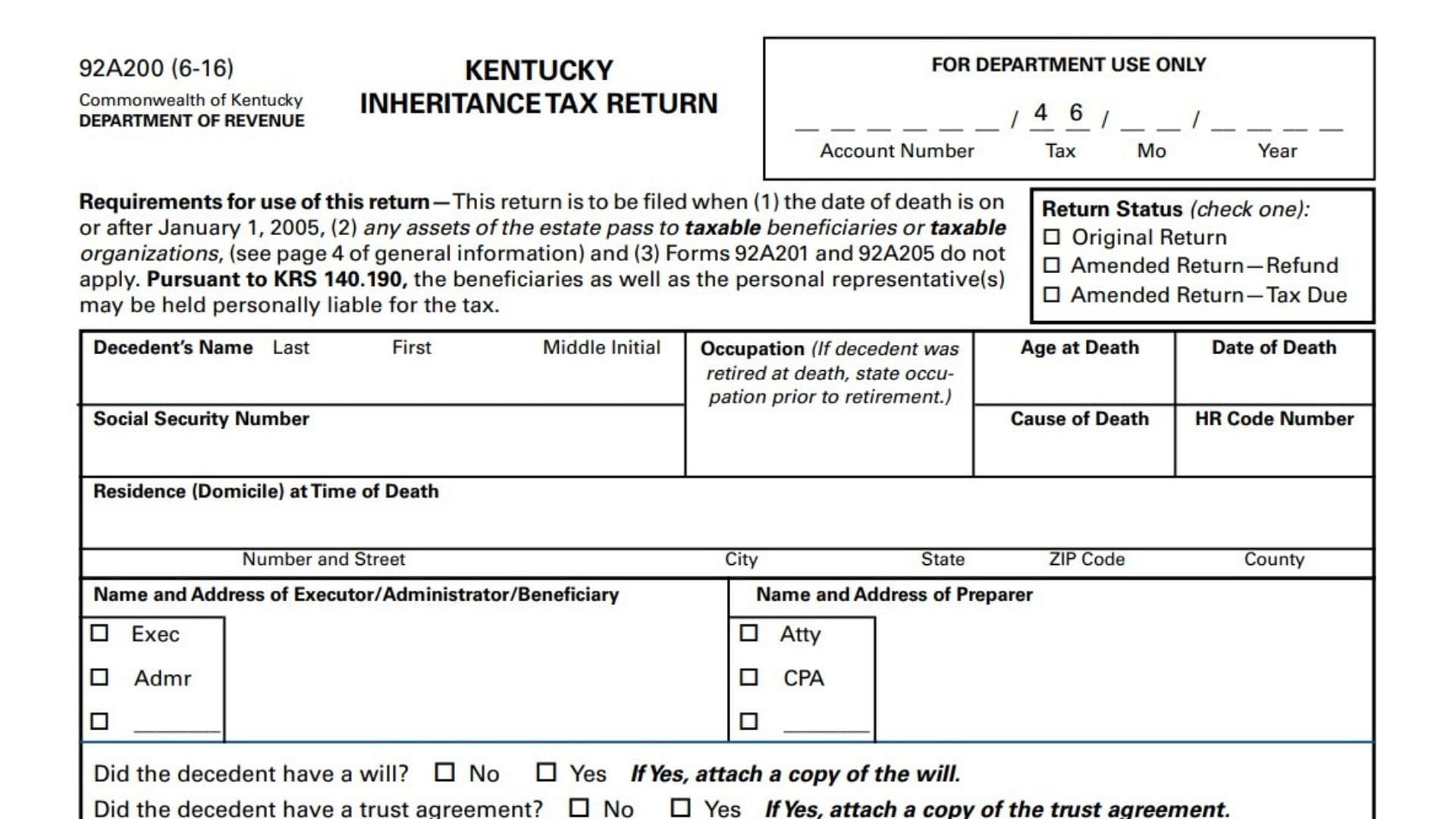
The Kentucky Inheritance Tax Return, Form 92A200, is used to report an estate’s property, deductions, beneficiaries, and Kentucky inheritance tax liability after a person dies. This return generally applies when the decedent died on or after January 1, 2005, at least one estate asset passes to a taxable beneficiary or taxable organization, and the estate does not qualify to use Form 92A201 or Form 92A205. The return collects identifying information about the decedent, the estate representative, and the return preparer. It also asks whether the decedent left a will or trust and whether a federal estate and gift tax return was required or filed for portability. The financial portion begins with the estate’s individually owned property, jointly owned property, qualified terminable interest property, powers of appointment, previously taxed property, and taxable gifts or transfers. The estate may then claim qualifying funeral expenses, administration expenses, debts, and a proportionate deduction for federal estate tax. Separate schedules provide space to identify each asset, debt, expense, beneficiary, and taxable transfer. After the net estate has been calculated, the tax computation schedule allocates property among heirs and beneficiaries, applies the appropriate inheritance tax treatment, and determines the total tax due. Interest and penalties must be added when applicable, while previous payments and available discounts are subtracted. The executor, administrator, beneficiary, or other responsible filer signs the return under criminal penalties and confirms that the information and attachments are accurate and complete. Beneficiaries and personal representatives may be held personally responsible for unpaid inheritance tax, so the return should be completed carefully and supported with wills, trust documents, financial statements, appraisals, receipts, federal filings, and other relevant records.
Who Should File The Kentucky Inheritance Tax Return?
Use Form 92A200 when all of the following conditions apply:
- The decedent’s date of death was January 1, 2005, or later.
- At least one estate asset passes to a taxable beneficiary or taxable organization.
- The estate is not eligible to use Form 92A201 or Form 92A205.
The return may be prepared and filed by the executor, administrator, beneficiary, attorney, certified public accountant, or another authorized person. Before filing, confirm that this form edition and its filing procedures are still accepted and that no later rules, rates, exemptions, mailing instructions, or required attachments apply.
How To File The Kentucky Inheritance Tax Return
Complete the supporting schedules before finishing the first page. The schedules calculate the amounts for individually owned assets, jointly owned assets, qualified terminable interest property, previously taxed property, gifts, funeral costs, administration costs, debts, federal estate tax, and beneficiary distributions.
Transfer each schedule total to the corresponding line on the first page. Complete the tax computation schedule after the estate’s net value and each beneficiary’s distributive share are known. Transfer the total tax from that schedule to the first page, calculate any interest and penalties, subtract previous payments, and determine the final balance due or refund.
Attach all required supporting documents. Depending on the estate, these may include:
- A copy of the will.
- A copy of the trust agreement.
- A copy of the Federal Estate and Gift Tax Return.
- Deeds or trust instruments involving reportable gifts and transfers.
- Financial institution statements.
- Stock and bond valuation records.
- Business balance sheets and earnings statements.
- Appraisals.
- Funeral and administration expense records.
- Receipts, invoices, bills, mortgage records, and tax statements.
- Continuation pages for schedules that require additional space.
Sign and date the return. A paid preparer should also complete and sign the preparer section. Make a check payable to “Kentucky State Treasurer,” attach it to the return, and mail the filing to:
Kentucky Department of Revenue
Frankfort, KY 40620
Keep a complete copy of the signed return, schedules, attachments, and proof of payment with the estate’s records.

How To Complete The Kentucky Inheritance Tax Return
Department Use And Return Status
Department Use Only: Leave the account number, tax code, month, and year boxes blank. These spaces are reserved for the Kentucky Department of Revenue.
Return Status: Select only one return status.
Original Return: Check this box when filing the estate’s first Form 92A200.
Amended Return, Refund: Check this box when correcting a previously filed return and requesting a refund or reduction of tax.
Amended Return, Tax Due: Check this box when correcting a previously filed return and reporting additional tax.
Decedent Information
Decedent’s Name, Last: Enter the decedent’s legal last name.
Decedent’s Name, First: Enter the decedent’s legal first name.
Middle Initial: Enter the decedent’s middle initial, when applicable.
Occupation: State the decedent’s occupation. If the decedent was retired at death, enter the occupation held before retirement.
Age At Death: Enter the decedent’s age on the date of death.
Date Of Death: Enter the complete date on which the decedent died.
Social Security Number: Enter the decedent’s Social Security number.
Cause Of Death: State the reported cause of death.
HR Code Number: Enter the applicable HR code number if one has been assigned or is available for the estate.
Residence At Time Of Death
Residence Or Domicile At Time Of Death: Enter the decedent’s permanent legal residence when the death occurred. Domicile generally means the place the decedent considered a permanent home.
Number And Street: Enter the street number and street name of the decedent’s residence.
City: Enter the city of residence.
State: Enter the state of residence.
ZIP Code: Enter the ZIP code.
County: Enter the county in which the decedent was domiciled.
Estate Representative Information
Name And Address Of Executor, Administrator, Or Beneficiary: Enter the full name and mailing address of the person responsible for filing or handling the return.
Executor Checkbox: Check “Exec” when the filer is the court-appointed executor under the decedent’s will.
Administrator Checkbox: Check “Admr” when the filer is the court-appointed administrator of an intestate estate or another estate without an acting executor.
Other Capacity Checkbox: Check the blank option and identify the filer’s capacity when the person is acting in another role, such as a beneficiary.
Preparer Information
Name And Address Of Preparer: Enter the full name and business mailing address of the person who prepared the return.
Attorney Checkbox: Check “Atty” when the preparer is acting as an attorney.
Certified Public Accountant Checkbox: Check “CPA” when the preparer is a certified public accountant.
Other Preparer Checkbox: Check the blank option and state the preparer’s professional capacity when neither of the listed choices applies.
Will, Trust, And Federal Filing Questions
Did The Decedent Have A Will?: Check “Yes” or “No.” If “Yes” is selected, attach a complete copy of the will and any relevant codicils.
Did The Decedent Have A Trust Agreement?: Check “Yes” or “No.” If “Yes” is selected, attach a complete copy of the trust agreement and any relevant amendments.
Federal Estate And Gift Tax Return, Not Required: Select this option when the estate was not required to file a federal estate and gift tax return and did not file one for portability.
Federal Estate And Gift Tax Return, Required: Select this option when a federal return was required. Enclose a copy with the Kentucky return.
Federal Estate And Gift Tax Return, Not Required But Filed For Portability: Select this option when the federal return was not otherwise required but was filed to preserve portability. Enclose a copy.
Gross Estate Lines
Line-By-Line Gross Estate Instructions
Line 1: Individually Owned Assets: Enter the total fair cash value of property owned solely by the decedent. Use the total from the Individually Owned Assets schedule. Include applicable real estate, financial accounts, securities, business interests, personal property, debts owed to the decedent, taxable annuities, and life insurance payable to the estate.
Line 2: Jointly Owned Assets: Enter the taxable value of the decedent’s interest in jointly owned property. Transfer the amount from the Jointly Owned Assets schedule, not necessarily the full value of every jointly owned asset.
Line 3: Qualified Terminable Interest Property And Powers Of Appointment: Enter the total date-of-death value of reportable qualified terminable interest property and property subject to a general power of appointment. Use the total from the applicable schedule.
Line 4: Previously Taxed Property: Enter the date-of-death value of qualifying property that was taxed in a prior Kentucky estate when the prior decedent died within five years of the present decedent. Use the Previously Taxed Property schedule.
Line 5: Gifts And Transfers: Enter the total value of taxable gifts and transfers, including applicable transfers made within three years before death and transfers in which the decedent retained a life interest, income interest, or certain powers.
Total Gross Estate: Add Lines 1 through 5. Enter the combined value of all reportable gross estate property.
Deduction Lines
Line-By-Line Deduction Instructions
Line 6: Funeral Expenses: Enter qualifying funeral, monument, cemetery lot, cemetery maintenance, and related expenses that were actually paid and not reimbursed. Use the total from the Funeral Expenses schedule. The deductible funeral expense total shown on this form may not exceed $5,000.
Line 7: Administration Expenses: Enter administration expenses that were actually allowed and paid, including qualifying executor or administrator commissions, attorney fees, appraisal fees, and other estate administration costs. Use the Administration Expenses schedule.
Line 8: Debts Of Decedent: Enter the total deductible debts, taxes, mortgages, and liens paid by the personal representative. Use the Debts of Decedent schedule and retain supporting records.
Line 9: Federal Estate Tax: Check whether the federal estate tax amount is paid or estimated. Enter the allowable proportionate federal estate tax deduction calculated for Kentucky purposes.
Total Deductions: Add Lines 6 through 9 and enter the result.
Net Estate: Subtract Total Deductions from Total Gross Estate. This amount should agree with the total distributive shares reported on the tax computation schedule.
Total Tax Due From Tax Computation Form 92A200: Transfer the final tax amount from the Tax Computation Schedule.
Interest, Penalty, Payment, And Refund Lines
Line-By-Line Interest And Penalty Instructions
Line 10: Interest For Late Payment: Enter the interest due when inheritance tax was not paid by the applicable payment deadline. Calculate the amount using the rate and period required for the estate.
Line 11: Late Filing Penalty: Enter the applicable penalty when the return was filed after its required filing date.
Line 12: Late Payment Penalty: Enter the applicable penalty when tax was not paid by the required payment date.
Line 13: Total Due: Add the inheritance tax, late-payment interest, late-filing penalty, and late-payment penalty. Enter the combined amount.
Line 14: Total Previously Paid: Enter all inheritance tax payments previously made for the estate, including payments submitted with an earlier return or estimated payment.
Line 15: Balance Due Or Refund: Subtract Line 14 from Line 13. If Line 13 is larger, the result is the balance due. If Line 14 is larger, the difference is the refund amount requested.
Payment And Signature Section
Payment Check: Make the check payable to “Kentucky State Treasurer.” Attach it securely to the return.
Declaration: Review the return and all accompanying documents before signing. The signer is declaring under criminal penalties that the filing is true, correct, and complete to the best of that person’s knowledge and belief.
Signature Of Executor, Administrator, Or Beneficiary: The person responsible for the return must sign here.
Social Security Number Of Signer: Enter the Social Security number of the executor, administrator, beneficiary, or other signing individual.
Date: Enter the date on which the return is signed.
Telephone Number: Enter a daytime telephone number, including area code.
Email Address Of Executor, Administrator, Or Beneficiary: Enter an email address at which the estate representative can be contacted.
Signature Of Preparer: The person who prepared the return should sign this line when someone other than the estate representative prepared it.
Preparer Date: Enter the date the preparer signs the return.
Preparer Telephone Number: Enter the preparer’s telephone number, including area code.
Preparer Email Address: Enter the preparer’s email address.
Individually Owned Assets Schedule Instructions
Use this schedule to list every reportable asset owned solely by the decedent. Complete additional copies when the available space is insufficient.
Schedule Fields
Schedule Line 1: Estate Of: Enter the decedent’s full legal name.
Schedule Line 2: Page Number: Enter the current schedule page number and the total number of Individually Owned Assets pages.
Schedule Line 3: Item Number: Assign a separate number to each asset or group of substantially identical assets.
Schedule Line 4: Description Of Property: Describe the property clearly enough to identify it. For securities, provide the corporation or issuer. For a debt, note, or account, provide the bank, obligor, or debtor.
Schedule Line 5: Accrued Rents, Interest, Or Dividends: Enter income earned or declared before death but unpaid on the date of death.
Schedule Line 6: Number Of Shares: Enter the number of shares for stocks, mutual funds, or other share-based investments.
Schedule Line 7: Fair Cash Value On Date Of Death: Enter the property’s fair cash value as of the decedent’s date of death.
Schedule Line 8: Total Including Continuation Pages: Add the fair cash values from this schedule and every continuation page.
Schedule Line 9: Transfer To Page 1: Enter the total on Page 1, Line 1.
Schedule Line 10: Additional Space: Duplicate the schedule when additional entries are needed. Carry the total from all continuation pages into the schedule total.
What To Report As Individually Owned Assets
Real Property: List all real estate owned solely by the decedent. Agricultural or horticultural land may require a special valuation method, so determine whether fair cash value or an authorized agricultural valuation applies.
Publicly Traded Stocks: Value publicly traded stock by averaging its quoted high and low selling prices on the date of death.
Closely Held Or Inactive Stock: Explain the valuation method used. Include a balance sheet prepared near the date of death and statements showing net earnings and dividends for the five years immediately preceding death.
Dividends: Include dividends declared and recorded in the decedent’s name but not paid before death. Attach statements or similar records supporting the amount.
Bonds: Report individually owned bonds, including United States bonds and United States bonds payable on death to another person. Identify the series, maturity value, and purchase date.
Securities Without A Sale On The Date Of Death: When no sale occurred on the date of death, determine value using information from the last working day before death and the first working day after death. Average the applicable high and low market quotations.
Mortgages, Notes, And Cash: List all individually owned cash, mortgages, and notes. Include interest accrued through the date of death.
Mortgage And Note Descriptions: State the interest rate, the date of the last interest payment before death, and the due date.
Out-Of-State Accounts: When an account is maintained outside Kentucky, provide the financial institution’s name and address.
Life Insurance Payable To The Estate: Include life insurance payable to the insured or the decedent’s estate.
Life Insurance Payable To A Named Beneficiary: Do not include life insurance payable directly to a designated beneficiary, testamentary trustee, or lifetime trust trustee when it qualifies as tax-free under the stated rule.
Business And Partnership Interests: Report ownership interests in businesses and partnerships. Attach a balance sheet showing capital accounts.
Claims And Amounts Owed To The Decedent: Include enforceable debts, claims, judgments, and other amounts payable to the decedent. Exclude wrongful death claims addressed under KRS 411.130.
Other Rights And Interests: Report royalties, leaseholds, contracts, trust fund shares, and similar property rights.
Household And Personal Property: Include household goods, personal effects, antiques, jewelry, collections, automobiles, and other valuable tangible property.
Farm Property: Include farm products, growing crops, livestock, farm machinery, and other individually owned agricultural property.
Qualified Employee Annuity Payments: Certain payments to a beneficiary of a deceased employee may be taxable only in the proportion that the decedent’s contributions bear to total contributions. Review the plan records to establish the taxable portion.
Retired Serviceman’s Family Protection Plan Or Survivor Benefit Plan: Proceeds from these plans are treated as exempt under the rule referenced by the form.
Individual Retirement Accounts And Annuities: Determine the treatment of individual retirement accounts and annuities under the applicable Kentucky provisions. A lump-sum IRA distribution is treated as taxable for purposes of these instructions.
Other Annuities And Deferred Compensation: Report the full value when the decedent retained ownership rights at death, such as the right to name or change the beneficiary.
Jointly Owned Assets Schedule Instructions
Use this schedule for real estate, bank accounts, securities, tangible personal property, and other assets owned by the decedent with one or more other people.
Schedule Fields
Schedule Line 1: Estate Of: Enter the decedent’s full name.
Schedule Line 2: Page Number: Enter the current page number and total number of Jointly Owned Assets pages.
Schedule Line 3: Item Number: Number each jointly owned asset separately.
Schedule Line 4: Description Of Property: Describe the property and identify the corporation, obligor, bank, debtor, account, or other relevant party.
Schedule Line 5: Name Of Co-Owners: Enter the full name of every co-owner as of the date of death.
Schedule Line 6: Decedent’s Interest: Enter the fraction or percentage owned by the decedent.
Schedule Line 7: Date Placed In Joint Names: Enter the date the property was transferred into joint ownership. This field is required.
Schedule Line 8: With Or Without Survivorship: State whether the joint ownership included survivorship rights. This field is required.
Schedule Line 9: Value Of 100 Percent At Date Of Death: Enter the fair cash value of the entire property, not only the decedent’s portion.
Schedule Line 10: Total Including Continuation Pages: Add the full values of all property listed on this schedule and its continuation pages.
Schedule Line 11: Value Of Decedent’s Interest: Calculate the value attributable to the decedent after applying the appropriate ownership fraction and tax treatment.
Schedule Line 12: Transfer To Page 1: Enter the value of the decedent’s taxable interest on Page 1, Line 2.
Schedule Line 13: Additional Space: Duplicate the schedule when necessary and include all continuation-page amounts in the totals.
Joint Ownership Reporting Rules
All Jointly Owned Property: Report jointly owned real estate, bank accounts, certificates of deposit, stocks, bonds, tangible personal property, and other jointly held assets.
Property Placed In Joint Ownership Within Three Years: Property transferred into joint ownership by the decedent within three years before death may be taxable at its full value when the transfer was made without adequate consideration and falls within the applicable contemplation-of-death rule.
Joint Certificates Of Deposit: Joint certificates of deposit do not automatically carry the same presumption. Report the decedent’s actual ownership percentage according to the applicable joint property rules.
Survivorship Property: A surviving joint owner’s acquisition of the decedent’s share is treated as a transfer. The taxable share may be one-half or another appropriate fraction based on the ownership arrangement and supporting evidence.
Property Transferred More Than Three Years Before Death: Whether an earlier transfer was made in contemplation of death may depend on the facts and applicable legal determination.
Stock And Bond Valuations: For interests that require financial support, attach a balance sheet prepared near the date of death and statements showing net earnings and dividends for the preceding five-year period.
Qualified Terminable Interest Property And Powers Of Appointment Schedule
Use this schedule for property subject to a general power of appointment and property for which a qualified terminable interest property election was made in a prior estate.
Schedule Fields
Schedule Line 1: Estate Of: Enter the present decedent’s full name.
Schedule Line 2: Page Number: Enter the current page number and the total number of pages used for this schedule.
Schedule Line 3: Item Number: Assign a separate number to each property interest.
Schedule Line 4: Name Of Prior Decedent Or Donor: Identify the person whose estate, trust, will, deed, contract, insurance policy, or other instrument created the interest.
Schedule Line 5: Description Of Property: Describe the property and identify the corporation, obligor, bank, debtor, trust, or other relevant source.
Schedule Line 6: Fair Cash Value On Present Decedent’s Date Of Death: Enter the property’s value on the date the present decedent died.
Schedule Line 7: Total Including Continuation Pages: Add all entries from the schedule and its continuation pages.
Schedule Line 8: Transfer To Page 1: Enter the total on Page 1, Line 3.
Schedule Line 9: Additional Space: Duplicate the schedule when more entries are required.
Qualified Terminable Interest Property Rules
Prior Spousal Election: Include the value of a surviving spouse’s interest in qualified terminable interest property when that interest was previously covered by the applicable Kentucky spousal election.
Date-Of-Death Value: Value the property as of the surviving spouse’s date of death.
Recovery Of Tax From Trust Or Life Estate: The estate’s personal representative may generally recover the portion of tax attributable to the trust or life estate unless the decedent’s will directs otherwise.
General Power Of Appointment: Report property passing under a general power created by a will, deed, trust, contract, insurance policy, or another instrument.
Exercised Or Unexercised Power: Report the property even when the decedent did not exercise the power.
Power To Select Remainder Beneficiaries: When the surviving spouse could appoint the remainder beneficiaries, tax treatment is based on the beneficiaries named by the surviving spouse and their relationship to that spouse.
No Power To Select Remainder Beneficiaries: When the surviving spouse lacked that power, the property generally passes according to the first spouse’s instrument. The applicable rates and exemptions are ordinarily determined by the beneficiaries’ relationship to the second spouse, subject to the alternative treatment described for situations that would increase tax.
Prior Decedent Was A Nonresident Or Died Before July 1, 1985: The trust or life estate is not included under the stated rule when the first decedent was not a Kentucky resident or died before that date.
Qualified Terminable Interest Election: The responsible representative, trustee, or transferee may elect to treat the entire qualifying trust or life-estate value as passing to the surviving spouse for purposes of the spousal exemption.
Election Form: Make the election on Form 92A936.
Election Deadline: File the election by the return’s due date, including an approved extension, or with the first return filed, whichever occurs later under the form’s instructions.
Irrevocable Election: Once made, the election cannot be withdrawn.
Federal Election Not Required: A matching federal marital deduction election or federal estate return is not required solely to make the Kentucky election described here.
Previously Taxed Property Schedule Instructions
Use this schedule for qualifying property received from a prior estate when the prior decedent died within five years before the present decedent.
Schedule Fields
Schedule Line 1: Estate Of: Enter the present decedent’s full name.
Schedule Line 2: Page Number: Enter the current page number and total pages for this schedule.
Schedule Line 3: Item Number: Assign a separate number to each property item.
Schedule Line 4: Prior Decedent’s Name And Date Of Death: Identify the prior decedent and enter that person’s date of death.
Schedule Line 5: Property Description: Describe the property and identify the corporation, obligor, bank, debtor, account, or other source.
Schedule Line 6: Amount Of Tax Previously Paid: Enter the Kentucky inheritance tax previously paid by the present decedent on that property.
Schedule Line 7: Fair Cash Value On Present Decedent’s Date Of Death: Enter the value of the property as of the present decedent’s death.
Schedule Line 8: Total Including Continuation Pages: Add all qualifying property values from this schedule and its continuation pages.
Schedule Line 9: Transfer To Page 1: Enter the total on Page 1, Line 4.
Schedule Line 10: Additional Space: Duplicate the schedule when needed and include every continuation-page amount.
Previously Taxed Property Rules
Five-Year Requirement: The prior decedent must have died within five years before the present decedent’s death.
Prior Kentucky Tax: The property must have been subject to Kentucky inheritance or estate tax in the prior estate.
Property Identification: Clearly connect the current property to the property taxed in the prior estate. Property received in exchange for the previously taxed property may qualify when the connection can be documented.
Separate Credit Calculations: Prepare separate credit calculations when the present decedent paid inheritance tax in more than one prior estate.
Credit For Prior Tax: Report the tax previously paid so that the allowable credit can be calculated on the Tax Computation Schedule.
Insufficient Credit: If the credit claimed exceeds the allowable amount, the estate may be billed for additional tax and applicable interest.
Valuation Method: Value the property using the same method that would apply to similar property on another estate schedule.
No Double Reporting: Property entered on this schedule must not also appear on another asset schedule.
Gifts And Transfers Schedule Instructions
Use this schedule to report gifts or transfers made within three years before death and lifetime transfers in which the decedent retained possession, enjoyment, income, a life interest, or certain powers.
Schedule Fields
Schedule Line 1: Estate Of: Enter the decedent’s full name.
Schedule Line 2: Page Number: Enter the current page number and total number of Gifts and Transfers pages.
Schedule Line 3: Life Interest Retained: Check “Yes” if the decedent retained a life interest in any listed property. Check “No” if no life interest was retained.
Schedule Line 4: Item Number: Assign a separate number to each gift or transfer.
Schedule Line 5: To Whom Made: Enter the full name of the recipient or transferee.
Schedule Line 6: Description Of Property Transferred: Describe the transferred property clearly.
Schedule Line 7: Date Of Transfer: Enter the date on which the transfer occurred.
Schedule Line 8: Value At Date Of Death: Enter the value used for inheritance tax purposes as of the decedent’s date of death.
Schedule Line 9: Total Including Continuation Pages: Add all reportable transfer values from this schedule and its continuation pages.
Schedule Line 10: Transfer To Page 1: Enter the total on Page 1, Line 5.
Schedule Line 11: Additional Space: Duplicate the schedule when additional entries are needed.
Gifts And Transfers Reporting Rules
Transfers Within Three Years: Report gifts and transfers of a material part of the estate made within three years before death when they fall within the applicable inheritance tax provisions.
Retained Life Estate Or Income: Report lifetime transfers in which the decedent retained possession, enjoyment, income, or another life interest.
Retained Power Over Beneficiaries: Report a transfer when the decedent retained an actual or contingent power to decide who would possess the property or receive its income.
Transfers Effective At Or After Death: Report transfers intended to take effect in possession or enjoyment at or after the decedent’s death.
Revocable Trust Property: Report property transferred to a trust when the settlor retained a power of revocation exercisable by will.
Adequate Consideration Exception: A bona fide sale for full and adequate monetary consideration may not be treated as a taxable gift or transfer under these provisions.
Deed Or Trust Attachment: Attach a copy of the deed or trust instrument used to make the transfer.
Excluded Transfer Explanation: When a listed transfer is not being included in the taxable estate, provide complete details and explain the reason for exclusion.
Agricultural Or Horticultural Land: Determine whether special agricultural valuation rules apply before entering the value.
Funeral Expenses Schedule Instructions
Report only funeral and related expenses that were actually paid and were not reimbursed.
Schedule Fields
Schedule Line 1: Estate Of: Enter the decedent’s full name.
Schedule Line 2: Description: Identify the expense.
Schedule Line 3: To Whom Paid: Enter the name of the funeral home, cemetery, monument company, service provider, or other payee.
Schedule Line 4: Amount Paid: Enter the amount actually paid.
Funeral: Enter the qualifying cost of funeral services and related charges.
Monument: Enter the amount paid for a monument or grave marker.
Cemetery Lot: Enter the amount paid for the cemetery lot.
Maintenance Of Lot: Enter qualifying amounts paid for cemetery lot maintenance.
Other, Specify: Describe any other qualifying funeral-related expense and enter the amount paid.
Total Funeral Expenses: Add all qualifying amounts, including continuation-page entries. Do not enter more than $5,000 as the deductible funeral expense total on this form.
Transfer To Page 1: Enter the allowable total on Page 1, Line 6.
Administration Expenses Schedule Instructions
Use this section for qualifying estate administration expenses that were actually allowed and paid.
Schedule Fields
Schedule Line 1: Description: Identify the type of administration expense.
Schedule Line 2: To Whom Paid: Enter the name of the person or business that received payment.
Schedule Line 3: Amount Paid: Enter the amount actually paid.
Executors’ Or Administrators’ Commissions: Enter commissions paid to an executor or administrator for administering the estate.
Attorneys’ Fees: Enter qualifying legal fees paid for estate administration.
Appraisers’ Fees: Enter amounts paid for property appraisals used in administering or valuing the estate.
Other, Specify: Describe other qualifying administration expenses and state the amount paid.
Total Administration Expenses: Add all entries, including amounts reported on attached continuation sheets.
Transfer To Page 1: Enter the total on Page 1, Line 7.
Additional Expenses: Attach a separate sheet when the provided space is insufficient. Include the estate name, expense description, payee, and amount for every additional entry.
Debts Of Decedent Schedule Instructions
Use this schedule to report deductible obligations, taxes, mortgages, and liens.
Schedule Fields
Schedule Line 1: Estate Of: Enter the decedent’s full name.
Schedule Line 2: Item Number: Number each debt separately.
Schedule Line 3: Creditor: Enter the creditor’s full name.
Schedule Line 4: Nature Of Claim: Explain the type and purpose of the debt, such as a medical bill, personal loan, mortgage, tax liability, or lien.
Schedule Line 5: Amount: Enter the amount of the deductible obligation.
Schedule Line 6: Total Debts Of Decedent: Add all deductible debts from the schedule and continuation pages.
Schedule Line 7: Transfer To Page 1: Enter the total on Page 1, Line 8.
Debt Deduction Rules
Payment By Personal Representative: Debts and taxes are deductible when paid by the personal representative and otherwise qualify under the applicable rules.
Supporting Records: Provide receipts, invoices, bills, account statements, cancelled checks, or similar proof.
Real Property Taxes: Real property taxes may be deductible when they were a lien against the decedent’s property on the date of death.
Jointly Owned Property: State the decedent’s percentage of responsibility for debts and taxes connected with jointly owned property.
Female Decedent Survived By Husband: Under the rule stated in this form edition, the decedent’s personal debts, other than taxes or mortgages on her real property, are not deductible unless they are paid from estate proceeds.
Mortgages And Liens: List all mortgages and liens for which the decedent was responsible.
Joint Mortgage Liability: When a mortgage is secured by jointly owned property, deduct only the decedent’s proper share of the liability.
Credit Life Insurance: Do not deduct the portion of a mortgage paid or secured by credit life insurance.
Federal Estate Tax Schedule Instructions
Paid Or Estimated Checkbox: Check “Paid” when the federal estate tax has been paid. Check “Estimated” when the amount is based on an estimate.
Federal Estate Tax Amount: Obtain the starting amount from the Federal Estate and Gift Tax Return.
Kentucky Proportion: Calculate the deductible portion based on the relationship between the Kentucky net estate subject to federal estate tax and the total net estate everywhere subject to federal estate tax.
Calculation: Divide the Kentucky net estate before the federal estate tax deduction by the federal taxable estate, including federal taxable gifts. Apply the resulting proportion to the federal estate tax as required.
Total: Enter the allowable Kentucky federal estate tax deduction.
Transfer To Page 1: Enter the total on Page 1, Line 9.
Property Having A Situs Outside Kentucky Schedule
This schedule supplies information needed to determine the allowable federal estate tax deduction. Its total is not entered as a separate amount on Page 1.
Schedule Fields
Schedule Line 1: Location And Description Of Property: State where the property is located and describe it clearly.
Schedule Line 2: Fair Cash Value At Date Of Death: Enter the property’s actual fair cash value on the decedent’s date of death.
Schedule Line 3: Mortgages And Taxes: Enter mortgages, property taxes, and other qualifying obligations connected with the property.
Schedule Line 4: Net Value At Date Of Death: Subtract the mortgages and taxes from the fair cash value and enter the result.
Schedule Line 5: Total: Add the net values of all property located outside Kentucky.
Do Not Transfer To Page 1: Do not include this schedule total as a separate Page 1 entry.
Out-Of-State Property Rules
Property With A Situs Outside Kentucky: Report the location, description, and actual date-of-death value of all property having a legal or physical situs outside Kentucky.
Mortgages And Taxes: Identify mortgages and taxes attached to each property.
Federal Estate Tax Deduction: Use this information when determining the portion of federal estate tax deductible for Kentucky inheritance tax purposes.
Intangible Property Of A Kentucky Domiciliary: Report taxable intangible property located outside Kentucky when the decedent was domiciled in Kentucky.
Tax Computation Schedule Instructions
Complete this schedule after calculating the net estate and determining how property passes to every heir, beneficiary, organization, trust, or other recipient.
Beneficiary Information Lines
Schedule Line 1: Estate Of: Enter the decedent’s full name.
Schedule Line 2: Names Of Heirs And Beneficiaries: List every heir and beneficiary, including recipients of exempt transfers.
Schedule Line 3: Itemized Property Received: Describe or itemize each recipient’s share of the estate. Provide enough information to connect the distribution to the estate’s assets.
Schedule Line 4: Social Security Number: Enter the beneficiary’s Social Security number or the appropriate identifying number for another recipient.
Schedule Line 5: Relationship: State the beneficiary’s relationship to the decedent. Enter the relationship even when no family relationship exists.
Schedule Line 6: Age: Enter the beneficiary’s age when required for the tax calculation or exemption determination.
Schedule Line 7: Distributive Share: Enter the total value of property passing to that beneficiary.
Schedule Line 8: Tax: Calculate and enter the inheritance tax attributable to that beneficiary’s distributive share after applying the appropriate relationship classification, exemptions, credits, and rates.
Tax Computation Totals
Total From Continuation Sheets: Enter the combined distributive-share and tax totals from all continuation sheets.
Total Distributive Shares: Add every beneficiary’s distributive share. This total must equal the Net Estate reported on Page 1.
Inheritance Tax: Add the tax calculated for all taxable beneficiaries.
Discount Of 5 Percent: Subtract the allowable 5 percent discount when the tax qualifies for the discount by being paid within nine months after death.
Less Deferred Payments: Subtract qualifying deferred tax payments according to the applicable deferral rules.
Total Tax Due: Subtract the discount and deferred payments from the inheritance tax. Enter the final amount on Page 1 in the space for Total Tax Due from the Tax Computation Form.
Federal Return Attachment Reminder: Attach a copy of the Federal Estate and Gift Tax Return when federal filing was required.
Tax Computation Continuation Sheet Instructions
Use the continuation sheet when the main Tax Computation Schedule does not provide enough beneficiary rows.
Continuation Line 1: Estate Of: Enter the decedent’s full name on every continuation sheet.
Continuation Line 2: Names Of Heirs And Beneficiaries: Continue listing beneficiaries, including recipients of exempt transfers.
Continuation Line 3: Property Received: Itemize each beneficiary’s property or estate share.
Continuation Line 4: Social Security Number: Enter the recipient’s identifying number.
Continuation Line 5: Relationship: State the recipient’s relationship to the decedent.
Continuation Line 6: Age: Enter the recipient’s age when applicable.
Continuation Line 7: Distributive Share: Enter the value passing to the recipient.
Continuation Line 8: Tax: Enter the inheritance tax attributable to that share.
Continuation Line 9: Total: Add the distributive shares and taxes reported on the continuation sheet.
Continuation Line 10: Transfer To Main Tax Computation Schedule: Transfer the continuation-sheet totals to the “Total from continuation sheets” line on the main Tax Computation Schedule.
Final Kentucky Inheritance Tax Return Review
Before mailing the Kentucky Inheritance Tax Return, confirm that every schedule total has been transferred to the correct first-page line, the beneficiary distributions equal the net estate, and the tax computation agrees with the tax amount reported on Page 1. Make sure the correct return-status box is checked, every required attachment is included, and all valuation and deduction amounts are supported by records. Review the will and trust questions, federal filing status, interest, penalties, previous payments, and final balance. The estate representative and preparer should sign and date the appropriate sections, include current contact information, attach payment when tax is due, and retain a complete copy of the filing.