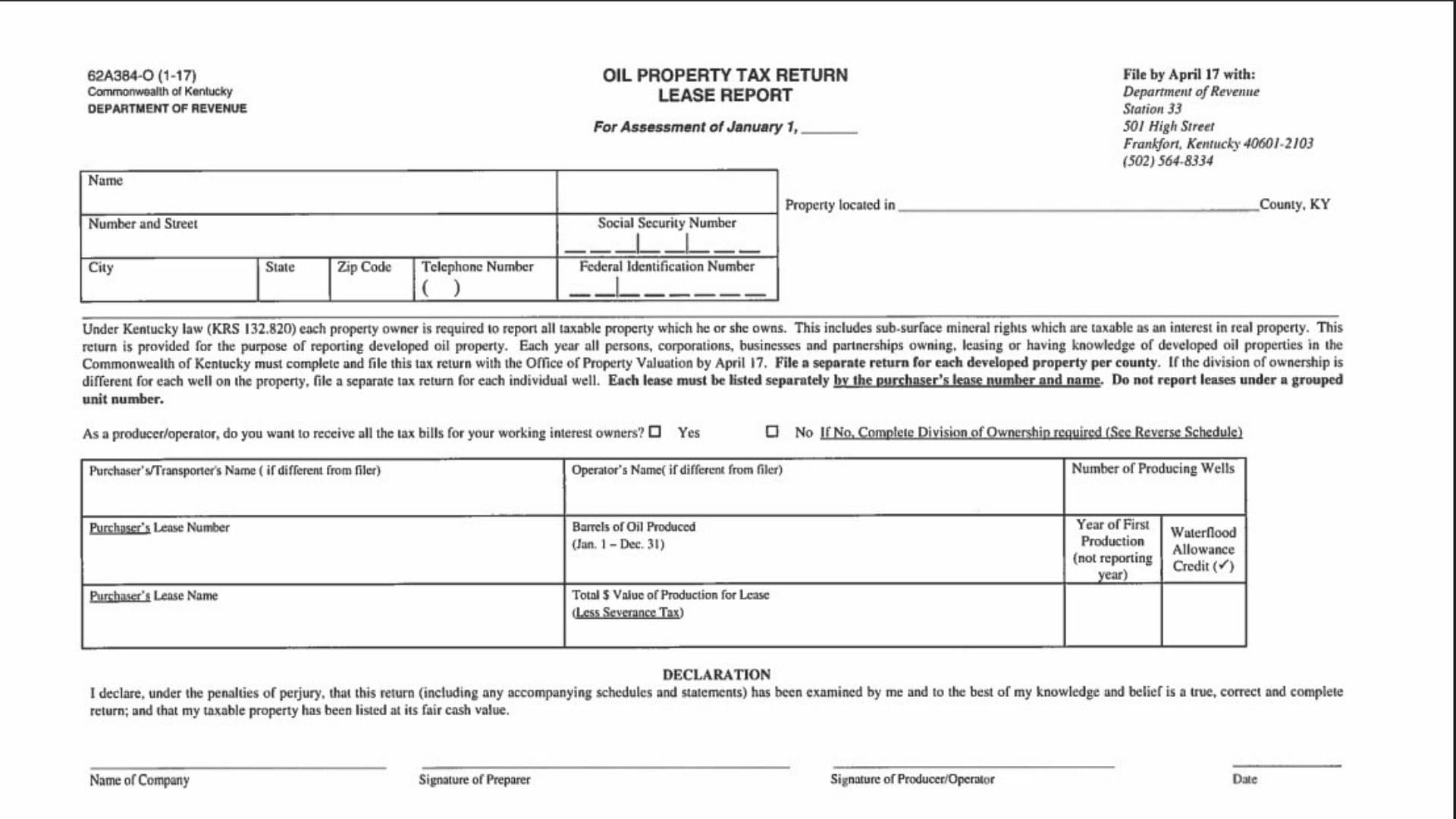
The Kentucky Oil Property Tax Return Lease Report is used to report developed oil property for Kentucky property tax assessment purposes. Kentucky treats subsurface mineral rights as an interest in real property, and property owners are required to report taxable property they own. This return is designed specifically for developed oil property and collects information needed to identify the taxpayer, the county where the property is located, the producer or operator, the oil purchaser or transporter, individual leases, production amounts, ownership interests, and other information used in valuing and billing the property. Persons, corporations, businesses, and partnerships that own, lease, operate, or have knowledge of developed oil property in Kentucky are expected to provide the applicable information. A separate return is required for each developed property in each county. When ownership differs from one well to another on the same property, a separate return should be prepared for each individual well. Leases must also be reported separately using the purchaser’s lease number and lease name rather than combining several leases under a grouped unit number. The return also gives a producer or operator the option of receiving the tax bills for working-interest owners. If the producer or operator does not elect to receive those bills, the Division of Interest Ownership Schedule must be completed so the Department of Revenue has the ownership information needed for billing. The return includes production details such as barrels produced, the year production began, the value of production, and any applicable waterflood allowance credit. It concludes with a declaration signed under penalties of perjury confirming that the reported information is true, correct, and complete and that taxable property has been listed at its fair cash value.
How To File The Kentucky Oil Property Tax Return Lease Report
The return is prepared for an assessment date of January 1. Enter the applicable assessment year in the space provided at the top.
The filing deadline shown on the return is April 17. Filings received after April 17 may be subject to applicable penalties.
Send the completed return to:
Kentucky Department of Revenue
Station 33
501 High Street
Frankfort, Kentucky 40601-2103
The telephone number provided for questions is (502) 564-8334.
Prepare a separate return for each developed oil property in each county. If individual wells on the same property have different ownership divisions, prepare separate returns for those wells as well.
Each lease must be reported separately using its purchaser’s lease number and lease name. Do not combine separate leases under a single grouped unit number.
If the producer or operator chooses not to receive all tax bills for working-interest owners, complete the Division of Interest Ownership Schedule on the reverse side.

How To Complete The Kentucky Oil Property Tax Return Lease Report Line By Line
Header And Assessment Information
Form Identification
The return is identified as Kentucky’s Oil Property Tax Return Lease Report. It is administered by the Commonwealth of Kentucky Department of Revenue.
For Assessment Of January 1
Enter the year for which the January 1 property tax assessment applies.
The property and ownership information reported should reflect the applicable assessment date.
Filing Deadline
The return indicates that it should be filed by April 17.
Complete, sign, and submit the required information by that deadline to avoid applicable late-filing penalties.
Taxpayer Identification Information
This section identifies the person or business associated with the developed oil property.
Name
Enter the full legal name of the individual, company, corporation, partnership, or other filer responsible for the return.
Use the same legal name associated with the taxpayer’s records.
Number And Street
Enter the filer’s street number and street name.
Provide a complete address that can be used for correspondence concerning the property tax return.
City
Enter the city associated with the filer address.
State
Enter the appropriate state abbreviation.
ZIP Code
Enter the ZIP Code associated with the address.
Telephone Number
Enter a telephone number where the filer or an appropriate representative can be contacted.
Include the area code.
Social Security Number
Enter the applicable Social Security number when the filer is an individual and this identifying number applies.
Review the number carefully before submitting the return.
Federal Identification Number
Enter the applicable federal identification number for a business or other entity when required.
Use the identification number associated with the filer shown at the top of the return.
Property Located In County, KY
Enter the Kentucky county in which the developed oil property reported on this return is located.
Because the form requires separate reporting by property and county, do not combine properties from different counties on one return.
Developed Oil Property Reporting Requirements
The return explains several reporting rules that should be followed when deciding what information belongs on the filing.
Report Taxable Oil Property Interests
Report the developed oil property and applicable subsurface mineral interests owned, leased, operated, or otherwise required to be disclosed for Kentucky property tax purposes.
File By Developed Property And County
Prepare a separate return for each developed property in each county.
This keeps production and ownership information connected to the correct property and jurisdiction.
Separate Wells With Different Ownership
If the ownership division is not the same for every well on a property, file a separate return for each well whose ownership is different.
Do not combine wells when doing so would mix different ownership percentages or owners.
Report Each Lease Separately
List every lease separately using the purchaser’s lease name and lease number.
Do not combine separate leases under a grouped unit number.
Working-Interest Tax Bill Election
Do You Want To Receive All Tax Bills For Your Working-Interest Owners?
The producer or operator must indicate whether they want to receive all property tax bills associated with their working-interest owners.
Check either Yes or No.
Yes
Select Yes if the producer or operator wants the applicable working-interest tax bills sent to them.
No
Select No if the producer or operator does not want to receive all of those tax bills.
If No is selected, the Division of Interest Ownership Schedule must be completed so billing can be based on the individual ownership information.
Lease And Production Information
This section provides the main operating, purchasing, lease, and production information for the developed oil property.
Purchaser/Transporter’s Name
Enter the name of the purchaser or transporter associated with the oil produced from the property.
This field is particularly important when that party is different from the filer.
Use the complete business or legal name.
Operator’s Name
Enter the operator’s name when the operator is different from the filer.
Use the legal or business name of the party responsible for operating the property.
Number Of Producing Wells
Enter the number of wells on the reported property or lease that are producing oil.
Report producing wells rather than unrelated wells that do not belong to the reported lease information.
Purchaser’s Lease Number
Enter the lease number used by the purchaser.
Each lease should be listed separately under its own purchaser lease number.
Do not replace individual lease numbers with a grouped unit number.
Barrels Of Oil Produced
Enter the number of barrels of oil produced during the period from January 1 through December 31.
Use production records for the lease or property being reported.
Make sure the amount represents barrels rather than the dollar value of production.
Year Of First Production
Enter the year in which the property or lease first began producing oil.
This field asks for the first production year, not the year for which the current tax return is being prepared.
For example, if production began several years before the current assessment year, enter the original production year.
Purchaser’s Lease Name
Enter the lease name used by the purchaser.
The lease name should correspond with the purchaser’s lease number entered for the same property.
Each lease must be reported individually.
Total Dollar Value Of Production For Lease
Enter the total value of production attributable to the lease.
The amount reported in this field should be stated after subtracting the applicable severance tax, as directed by the return.
Use records that correspond with the lease and production period being reported.
Waterflood Allowance Credit Percentage
Enter the applicable waterflood allowance credit percentage when the lease qualifies for such a credit.
Report the percentage that applies to the property rather than entering a dollar amount in this field.
Declaration
The declaration is the certification portion of the return.
By signing, the filer confirms under penalties of perjury that the return, together with any accompanying schedules or statements, has been reviewed and is believed to be true, correct, and complete.
The declaration also confirms that taxable property has been reported at its fair cash value.
Review the entire return and all attached ownership schedules before signing.
Name Of Company
Enter the full name of the company associated with the filing.
Use the legal business name connected with the oil property and the return.
Signature Of Preparer
The person who prepared the return should sign this line.
The signature identifies the individual responsible for preparing the information reported on the return.
Signature Of Producer/Operator
The producer or operator should sign in the designated space.
This signature confirms the filing from the producer or operator’s side.
Date
Enter the date on which the applicable signatures are provided.
Make sure the return is dated before it is submitted.
Late Filing Notice
Returns received after April 17 are subject to applicable penalties.
Complete and send the filing early enough to meet the stated deadline.
Oil Property Division Of Interest Ownership Schedule
The ownership schedule is used to identify the people or entities holding working, royalty, overriding, or other applicable interests in the reported oil property.
It is especially important when tax bills need to be prepared according to individual ownership interests.
Ownership Schedule Header Information
Lease Number
Enter the purchaser’s lease number associated with the ownership schedule.
Use the same lease identification that corresponds with the property reported on the main return.
Lease Name
Enter the applicable lease name.
Make sure the lease name corresponds with the lease number entered above.
Page
Enter the page number when more than one ownership schedule page is required.
Numbering additional pages helps keep a multi-page ownership schedule in the correct order.
Ownership Schedule Columns
Use one row for each owner whose interest must be reported.
Owner Name
Enter the full name of each working-interest, royalty-interest, overriding-interest, or other applicable owner.
List owners separately rather than combining multiple people or entities in one row.
Social Security Number Or FEIN
Enter the owner’s Social Security number or Federal Employer Identification Number, whichever applies.
Use the SSN for an applicable individual owner or the federal identification number for an applicable entity.
Owner Address
Enter the owner’s complete street or mailing address.
The address should be sufficient for identifying and billing the owner.
City
Enter the city associated with the owner’s address.
State
Enter the applicable state abbreviation.
ZIP Code
Enter the ZIP Code associated with the owner’s address.
Decimal Percentage Ownership Of Lease
Enter the owner’s interest in the lease as a decimal percentage.
For example, an ownership amount may be expressed in decimal form such as 0.875 when that value accurately represents the owner’s interest.
Use the actual ownership percentage applicable to each owner.
Ownership Type
Identify the type of ownership by entering the applicable letter.
W – Working Interest
Enter W when the person or entity holds a working interest in the property.
R – Royalty Interest
Enter R when the reported owner holds a royalty interest.
O – Overriding Interest
Enter O when the reported interest is an overriding interest.
Use the ownership designation that accurately reflects the owner’s relationship to the property.
Additional Ownership Information Requirements
The producer, operator, or authorized agent is responsible for supplying complete ownership information for the property as it exists on January 1 of the tax year.
Names And Identification Numbers
Report the names and Social Security numbers or federal identification numbers of the working, royalty, and overriding-interest owners associated with the property.
Owner Addresses
Provide the address for each reported owner.
Each address should correspond to the owner listed on that row.
Ownership Percentage
Provide the decimal ownership percentage for each individual owner.
The combined information should accurately represent the division of interest in the property.
Ownership Designation
Identify the type of interest using W, R, or O, as applicable.
Annual Net Income When Applicable
When applicable, report annual net income, including delayed rentals, for the royalty or fee owner as required by the ownership instructions.
If additional space is necessary to provide ownership-related information, use an appropriate additional schedule so the required information is not omitted.
When The Producer Or Operator Owns All Interests
A special instruction applies when the producer or operator owns the entire interest in the property, including both the working and royalty interests.
Decimal Ownership
Enter 1.00 in the decimal ownership field when the producer or operator owns the entire property interest.
Ownership Type
Enter A as the ownership type when all interests are owned by the producer or operator.
The return explains that the assessment in this situation is based on an industry-standard division of 0.875 working interest and 0.125 royalty interest.
Tax Billing Based On The Ownership Schedule
Tax bills are prepared according to the information entered on the ownership schedule.
For that reason, complete owner names, identification numbers, addresses, ownership percentages, and ownership types carefully.
The schedule should reflect how the filer wants the ownership interests recognized for billing purposes.
Incorrect or incomplete ownership information may result in tax bills being associated with the wrong owner or ownership percentage.