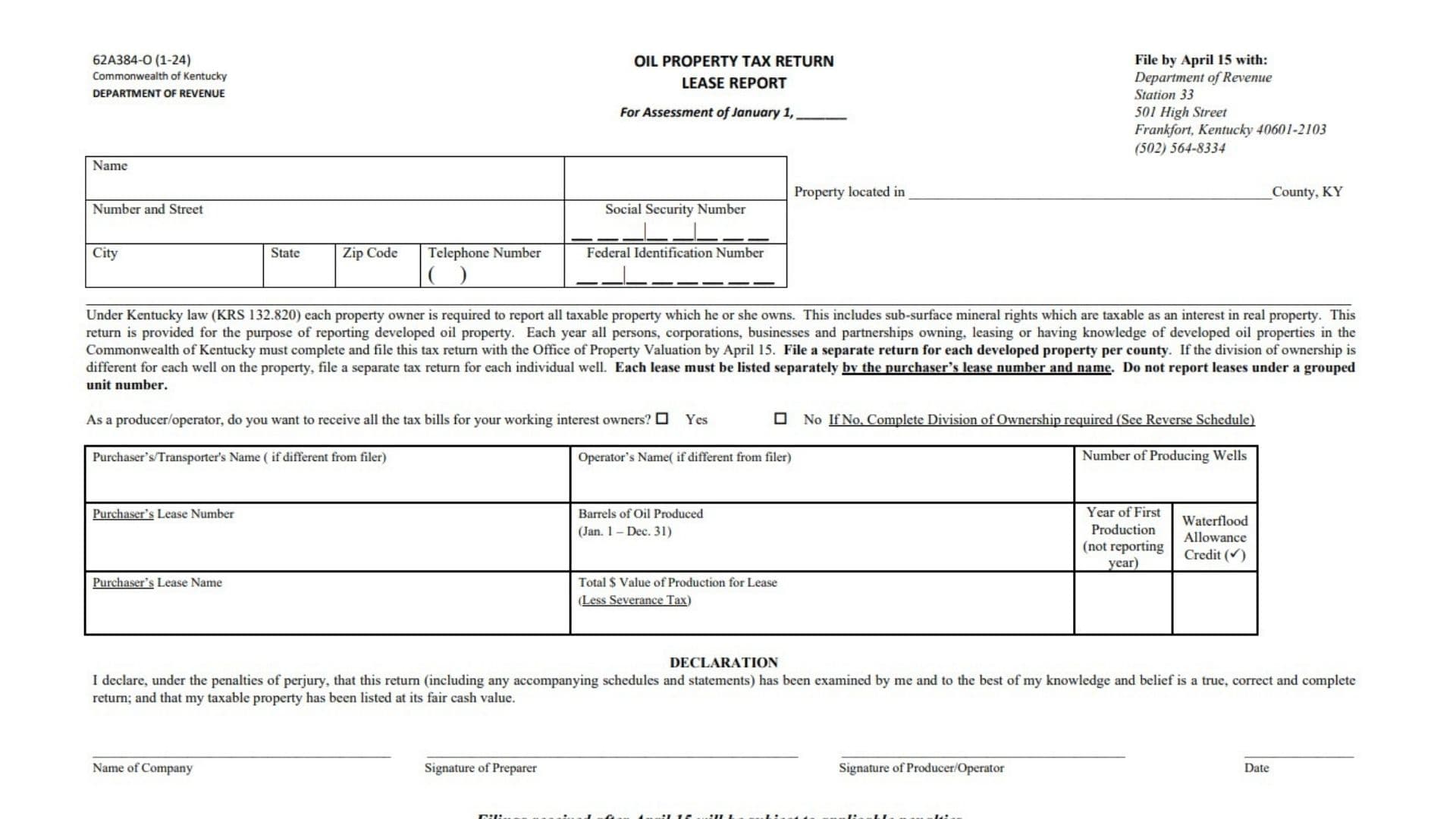
Kentucky Form 62A384-O, the Oil Property Tax Return Lease Report, is used to report developed oil property for Kentucky property tax purposes. Kentucky requires taxable property owners to report taxable property they own, including subsurface mineral rights that are treated as an interest in real property. The return is intended specifically for developed oil property and collects information about the taxpayer, the county where the property is located, the oil lease, the purchaser or transporter, the operator, producing wells, annual oil production, production value, and certain ownership interests. The filing requirement applies each year to persons, corporations, businesses, and partnerships that own, lease, or have knowledge of developed oil property in Kentucky. The form also includes an Oil Property Division of Interest – Ownership Schedule for reporting working, royalty, and overriding interests when ownership information must be provided. Completing the return accurately is important because the information is used for property assessment and, when the ownership schedule applies, for preparing tax bills for the appropriate interest owners.
How To File Form 62A384-O
Form 62A384-O must be filed by April 15 with the Kentucky Department of Revenue at:
Department of Revenue
Station 33
501 High Street
Frankfort, Kentucky 40601-2103
The return is prepared for an assessment date of January 1. Enter the applicable assessment year at the top of the form.
A separate return is required for each developed property within a county. Do not combine separate leases under a grouped unit number. Each lease must be identified individually using the purchaser’s lease number and lease name.
If the division of ownership is different from one well to another on the same property, prepare a separate tax return for each individual well rather than combining those wells on one return.
Before beginning the form, gather the following information:
- The assessment year.
- The filer’s name and mailing address.
- Social Security number or federal identification information requested for the filer.
- Telephone number.
- Kentucky county where the property is located.
- Purchaser or transporter information.
- Operator information.
- Purchaser’s lease number and lease name.
- Number of producing wells.
- Total barrels of oil produced during the calendar year.
- Year production first began.
- Whether a waterflood allowance credit applies.
- Total production value after severance tax.
- Ownership records for working, royalty, and overriding interest owners when the ownership schedule is required.
- Ownership percentages and ownership types.
- Applicable annual net-income information for royalty or fee owners.
The form itself does not assign numbers to its individual fields. For accuracy, the instructions below follow the printed fields in the order they appear rather than creating artificial line numbers.

How To Complete Form 62A384-O
Assessment And Taxpayer Information
Assessment of January 1
Enter the year for which the January 1 property assessment is being reported. This identifies the assessment period covered by the return.
Name
Enter the name of the person, company, corporation, partnership, or other filer responsible for the return.
Number and Street
Enter the filer’s street mailing address, including the street number and street name.
City
Enter the city associated with the filer’s mailing address.
State
Enter the appropriate state abbreviation for the mailing address.
Zip Code
Enter the ZIP code for the filer’s mailing address.
Telephone Number
Provide a telephone number where the filer or responsible party can be contacted regarding the return.
Social Security Number
Enter the Social Security number requested for an individual filer when applicable. Make sure the number is entered in the designated identification field.
Federal Identification Number
Enter the applicable federal identification number for the business or entity filing the return when appropriate.
Property Located In County, KY
Enter the name of the Kentucky county in which the developed oil property being reported is located. Because separate returns are required for developed properties by county, make sure this entry corresponds specifically to the property reported on this return.
Property And Lease Reporting Requirements
Before completing the production information, determine whether the return covers the correct property and lease.
Each developed property must be reported separately by county. If different wells have different divisions of ownership, each affected well requires its own return. Each lease must also be reported by its individual purchaser’s lease number and lease name rather than by a combined or grouped unit number.
Tax Billing Election
Producer/Operator Tax Bill Question
The form asks whether the producer or operator wants to receive all tax bills for the working interest owners.
Select Yes if the producer or operator wants those working-interest tax bills sent to the producer/operator.
Select No if the producer or operator does not want to receive all of those tax bills.
If No is selected, the Division of Interest – Ownership Schedule on the reverse side must be completed so the ownership and billing information can be identified.
Purchaser, Operator, And Production Information
Purchaser’s/Transporter’s Name
Enter the name of the purchaser or transporter when that party is different from the filer. This field identifies the business or person purchasing or transporting production from the reported lease.
Operator’s Name
Enter the operator’s name when the operator is different from the filer. If another party operates the wells or lease, identify that party here.
Number of Producing Wells
Enter the number of producing oil wells associated with the property or lease covered by this return. Report producing wells rather than wells that are not producing.
Purchaser’s Lease Number
Enter the specific lease number assigned by the purchaser. Use the individual purchaser’s lease number for the property being reported and do not substitute a grouped unit number.
Barrels of Oil Produced — January 1 Through December 31
Enter the total number of barrels of oil produced during the full calendar year from January 1 through December 31 for the lease being reported.
Use your production records to determine the annual total and make sure the figure relates only to the property or lease covered by this return.
Year of First Production
Enter the year in which production first began for the property or lease.
This field is specifically asking for the first production year, not the reporting year. For example, if you are filing a current return for a lease that first began producing several years earlier, enter the original year production began.
Waterflood Allowance Credit
Check the waterflood allowance credit box when the reported property qualifies for that credit.
The return provides a checkbox for this item but does not contain a separate eligibility test or credit calculation. Do not mark the box unless the allowance applies to the reported lease.
Purchaser’s Lease Name
Enter the purchaser’s name for the specific lease being reported. The lease name should correspond with the purchaser’s lease number entered above.
Each lease must be listed separately using its individual lease number and name.
Total Dollar Value of Production for Lease — Less Severance Tax
Enter the total dollar value of production attributable to the reported lease after subtracting severance tax.
Use the production value for the specific lease covered by this return rather than combining unrelated leases or grouped units.
Declaration And Signature Section
The declaration section is the filer’s certification that the return and any accompanying schedules or statements have been reviewed and, to the best of the signer’s knowledge and belief, are true, correct, and complete. The declaration also confirms that taxable property has been reported at its fair cash value.
Review all entries carefully before signing.
Name of Company
Enter the company name associated with the return. Make sure it agrees with the entity information used elsewhere on the filing.
Signature of Preparer
The person who prepared the return should sign in the designated preparer signature area.
Signature of Producer/Operator
The producer or operator responsible for the filing should sign in the appropriate signature space.
Date
Enter the date the return is signed.
The form warns that filings received after April 15 are subject to applicable penalties, so the completed return should be submitted by the filing deadline.
Oil Property Division of Interest – Ownership Schedule
The Oil Property Division of Interest – Ownership Schedule is used to report the ownership interests connected with the developed oil property. It identifies the working, royalty, and overriding interest owners associated with the property as of January 1 of the applicable tax year.
The schedule is particularly important when the producer/operator chooses No in response to the question about receiving all tax bills for working interest owners. Tax bills are prepared using the ownership information reported on this schedule, so the schedule should reflect the intended billing arrangement accurately.
Schedule Identification Information
Lease Number
Enter the same lease number for which the ownership information is being reported. The number should clearly identify the applicable lease.
Lease Name
Enter the corresponding lease name.
Page
Enter the page number for the ownership schedule. If additional pages are needed to report all owners, number the pages so the complete schedule can be kept in the proper order.
How To Complete Each Ownership Entry
Use a separate row for each owner whose interest must be reported.
Owner Name
Enter the full name of the working interest, royalty interest, or overriding interest owner associated with the property as of January 1 of the tax year.
Do not combine multiple owners into a single entry when their ownership interests need to be reported separately.
Social Security Number or FEIN
Enter the owner’s Social Security number or Federal Employer Identification Number, as applicable.
Use the identification number that belongs to the owner listed in that row.
Owner Address
Enter the owner’s mailing address.
The address should be complete enough to identify where correspondence or tax-related information for the owner should be sent.
City
Enter the city associated with the owner’s mailing address.
State
Enter the owner’s state.
Zip Code
Enter the ZIP code associated with the owner’s mailing address.
Decimal Percentage Ownership of Lease
Enter the owner’s share of the lease as a decimal.
For example, an ownership share represented as 0.875 corresponds to an 87.5% interest. Enter the decimal interest belonging to the specific owner shown on that row.
Make sure the decimal entered reflects that owner’s actual ownership interest in the lease.
Ownership Type
Identify the type of ownership by entering the appropriate letter:
- W for a working interest.
- R for a royalty interest.
- O for an overriding interest.
Use the ownership designation that corresponds with the interest held by the owner listed in that row.
Annual Net Income Information
The ownership schedule instructions also require annual net income to be reported when applicable for each royalty or fee owner.
The annual net-income amount includes delayed payments. Make sure applicable income information is included as required for the royalty or fee owner being reported.
Special Rule When the Producer/Operator Owns All Interests
If the producer/operator owns all working and royalty interests in the property, the ownership schedule provides a special reporting instruction.
Decimal Percentage Ownership
Enter 1.00 to show that the producer/operator owns the entire interest.
Ownership Type
Enter A as the ownership-type designation when the producer/operator owns all working and royalty interests.
For assessment purposes in this situation, the form states that the ownership will be based on an industry-standard allocation of:
- 0.875 working interest, and
- 0.125 royalty interest.
The ownership schedule also determines how tax bills are prepared. Complete the schedule so that it accurately reflects the desired billing arrangement.
Understanding Separate Property, Well, And Lease Reporting
One of the most important parts of completing Form 62A384-O correctly is determining what must be reported separately.
A separate return should be prepared for each developed property within each Kentucky county. If properties are located in different counties, do not combine them on one return.
If ownership is divided differently among individual wells on the same property, prepare a separate return for each well whose ownership division differs.
Leases must also be identified separately. Use each purchaser’s individual lease number and lease name. Do not replace those individual lease identifiers with a grouped unit number.
Following these distinctions helps ensure that production, property value, ownership, and tax billing are associated with the correct developed oil property.
Information To Verify With Your Records
Before signing the return, compare the entries with your property, lease, production, and ownership records.
Confirm that the barrels of oil produced represent the correct January 1 through December 31 production period. Check that the production value applies only to the lease shown on the return and that severance tax has been deducted as required by the field.
Verify the original year of first production rather than entering the current filing year automatically.
If the property has multiple owners, compare each owner’s name, identification number, address, decimal ownership share, and ownership type with the ownership information effective on January 1 of the tax year.
If ownership varies from well to well, verify that separate returns have been prepared where required.
Final Review Before Filing
Before submitting Kentucky Form 62A384-O, review the entire return and confirm the following:
- The correct January 1 assessment year is entered.
- The filer’s name and mailing address are complete.
- The appropriate taxpayer identification information has been entered.
- A valid telephone number is provided.
- The correct Kentucky county is listed for the property.
- A separate return has been prepared for each developed property as required.
- Separate well returns have been prepared if the division of ownership differs between wells.
- Each lease is reported separately by the purchaser’s lease number and lease name.
- No lease has been reported only under a grouped unit number.
- The producer/operator tax-bill question has been answered Yes or No.
- The ownership schedule has been completed if No was selected for receiving all working-interest tax bills.
- The purchaser or transporter is identified when different from the filer.
- The operator is identified when different from the filer.
- The number of producing wells is correct.
- The purchaser’s lease number is correct.
- Annual oil production for January 1 through December 31 is accurately reported.
- The year of first production is the actual first production year and not simply the reporting year.
- The waterflood allowance credit box is checked only when applicable.
- The purchaser’s lease name matches the reported lease.
- The total production value is reported after severance tax as required by the form.
- The company name is complete.
- The preparer has signed the return where required.
- The producer/operator has signed the return.
- The return is dated.
- Each required owner is listed on the ownership schedule.
- Each owner’s Social Security number or FEIN is entered as applicable.
- Each owner’s complete address, city, state, and ZIP code are provided.
- Each owner’s decimal ownership interest has been verified.
- Each ownership type is correctly identified as W, R, or O.
- Applicable annual net-income information for royalty or fee owners has been included.
- If the producer/operator owns all working and royalty interests, 1.00 is entered for ownership and A is entered for ownership type.
- Additional ownership schedule pages are numbered and included if needed.
- The ownership schedule reflects the intended tax-billing arrangement.
- The completed return is ready to be filed with the Kentucky Department of Revenue by April 15.