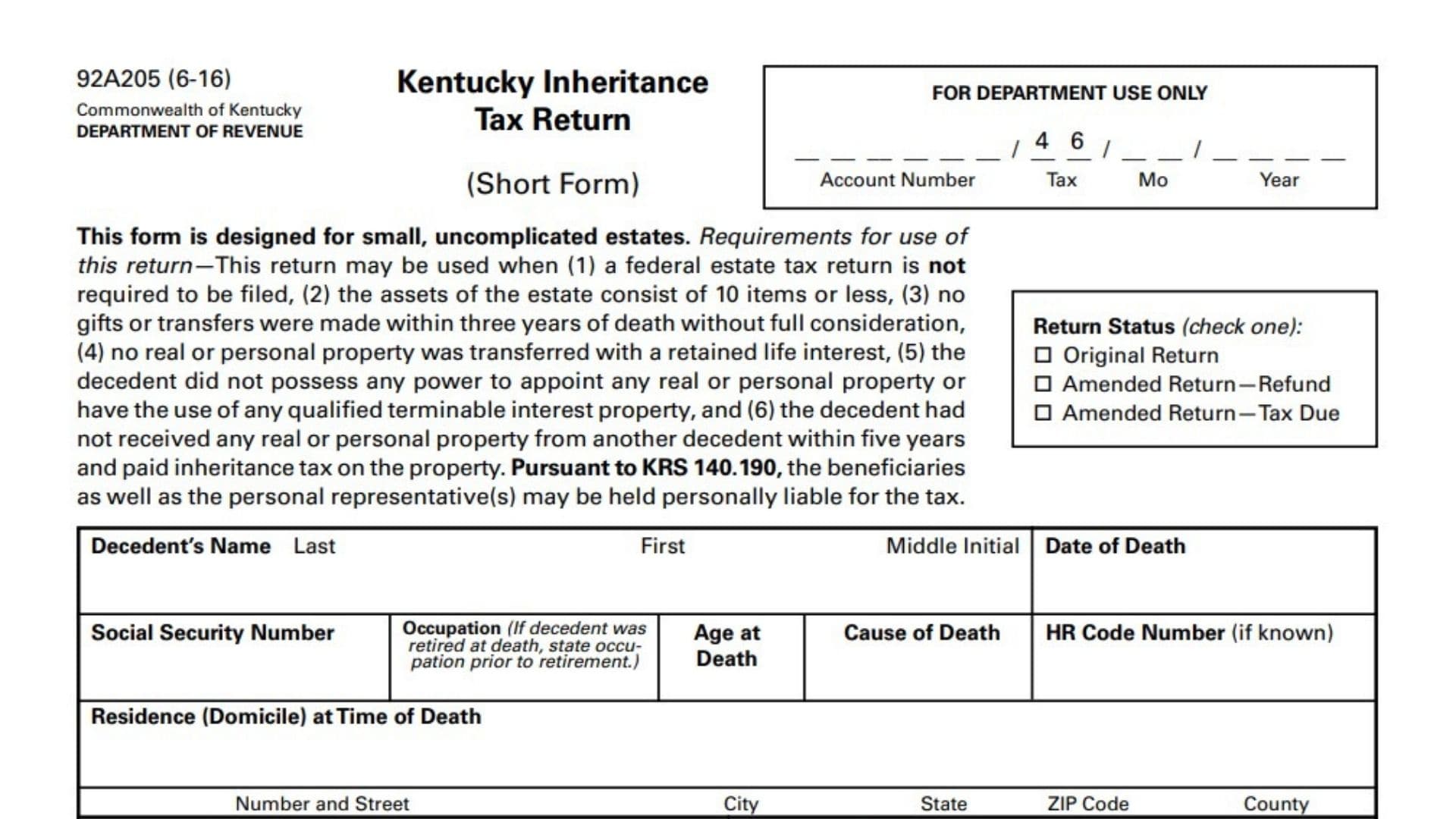
The Kentucky Inheritance Tax Return Short Form, Form 92A205, is designed for small and uncomplicated estates that owe Kentucky inheritance tax but do not require the more detailed reporting schedules used for larger or more complex estates. The form combines the estate’s identifying information, property list, deductions, beneficiary distributions, inheritance tax calculation, interest, penalties, payments, and final balance into three pages. It may be used only when a Federal Estate and Gift Tax Return is not required, the estate has no more than ten asset items, and the decedent did not make certain gifts or property transfers during the three years before death without receiving full consideration. The form also cannot be used when the decedent transferred property while retaining a life interest, possessed a power of appointment over property, used qualified terminable interest property, or received previously taxed property from another person who died within five years. The filer begins by listing all property owned by the decedent or in which the decedent held an interest, including individually owned and jointly owned assets. The estate may then subtract qualifying funeral expenses, administration expenses, mortgages, liens, and debts to calculate the net estate. Every heir, beneficiary, and exempt organization receiving property must be entered on the tax computation schedule, along with the recipient’s relationship, identifying information, distributive share, and inheritance tax. The total inheritance tax is transferred to the first page, where the estate may claim the applicable 5 percent early-payment discount and calculate interest or penalties when necessary. The executor, administrator, beneficiary, or other responsible representative signs the return under criminal penalties. Both the estate’s beneficiaries and its personal representatives may be held personally responsible for unpaid tax, so all property values, deductions, beneficiary classifications, and payment calculations should be carefully reviewed before filing.
Who Can Use The Kentucky Inheritance Tax Return Short Form?
The estate may use the short form only when every eligibility condition is satisfied.
Line 1: Federal Estate Tax Return Requirement: Confirm that the estate is not required to file a Federal Estate and Gift Tax Return. When a federal estate tax return is required, do not use this short form.
Line 2: Ten-Asset Limit: Confirm that the estate consists of ten asset items or fewer. Count all property items owned by the decedent or in which the decedent held a reportable interest.
Line 3: Gifts And Transfers Within Three Years: Confirm that the decedent did not make gifts or transfers within three years before death without receiving full and adequate consideration.
Line 4: Retained Life Interest: Confirm that the decedent did not transfer real or personal property while retaining the right to possess, use, enjoy, or receive income from the property for life.
Line 5: Powers Of Appointment And Qualified Terminable Interest Property: Confirm that the decedent did not possess a power to appoint real or personal property and did not have the use of qualified terminable interest property.
Line 6: Previously Taxed Property: Confirm that the decedent did not receive real or personal property from another decedent who died within five years when Kentucky inheritance tax had been paid on that property.
Line 7: Personal Responsibility For Tax: Understand that beneficiaries and personal representatives may be held personally liable for Kentucky inheritance tax that is not properly reported or paid.
When the estate fails any of these requirements, the longer Kentucky inheritance tax return may be required.
How To File The Kentucky Inheritance Tax Return Short Form
Complete Section I and Section II before finishing the financial lines on the first page. Section I determines the gross estate, while Section II determines the estate’s allowable deductions and net estate.
Complete a separate Real Estate Valuation Information Form for every parcel of real property included in the estate. Gather date-of-death statements, appraisals, deeds, account records, ownership documents, debt records, receipts, and other information supporting the reported values and deductions.
For stocks and bonds, obtain the records needed to support the valuation. This may include a balance sheet prepared near the date of death and information showing net earnings and dividends paid during the five years immediately preceding death.
After calculating the net estate, complete Section III. List every heir, beneficiary, and exempt organization, itemize the property or share each one receives, and calculate any inheritance tax attributable to that recipient.
Transfer the net estate and total inheritance tax to the first page. Calculate the early-payment discount, interest, penalties, previous payments, and final balance.
Attach a copy of the will when the decedent had a will. Attach a copy of the trust agreement when the decedent had a trust.
Sign and date the return. A separate preparer should also complete and sign the preparer section.
When payment is due, make the check payable to “Kentucky State Treasurer.” Attach the check to the return and mail the completed filing to:
Kentucky Department of Revenue
Frankfort, KY 40620
Keep a complete copy of the return, payment, schedules, valuation documents, and attachments with the estate’s records.

How To Complete The Kentucky Inheritance Tax Return Short Form
Department Use And Return Status
Line 8: Department Use Only: Leave this entire box blank. The Kentucky Department of Revenue uses it to record the estate’s account number, tax code, tax month, and tax year.
Line 9: Account Number: Do not enter anything in this field.
Line 10: Tax Code: Leave the tax field blank.
Line 11: Tax Month: Leave the month field blank.
Line 12: Tax Year: Leave the year field blank.
Line 13: Return Status: Select only one return status.
Line 14: Original Return: Check this box when submitting the estate’s first Form 92A205.
Line 15: Amended Return, Refund: Check this box when correcting a previously filed return and the correction produces a refund or reduces the estate’s tax liability.
Line 16: Amended Return, Tax Due: Check this box when correcting a previously filed return and the correction results in additional tax.
Decedent Information
Line 17: Decedent’s Last Name: Enter the decedent’s legal last name.
Line 18: Decedent’s First Name: Enter the decedent’s legal first name.
Line 19: Middle Initial: Enter the decedent’s middle initial. Leave this space blank when the decedent had no middle name.
Line 20: Date Of Death: Enter the complete month, day, and year of death.
Line 21: Social Security Number: Enter the decedent’s complete Social Security number.
Line 22: Occupation: Enter the decedent’s occupation. If the decedent was retired at death, enter the occupation held before retirement.
Line 23: Age At Death: Enter the decedent’s age on the date of death.
Line 24: Cause Of Death: Enter the cause of death shown in the estate’s official records.
Line 25: HR Code Number: Enter the applicable HR code number when it is known. Leave the field blank when no number is available.
Residence At Time Of Death
Line 26: Residence Or Domicile At Time Of Death: Enter the decedent’s permanent legal residence on the date of death.
Line 27: Number And Street: Enter the street number, street name, apartment number, unit number, or rural route information.
Line 28: City: Enter the city associated with the decedent’s domicile.
Line 29: State: Enter the state in which the decedent was domiciled.
Line 30: ZIP Code: Enter the applicable ZIP code.
Line 31: County: Enter the county where the decedent’s residence was located.
Executor, Administrator, Or Beneficiary Information
Line 32: Name And Address Of Executor, Administrator, Or Beneficiary: Enter the full name and mailing address of the person responsible for handling or filing the return.
Line 33: Executor: Check “Exec” when the person handling the return is the executor appointed under the decedent’s will.
Line 34: Administrator: Check “Admr” when the person handling the return is the court-appointed administrator.
Line 35: Other Capacity: Check the blank option when the filer is acting in another capacity. Write the appropriate role on the blank line, such as beneficiary or another authorized representative.
Preparer Information
Line 36: Name And Address Of Preparer: Enter the complete name and business address of the person who prepared the return.
Line 37: Attorney: Check “Atty” when the preparer is acting as an attorney.
Line 38: Certified Public Accountant: Check “CPA” when the preparer is a certified public accountant.
Line 39: Other Preparer Capacity: Check the blank option when the preparer is acting in another professional capacity. Enter that role on the blank line.
When no separate preparer was used, the preparer fields may be left blank.
Will And Trust Questions
Line 40: Did The Decedent Have A Will?: Check “Yes” when the decedent left a will. Check “No” when the decedent did not leave a will.
Line 41: Will Attachment: Attach a complete copy of the will when “Yes” is checked. Include any codicils or amendments that affect the distribution of property.
Line 42: Did The Decedent Have A Trust Agreement?: Check “Yes” when the decedent had a trust agreement. Check “No” when no trust agreement existed.
Line 43: Trust Agreement Attachment: Attach a copy of the trust agreement when “Yes” is checked. Include amendments or restatements that affect ownership or distribution of estate property.
First-Page Tax And Payment Lines
Line 44: Net Estate From Page 2: Transfer the Net Estate amount calculated at the end of Section II. This amount equals the Total Gross Estate minus Total Deductions.
Line 45: Inheritance Tax Due From Section III: Transfer the Total Inheritance Tax Due calculated in Section III.
Line 46: Discount Of 5 Percent: Calculate 5 percent of the inheritance tax when the tax qualifies for the discount by being paid within nine months after the decedent’s death. Enter the discount as a subtraction.
Line 47: Total Tax Due: Subtract the 5 percent discount from the inheritance tax due. When no discount applies, enter the full inheritance tax amount.
Interest And Penalty Lines
Line 48: Interest For Late Payment: Enter the interest owed when the tax was not paid by the applicable payment deadline. Calculate interest using the rate and period that apply to the estate.
Line 49: Late Filing Penalty: Enter the applicable penalty when the return is filed after its required filing date.
Line 50: Late Payment Penalty: Enter the applicable penalty when the inheritance tax is paid after its required payment date.
Line 51: Total Due: Add Total Tax Due, late-payment interest, the late-filing penalty, and the late-payment penalty.
Line 52: Total Previously Paid: Enter all inheritance tax payments previously made for the estate. Include payments made with an earlier return or before the final return was completed.
Line 53: Balance Due Or Refund: Subtract Total Previously Paid from Total Due. When Total Due is larger, the result is the balance that must be paid. When previous payments are larger, the difference is the potential refund amount.
Payment And Mailing Instructions
Line 54: Payee: Make the payment check payable to “Kentucky State Treasurer.”
Line 55: Check Attachment: Attach the payment to the completed return.
Line 56: Mailing Address: Mail the return, required attachments, and payment to the Kentucky Department of Revenue in Frankfort, Kentucky 40620.
Declaration And Signature Section
Line 57: Declaration: Review the complete return and all accompanying documents before signing. The signer declares under criminal penalties that the information is true, correct, and complete to the best of the signer’s knowledge and belief.
Line 58: Signature Of Executor, Administrator, Or Beneficiary: The executor, administrator, beneficiary, or other authorized person responsible for the filing must sign this line.
Line 59: Social Security Number Of Signer: Enter the Social Security number of the person signing the return.
Line 60: Signature Date: Enter the date the estate representative signs the return.
Line 61: Telephone Number Of Estate Representative: Enter a daytime telephone number, including the area code.
Line 62: Email Address Of Estate Representative: Enter a current email address for the executor, administrator, beneficiary, or other signer.
Line 63: Signature Of Preparer: A separate professional or paid preparer should sign this line.
Line 64: Preparer Date: Enter the date the preparer signs the return.
Line 65: Preparer Telephone Number: Enter the preparer’s telephone number, including the area code.
Line 66: Preparer Email Address: Enter the preparer’s current email address.
Section I, Gross Estate Instructions
Section I is used to report all property the decedent owned or in which the decedent held an interest. The short form may be used only when the estate contains ten items or fewer.
List each asset on a separate row. Include individually owned assets and the decedent’s interest in jointly owned property.
Section I Preliminary Requirements
Line 67: List All Property Interests: Include every item owned by the decedent and every asset in which the decedent had a reportable ownership interest.
Line 68: Real Estate Valuation Form: Complete a separate Form 92A204, Real Estate Valuation Information Form, for every parcel of real estate.
Line 69: Stock And Bond Support: Provide supporting information for reported stock and bond values.
Line 70: Balance Sheet: When applicable, include a balance sheet prepared as close as possible to the decedent’s date of death.
Line 71: Earnings And Dividend Information: Include information showing net earnings and dividends paid during the five years immediately preceding death when required to support the valuation.
Line 72: Financial Institution Records: Financial institution statements may be used when they adequately support the reported values.
Section I Property Columns
Line 73: Description And Location Of Real Or Personal Property: Describe each asset clearly and state its location when applicable.
For real estate, enter the address, county, state, parcel description, or other identifying information.
For a bank account, identify the financial institution and type of account.
For stocks or bonds, identify the issuer and number of shares or units.
For a vehicle, enter the year, make, model, and other useful identifying details.
For personal property, describe the property or group of property with enough detail to support the valuation.
Line 74: Individual Ownership: Check or mark the Individual column when the decedent owned the entire asset alone.
Line 75: Joint Ownership: Complete the joint ownership columns when the property was owned by the decedent and at least one other person.
Line 76: Joint With Survivorship: Mark the “With” column when the property passed to the surviving owner through a right of survivorship.
Line 77: Joint Without Survivorship: Mark the “Without” column when the ownership arrangement did not contain survivorship rights.
Line 78: Date Placed In Joint Names: Enter the date the asset was placed in joint ownership. This information is required for every jointly owned item.
Line 79: Name Of Co-Owner: Enter the complete name of each person who jointly owned the property with the decedent.
Line 80: Fair Cash Value Of 100 Percent Interest At Date Of Death: Enter the fair cash value of the entire asset as of the decedent’s date of death, even when the decedent owned only part of it.
Line 81: Decedent’s Interest: Enter the value of the portion attributable to the decedent. Base this amount on the decedent’s ownership percentage, contributions, survivorship arrangement, and applicable inheritance tax treatment.
Line 82: Additional Property Rows: Continue entering each asset on a separate row until all property has been reported. The short form is limited to estates with ten asset items or fewer.
Line 83: Total Gross Estate: Add the values entered in the Decedent’s Interest column. Enter the combined amount as the Total Gross Estate.
Section II, Deductions Instructions
Section II is used to subtract qualifying estate expenses, debts, mortgages, and liens from the Total Gross Estate.
Retain receipts, invoices, court records, cancelled checks, account statements, mortgage documents, lien statements, and other evidence supporting each deduction.
Funeral And Burial Expenses
Line 84: Funeral Expenses: Enter qualifying funeral costs paid by or on behalf of the estate.
Line 85: Monument: Enter the amount paid for a monument, grave marker, or similar memorial.
Line 86: Cemetery Lot And Maintenance: Enter qualifying amounts paid for the cemetery lot and maintenance of the lot.
Line 87: Funeral Expense Subtotal: Add the funeral, monument, cemetery lot, and maintenance amounts. The deductible subtotal entered on this form cannot exceed $5,000.
When the combined costs are greater than $5,000, enter only $5,000 on the subtotal line.
Administration Expenses
Line 88: Personal Representatives’ Commissions: Enter qualifying commissions paid or payable to the estate’s executor, administrator, or other personal representative.
Line 89: Attorneys’ Fees: Enter qualifying legal fees connected with administering or settling the estate.
Line 90: Appraisers’ Fees And Court Costs: Enter qualifying appraisal charges and court costs paid in connection with the estate.
Mortgages, Liens, And Other Debts
Line 91: Mortgages And Liens: Enter the decedent’s share of qualifying mortgages and liens.
For jointly owned property, include only the portion properly attributable to the decedent.
Line 92: Other Debts Of Decedent: Enter other qualifying debts owed by the decedent.
Line 93: Debt Itemization Requirement: Itemize the other debts only when the total of those debts exceeds $500.
Line 94: First Other Debt Description: Describe the first reportable debt and enter its amount.
Line 95: Second Other Debt Description: Describe the second reportable debt and enter its amount.
Line 96: Third Other Debt Description: Describe the third reportable debt and enter its amount.
Line 97: Fourth Other Debt Description: Describe the fourth reportable debt and enter its amount.
When additional explanation is needed, attach a separate statement identifying the creditor, nature of the debt, and amount.
Deduction And Net Estate Totals
Line 98: Total Deductions: Add the funeral expense subtotal, personal representative commissions, attorney fees, appraisal fees, court costs, mortgages, liens, and other deductible debts.
Line 99: Net Estate: Subtract Total Deductions from Total Gross Estate.
Line 100: Transfer Net Estate To Page 1: Enter the resulting Net Estate on the first-page line labeled “Net Estate from page 2.”
Section III, Tax Computation Schedule Instructions
Section III is used to report every heir, beneficiary, and exempt organization that receives property from the estate. It also calculates the inheritance tax attributable to each taxable distributive share.
The combined distributive shares must equal the Net Estate calculated in Section II.
Beneficiary And Distribution Columns
Line 101: Names Of Heirs And Beneficiaries: Enter the full legal name of every person who receives property from the estate.
Line 102: Exempt Organizations: Enter the complete legal name of every exempt organization receiving property.
Line 103: Itemized Shares Of Property: Describe or itemize the property received by each beneficiary or organization. Provide enough information to identify the recipient’s share.
Line 104: Social Security Number: Enter the beneficiary’s Social Security number. For an organization, use the appropriate identifying number when required.
Line 105: Relationship: State the beneficiary’s exact relationship to the decedent. Examples include spouse, child, grandchild, sibling, niece, nephew, friend, or unrelated beneficiary.
For an organization, describe its status or indicate that it is an exempt organization.
Line 106: Age: Enter the beneficiary’s age when it is relevant to the inheritance tax calculation or exemption.
Line 107: Distributive Share: Enter the total value of property passing to the beneficiary or exempt organization.
Line 108: Tax: Calculate the Kentucky inheritance tax attributable to that recipient’s distributive share after applying the appropriate beneficiary classification, exemption, and tax rate.
Enter zero when the entire distributive share qualifies for an exemption.
Line 109: Additional Beneficiary Rows: Continue listing every recipient on a separate row. Do not omit exempt beneficiaries or organizations.
Section III Totals
Line 110: Total Distributive Shares: Add the distributive shares of all heirs, beneficiaries, and exempt organizations.
Line 111: Net Estate Comparison: Confirm that Total Distributive Shares equals the Net Estate calculated in Section II.
When the amounts do not agree, review the property values, deductions, beneficiary allocations, and mathematical calculations before filing.
Line 112: Total Inheritance Tax Due: Add the tax amounts calculated for all taxable beneficiaries.
Line 113: Transfer Tax To Page 1: Enter the Total Inheritance Tax Due on the first-page line labeled “Inheritance tax due from Section III.”
Final Review Checklist
Before filing the Kentucky Inheritance Tax Return Short Form, confirm that the estate meets every eligibility requirement. Verify that no federal estate tax return is required, no more than ten property items are reported, and none of the disqualifying transfers, powers, interests, or previously taxed property situations applies.
Confirm that every individually and jointly owned asset is listed, each joint ownership field is completed, and every parcel of real estate has a separate valuation form. Review the date-of-death values and supporting financial records.
Make sure the deductions are supported by estate records, the funeral expense subtotal does not exceed $5,000, and other debts exceeding $500 are itemized.
Confirm that every beneficiary and exempt organization is listed, the distributive shares equal the Net Estate, and the inheritance tax has been correctly transferred to the first page.
Review the 5 percent discount, interest, penalties, previous payments, and final balance. Attach the will and trust agreement when applicable.
The estate representative and preparer should complete all required contact information, sign and date the return, attach payment when tax is due, and retain a complete copy of the filing.