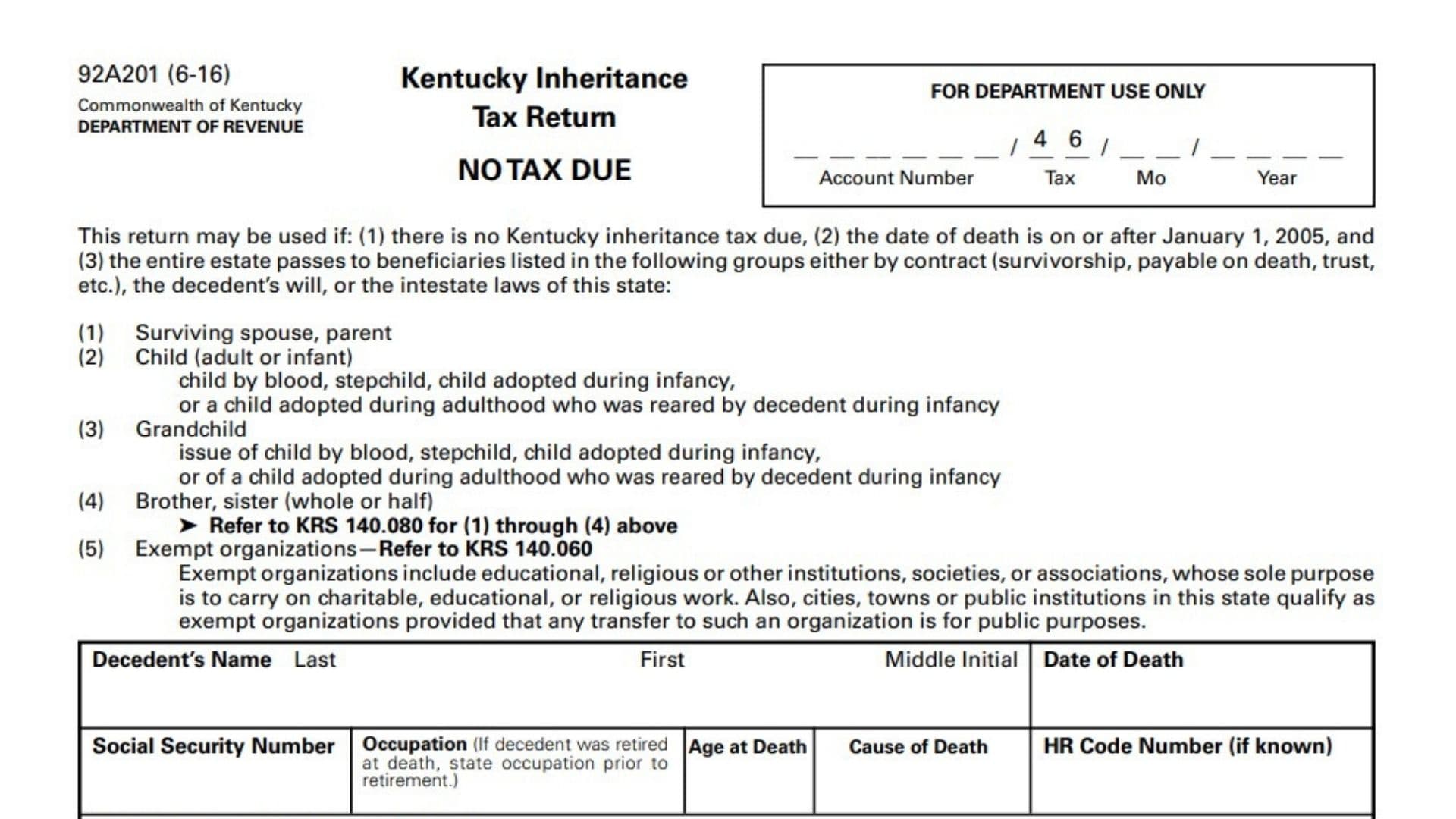
The Kentucky Inheritance Tax Return No Tax Due form, also known as Form 92A201, is used to report an estate when no Kentucky inheritance tax is owed and the estate passes entirely to beneficiaries or organizations that qualify for an exemption. The form applies to qualifying estates when the decedent died on or after January 1, 2005. It collects basic information about the deceased person, the executor, administrator, beneficiary, and any professional preparer. It also asks whether the decedent had a will or trust and whether a Federal Estate and Gift Tax Return was required or filed for portability. The property schedule on the second page is optional, so the filer may list the estate’s real and personal property and each asset’s fair cash value as of the date of death, but that section is not mandatory for filing this return. The beneficiary schedule is mandatory because the Kentucky Department of Revenue must be able to confirm that every recipient belongs to an exempt beneficiary class. Qualifying beneficiaries generally include a surviving spouse, parent, qualifying child, qualifying grandchild, brother, sister, or an eligible charitable, educational, religious, public, or similar exempt organization. The responsible filer signs the return under criminal penalties, confirming that the return and its attachments are accurate and complete. Although this is a no-tax-due return, the filer should still carefully review the estate’s beneficiaries, ownership arrangements, payable-on-death accounts, survivorship property, trusts, will provisions, and intestate distributions before using it. When inheritance tax is actually due, a different Kentucky inheritance tax return must be used.
Who Can Use The Kentucky Inheritance Tax Return No Tax Due Form?
Form 92A201 may be used only when all of the following conditions are satisfied:
- No Kentucky inheritance tax is due.
- The decedent died on or after January 1, 2005.
- The entire estate passes to exempt beneficiaries through a will, trust, contract, survivorship arrangement, payable-on-death designation, Kentucky intestate law, or another valid transfer method.
The entire estate must pass to one or more of the following qualifying recipients.
Surviving Spouse Or Parent
Property may pass to the decedent’s surviving husband, surviving wife, mother, or father.
Qualifying Child
A qualifying child may include:
- A biological child.
- A stepchild.
- A child adopted during infancy.
- A person adopted as an adult who was raised by the decedent during that person’s infancy.
Qualifying Grandchild
A qualifying grandchild may include a descendant of:
- A biological child.
- A stepchild.
- A child adopted during infancy.
- A person adopted as an adult who was raised by the decedent during infancy.
Brother Or Sister
A full brother, full sister, half brother, or half sister may qualify as an exempt beneficiary.
Exempt Organization
An exempt organization may include an eligible educational, religious, charitable, public, or similar organization whose purpose is to perform qualifying charitable, educational, religious, or public work.
A city, town, or public institution in Kentucky may qualify when the transferred property will be used for public purposes.
When This Form May Not Be Required
An inheritance tax return may not need to be filed with the Kentucky Department of Revenue when all taxable property passes to exempt beneficiaries and no Federal Estate and Gift Tax Return is filed.
In that situation, the court may accept an affidavit of exemption for the final settlement and closing of the estate administration.
The executor, administrator, beneficiary, or estate adviser should verify whether the court requires an affidavit, a copy of this return, or another document before deciding not to file.
When A Different Kentucky Inheritance Tax Form Is Required
Do not use the No Tax Due form when any part of the estate passes to a taxable beneficiary and Kentucky inheritance tax is owed.
When tax is due, the estate may need to use Form 92A200 or Form 92A205, depending on the estate’s circumstances.
How To File The Kentucky Inheritance Tax Return No Tax Due Form
Begin by confirming that every beneficiary qualifies for an exemption. Review the will, trust documents, beneficiary designations, survivorship agreements, payable-on-death accounts, transfer-on-death registrations, deeds, and Kentucky intestate succession rules.
Gather the following information before completing the return:
- The decedent’s complete legal name.
- The decedent’s Social Security number.
- The decedent’s date of death.
- The decedent’s age and occupation.
- The decedent’s cause of death.
- The decedent’s final legal residence.
- The executor’s, administrator’s, or beneficiary’s contact information.
- The preparer’s contact information, when applicable.
- A complete list of beneficiaries and their relationships to the decedent.
- A copy of the will, when the decedent had a will.
- A copy of the trust agreement, when the decedent had a trust.
- A copy of the Federal Estate and Gift Tax Return, when required or filed for portability.
- Property descriptions and date-of-death values, when completing the optional property schedule.
Complete the first page and the mandatory beneficiary schedule. Complete the property schedule when the estate or the person handling it wants to provide a record of the property included in the estate.
Attach all required documents, review the declaration, and obtain the proper signatures. Because this is a no-tax-due return, no inheritance tax payment should accompany it.
Mail the completed return and attachments to:
Kentucky Department of Revenue
Frankfort, Kentucky 40620
Keep a complete copy of the signed return and all supporting documents with the estate records.

How To Complete The Kentucky Inheritance Tax Return No Tax Due Form
Eligibility Section
Line 1: No Kentucky Inheritance Tax Due: Confirm that the estate does not owe Kentucky inheritance tax. Do not use this return merely because the estate has little property. The tax result depends on who receives the property and whether each recipient qualifies for an exemption.
Line 2: Date Of Death Requirement: Confirm that the decedent’s date of death was January 1, 2005, or later.
Line 3: Method Of Transfer: Confirm that the property passes through a valid transfer method, such as survivorship, a payable-on-death designation, a trust, a will, or Kentucky intestate succession law.
Line 4: Surviving Spouse Or Parent: Confirm that any property reported under this beneficiary category passes to the decedent’s surviving spouse, mother, or father.
Line 5: Child: Confirm that a beneficiary identified as a child is a biological child, stepchild, child adopted during infancy, or qualifying adult adoptee who was raised by the decedent during infancy.
Line 6: Grandchild: Confirm that a beneficiary identified as a grandchild is the qualifying descendant of a biological child, stepchild, child adopted during infancy, or qualifying adult adoptee raised by the decedent during infancy.
Line 7: Brother Or Sister: Confirm that the beneficiary is the decedent’s full or half brother or sister.
Line 8: Exempt Organization: Confirm that the organization qualifies for exemption and that the transfer will be used for an eligible charitable, educational, religious, public, or similar exempt purpose.
Department Use Section
Line 9: Department Use Only: Leave the entire Department Use Only box blank. The Kentucky Department of Revenue uses this area to record the estate’s account number, tax code, month, and year.
Decedent Information
Line 10: Decedent’s Last Name: Enter the deceased person’s legal last name.
Line 11: Decedent’s First Name: Enter the deceased person’s legal first name.
Line 12: Middle Initial: Enter the decedent’s middle initial. Leave this field blank when the decedent did not have a middle name.
Line 13: Date Of Death: Enter the complete month, day, and year of death.
Line 14: Social Security Number: Enter the decedent’s complete Social Security number. Review the number carefully before filing.
Line 15: Occupation: Enter the decedent’s occupation. When the decedent was retired at death, enter the occupation held before retirement.
Line 16: Age At Death: Enter the decedent’s age on the date of death.
Line 17: Cause Of Death: Enter the cause of death shown in the estate’s official records.
Line 18: HR Code Number: Enter the applicable HR code number when it is known. Leave the field blank when no code is available.
Residence At Time Of Death
Line 19: Residence Or Domicile At Time Of Death: Enter the decedent’s permanent legal residence at the time of death. Domicile generally refers to the place the decedent considered a permanent home.
Line 20: Number And Street: Enter the street number, street name, apartment number, unit number, or rural route information for the decedent’s residence.
Line 21: City: Enter the city associated with the decedent’s final domicile.
Line 22: State: Enter the state in which the decedent was domiciled.
Line 23: ZIP Code: Enter the full ZIP code for the decedent’s residence.
Line 24: County: Enter the county in which the residence was located.
Executor, Administrator, Or Beneficiary Information
Line 25: Name And Address Of Executor, Administrator, Or Beneficiary: Enter the complete name and mailing address of the person responsible for preparing, signing, or submitting the return on behalf of the estate.
Line 26: Executor Checkbox: Check “Exec” when the person handling the return is the executor appointed under the decedent’s will.
Line 27: Administrator Checkbox: Check “Admr” when the person handling the return is the court-appointed administrator.
Line 28: Other Capacity Checkbox: Check the blank role option when the filer is acting in another capacity. Write the appropriate title or role on the blank line, such as beneficiary, personal representative, trustee, or another applicable designation.
Preparer Information
Line 29: Name And Address Of Preparer: Enter the full name and business address of the attorney, accountant, tax preparer, or other person who prepared the return.
Line 30: Attorney Checkbox: Check “Atty” when the preparer is acting as an attorney.
Line 31: Certified Public Accountant Checkbox: Check “CPA” when the preparer is acting as a certified public accountant.
Line 32: Other Preparer Checkbox: Check the blank option when the preparer is acting in another professional capacity. State the preparer’s role on the blank line.
When no separate preparer was used, the preparer name, address, role, signature, telephone number, and email fields may be left blank.
Will And Trust Questions
Line 33: Did The Decedent Have A Will?: Check “Yes” when the decedent left a valid will. Check “No” when the decedent did not have a will.
Line 34: Will Attachment: When “Yes” is checked, attach a complete copy of the will. Include any codicils or amendments that affect the distribution of the estate.
Line 35: Did The Decedent Have A Trust Agreement?: Check “Yes” when the decedent had a trust agreement that may affect the estate or its beneficiaries. Check “No” when there was no trust agreement.
Line 36: Trust Agreement Attachment: When “Yes” is checked, attach a complete copy of the trust agreement. Include amendments, restatements, or other documents that affect the beneficiaries or property distributions.
Federal Estate And Gift Tax Return Status
Select only one federal filing status.
Line 37: Federal Return Not Required: Check this box when the estate was not required to file a Federal Estate and Gift Tax Return and no federal return was filed for portability.
Line 38: Federal Return Required: Check this box when the estate was required to file a Federal Estate and Gift Tax Return. Attach a complete copy to the Kentucky filing.
Line 39: Federal Return Not Required But Filed For Portability: Check this box when the federal return was not otherwise required but was filed to preserve a deceased spouse’s unused federal exclusion amount. Attach a copy of the federal return.
Property And Beneficiary Schedule Notice
Line 40: Property Listing Notice: The real and personal property schedule appears in Part I. Completing that schedule is optional.
Line 41: Beneficiary Listing Notice: The beneficiary schedule appears in Part II. Every filer using this return must complete the beneficiary schedule.
Line 42: Beneficiary Relationship Requirement: Enter each beneficiary’s relationship to the decedent. The relationship is necessary to establish that the beneficiary qualifies for exempt treatment.
Total Value Of Property
Line 43: Total Value Of Property From Reverse Side: Enter the total fair cash value calculated in Part I when the optional property schedule has been completed.
This field may be left blank when the property schedule is not completed.
When an amount is entered, it should equal the sum of all date-of-death property values listed in Part I.
Declaration And Signature Section
Line 44: Declaration: Read the declaration before signing. The signer confirms under criminal penalties that the return and all accompanying documents have been examined and are true, correct, and complete to the best of the signer’s knowledge and belief.
Line 45: Signature Of Executor, Administrator, Or Beneficiary: The executor, administrator, beneficiary, or other authorized person responsible for the return must sign this line.
Line 46: Representative Signature Date: Enter the date on which the executor, administrator, or beneficiary signs the return.
Line 47: Representative Telephone Number: Enter a daytime telephone number, including the area code, where the estate representative can be reached.
Line 48: Representative Email Address: Enter the estate representative’s current email address.
Line 49: Signature Of Preparer: The paid or professional preparer should sign this line when someone other than the estate representative prepared the return.
Line 50: Preparer Signature Date: Enter the date on which the preparer signs the return.
Line 51: Preparer Telephone Number: Enter the preparer’s telephone number, including the area code.
Line 52: Preparer Email Address: Enter the preparer’s current email address.
Mailing Line
Line 53: Mailing Address: Mail the completed and signed return, together with all required attachments, to the Kentucky Department of Revenue in Frankfort, Kentucky 40620.
Part I, Property Instructions
Part I provides an optional schedule for listing the estate’s real and personal property. Although the schedule is optional, completing it may create a useful summary of the assets included in the estate.
How To List Property
Enter each property item on a separate row whenever possible. Similar assets may be grouped when the description remains clear and the total value can be supported.
Property may include:
- Real estate.
- Bank accounts.
- Certificates of deposit.
- Stocks and bonds.
- Vehicles.
- Business interests.
- Farm property.
- Household goods.
- Jewelry.
- Collections.
- Notes receivable.
- Life insurance payable to the estate.
- Other real or personal property owned by the decedent.
Do not include property that did not belong to the decedent unless the decedent held a reportable ownership interest.
Part I Line-By-Line Instructions
Line 54: Part I, Property: Complete this section when choosing to provide an itemized list of the decedent’s real and personal property.
Line 55: Description And Location Of Real Or Personal Property: Describe each asset clearly. Include the property’s location when relevant.
For real estate, provide the street address, county, state, or another identifying location.
For a bank account, identify the financial institution and account type.
For stocks or bonds, identify the issuer and the number of shares or units when known.
For a vehicle, provide the year, make, model, and another useful identifier.
For personal property, describe the item or group of items with enough detail to explain what was valued.
Line 56: Fair Cash Value At Date Of Death: Enter the fair cash value of each property item as of the decedent’s date of death.
Fair cash value generally means the amount a willing buyer would pay a willing seller when neither person is required to complete the transaction and both understand the relevant facts.
Use reliable statements, appraisals, market quotations, account balances, or other valuation records to support each amount.
Line 57: Additional Property Rows: Continue listing each property item and its corresponding date-of-death value on the available rows.
When the space is insufficient, attach a continuation sheet containing:
- The decedent’s name.
- A description and location for each additional asset.
- The fair cash value of each asset as of the date of death.
- A subtotal for the continuation sheet.
Line 58: Total Value Of Property: Add the fair cash values of all property listed in Part I and on any continuation sheets.
Line 59: Transfer Of Property Total: Transfer the Part I total to the “Total Value of Property from Reverse Side” field on the first page.
Part II, Beneficiaries Instructions
Part II must be completed. List every person or organization receiving estate property and state that recipient’s relationship to the decedent.
Do not omit beneficiaries merely because their transfers are exempt. The purpose of this section is to show that the entire estate passes to exempt recipients.
Include beneficiaries receiving property through:
- The decedent’s will.
- A trust.
- Kentucky intestate succession.
- Joint ownership with survivorship.
- Payable-on-death accounts.
- Transfer-on-death registrations.
- Beneficiary designations.
- Contracts.
- Other direct transfer arrangements.
Part II Line-By-Line Instructions
Line 60: Part II, Beneficiaries: Complete this section for every estate using the No Tax Due return.
Line 61: Name Of Beneficiary: Enter the full legal name of each person or organization receiving property from the decedent.
List each beneficiary on a separate row.
For an individual, enter the person’s first and last name.
For an organization, enter its complete legal name.
Line 62: Relationship To Decedent: State how each beneficiary was related to the decedent.
Examples include:
- Surviving spouse.
- Mother.
- Father.
- Son.
- Daughter.
- Stepchild.
- Adopted child.
- Grandson.
- Granddaughter.
- Brother.
- Sister.
- Half brother.
- Half sister.
- Exempt charitable organization.
- Exempt educational organization.
- Exempt religious organization.
- Kentucky city or town receiving property for a public purpose.
- Qualifying public institution.
Do not enter only “relative,” “family,” or “beneficiary.” Use the specific relationship needed to establish the exemption.
Line 63: Additional Beneficiary Rows: Continue listing beneficiaries and relationships on each available row.
When the space is insufficient, attach a continuation sheet containing:
- The decedent’s full name.
- Each additional beneficiary’s full legal name.
- Each beneficiary’s exact relationship to the decedent.
- The legal name and exempt purpose of any organization receiving property.
Line 64: Review Of All Beneficiaries: Confirm that every recipient belongs to an exempt category. When even one taxable beneficiary receives estate property, the estate may not qualify to use this form.
Final Filing Determination
Line 65: All Taxable Assets Pass To Exempt Beneficiaries: Confirm that all property subject to Kentucky inheritance tax passes to exempt beneficiaries.
Line 66: Federal Estate And Gift Tax Return Not Filed: Determine whether a federal estate return was filed. When all taxable assets pass to exempt beneficiaries and no federal return was filed, a Kentucky inheritance tax return may not be necessary.
Line 67: Affidavit Of Exemption: Determine whether an affidavit of exemption may be submitted to the probate court for final settlement and closure of the estate instead of filing an inheritance tax return.
Line 68: Tax Is Due: Do not file this No Tax Due return when Kentucky inheritance tax is owed.
Line 69: Alternative Tax Return: Use the applicable taxable-estate return, such as Form 92A200 or Form 92A205, when the estate owes Kentucky inheritance tax.
Final Review Checklist
Before mailing the Kentucky Inheritance Tax Return No Tax Due form, confirm that:
- The decedent died on or after January 1, 2005.
- No Kentucky inheritance tax is due.
- Every beneficiary is listed in Part II.
- Every beneficiary’s exact relationship to the decedent is entered.
- All beneficiaries qualify for exempt treatment.
- The decedent’s identifying information is complete.
- The final residence and county are correctly reported.
- The filer’s name, address, role, telephone number, and email address are included.
- The preparer section is completed when applicable.
- The correct federal estate return status is checked.
- A copy of the will is attached when the decedent had a will.
- A copy of the trust is attached when the decedent had a trust.
- A federal return copy is attached when required or filed for portability.
- The optional property total agrees with Part I when Part I is completed.
- The estate representative has signed and dated the return.
- The preparer has signed and dated the return when applicable.
- No inheritance tax payment is enclosed because the return reports no tax due.
- A complete copy is retained with the estate’s permanent records.