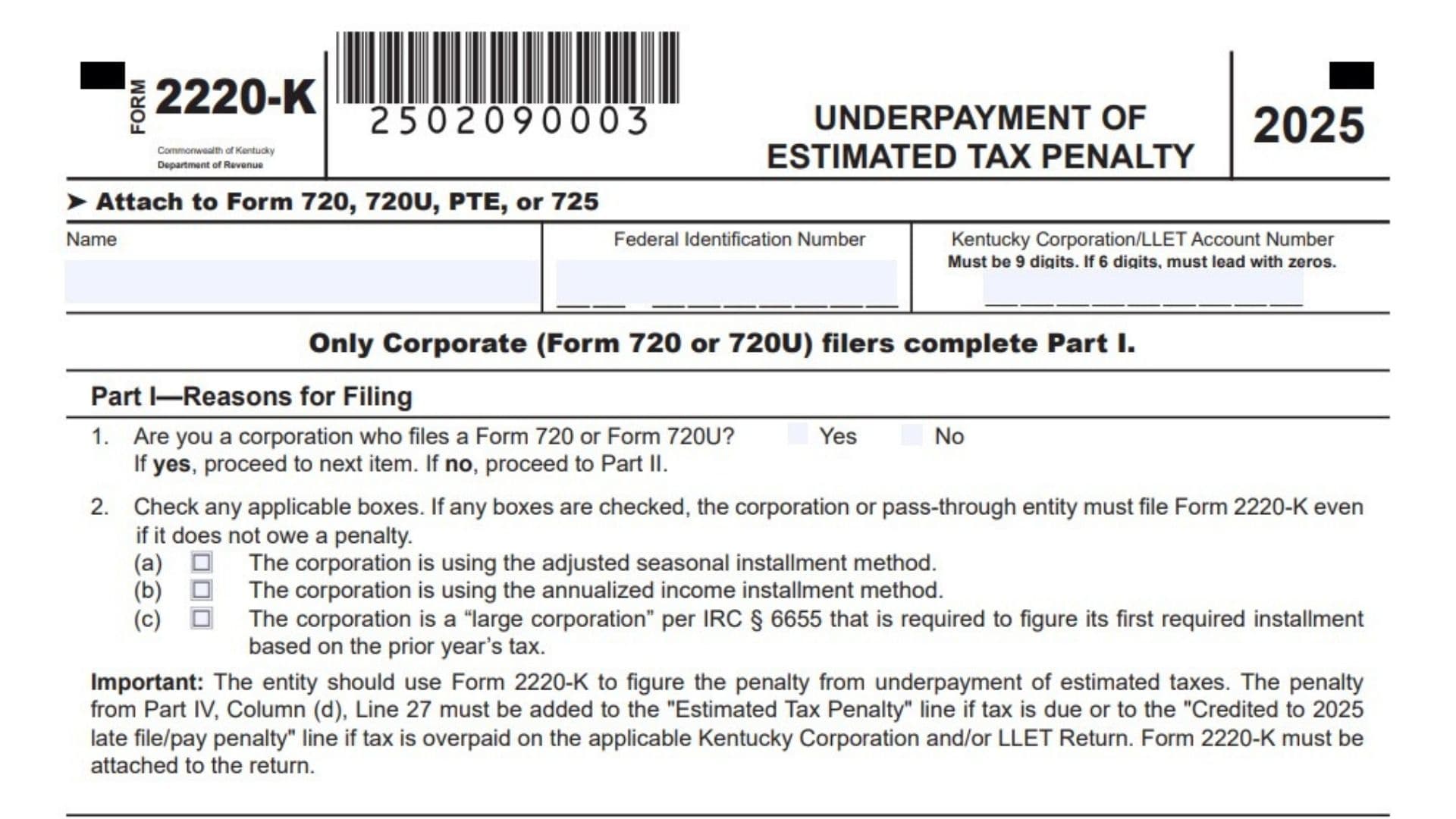
Form 2220-K (Form 41A720-S6), issued by the Commonwealth of Kentucky Department of Revenue, is the official tax calculation schedule used by corporations and pass-through entities to determine whether they owe an underpayment penalty for estimated corporation income tax and Limited Liability Entity Tax (LLET), and to calculate the statutory addition to tax under KRS 141.044. Kentucky tax law requires taxable businesses to pay estimated income tax and LLET in quarterly installments throughout the tax year whenever their combined tax liability reaches statutory thresholds. Form 2220-K establishes the required annual payment, determines whether an underpayment occurred in any of the four quarterly payment periods, applies safe-harbor exceptions or alternative income methods, and calculates daily penalty charges across applicable interest periods. Filing this form correctly ensures that businesses avoid erroneous penalty assessments, take legitimate advantage of seasonal or annualization relief, and reconcile estimated tax penalties accurately on their parent tax returns.
How To File Form 2220-K
Form 2220-K is an attachment schedule rather than a standalone tax return. Businesses subject to estimated tax rules must submit the completed schedule alongside their annual Kentucky corporate income tax and LLET return, such as Form 720 (Kentucky Corporation Income Tax and LLET Return) or Form 720U (Unitary Combined Return).
Before completing Form 2220-K, taxpayers and accountants should have the following records and forms ready:
- The current tax year’s return figures, including total LLET liability, income tax liability, and nonrefundable tax credits claimed on Schedule TCS (Tax Credit Summary Schedule).
- The prior tax year’s filed Kentucky tax return to evaluate safe-harbor eligibility based on prior-year tax.
- Detailed records of all estimated tax payments remitted via electronic funds transfer or quarterly vouchers, including exact payment clearance dates.
- Converted Federal Form 2220 (Schedule A) and Federal Form 8842 elections if the business is electing the adjusted seasonal installment method or the annualized income installment method.

How to Complete Kentucky Form 2220-K
Header And General Information
Begin by providing the entity’s identifying details at the top of the schedule.
Name Of Corporation Or Entity
Enter the legal business name exactly as shown on the accompanying Kentucky corporate tax return.
Kentucky Account Number
Enter the six-digit Kentucky Department of Revenue corporate or pass-through account number.
Federal Identification Number (FEIN)
Enter the nine-digit Federal Employer Identification Number assigned to the entity by the Internal Revenue Service.
Part I: Exceptions To The Penalty
Part I identifies whether the entity qualifies for statutory exceptions, alternative calculation methods, or special rules that alter how quarterly installments are calculated.
Line 1: Underpayment Safe Harbor Exemption Threshold
This line confirms whether the business qualifies for an automatic exemption from estimated underpayment penalties. If the entity’s total tax liability for the current tax year shown on Part II, Column C, Line 3 is less than 5,000 dollars, or if the taxable period was less than 4 months, no penalty is due. In these cases, you do not need to calculate underpayments or penalties in Part III unless special reporting criteria apply.
Line 2, Box a: Adjusted Seasonal Installment Method Checkbox
Check this box if the entity’s income fluctuated significantly throughout the year due to seasonal operations and you are using the Adjusted Seasonal Installment Method Worksheet to reduce or eliminate required quarterly installments.
Line 2, Box b: Annualized Income Installment Method Checkbox
Check this box if the business earned income unevenly during the year and you are calculating required quarterly payments using the Annualized Income Installment Method Worksheet.
Line 2, Box c: Large Corporation Safe Harbor Checkbox
Check this box if the entity meets the definition of a large corporation under Internal Revenue Code Section 6655 (having taxable income of 1 million dollars or more in any of the three preceding tax years). Large corporations may only base their first required quarterly installment on prior-year tax liability.
Part II: Required Annual Payment
Part II calculates the total annual tax liability for both the Limited Liability Entity Tax (LLET) and Corporation Income Tax to determine the minimum statutory payment required for the year.
Line 3, Column A: Current Year LLET
Enter the net LLET liability from the current year tax return after subtracting allowable nonrefundable credits claimed on Schedule TCS.
Line 3, Column B: Current Year Income Tax
Enter the net corporation income tax liability from the current year tax return after subtracting allowable nonrefundable credits, including the nonrefundable LLET credit and statutory credits from Schedule TCS.
Line 3, Column C: Current Year Total Tax
Add Column A, Line 3 and Column B, Line 3 together. If the combined total in Column C is less than 5,000 dollars, or if the tax year covered a period of less than 4 months, no penalty is due and you may stop here.
Line 4, Column A: Prior Year LLET
Enter the net LLET liability from the preceding full 12-month tax year return after reducing for allowable tax credits. Skip Line 4 entirely if the prior year return was for a period of less than 12 months, if the prior-year LLET was equal to the statutory minimum of 175 dollars, and if the prior-year income tax was zero.
Line 4, Column B: Prior Year Income Tax
Enter the net corporation income tax liability from the preceding full 12-month tax year return after reducing for allowable tax credits.
Line 4, Column C: Prior Year Total Tax
Add Column A, Line 4 and Column B, Line 4 together.
Line 5, Column C: Required Annual Payment Determination
Compare Column C, Line 3 to Column C, Line 4. Enter the smaller of the two figures. If you were required to skip Line 4 due to the prior-year minimum or short-year rules, carry the total current year amount from Column C, Line 3 directly to this line.
Worksheet: Adjusted Seasonal And Annualized Income Installment Method
Complete this worksheet only if Box a or Box b in Part I, Line 2 is checked. It recalculates required income tax installments using annualized or seasonal income figures before factoring in LLET and nonrefundable credits.
Line 1: Seasonal Or Annualized Installments From Converted Federal Schedule
Enter the calculated income tax installment amounts from each corresponding column of your converted Federal Form 2220, Schedule A, Part III, Line 32.
Line 2: Cumulative Preceding Column Allocations
Enter the sum of the amounts from Line 7 of all preceding columns. Leave Column A blank. Complete Lines 3 through 7 sequentially for each column before filling out Line 2 of the next column.
Line 3: Net Seasonal Or Annualized Installment Amount
Subtract Line 2 from Line 1. If the calculation produces zero or a negative figure, enter zero.
Line 4: Base Statutory Installment Amount
Enter 25 percent (0.25) of the smaller of Part II, Column B, Line 3 or Part II, Column B, Line 4. If Part II, Column B, Line 4 was skipped, enter 25 percent of Part II, Column B, Line 3. Large corporations must follow the specific installment apportionment rules detailed in the large corporation instructions.
Line 5: Preceding Column Excess Adjustment
Subtract Line 7 of the preceding column from Line 6 of the preceding column. Leave Column A blank.
Line 6: Adjusted Base Installment
Add Line 4 and Line 5 in each column.
Line 7: Tentative Income Installment Before Credits
Compare Line 3 and Line 6 in each column, and enter the smaller amount.
Line 8: Kentucky Statutory Credits
Enter the allowable portion of Kentucky statutory tax credits from Schedule TCS allocable to each installment period.
Line 9: Quarterly LLET Credit Reduction
Take the current year LLET liability from Part II, Column A, Line 3, subtract the 175-dollar statutory minimum, divide the remaining figure by 4, and enter the result in each column. Round the result to the nearest whole dollar.
Line 10: Final Required Quarterly Income Tax Installment
Subtract Line 8 and Line 9 from Line 7 in each column. If the result is negative, enter zero. Transfer these quarterly amounts to Part III, Line 7.
Line 11: Quarterly LLET Allocation
Divide the total current year LLET from Part II, Column A, Line 3 by 4, and enter the result in each column. Round to two decimal places. Transfer these amounts to Part III, Line 8.
Line 12: Combined Required Quarterly Installments
Add Line 10 and Line 11 in each column. If the sum of Line 12 across all columns is less than 5,000 dollars, or if the tax period is under 4 months, no underpayment penalty is due.
Part III: Figuring The Underpayment
Part III evaluates each of the four statutory payment quarters (Columns a, b, c, and d) sequentially to establish whether an underpayment or overpayment occurred. You must complete Lines 11 through 17 for one column before moving to the next.
Line 6: Installment Due Dates
These fields display the statutory calendar or fiscal due dates for each installment. For calendar-year filers, these dates represent the 15th day of the 4th, 6th, 9th, and 12th months of the tax year. Fiscal-year filers must use the corresponding 15th day of their respective fiscal months.
Line 7: Required Income Tax Installments
Enter the required quarterly income tax installment for each period:
- If Box a or Box b in Part I, Line 2 is checked, enter the amount from Line 10 of the worksheet on Page 6 into each column.
- If Box c in Part I is checked for a large corporation without annualized methods, calculate the first installment based on 25 percent of prior-year income tax (Part II, Column B, Line 4) and recapture any remaining balance across subsequent quarters per the large corporation rules.
- If no boxes in Part I are checked and current year tax governs (Part II, Column C, Line 5 equals Line 3), enter 25 percent of Part II, Column B, Line 3 in each column. Otherwise, enter 25 percent of Part II, Column B, Line 4 in each column.
Line 8: Required LLET Installments
Enter the required quarterly LLET installment for each period:
- If Box a or Box b in Part I is checked, enter the amount from Line 11 of the worksheet on Page 6 into each column.
- If no boxes in Part I are checked and current year tax governs, enter 25 percent of Part II, Column A, Line 3 in each column. Otherwise, enter 25 percent of Part II, Column A, Line 4 in each column.
Line 9: Total Required Installments
Add Line 7 and Line 8 in each column.
Line 10: Estimated Tax Paid Or Credited
Enter the total estimated tax payments made and prior-year credit carryforwards applied for each installment period. For Column a, include prior-year overpayments credited to the current year and all payments received by the first installment due date. For Columns b, c, and d, enter payments remitted after the prior installment due date through the current installment due date. For Column a only, carry the Line 10 figure directly to Line 14.
Line 11: Prior Column Overpayment Carryforward
Enter the overpayment amount carried forward from Line 17 of the preceding column. Leave Column a blank.
Line 12: Total Available Payments And Credits
Add Line 10 and Line 11 within each column.
Line 13: Prior Column Unapplied Underpayment Total
Enter the combined total of unapplied amounts from Lines 15 and 16 of the preceding column. Leave Column a blank.
Line 14: Net Effective Payment
Subtract Line 13 from Line 12 in each column. If the result is zero or less, enter zero. For Column a only, enter the exact amount from Line 10.
Line 15: Unapplied Prior Underpayment Balance
If the amount on Line 14 is zero, subtract Line 12 from Line 13 and enter the difference. If Line 14 is greater than zero, enter zero.
Line 16: Underpayment Amount
Compare Line 14 to Line 9. If Line 14 is less than or equal to Line 9, subtract Line 14 from Line 9 and enter the result here. Once entered, move to Line 11 of the next column. If Line 14 is greater than Line 9, enter zero and proceed to Line 17.
Line 17: Overpayment Amount
If Line 9 is less than Line 14, subtract Line 9 from Line 14 and enter the excess payment amount here. Carry this overpayment figure to Line 11 of the subsequent column. If Line 9 is equal to or greater than Line 14, enter zero.
Part IV: Figuring The Penalty
Part IV computes the daily addition to tax penalty on any quarterly underpayments reported on Line 16 based on statutory interest rates across applicable calendar periods.
Line 18: Payment Date Or Cut-Off Date
For each column with an underpayment on Line 16, enter the date the specific installment was paid in full or the 15th day of the 4th month following the close of the tax year, whichever date is earlier.
Line 19: Total Number Of Days Underpaid
Enter the total number of calendar days elapsed from the statutory installment due date on Line 6 to the payment or cut-off date shown on Line 18.
Line 20: First Period Days
Enter the number of days from Line 19 that fall after April 15, 2025, and before January 1, 2026.
Line 21: First Period Penalty Computation
Calculate the penalty for the first period using the formula: multiply the underpayment amount on Line 16 by the fraction of Line 20 divided by 365, and multiply that result by the statutory penalty rate for this period (10 percent).
Line 22: Second Period Days
Enter the number of days from Line 19 that fall after December 31, 2025, and before either January 1, 2027, or the day after the statutory return due date, whichever occurs earlier.
Line 23: Second Period Penalty Computation
Calculate the penalty for the second period using the formula: multiply the underpayment amount on Line 16 by the fraction of Line 22 divided by 365, and multiply that result by the statutory penalty rate for this period (9 percent).
Line 24: Third Period Days (Fiscal Year Filers)
For fiscal-year taxpayers ending between September and November 2025, enter the number of days from Line 19 falling after December 31, 2026, and before March 16, 2027, or the day after the return due date, whichever is earlier.
Line 25: Third Period Penalty Computation
Calculate the penalty for the third period by multiplying the underpayment amount on Line 16 by the fraction of Line 24 divided by 365, and multiplying that result by the statutory annual penalty interest rate published for that calendar year.
Line 26: Total Column Penalty Amount
Add the calculated penalty amounts from Line 21, Line 23, and Line 25 in each respective column.
Line 27: Total Estimated Tax Underpayment Penalty
Add the penalty amounts across Columns a through d of Line 26. Enter the grand total in Column d. Transfer this final penalty figure directly to your Kentucky corporate return:
- If the return reflects a tax balance due, add this penalty amount to the Estimated Tax Penalty line on Form 720 or Form 720U.
- If the return reflects a tax overpayment, add this penalty amount to the late file/pay penalty line to reduce the credited overpayment or refund amount accordingly.
Final Review Before Filing
Before submitting Form 2220-K with your Kentucky return, verify the following items:
- Check whether the combined tax liability on Part II, Column C, Line 3 is under 5,000 dollars to ensure you are not calculating an unnecessary penalty.
- Verify that prior-year tax numbers on Line 4 come from a full 12-month return and exceed the 175-dollar LLET minimum before using the prior-year safe harbor.
- Confirm that large corporations apply the prior-year safe harbor only to the first quarterly installment.
- If using seasonal or annualized installment methods, make sure Kentucky Converted Federal Form 2220 (Schedule A) and Form 8842 elections are properly attached.
- Double-check that Part III was completed column by column so that all unapplied underpayments and overpayment credits were rolled forward accurately.
- Verify that the day counts on Lines 20, 22, and 24 equal the total underpayment days reported on Line 19.
- Ensure the final calculated penalty on Line 27 is accurately carried over to Form 720 or Form 720U.