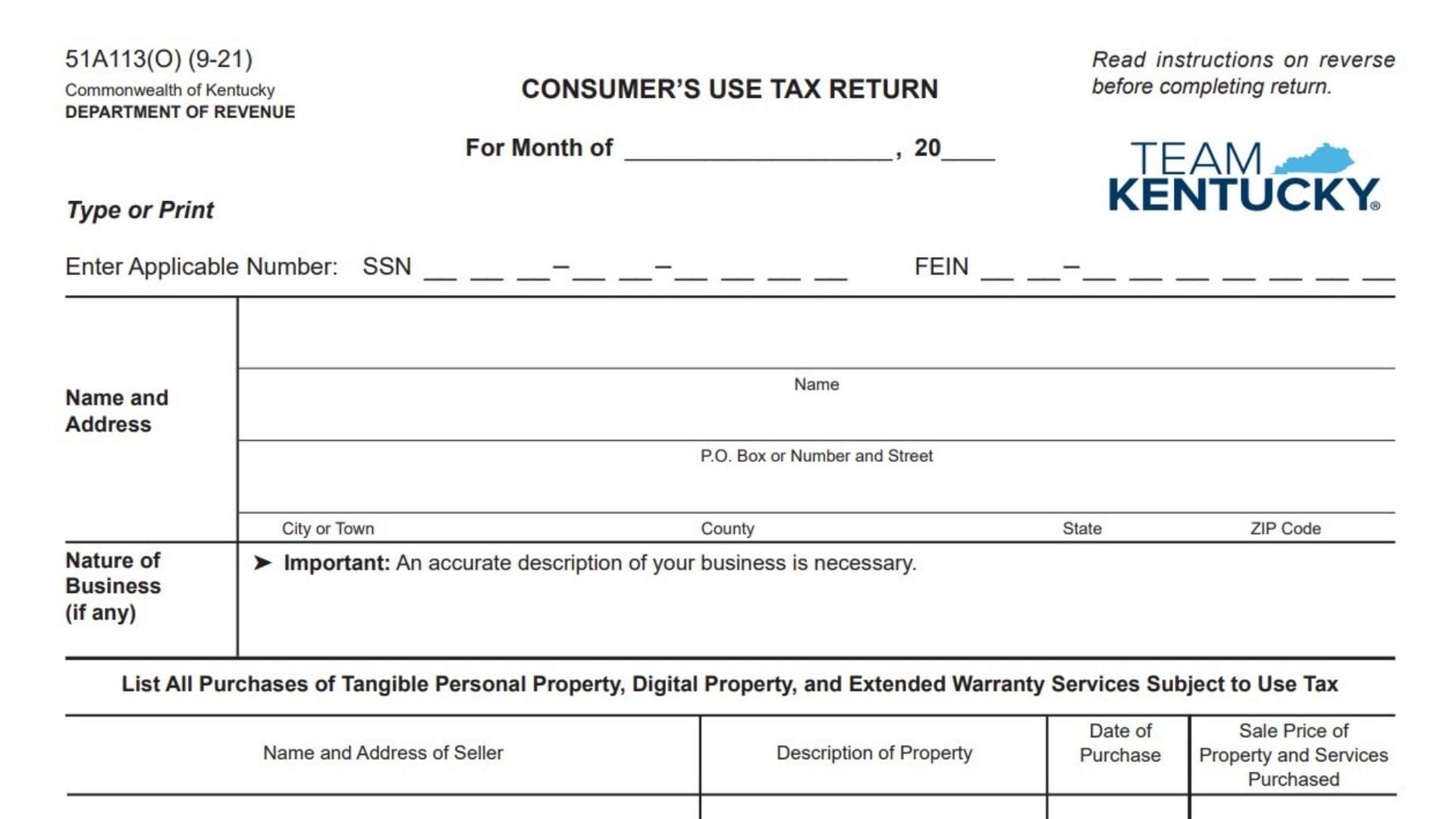
The Kentucky Consumer’s Use Tax Return, Form 51A113(O), is used by certain individuals and businesses to report Kentucky use tax on taxable purchases for which Kentucky sales or use tax was not paid to the seller. The return generally applies when tangible personal property, qualifying digital property, or taxable extended warranty services are purchased for storage, use, or consumption in Kentucky without payment of Kentucky tax. Common examples may include untaxed online purchases, mail-order purchases, items bought from out-of-state sellers, taxable digital products delivered electronically, and qualifying extended warranty agreements. This particular return is intended only for people or businesses that owe use tax but are not registered consumers or registered retailers. Registered consumers and retailers must use the return supplied by the Kentucky Department of Revenue or file through the applicable electronic system. The return is prepared for the month in which the untaxed purchase occurred and is generally due 20 days after that month ends. The purchaser lists each taxable transaction, identifies the seller, describes the property or service, provides the purchase date and taxable sales price, and calculates use tax at 6 percent. A timely filer may claim limited compensation, subject to the percentage rules and $50 maximum stated on the form. Late returns or payments may require penalties and interest. The taxpayer must sign the return under penalties of perjury, attach any necessary continuation schedule, include payment for the total amount due, and mail the return to the Kentucky Department of Revenue.
Who Should File The Kentucky Consumer’s Use Tax Return?
Use this return when all of the following apply:
- You purchased taxable property or services for storage, use, or consumption in Kentucky.
- Kentucky sales or use tax was not paid to the seller.
- You are responsible for paying the use tax.
- You are not registered with Kentucky as a consumer or retailer that files on another return.
Do not use this form if you are a registered consumer or registered retailer. Those taxpayers must use the return provided by the Department of Revenue or the applicable electronic filing process.
What Purchases Must Be Reported?
Report taxable purchases of:
- Tangible personal property.
- Qualifying digital property.
- Taxable extended warranty services.
Tangible personal property generally includes movable physical goods, such as mobile homes, campers, airplanes, lumber, clothing, tools, machines, furniture, merchandise, and similar products.
Digital property may include electronically transferred digital audio works, digital books, finished artwork, digital photographs, newspapers, periodicals, magazines, video or audio greeting cards, video games, electronic games, and related digital codes.
Extended warranty services generally involve an agreement under which the purchaser pays a provider to repair, replace, support, or maintain taxable tangible personal property or digital property. The form applies the use tax treatment to qualifying agreements sold or extended after July 1, 2018, when the underlying property is taxable under the applicable Kentucky provisions.
How To File The Kentucky Consumer’s Use Tax Return
Prepare a separate return for each month in which a taxable untaxed purchase occurred. The return is due 20 days after the end of that month.
Before completing the return, gather:
- Purchase invoices.
- Receipts.
- Seller names and addresses.
- Purchase dates.
- Descriptions of the property or services.
- Sales prices.
- Records of cash discounts.
- Information about any Kentucky tax already paid.
- Your Social Security number or federal employer identification number.
- Your complete mailing address.
- Information describing your business, when applicable.
List every taxable purchase on the front of the return. Use the continuation schedule when the available rows are not sufficient. Add the continuation schedule subtotal to the purchases listed on the front and report the complete total on Line 1.
Calculate the tax, allowable compensation, penalties, interest, and final amount due. Sign and date the return.
Make the check payable to:
Kentucky State Treasurer
Mail the completed return and payment to:
Department of Revenue
Frankfort, Kentucky 40619
Keep a copy of the signed return, continuation schedules, invoices, calculations, and payment record.

How To Complete The Kentucky Consumer’s Use Tax Return
Form And Filing Period Information
Line 1: Form Identification: This document is the Consumer’s Use Tax Return. It is intended for unregistered individuals or businesses that must report Kentucky use tax.
Line 2: Read The Instructions: Review the complete instructions before entering information or calculating tax. The instructions explain eligibility, taxable purchases, deadlines, penalties, interest, and compensation.
Line 3: For Month Of: Enter the month in which the taxable purchase or purchases were made.
For example, enter “March” for taxable purchases made during March.
Line 4: Year: Enter the four-digit year that corresponds with the reporting month.
A return for purchases made in March 2026 should show March and 2026.
Line 5: Type Or Print: Enter all information legibly. Type the return or print clearly in ink.
Taxpayer Identification
Line 6: Enter Applicable Number: Choose the identification number that applies to the taxpayer. Complete either the Social Security number field or the federal employer identification number field.
Line 7: Social Security Number: An individual filing the return in a personal capacity should enter the complete nine-digit Social Security number.
Do not enter a business identification number in this field.
Line 8: Federal Employer Identification Number: A business or other entity should enter its nine-digit federal employer identification number.
Do not enter both identification numbers unless specifically instructed to do so.
Name And Address
Line 9: Name: Enter the full legal name of the individual or business responsible for the use tax.
A business should use the legal name associated with its federal employer identification number.
Line 10: P.O. Box Or Number And Street: Enter the taxpayer’s complete mailing address.
Include a post office box, street number, street name, apartment number, suite number, or unit number when applicable.
Line 11: City Or Town: Enter the city or town associated with the mailing address.
Line 12: County: Enter the county connected with the taxpayer’s address or Kentucky business location.
Line 13: State: Enter the two-letter state abbreviation.
Line 14: ZIP Code: Enter the complete ZIP code. Include the additional four digits when known.
Nature Of Business
Line 15: Nature Of Business: If the taxpayer operates a business, provide an accurate description of its activity.
Examples include:
- Retail sale of furniture.
- Residential construction.
- Manufacturing automotive components.
- Consulting services.
- Equipment rental.
- Restaurant operations.
- Wholesale distribution.
Do not enter a vague description such as “business,” “sales,” or “services.”
Line 16: No Business Activity: When the return concerns a personal purchase and no business is involved, enter “Individual,” “Personal Purchase,” or “N/A,” as appropriate.
Purchase Listing Instructions
List every purchase of taxable tangible personal property, digital property, and extended warranty services for which Kentucky sales or use tax was not paid.
Use a separate row for each transaction whenever possible.
Seller Information
Line 17: Name And Address Of Seller: Enter the complete name and address of the seller for each purchase.
Include:
- Seller’s legal or business name.
- Street address or post office box.
- City.
- State.
- ZIP code.
For an online seller, use the seller information shown on the invoice or receipt.
Property Or Service Description
Line 18: Description Of Property: Describe the property, digital product, or extended warranty service purchased.
Use a description specific enough to identify the taxable item.
Examples include:
- Laptop computer.
- Office desk.
- Industrial cutting machine.
- Digital photography package.
- Downloadable electronic game.
- Three-year equipment warranty.
- Construction materials.
- Household furniture.
Avoid descriptions such as “items,” “goods,” or “miscellaneous.”
Purchase Date
Line 19: Date Of Purchase: Enter the month, day, and year of the transaction.
Use the invoice date or purchase date shown in the seller’s records.
Sales Price
Line 20: Sales Price Of Property And Services Purchased: Enter the taxable sales price for each purchase.
The sales price generally means the purchaser’s cost after subtracting any cash discount received.
Include the taxable amount paid for:
- Tangible personal property.
- Digital property.
- Extended warranty services.
- Other charges included in the taxable sales price.
Do not include property on which the full Kentucky sales or use tax was already paid.
Additional Space
Line 21: Additional Space Notice: When the front page does not provide enough rows, use the continuation schedule on the reverse side.
Do not combine unrelated purchases merely to avoid completing the continuation schedule.
Tax Calculation Lines
Line 1, Total Taxable Purchases
Line 22: Line 1, Total Sales Price: Add the sales prices of all taxable tangible personal property, digital property, and extended warranty services.
Include:
- Purchases listed on the front page.
- The subtotal from the continuation schedule.
- All other taxable purchases made during the reporting month.
Enter the combined amount on Line 1.
Line 2, Use Tax
Line 23: Line 2, Use Tax: Multiply Line 1 by 6 percent.
Use this calculation:
Line 1 × 0.06 = Line 2
For example, if Line 1 is $2,000:
$2,000 × 0.06 = $120
Enter $120 on Line 2.
Line 3, Compensation
Line 24: Line 3, Compensation: Calculate the allowable compensation only when the return and tax are paid on or before the due date.
Compensation is calculated as follows:
- 1.75 percent of the first $1,000 of tax.
- 1.5 percent of tax exceeding $1,000.
- Maximum total compensation of $50.
This calculation is based on the tax amount on Line 2, not the taxable purchases on Line 1.
Line 25: Compensation On The First $1,000 Of Tax: Multiply the first $1,000 of Line 2 tax by 0.0175.
The maximum compensation for this portion is $17.50.
Line 26: Compensation On Tax Over $1,000: When Line 2 exceeds $1,000, multiply the portion above $1,000 by 0.015.
Add that result to the compensation calculated on the first $1,000.
Line 27: Maximum Compensation: Do not enter more than $50 on Line 3.
Line 28: Late Filing Or Payment: Do not claim compensation when the tax is not paid on or before the return’s due date.
Line 4, Tax Due
Line 29: Line 4, Tax Due: Subtract the compensation on Line 3 from the use tax on Line 2.
Use this calculation:
Line 2 minus Line 3 = Line 4
When no compensation is allowed, Line 4 will equal Line 2.
Line 5, Penalty
Line 30: Line 5, Penalty: Enter the total applicable penalty for filing late, paying late, or both.
Do not enter a penalty when the return and payment are timely.
Late Filing Penalty
Line 31: Late Filing Penalty Rate: The late filing penalty is 2 percent of the tax for every 30 days, or part of a 30-day period, that the return is late.
Line 32: Maximum Late Filing Percentage: The percentage-based late filing penalty generally cannot exceed 20 percent of the tax.
Line 33: Minimum Late Filing Penalty: When the calculated percentage penalty is less than $10, enter the $10 minimum.
Late Payment Penalty
Line 34: Late Payment Penalty Rate: The late payment penalty is 2 percent of the unpaid tax for every 30 days, or part of a 30-day period, that payment is late.
Line 35: Minimum Late Payment Penalty: A minimum late payment penalty of $10 applies under the instructions.
Line 36: Combined Penalties: When both filing and payment are late, determine all applicable penalties and enter the total on Line 5.
Line 6, Interest
Line 37: Line 6, Interest: Enter interest due on a late tax payment.
Interest applies to unpaid tax under the applicable Kentucky underpayment interest rate.
Line 38: Interest Rate: Use the annual interest percentage that applies to the relevant late-payment period.
Do not automatically use an example rate from an earlier year.
Line 39: Daily Interest Rate: Divide the annual underpayment rate by 365.
Line 40: Number Of Days Late: Count the number of days between the payment due date and the date payment is made.
Line 41: Interest Calculation: Calculate interest using this formula:
Annual underpayment rate ÷ 365 × number of days late × unpaid tax = interest
Enter the result on Line 6.
Line 7, Total Amount Due
Line 42: Line 7, Total Amount Due And Payable: Add Lines 4, 5, and 6.
Use this calculation:
Line 4 + Line 5 + Line 6 = Line 7
Enter the complete amount that will accompany the return.
Declaration And Signature Instructions
Line 43: Perjury Declaration: Read the declaration before signing.
By signing, the taxpayer states under penalties of perjury that the return, schedules, and statements have been examined and are true, correct, and complete to the best of the taxpayer’s knowledge and belief.
Line 44: Date: Enter the date on which the return is signed.
Use the complete month, day, and year.
Line 45: Taxpayer’s Signature: The taxpayer or an authorized representative must sign the return.
For an individual purchase, the individual taxpayer should sign.
For a business, an owner, officer, partner, member, employee, or other properly authorized representative should sign.
Do not submit the return without a signature.
Payment And Mailing Instructions
Line 46: Payment Payee: Make the check payable to:
Kentucky State Treasurer
Line 47: Payment Amount: The check should equal the amount entered on Line 7 unless the Department of Revenue has instructed otherwise.
Line 48: Return And Check: Mail the signed return together with the payment.
Line 49: Mailing Recipient: Address the submission to the Department of Revenue.
Line 50: Mailing Location: Mail the return and payment to:
Department of Revenue
Frankfort, Kentucky 40619
Notice Instructions
Line 51: Limited Use Of This Return: File this return only when you owe use tax and are not a registered consumer or registered retailer.
Line 52: Registered Consumers: A registered consumer should not use this form. Use the return supplied by the Department of Revenue or the applicable electronic filing system.
Line 53: Registered Retailers: A registered retailer should not use this form. Report the tax on the retailer’s assigned return or electronic filing account.
Filing Deadline Instructions
Line 54: Monthly Filing Requirement: Prepare the return for the month in which the untaxed purchase occurred.
Line 55: Due Date: File the return within 20 days after the end of the purchase month.
For example, a taxable purchase made during March generally belongs on a return due 20 days after March ends.
Line 56: Payment Due With Return: Submit the full amount due with the return.
Filing a return without payment does not satisfy the payment obligation and may result in interest or penalties.
Tax Rate Instructions
Line 57: Six Percent Tax Rate: Calculate use tax at 6 percent of the taxable sales price of qualifying purchases made during the month without payment of sales tax.
Line 58: Purchases With Tax Already Paid: Do not include purchases on which the full Kentucky sales or use tax was properly paid.
When another jurisdiction’s tax was paid, determine whether additional Kentucky use tax is required before completing the return.
Sales Price Instructions
Line 59: Cost To The Purchaser: Begin with the amount charged to the purchaser for the taxable property or service.
Line 60: Cash Discounts: Subtract a qualifying cash discount received by the purchaser.
Line 61: Noncash Value: Consider value paid in money or another form when determining the purchase cost.
Line 62: Supporting Records: Retain invoices, receipts, contracts, and payment records supporting the sales price entered on the return.
Tangible Personal Property Instructions
Line 63: Tangible And Movable Property: Report taxable physical personal property that can be moved or transferred.
Line 64: Mobile Homes And Campers: Include taxable untaxed purchases of mobile homes, campers, or similar property when Kentucky use tax applies.
Line 65: Airplanes: Include taxable aircraft purchases when no Kentucky tax was paid and Kentucky use tax is due.
Line 66: Lumber And Construction Materials: Include untaxed lumber and similar taxable goods used or consumed in Kentucky.
Line 67: Clothing: Include taxable clothing purchases when Kentucky tax was not paid.
Line 68: Tools And Machines: Include tools, machinery, and equipment when purchased without payment of applicable Kentucky tax.
Line 69: Furniture: Include taxable household, office, or business furniture purchased without Kentucky tax.
Line 70: Other Goods And Merchandise: Report other taxable movable products that do not fall into the listed examples.
Digital Property Instructions
Line 71: Electronically Transferred Digital Property: Report qualifying digital property delivered, accessed, or transferred electronically when Kentucky tax was not paid.
Line 72: Digital Audio Works: Include qualifying downloaded or electronically transferred audio products.
Line 73: Digital Books: Include qualifying electronic books.
Line 74: Finished Artwork And Digital Photographs: Include taxable finished digital artwork and digital photographs.
Line 75: Periodicals, Newspapers, And Magazines: Include qualifying electronically transferred periodicals, newspapers, and magazines.
Line 76: Video And Audio Greeting Cards: Include qualifying electronic video or audio greeting card products.
Line 77: Video Games And Electronic Games: Include qualifying downloaded or electronically transferred games.
Line 78: Digital Codes: Include taxable digital codes connected with the listed digital property.
Extended Warranty Service Instructions
Line 79: Service Contract Agreement: Include a qualifying extended warranty agreement under which the purchaser pays for repair, replacement, support, or maintenance services.
Line 80: Covered Property: The agreement must relate to qualifying tangible personal property or digital property.
Line 81: Agreement Date: The instructions apply to qualifying service agreements sold or extended after July 1, 2018.
Line 82: Taxable Underlying Property: The property covered by the warranty must be subject to the applicable Kentucky tax provisions.
Completing The Purchase Schedule
Line 83: List Every Taxable Purchase: Enter every qualifying untaxed purchase made during the reporting month.
Line 84: Property Stored In Kentucky: Include taxable property purchased for storage in Kentucky.
Line 85: Property Used In Kentucky: Include taxable property purchased for use in Kentucky.
Line 86: Property Consumed In Kentucky: Include taxable property or services consumed in Kentucky.
Line 87: Include All Purchases On Line 1: Add every taxable amount and report the complete total on Line 1.
Additional Purchase Schedule Instructions
Use the continuation schedule when the front page does not provide enough purchase rows.
Line 88: Additional Space Heading: This section continues the list of taxable tangible personal property, digital property, and extended warranty services.
Line 89: Name And Address Of Seller: Enter the seller’s complete name and address for each additional transaction.
Line 90: Description Of Property: Clearly describe the additional property, digital product, or warranty service.
Line 91: Date Of Purchase: Enter the purchase date for each additional transaction.
Line 92: Sales Price Of Property And Services Purchased: Enter the taxable sales price of each additional purchase.
Line 93: Additional Rows: Continue listing transactions separately until every taxable purchase has been reported.
Line 94: Continuation Schedule Subtotal: Add the sales prices entered on the continuation schedule.
Line 95: Include Subtotal On Front Page: Add the continuation subtotal to the purchases listed on the front page and include the combined amount on Line 1.
Do not enter the continuation subtotal as a separate tax amount.
Compensation Calculation Example
Assume Line 2 shows $1,500 of use tax and the return is filed and paid on time.
Calculate compensation on the first $1,000:
$1,000 × 1.75% = $17.50
Calculate compensation on the remaining $500:
$500 × 1.5% = $7.50
Add the two amounts:
$17.50 + $7.50 = $25.00
Enter $25 on Line 3.
If the calculation produces more than $50, enter only $50.
Final Review Checklist
Before mailing the Kentucky Consumer’s Use Tax Return, confirm that:
- The correct reporting month and year are entered.
- The appropriate Social Security number or federal employer identification number is complete.
- The taxpayer’s legal name and address are correct.
- The nature of the business is accurately described.
- Every taxable untaxed purchase is listed.
- Each seller’s name and address are entered.
- Each property or service is clearly described.
- Every purchase date is included.
- The sales prices are accurate.
- The continuation schedule is completed when needed.
- The continuation subtotal is included on Line 1.
- Line 2 equals 6 percent of Line 1.
- Compensation is claimed only when allowed.
- Compensation does not exceed $50.
- Line 4 equals Line 2 minus Line 3.
- Applicable penalties are included on Line 5.
- Applicable interest is included on Line 6.
- Line 7 equals the total of Lines 4, 5, and 6.
- The return is signed and dated.
- The check is payable to Kentucky State Treasurer.
- The payment equals the amount due.
- The return is mailed by the applicable deadline.
- Copies of the return, invoices, schedule, and payment are retained.