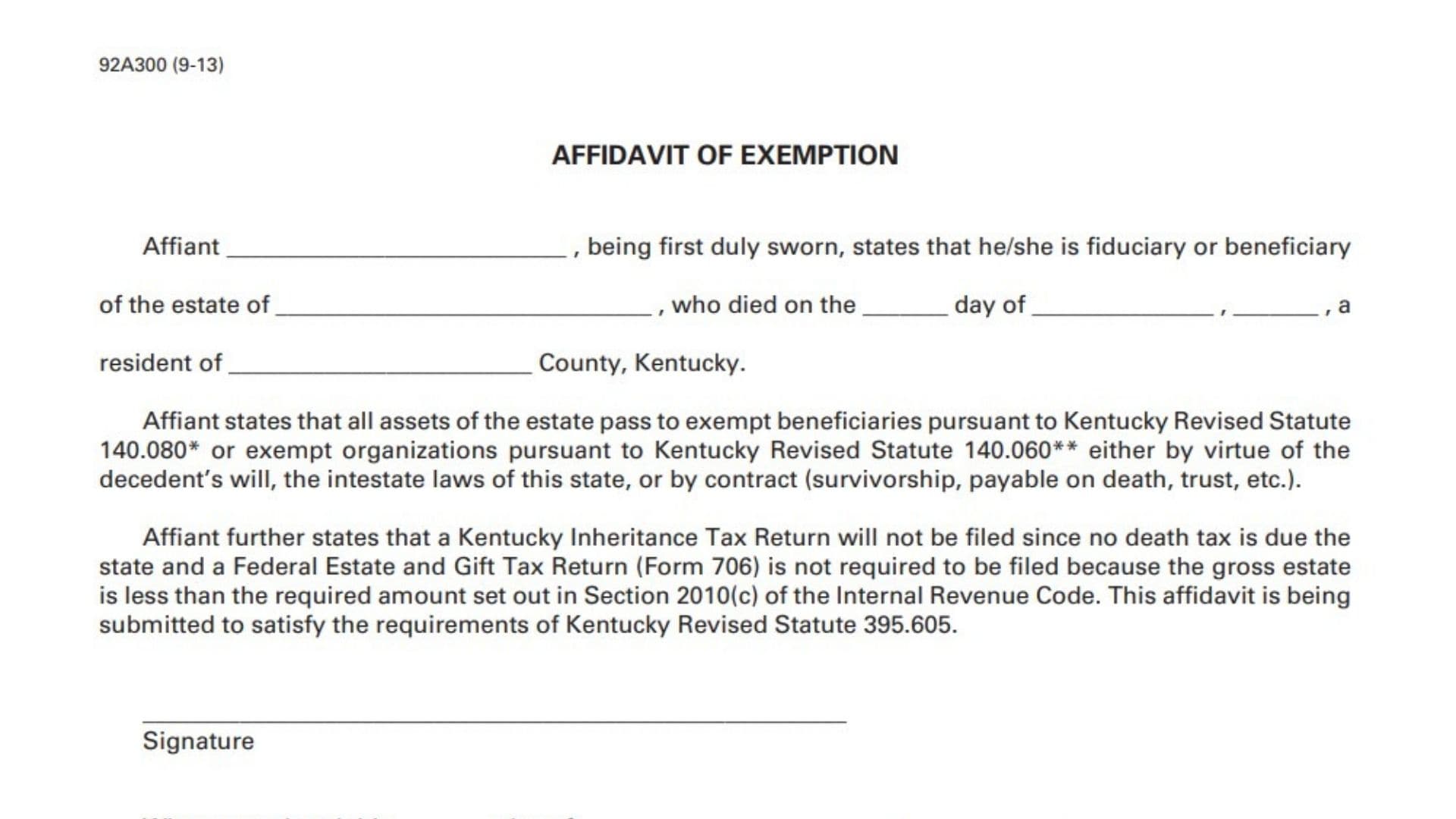
The Kentucky Affidavit of Exemption, Form 92A300, is a sworn statement used in the administration of a qualifying Kentucky estate when all estate assets pass to beneficiaries or organizations that are exempt from Kentucky inheritance tax, no Kentucky death tax is due, and the estate is not required to file a federal estate tax return. The person signing the affidavit, known as the affiant, must be a fiduciary or beneficiary of the deceased person’s estate. Through the affidavit, the affiant confirms the decedent’s identity, date of death, Kentucky county of residence, and the exempt status of every person or organization receiving estate property. Property may pass through the decedent’s will, Kentucky intestate succession law, survivorship ownership, a payable-on-death designation, a trust, or another qualifying contract. The affidavit also states that a Kentucky Inheritance Tax Return will not be filed because no Kentucky inheritance tax is owed and that a Federal Estate and Gift Tax Return, commonly called Form 706, is not required because the estate is below the applicable federal filing threshold. The affidavit is submitted to meet estate settlement requirements and may be used in connection with closing the administration of an estate. Because it is a sworn legal statement, the affiant should verify every beneficiary, transfer method, property interest, and federal filing requirement before signing. The document must be signed in front of a notary public, who completes the acknowledgment and commission information.
Who Can Use The Kentucky Affidavit Of Exemption?
This affidavit may be appropriate when all of the following conditions are satisfied:
- The person completing it is a fiduciary or beneficiary of the estate.
- The decedent was a resident of a Kentucky county.
- Every estate asset passes to an exempt beneficiary or qualifying exempt organization.
- No Kentucky inheritance tax is due.
- A Kentucky Inheritance Tax Return will not be filed.
- A Federal Estate and Gift Tax Return is not required for the estate.
- The affidavit is being provided as part of the final settlement or closing of the estate administration.
Do not use the affidavit when any estate asset passes to a taxable recipient or when Kentucky inheritance tax is due. A proper Kentucky inheritance tax return may be required in that situation.
Who Qualifies As An Exempt Beneficiary?
The beneficiary categories identified on the form include:
- The decedent’s spouse.
- The decedent’s child.
- The decedent’s stepchild.
- The decedent’s grandchild.
- The decedent’s parent.
- The decedent’s brother.
- The decedent’s sister.
The estate should verify the exact legal relationship of every recipient. Do not assume that all relatives qualify merely because they are members of the decedent’s family.
What Qualifies As An Exempt Organization?
A qualifying exempt organization may include an educational, religious, charitable, or similar institution, society, or association whose sole purpose is to carry out charitable, educational, or religious work.
A Kentucky city, town, or public institution may also qualify when the transfer is made for a public purpose.
Before relying on this exemption, confirm the organization’s legal name, purpose, status, and intended use of the transferred property.
How To File The Kentucky Affidavit Of Exemption
Begin by reviewing the decedent’s estate plan and every method through which property passes. Examine the will, trust documents, deeds, survivorship arrangements, payable-on-death accounts, transfer-on-death registrations, beneficiary designations, contracts, and Kentucky intestate succession rules.
Prepare a complete list of estate beneficiaries and organizations. Confirm that each recipient qualifies for exempt treatment and that no property passes to a taxable beneficiary.
Determine whether a Federal Estate and Gift Tax Return is required for the estate. Federal filing thresholds and requirements can depend on the decedent’s year of death and other circumstances, so confirm the applicable rules before signing the affidavit.
Gather the following information:
- The affiant’s full legal name.
- The affiant’s role as fiduciary or beneficiary.
- The decedent’s full legal name.
- The decedent’s complete date of death.
- The Kentucky county in which the decedent resided.
- A list of all beneficiaries and their relationships to the decedent.
- Information about any exempt organizations receiving property.
- The will, trust, beneficiary designations, or other transfer documents.
- Information needed to determine whether a federal estate tax return is required.
Complete the affidavit without leaving unexplained blanks. Do not sign it in advance. The affiant must sign before a notary public, who will complete the notarization section.
Submit the completed and notarized affidavit to the court, estate representative, clerk, or other party handling the final settlement and closing of the estate, as required by the estate administration process.
Keep a copy of the signed affidavit and all supporting records with the estate’s permanent files.

How To Complete The Kentucky Affidavit Of Exemption
Affiant And Estate Identification
Line 1: Affidavit Of Exemption: This is the title of the document. It identifies the filing as a sworn statement that the estate qualifies for exemption from Kentucky inheritance tax filing requirements.
Line 2: Affiant: Enter the complete legal name of the person making the sworn statement.
Use the person’s first name, middle name or initial, and last name. Include a suffix when applicable.
The person entered here must be able to truthfully confirm the estate information contained in the affidavit.
Line 3: Fiduciary Or Beneficiary Status: Confirm that the affiant is either a fiduciary or beneficiary of the estate.
A fiduciary may be an executor, administrator, personal representative, or another person legally responsible for administering the estate.
A beneficiary is a person entitled to receive property from the estate.
Although the form does not provide a separate checkbox, the affiant should understand and be able to establish the capacity in which the affidavit is signed.
Line 4: Estate Of: Enter the decedent’s complete legal name.
Use the same name shown on the death certificate, probate documents, will, trust, and other estate records.
Do not enter the name of the executor, administrator, or beneficiary in this blank.
Date Of Death
Line 5: Day Of Death: Enter the numerical day of the month on which the decedent died.
For example, enter “15” when the death occurred on March 15.
Line 6: Month Of Death: Enter the full name of the month in which the decedent died.
For example, enter “March.”
Line 7: Year Of Death: Enter the four-digit year in which the decedent died.
The completed date should agree with the death certificate and all other estate filings.
Kentucky County Of Residence
Line 8: County Of Residence: Enter the name of the Kentucky county in which the decedent was a resident at the time of death.
Enter only the county name in the blank because the word “County” already appears after it.
For example, enter “Fayette,” not “Fayette County.”
Residence in this section generally refers to the decedent’s permanent legal residence or domicile at death.
Statement About Exempt Estate Assets
Line 9: All Estate Assets Pass To Exempt Recipients: By completing and signing the affidavit, the affiant states that every asset of the estate passes to an exempt beneficiary or exempt organization.
Review all probate and nonprobate assets before making this statement. This includes property passing outside the will.
Examples may include:
- Joint property with survivorship rights.
- Payable-on-death bank accounts.
- Transfer-on-death securities.
- Trust property.
- Real estate.
- Personal property.
- Business interests.
- Financial accounts.
- Contractual death benefits.
- Property distributed under Kentucky intestate law.
The statement must be true for all estate assets. One transfer to a taxable beneficiary may prevent the estate from using this affidavit.
Line 10: Exempt Beneficiaries: Confirm that each individual receiving property belongs to an exempt beneficiary class under the Kentucky inheritance tax rules identified in the affidavit.
Record each beneficiary’s exact relationship to the decedent in the estate files.
Do not describe a beneficiary only as a relative. Identify the specific relationship, such as spouse, child, grandchild, parent, brother, or sister.
Line 11: Exempt Organizations: Confirm that every organization receiving estate property qualifies for exempt treatment.
Retain documentation showing the organization’s:
- Complete legal name.
- Charitable, educational, religious, or public purpose.
- Address.
- Organizational status.
- Intended use of the property.
When property passes to a city, town, or public institution in Kentucky, confirm that the transfer is for a public purpose.
Method By Which Property Passes
Line 12: Property Passing Under The Will: Include property distributed according to the decedent’s valid Last Will and Testament.
Review all will provisions, codicils, specific gifts, residuary distributions, and trust provisions to confirm the identity of each recipient.
Line 13: Property Passing Under Intestate Law: Include property distributed under Kentucky intestate succession law when the decedent died without a will or when the will did not control all property.
Confirm that every intestate heir receiving property qualifies for exemption.
Line 14: Property Passing By Contract: Include property passing under a contractual or ownership arrangement rather than through probate.
This may include:
- Survivorship property.
- Payable-on-death accounts.
- Transfer-on-death accounts.
- Trust property.
- Contractual beneficiary arrangements.
- Other property that transfers automatically at death.
Review the governing contract or account designation instead of relying only on the will.
Statement About The Kentucky Inheritance Tax Return
Line 15: Kentucky Inheritance Tax Return Will Not Be Filed: By signing the affidavit, the affiant states that the estate will not file a Kentucky Inheritance Tax Return.
Make this statement only after confirming that the estate satisfies the exemption requirements.
An affidavit should not be used simply to avoid preparing a tax return when one is legally required.
Line 16: No Kentucky Death Tax Is Due: Confirm that the estate owes no Kentucky inheritance or death tax.
The estate’s tax status depends primarily on who receives the property and whether each recipient qualifies for an exemption.
Review every beneficiary and transfer before making this statement.
Statement About The Federal Estate Tax Return
Line 17: Federal Estate And Gift Tax Return Not Required: Confirm that the estate is not required to file Federal Estate and Gift Tax Return Form 706.
The affidavit should not be signed until the federal filing requirement has been reviewed.
A federal return may be required for reasons not apparent from the estate’s probate value alone. Consider all property included in the federal gross estate and any other applicable filing rules.
Line 18: Gross Estate Below The Filing Requirement: Confirm that the estate’s gross value is below the federal filing amount that applies under the relevant Internal Revenue Code provision.
Use the federal threshold applicable to the decedent’s year of death.
The gross estate may include more than property passing through probate. Review life insurance, trusts, jointly owned property, retirement benefits, transferred property, and other interests that may be included for federal purposes.
Line 19: Internal Revenue Code Section 2010(c): This reference identifies the federal provision associated with the applicable estate tax exclusion or filing amount.
No separate information must be entered for this reference, but the affiant must confirm that the estate falls below the applicable federal filing requirement.
Purpose Of The Affidavit
Line 20: Kentucky Revised Statute 395.605 Requirement: The affidavit states that it is being submitted to satisfy the estate settlement requirement identified in the form.
The affidavit may be used in connection with the final settlement and closing of the estate administration.
No information must be written on this reference line, but the affiant should understand the purpose for which the document is being submitted.
Affiant Signature Section
Line 21: Signature: The affiant must sign on the signature line.
Do not type or print the affiant’s name in place of a handwritten or otherwise legally accepted signature.
The person named as the affiant at the beginning of the document should be the same person who signs it.
The affiant should sign only after confirming that:
- Every estate asset has been reviewed.
- Every beneficiary is exempt.
- Every organization qualifies for exemption.
- No Kentucky inheritance tax is due.
- No Kentucky Inheritance Tax Return will be filed.
- A federal estate tax return is not required.
- All statements are accurate.
Do not sign the affidavit before appearing before the notary unless the notary specifically directs the affiant to do so.
Witness And Notarization Section
Witness Date
Line 22: Witness My Hand, Day: Enter the numerical day on which the affidavit is signed.
This should normally be the date on which the affiant appears before the notary.
Line 23: Witness My Hand, Month: Enter the full name of the month in which the affidavit is signed.
Line 24: Witness My Hand, Year: Enter the four-digit year in which the affidavit is signed.
The complete date should be consistent with the notarization date unless a legally valid reason exists for a difference.
Notarial Acknowledgment
Line 25: Sworn And Subscribed Before Me By: The notary public enters or confirms the full legal name of the affiant who appeared and swore to the affidavit.
The name should match the affiant’s name at the beginning of the document and the signature line.
The notary may require satisfactory identification before completing this section.
Line 26: Notarization Day: Enter the numerical day on which the affidavit was sworn and subscribed before the notary.
Line 27: Notarization Month: Enter the full name of the month in which the notarization occurred.
Line 28: Notarization Year: Enter the four-digit year in which the notarization occurred.
Line 29: Notary Public: The notary public signs the designated line.
The affiant should not sign or write the notary’s name on this line.
The notary should add any seal, stamp, identification number, county information, or other details required for a valid notarization.
Line 30: My Commission Expires: The notary enters the expiration date of the notarial commission.
The affiant should leave this field for the notary.
The notary’s commission must be valid on the date the affidavit is notarized.
Exempt Beneficiary Information
Line 31: Spouse: A surviving spouse is included among the exempt beneficiary categories identified on the affidavit.
Line 32: Children: The decedent’s qualifying children are included among the exempt beneficiary categories.
Line 33: Stepchildren: The decedent’s qualifying stepchildren are included among the exempt beneficiary categories.
Line 34: Grandchildren: The decedent’s qualifying grandchildren are included among the exempt beneficiary categories.
Line 35: Parent: A qualifying transfer to the decedent’s parent is included among the exempt beneficiary categories.
Line 36: Brother: A qualifying transfer to the decedent’s brother is included among the exempt beneficiary categories.
Line 37: Sister: A qualifying transfer to the decedent’s sister is included among the exempt beneficiary categories.
When the relationship is unusual, disputed, or affected by adoption, remarriage, or another legal circumstance, confirm the beneficiary’s classification before using the affidavit.
Exempt Organization Information
Line 38: Educational Organizations: An organization devoted solely to qualifying educational work may be treated as an exempt organization.
Line 39: Religious Organizations: An organization devoted solely to qualifying religious work may be treated as exempt.
Line 40: Charitable Organizations: An institution, society, or association devoted solely to qualifying charitable work may be treated as exempt.
Line 41: Sole-Purpose Requirement: Confirm that the organization’s sole purpose is to carry out the charitable, educational, or religious activity required for exemption.
Line 42: Kentucky Cities And Towns: A Kentucky city or town may qualify as an exempt recipient when the transferred property will be used for public purposes.
Line 43: Public Institutions: A Kentucky public institution may qualify when it receives property for an eligible public purpose.
Line 44: Public-Purpose Requirement: Confirm and document the public purpose for which the city, town, or public institution will use the transferred property.
Form Identification
Line 45: Form Number And Revision Date: The form identification is 92A300 with a September 2013 revision date.
Nothing needs to be entered on this line. It identifies the version of the affidavit being completed.
Before submitting the affidavit, confirm that the court or agency handling the estate accepts this version.
Final Review Checklist
Before signing and submitting the Kentucky Affidavit of Exemption, confirm that:
- The affiant’s full legal name is entered.
- The affiant is a fiduciary or beneficiary of the estate.
- The decedent’s full legal name is correct.
- The complete date of death is entered.
- The decedent’s Kentucky county of residence is correct.
- Every probate asset has been reviewed.
- Every nonprobate asset has been reviewed.
- Every beneficiary is exempt.
- Every organization qualifies for exemption.
- Property passing by will has been reviewed.
- Property passing under intestate law has been reviewed.
- Survivorship and payable-on-death property has been reviewed.
- Trust and contractual transfers have been reviewed.
- No Kentucky inheritance tax is due.
- A Kentucky Inheritance Tax Return is not required.
- The federal estate tax filing requirement has been checked.
- The affidavit has not been signed in advance of notarization.
- The affiant signs before the notary.
- The signature and notarization dates are complete.
- The notary signs the document.
- The notary enters the commission expiration date.
- Any required notarial seal or stamp is included.
- A complete copy is retained with the estate records.