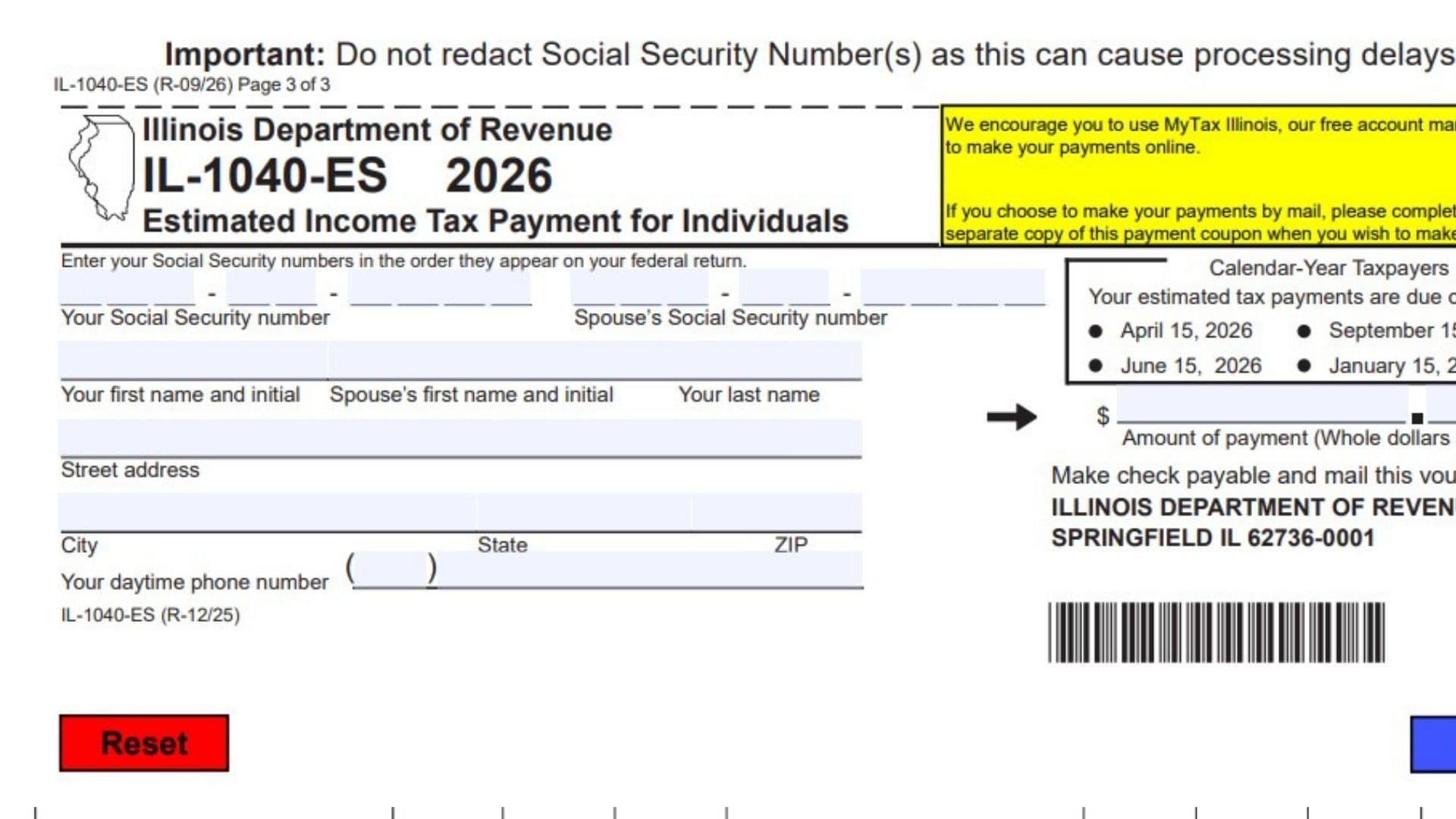
Illinois Form IL-1040-ES, officially titled Estimated Income Tax Payments for Individuals, is a tax form issued by the Illinois Department of Revenue. It is used by individuals to calculate and make estimated state income tax payments during the 2026 tax year. The form helps taxpayers pay their expected Illinois income tax liability throughout the year rather than waiting until they file their annual income tax return.
Estimated tax payments are generally required when an individual reasonably expects their 2026 Illinois income tax liability to exceed $1,000 after subtracting Illinois income tax withholding, pass-through withholding, and certain eligible tax credits. These credits include income taxes paid to other states, Illinois property tax credits, K-12 education expenses, volunteer emergency worker credits, Earned Income Tax Credit (EITC), Child Tax Credit, Pass-Through Entity Tax credits, and credits reported through Schedule 1299-C.
The form is particularly relevant to individuals who receive income that is not fully subject to Illinois withholding. This may include taxpayers whose income is entirely or partially exempt from withholding. It also applies to individuals who expect their withholding and available tax credits to be insufficient to cover their Illinois income tax liability.
Form IL-1040-ES contains an Estimated Tax Worksheet, an Amended Estimated Tax Worksheet, a Record of Estimated Tax Payments, and individual estimated tax payment vouchers. The Estimated Tax Worksheet helps taxpayers calculate their expected Illinois taxable income, estimated tax liability, available withholding, credits, and required installment payments. The Amended Estimated Tax Worksheet helps recalculate future payments when income or other tax circumstances change during the year.
The payment voucher is used when taxpayers choose to pay by check or money order. It collects identifying information, including Social Security Numbers, taxpayer names, mailing address, telephone number, and payment amount. The record of estimated tax payments provides space to track voucher amounts, payment dates, and check or money order numbers.
Completing Form IL-1040-ES correctly is important because insufficient or late estimated tax payments may result in penalties. Taxpayers must calculate their estimated liability carefully, follow the applicable payment schedule, account for eligible withholding and credits, and maintain accurate payment records. The form also provides electronic payment options through MyTax Illinois, credit card services, and electronic funds transfer.
How To File Illinois Form IL-1040-ES
Illinois Form IL-1040-ES is used to calculate and submit estimated income tax payments for individuals for the 2026 tax year.
Taxpayers can make payments electronically or by mailing the appropriate estimated tax payment voucher with a check or money order.
Who Must Make Estimated Income Tax Payments?
You generally must make estimated income tax payments if you reasonably expect your 2026 Illinois income tax liability to exceed $1,000 after subtracting:
- Illinois income tax withholding.
- Pass-through withholding.
- Income tax paid to other states credit.
- Illinois property tax credit.
- K-12 education expenses credit.
- Volunteer Emergency Worker credit.
- Earned Income Tax Credit (EITC).
- Child Tax Credit.
- Pass-Through Entity Tax credit.
- Schedule 1299-C income tax subtractions and credits for individuals.
You will likely need to make estimated payments if your income is fully or partially exempt from Illinois income tax withholding.
Exceptions To Estimated Tax Payments
The form identifies two categories of taxpayers who do not have to make estimated payments:
Individuals Age 65 Or Older Living In A Nursing Home
You are not required to make estimated tax payments if you are at least 65 years old and permanently living in a nursing home.
Farmers
Farmers are exempt from the estimated payment requirement described in the form.
For this purpose, you qualify as a farmer if at least two-thirds of your total federal gross income comes from farming.
2026 Estimated Tax Payment Due Dates
The first estimated tax payment is due April 15, 2026.
You can either pay the entire estimated tax amount on that date or divide the amount into four equal installments.
The payment schedule for calendar-year taxpayers is:
| Installment | Due date |
|---|---|
| First payment | April 15, 2026 |
| Second payment | June 15, 2026 |
| Third payment | September 15, 2026 |
| Fourth payment | January 15, 2027 |
If you file your tax return using a fiscal year rather than a calendar year, adjust the payment dates to correspond to your tax year.
What Happens If You Do Not Make Estimated Payments?
If you fail to make required estimated payments on time, the Illinois Department of Revenue may assess a late-payment penalty.
Generally, payments are applied to the earliest outstanding due date until the corresponding liability is paid, unless you provide specific instructions to apply a payment to another period.
However, you may avoid the estimated tax penalty if you pay at least one of the following amounts in four equal, timely installments:
- 90% of your current year’s tax liability.
- 100% of your previous year’s tax liability.
For additional information about penalties and interest, consult Illinois Publication 103, Penalties and Interest for Illinois Taxes.
Information To Prepare Before Completing The Form
Gather the following information before calculating your estimated tax:
- Expected Illinois base income for 2026.
- Expected exemption amount for 2026.
- Expected Illinois income tax withholding.
- Expected pass-through withholding.
- Expected income tax paid to other states credit.
- Expected Illinois property tax credit.
- Expected K-12 education expenses credit.
- Expected Volunteer Emergency Worker credit.
- Expected Earned Income Tax Credit.
- Expected Child Tax Credit.
- Expected Pass-Through Entity Tax credit.
- Expected Schedule 1299-C credits.
- Applicable surcharges.
- Previous-year overpayment applied to 2026, if applicable.
- Social Security Number.
- Spouse’s Social Security Number, if filing jointly.
- Taxpayer and spouse names.
- Mailing address and telephone number.
- Estimated payment information.
- Check or money order details, if paying by mail.
If you plan to file a joint income tax return, calculate your estimated tax using your combined expected income.

How To Complete Illinois Form IL-1040-ES
Form IL-1040-ES contains several sections designed to help taxpayers calculate their estimated tax, adjust payments when necessary, record completed payments, and submit individual payment vouchers.
The following instructions explain each section and numbered worksheet line.
Estimated Tax Worksheet
The Estimated Tax Worksheet appears on page 2 of Form IL-1040-ES.
Complete this worksheet to determine your expected 2026 Illinois income tax liability and calculate whether estimated payments are required.
The worksheet contains 11 lines covering expected income, exemptions, tax calculations, surcharges, withholding, credits, and installment payments.
Line-by-Line Estimated Tax Worksheet Instructions
Line 1: Illinois Base Income Expected In 2026
Enter the total Illinois base income you reasonably expect to receive during 2026.
Use the applicable income information and instructions associated with Form IL-1040, Illinois Individual Income Tax Return.
Your estimate should reflect the income you expect to receive during the entire tax year.
Line 2: Total Expected Exemption Amount
Enter the total exemption amount you expect to claim on your 2026 Illinois income tax return.
Use the amount expected to be reported on Form IL-1040, Line 10.
Refer to Form IL-1040 and the Schedule IL-E/EITC Instructions when determining the applicable exemption amount.
Line 3: Expected Net Income For 2026
Subtract Line 2 from Line 1.
The calculation is:
Net Expected Income = Line 1 − Line 2.
This amount represents your expected net income for the 2026 tax year after accounting for the exemption amount entered on Line 2.
Line 4: Illinois Income Tax Calculation
Multiply the amount on Line 3 by the Illinois income tax rate of 4.95%.
The calculation is:
Line 4 = Line 3 × 0.0495.
Enter the resulting amount on Line 4.
Line 5: Applicable Surcharges
Enter the amount of surcharges you expect to owe during 2026 for the following:
- Compassionate Use of Medical Cannabis Program Act surcharge.
- Sale of assets by gaming licensee surcharges.
Enter the combined expected surcharge amount on Line 5.
If neither surcharge applies, enter zero.
Line 6: Total Estimated Tax Before Withholding And Credits
Add Line 4 and Line 5.
The calculation is:
Line 6 = Line 4 + Line 5.
This amount represents your estimated Illinois tax and applicable surcharges before subtracting withholding and tax credits.
Line 7: Expected Illinois Income Tax Withholding And Pass-Through Withholding
Enter the total Illinois income tax you expect to have withheld from your wages or other income during 2026.
Also include any pass-through withholding you expect to be paid on your behalf during the tax year.
Combine the applicable withholding amounts and enter the total on Line 7.
Line 8: Expected Illinois Tax Credits
Enter the total amount of eligible tax credits you expect to claim on your 2026 Illinois income tax return.
The form identifies the following credit categories:
- Illinois property tax paid.
- Volunteer Emergency Worker credit.
- Income tax paid to other states.
- K-12 education expenses credit.
- Earned Income Tax Credit (EITC).
- Child Tax Credit.
- Pass-Through Entity Tax credit.
- Tax credits reported through Schedule 1299-C.
Add the applicable expected credits and enter the combined amount on Line 8.
Line 9: Total Withholding And Credits
Add Line 7 and Line 8.
The calculation is:
Line 9 = Line 7 + Line 8.
This amount represents your combined expected Illinois withholding, pass-through withholding, and eligible tax credits.
Line 10: Estimated Illinois Tax For 2026
Subtract Line 9 from Line 6.
The calculation is:
Line 10 = Line 6 − Line 9.
This amount represents your estimated Illinois income tax liability after accounting for expected withholding and credits.
The result determines whether you need to make estimated tax payments.
- If Line 10 is $1,000 or less, stop. You are not required to make estimated tax payments at this time.
- If Line 10 is more than $1,000, continue to Line 11.
If your income changes during the year, complete the Amended Estimated Tax Worksheet to recalculate your remaining payments.
Line 11: Amount Of Each Estimated Tax Payment
Divide Line 10 by four.
The calculation is:
Line 11 = Line 10 ÷ 4.
Round the result to the nearest whole dollar.
The amount on Line 11 represents each of your four estimated tax installments.
These installments are generally due April 15, June 15, and September 15, 2026, and January 15, 2027.
Special Rule For Previous-Year Overpayments
If you elected to apply a previous-year tax overpayment toward your 2026 estimated tax, you may be able to reduce your first estimated payment and subsequent payments.
The treatment depends on when the election was made:
- If you made the election on or before the extended due date of your previous-year return, you may reduce your first and subsequent estimated payments until the entire credit is used.
- If you made the election after the extended due date of your previous-year return, the credit is considered paid on the date you made the election.
Consider this rule when determining the actual amount to pay with your estimated tax installments.
Amended Estimated Tax Worksheet
Use the Amended Estimated Tax Worksheet when your expected income or other tax circumstances change during 2026.
You should recalculate your estimated tax using the revised information rather than continuing to rely on the original payment calculation.
When your income changes:
- Recalculate the Estimated Tax Worksheet using your updated income and tax information.
- Take the revised amount from the original worksheet’s Line 10.
- Enter that amount on Line 1 of the Amended Estimated Tax Worksheet.
- Complete the amended worksheet calculations for Lines 2 through 8.
Line-by-Line Amended Estimated Tax Worksheet Instructions
Line 1: Amended Estimated Tax
Enter the revised estimated tax amount from Line 10 of the Estimated Tax Worksheet.
Use the updated calculation that reflects your changed income or tax circumstances.
Line 2: Estimated Tax Per Installment
Divide Line 1 by four.
The calculation is:
Line 2 = Line 1 ÷ 4.
This amount represents the revised estimated payment for each installment before considering previous payments.
Line 3: Estimated Payments Already Made
Enter the total estimated tax payments already made using 2026 Forms IL-1040-ES.
Also include any previous-year overpayment that was applied to the 2026 tax year.
Add all applicable payments and enter the total on Line 3.
Line 4: Previously Due Estimated Payments
Multiply Line 2 by the number of estimated tax payments that were previously due.
The calculation is:
Line 4 = Line 2 × Number of Previously Due Installments.
This amount represents the revised installment total for the payment periods that have already become due.
Line 5: Difference Between Revised And Actual Payments
Subtract Line 3 from Line 4.
The calculation is:
Line 5 = Line 4 − Line 3.
This amount represents the difference between the revised payment requirement for previously due installments and the estimated payments already made.
The result may be negative.
Line 6: Amount Due On The Next Payment Date
Add Line 2 and Line 5.
Round the result to the nearest whole dollar.
The calculation is:
Line 6 = Line 2 + Line 5.
Use the result as follows:
- If Line 6 is positive, this is the amount due on your next payment date.
- If Line 6 is zero, nothing is due on the next payment date.
- If Line 6 is negative, nothing is due on the next payment date, and you must continue to Line 7.
If Line 6 is zero or positive, stop the amended worksheet calculation.
Line 7: Negative Amount From Line 6
Complete this line only if Line 6 is negative.
Enter the amount from Line 6 as a positive number.
For example, if Line 6 is negative $300, enter $300 on Line 7.
This amount is used to adjust the following installment.
Line 8: Amount Due On The Following Payment Date
Subtract Line 7 from Line 2.
Round the result to the nearest whole dollar.
The calculation is:
Line 8 = Line 2 − Line 7.
The resulting amount represents the estimated tax payment due on the following payment date, if applicable.
Estimated Tax Payment Voucher
The payment voucher is used when you choose to pay your estimated Illinois income tax by check or money order.
Complete a separate payment voucher for each estimated payment you wish to submit by mail.
The voucher appears on page 3 of Form IL-1040-ES.
Voucher Identification Information
Your Social Security Number
Enter your Social Security Number in the designated field.
Spouse’s Social Security Number
If you are filing a joint income tax return, enter your spouse’s Social Security Number.
Enter both Social Security Numbers in the same order in which they will appear on your federal income tax return.
Your First Name And Initial
Enter your first name and middle initial.
Spouse’s First Name And Initial
If filing jointly, enter your spouse’s first name and middle initial.
Your Last Name
Enter the last name associated with the tax return.
Street Address
Enter your complete residential mailing address, including the street number and street name.
City
Enter the city associated with your mailing address.
State
Enter the state abbreviation for your address.
ZIP
Enter your ZIP code.
Your Daytime Phone Number
Enter a telephone number where the Illinois Department of Revenue can reach you during normal business hours.
Include the appropriate area code.
Amount Of Payment
Enter the amount you are paying from Line 11 of the Estimated Tax Worksheet.
The voucher requires the payment amount to be entered in whole dollars.
Make sure the amount matches the installment being submitted.
Payment Voucher Due Dates
The voucher identifies the estimated payment dates for calendar-year taxpayers:
- April 15, 2026.
- June 15, 2026.
- September 15, 2026.
- January 15, 2027.
Use a separate voucher for each payment when paying by mail.
Check Or Money Order Instructions
Make your check or money order payable to:
Illinois Department of Revenue.
Mail the payment voucher and check or money order to:
Illinois Department of Revenue
Springfield, IL 62736-0001
Before mailing, print the following information on your payment:
- Your Social Security Number or Social Security Numbers.
- The applicable tax year.
- IL-1040-ES.
Detach the completed voucher and enclose it with your payment.
Do not mail the voucher when making an electronic payment.
Record Of Estimated Tax Payments
Page 3 of Form IL-1040-ES includes a Record of Estimated Tax Payments section.
This section helps taxpayers maintain a record of the estimated tax installments submitted during the year.
Use it to track each payment and maintain accurate payment records.
Voucher Amount
Enter the amount reported on each estimated tax payment voucher.
Record the actual amount submitted for the corresponding installment.
Voucher Date
Enter the date associated with the estimated tax voucher or payment.
This helps identify when each estimated payment was made.
Check Or Money Order Number
If you paid by check or money order, enter the corresponding check or money order number.
This information helps you identify and verify individual payments.
Total
Add the amounts recorded in the Voucher Amount column.
Enter the combined payment total in the Total row.
Keep this record updated as you make each estimated tax payment throughout 2026.
Electronic Payment Options
The Illinois Department of Revenue encourages taxpayers to use electronic payment methods when making estimated tax payments.
The form provides three electronic payment options.
Online Payment Through MyTax Illinois
Taxpayers can make estimated payments online through MyTax Illinois.
Visit mytax.illinois.gov to arrange a payment directly from your checking or savings account.
You will need your Illinois Personal Identification Number (IL-PIN).
Credit Card Payment
You can pay estimated taxes using one of the following credit cards:
- MasterCard.
- Discover.
- American Express.
- Visa.
The credit card service provider charges a convenience fee.
Visit tax.illinois.gov/payments/creditcard to access the credit card payment service.
Have your credit card information ready before starting the transaction.
Electronic Funds Transfer (EFT)
Taxpayers can also make payments through Electronic Funds Transfer.
To use this method, complete Form EFT-1, Authorization Agreement for Certain Electronic Payments.
For additional information or to obtain the form, visit tax.illinois.gov.
Important Electronic Payment Rule
If you pay electronically, do not mail the estimated tax payment voucher.
The voucher is intended for payments submitted by check or money order.
Important Filing And Calculation Rules
Before submitting your estimated tax payments, review the following requirements.
Joint Tax Return Calculations
If you plan to file a joint Illinois income tax return, calculate your estimated tax using your combined expected income.
Do not calculate the estimated payment using only one spouse’s income when the intended filing status is joint.
Changes In Income During The Year
If your income changes during 2026, recalculate your estimated tax liability.
Use the revised information to complete the Amended Estimated Tax Worksheet and determine the amount required for your remaining installments.
Uneven Income During The Year
If you do not receive your income evenly throughout the year or need to begin making estimated payments in the middle of the year, the regular installment calculation may not fully reflect your circumstances.
The instructions refer taxpayers to Form IL-2210, Computation of Penalties for Individuals, for additional information about annualizing income.
Fiscal-Year Taxpayers
If you file using a fiscal year, adjust the estimated payment due dates to correspond to your tax year.
The dates printed on the form are for calendar-year taxpayers.
Estimated Tax Payment Penalties
Late or insufficient estimated tax payments may result in penalties.
The form identifies a potential penalty exception when you pay at least 90% of your current-year tax or 100% of your previous-year tax in four equal, timely installments.
For additional information, consult Publication 103, Penalties and Interest for Illinois Taxes.
Who Should Not Use Form IL-1040-ES Vouchers?
The form specifically instructs taxpayers filing the following returns not to use IL-1040-ES payment vouchers:
- Form IL-990-T.
- Form IL-1041.
- Form IL-1065.
- Form IL-1120.
- Form IL-1120-ST.
These taxpayers should use the estimated tax payment voucher associated with their respective return type when making voluntary tax prepayments.
Where To Get Help With Illinois Form IL-1040-ES
If you need additional assistance with estimated tax calculations, payments, or filing requirements, contact the Illinois Department of Revenue.
Website: tax.illinois.gov
Telephone:
- 1-800-732-8866.
- 217-782-3336.
- TTY: 1-800-544-5304.
Mailing Address:
Illinois Department of Revenue
P.O. Box 19044
Springfield, Illinois 62794-9044
You may also visit a regional office for assistance.
Office Hours:
- Springfield office: 8:00 a.m. to 5:00 p.m.
- Other regional offices: 8:30 a.m. to 5:00 p.m.
Office hours are Monday through Friday.
Final Review Before Filing
Before submitting Illinois Form IL-1040-ES for 2026, review the worksheet, payment calculations, voucher, and payment records.
Use the following checklist to avoid common errors.
- Determine whether you are required to make estimated income tax payments.
- Confirm whether your expected Illinois tax liability exceeds $1,000 after withholding and eligible credits.
- Check whether you qualify for an estimated payment exception.
- Calculate joint estimated tax using combined income if filing jointly.
- Enter expected Illinois base income on Line 1.
- Enter expected exemptions on Line 2.
- Subtract Line 2 from Line 1 on Line 3.
- Apply the 4.95% tax rate on Line 4.
- Enter applicable surcharges on Line 5.
- Add Lines 4 and 5 on Line 6.
- Enter expected Illinois and pass-through withholding on Line 7.
- Enter eligible tax credits on Line 8.
- Add Lines 7 and 8 on Line 9.
- Subtract Line 9 from Line 6 on Line 10.
- Determine whether estimated payments are required based on Line 10.
- Divide Line 10 by four on Line 11 when applicable.
- Round installment payments to whole dollars.
- Account for any previous-year overpayment applied to 2026.
- Complete the Amended Estimated Tax Worksheet if your income changes.
- Review the payment dates for all four installments.
- Complete the Social Security Number fields on the payment voucher.
- Enter the taxpayer and spouse names when filing jointly.
- Provide the complete mailing address and daytime telephone number.
- Enter the correct payment amount from the Estimated Tax Worksheet, Line 11.
- Make the check or money order payable to Illinois Department of Revenue.
- Write the required Social Security Number, tax year, and IL-1040-ES on the payment.
- Detach and enclose the voucher with a mailed payment.
- Maintain the Record of Estimated Tax Payments.
- Record each voucher amount, payment date, and check or money order number.
- Do not mail a payment voucher when paying electronically.
- Verify that the selected payment method is appropriate for your return type.
Final Note: Illinois Form IL-1040-ES is an important tool for individuals who must pay estimated Illinois income tax during 2026. Accurate completion requires a realistic income estimate, correct exemption and tax credit calculations, proper withholding adjustments, and timely installment payments. If your financial circumstances change during the year, use the Amended Estimated Tax Worksheet to recalculate your remaining obligations and avoid unnecessary penalties.