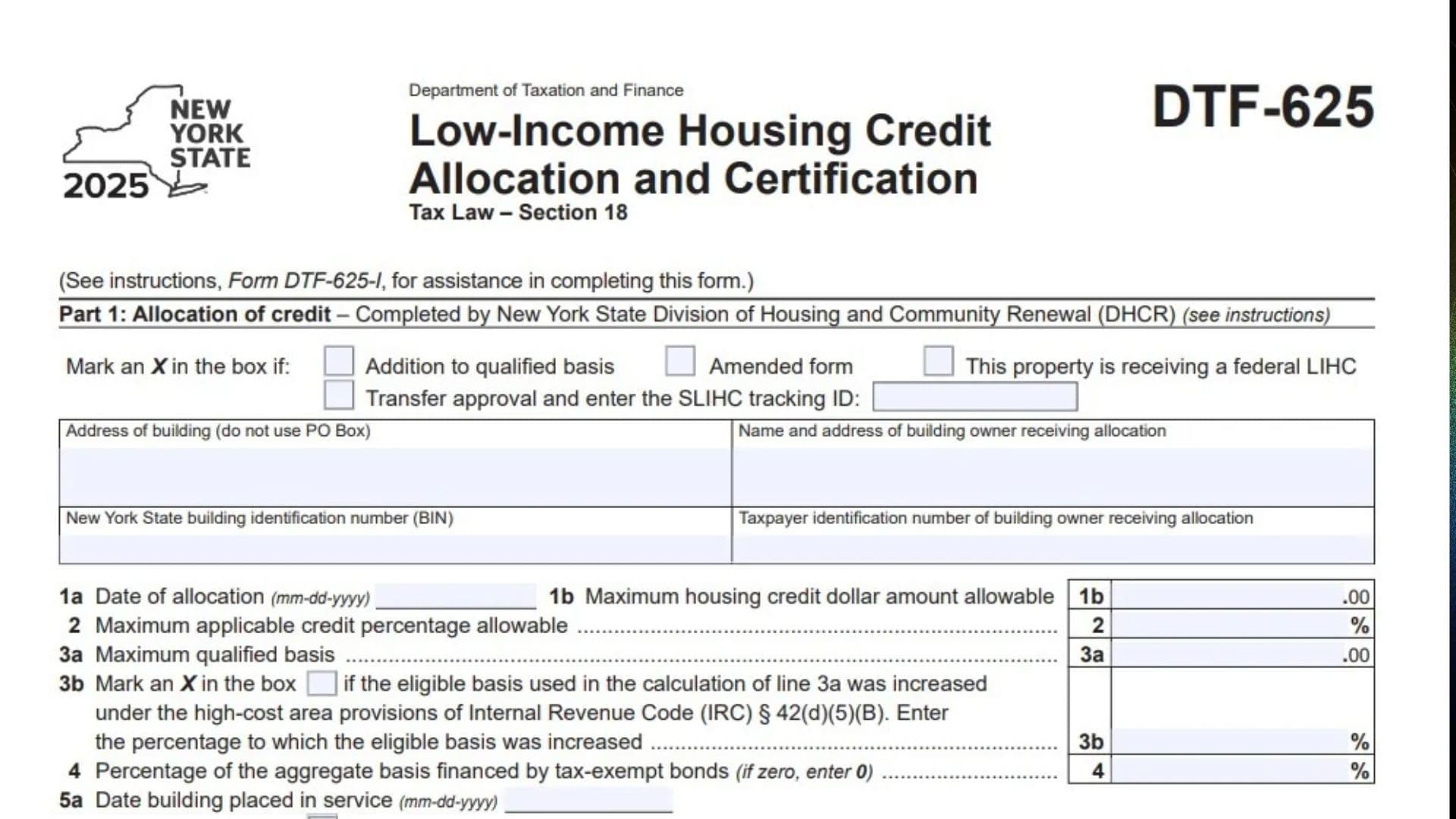
Form DTF-625, also known as the Low-Income Housing Credit Allocation and Certification form, is a New York State tax form used to document the allocation of low-income housing tax credits and certify that a building meets the requirements of the state’s low-income housing credit program. The form is administered by the New York State Department of Taxation and Finance under Tax Law Section 18. The form supports the allocation and certification of housing credits for qualifying residential buildings. It records important property information, the building owner’s identification details, the amount of credit allocated, the property’s eligible basis, and other figures used to determine the available housing credit. It also collects information about the building’s construction, rehabilitation, financing, and minimum set-aside requirements.
Form DTF-625 has two main parts. Part 1 is completed by the New York State Division of Housing and Community Renewal (DHCR). It records the credit allocation details and confirms the information associated with the building. Part 2 is completed by the building owner for the first year of the credit period. It collects information about the building’s eligible basis, qualified basis, project status, and tax credit elections.
Building owners use this form to certify that their properties qualify as part of a low-income housing project and meet the applicable requirements under New York State Public Housing Law Article 2-A and Internal Revenue Code Section 42. The information also helps establish the property’s credit allocation and the owner’s reporting responsibilities.
Completing the form correctly is important because errors in property identification, financial figures, eligibility selections, or tax elections can affect the credit allocation and certification process. Some elections made on this form are irrevocable, meaning they cannot be changed after they are made. Building owners should therefore review the applicable requirements and supporting information before selecting an election or signing the certification.
How To File Form DTF-625
Form DTF-625 must be sent to the New York State Department of Taxation and Finance at the designated filing address.
Where to Send Form DTF-625
Mail the completed form to:
Corporation Tax Desk Audit
TDAB – Tax Audit Administrator 1
W A Harriman Campus
Albany, NY 12227-4299
If you use a private delivery service instead of U.S. Mail, follow the designated delivery service requirements explained in New York State Publication 55.
Other Forms Required With Your Tax Reporting
Form DTF-625 is part of the reporting process for the New York Low-Income Housing Credit. Building owners should also understand the following related forms:
- Form DTF-625-ATT: Low Income Housing Credit Annual Statement. This form must be filed with the owner’s tax return for each year of the 15-year compliance period.
- Form DTF-624: Claim for Low-Income Housing Credit. Building owners use this form to claim the available housing credit.
Review the separate instructions for these forms to understand their individual filing requirements.
Information To Prepare Before Completing The Form
Gather the following information before starting:
- Building address and New York State Building Identification Number (BIN).
- Building owner’s legal name, address, and taxpayer identification number.
- Credit allocation date and maximum credit amount.
- Maximum applicable credit percentage.
- Eligible basis and qualified basis calculations.
- Tax-exempt bond financing information, if applicable.
- Date the building was placed in service.
- Construction or rehabilitation details.
- Information about the building’s multiple-building project status.
- Details needed to make the available tax credit elections.
- Supporting records for the building’s allocation, financial calculations, and certification.
Part 1 must be completed by DHCR. The building owner is responsible for completing Part 2 and signing the required certification.

How To Complete Form DTF-625
The form contains two main parts. Each part collects different information and must be completed by the appropriate party.
Part 1: Allocation Of Credit
Part 1 is completed by the New York State Division of Housing and Community Renewal (DHCR). It records the building’s credit allocation information, property identification details, and the maximum housing credit amounts allowed.
Building owners should review this section to understand the allocation information recorded for their property.
Property Information And Allocation Checkboxes
Addition To Qualified Basis
Mark this checkbox if the allocation relates to an addition to the building’s qualified basis. This identifies an allocation associated with an increase in the qualified basis.
Amended Form
Mark this checkbox if the form is being submitted as an amended allocation or certification document. This indicates that the form contains amended information.
This Property Is Receiving A Federal LIHC
Mark this checkbox if the property is also receiving a federal Low-Income Housing Credit (LIHC). This identifies the property’s participation in the federal housing credit program.
Transfer Approval And SLIHC Tracking ID
Mark this checkbox when the allocation involves transfer approval. Enter the associated SLIHC tracking identification number in the space provided. This number helps identify the relevant transfer approval record.
Address Of Building
Enter the complete physical address of the building receiving the credit allocation. Do not enter a post office box. Use the actual street address where the property is located.
Name And Address Of Building Owner Receiving Allocation
Enter the legal name and complete mailing address of the building owner receiving the housing credit allocation. Make sure the owner’s information is accurate and matches the relevant ownership records.
New York State Building Identification Number (BIN)
Enter the New York State Building Identification Number assigned to the property. This number identifies the building within the state’s records.
Taxpayer Identification Number Of Building Owner Receiving Allocation
Enter the taxpayer identification number (TIN) of the building owner receiving the allocation. Use the appropriate identification number associated with the owner.
Credit Allocation Details
Line 1a: Date Of Allocation
Enter the date on which the housing credit allocation was made. Use the month-day-year format (MM-DD-YYYY).
Line 1b: Maximum Housing Credit Dollar Amount Allowable
Enter the maximum dollar amount of housing credit allowed for the building under the allocation. Report the amount provided through the allocation process in dollars and cents.
Line 2: Maximum Applicable Credit Percentage Allowable
Enter the maximum applicable credit percentage allowed for the building. Report the percentage in the space provided.
Line 3a: Maximum Qualified Basis
Enter the maximum qualified basis established for the building. This figure represents the maximum qualified basis recognized for the credit allocation.
Line 3b: High-Cost Area Basis Increase
Mark the checkbox if the eligible basis used to calculate Line 3a was increased under the high-cost area provisions of Internal Revenue Code Section 42(d)(5)(B).
If the checkbox applies, enter the percentage to which the eligible basis was increased. Leave this selection unmarked if the high-cost area provision does not apply.
Line 4: Percentage Of The Aggregate Basis Financed By Tax-Exempt Bonds
Enter the percentage of the building’s aggregate basis financed through tax-exempt bonds.
If no part of the aggregate basis was financed by tax-exempt bonds, enter 0 rather than leaving the field blank.
Line 5a: Date Building Placed In Service
Enter the date the building was placed in service. Use the MM-DD-YYYY format.
This date identifies when the building was placed into service for the housing credit requirements.
Line 5b: Qualified Disaster Zone
Mark this checkbox if both of the following conditions apply:
- The allocation date entered on Line 1a falls within calendar year 2021 or 2022.
- The building is located in a qualified disaster zone.
If either condition is not met, the checkbox does not apply. Refer to the separate form instructions for the qualified disaster zone requirements.
Line 6: Building Allocation Classification
This section identifies the type of building or rehabilitation activity associated with the credit allocation. Mark all applicable boxes.
Line 6a: Newly Constructed And Federally Subsidized
Mark this checkbox if the building is newly constructed and receives federal subsidies.
Line 6b: Newly Constructed And Not Federally Subsidized
Mark this checkbox if the building is newly constructed but does not receive federal subsidies.
Line 6c: Existing Building
Mark this checkbox if the allocation relates to an existing building rather than a newly constructed property.
Line 6d: IRC Section 42(e) Rehabilitation Expenditures Federally Subsidized
Mark this checkbox if the allocation relates to rehabilitation expenditures under Internal Revenue Code Section 42(e) and those expenditures receive federal subsidies.
Line 6e: IRC Section 42(e) Rehabilitation Expenditures Not Federally Subsidized
Mark this checkbox if the allocation relates to rehabilitation expenditures under Internal Revenue Code Section 42(e) that do not receive federal subsidies.
Line 6f: Allocation Subject To Nonprofit Set-Aside Under IRC Section 42(h)(5)
Mark this checkbox if the building’s credit allocation is subject to the nonprofit set-aside requirements under Internal Revenue Code Section 42(h)(5).
Part 1: Authorized Official’s Certification
After completing the allocation information, an authorized DHCR official must review and certify Part 1.
The certification confirms that the allocation complies with the requirements of New York State Public Housing Law Article 2-A and Internal Revenue Code Section 42. The official also confirms that the information provided in Part 1 is true, correct, and complete to the best of their knowledge and belief.
Signature Of Authorized Official
The authorized DHCR official must sign the form to certify the allocation information.
Name (Type Or Print)
Enter the full name of the authorized official who signed Part 1. Print the name clearly.
Date
Enter the date the authorized official signs the certification.
Part 2: First-Year Certification
Part 2 must be completed by the building owner for the first year of the credit period.
This section collects information about the building’s eligible basis, qualified basis, project structure, and tax credit elections. It also requires the building owner to certify that the property qualifies as part of a low-income housing project and meets the applicable requirements.
Building Information And Basis Calculations
Line 7a: Date Building Placed In Service
Enter the date the building was placed in service. Use the MM-DD-YYYY format.
This date should reflect the building’s placed-in-service date for the first-year certification.
Line 7b: Eligible Basis Of Building
Enter the eligible basis of the building. This is the amount used to establish the building’s eligible costs for the housing credit calculation.
Use the applicable eligible basis calculation and supporting property records to determine the amount.
Line 8a: Original Qualified Basis Of The Building At Close Of First Year Of Credit Period
Enter the building’s original qualified basis at the end of the first year of the credit period.
This figure represents the qualified basis established for the building at the close of that first year. Use the appropriate basis calculation when completing this field.
Line 8b: Multiple Building Project Election
Answer Yes or No to indicate whether the building is being treated as part of a multiple-building project for purposes of Internal Revenue Code Section 42.
- Yes: Select this option if the building is being treated as part of a multiple-building project.
- No: Select this option if the building is not being treated as part of a multiple-building project.
The selection should reflect the actual project structure.
Eligible Basis Reduction Questions
Line 9a: Election To Reduce Eligible Basis Under IRC Section 42(i)(2)(B)
This question applies when either Box 6a or Box 6d is marked in Part 1.
Answer Yes or No to indicate whether the building owner elects to reduce the eligible basis under Internal Revenue Code Section 42(i)(2)(B).
- Yes: Select this option if the owner elects to reduce the eligible basis under this provision.
- No: Select this option if the owner does not make this election.
Line 9b: Reduction For Disproportionate Costs Of Non-Low-Income Units
This question concerns market-rate units that have quality standards above the average quality standards of the building’s low-income units.
Answer Yes or No to indicate whether the owner elects to reduce the eligible basis by the disproportionate costs associated with those non-low-income units under Internal Revenue Code Section 42(d)(3)(B).
- Yes: Select this option if the owner elects to apply the eligible basis reduction.
- No: Select this option if the owner does not make this election.
Line 10: Tax Credit Elections
Line 10 covers several elections that affect how the building is treated under the housing credit rules.
Important: The form specifically states that these elections are irrevocable. Once an election is made, it cannot be reversed. Review the relevant requirements and supporting calculations before making any selection.
Line 10a: Election To Begin The Credit Period In The First Year After The Building Is Placed In Service
Answer Yes or No to indicate whether the owner elects to begin the credit period in the first year after the building is placed in service under Internal Revenue Code Section 42(f)(1).
- Yes: Select this option to make the election to begin the credit period in the following year.
- No: Select this option if the owner does not make this election.
Line 10b: Election Not To Treat A Large Partnership As The Taxpayer
This election concerns the treatment of a large partnership under Internal Revenue Code Section 42(j)(5).
Mark the Yes checkbox if the owner elects not to treat the large partnership as the taxpayer for the applicable housing credit provisions.
The form provides a Yes checkbox for this election.
Line 10c: Minimum Set-Aside Requirement Under IRC Section 42(g)
Select the applicable minimum set-aside test for the building under Internal Revenue Code Section 42(g).
The form provides four options:
- 20-50 Test: Select this option if the building uses the 20-50 minimum set-aside test.
- 40-60 Test: Select this option if the building uses the 40-60 minimum set-aside test.
- Average Income: Select this option if the building uses the average income minimum set-aside option.
- 25-60 Test (NYC Only): Select this option if the building uses the 25-60 test applicable to New York City.
Choose the option that reflects the minimum set-aside requirement applicable to the building.
Line 10d: Minimum Set-Aside Requirement Under Public Housing Law Section 21(5)(b)
Mark the checkbox for the 40-90 minimum set-aside requirement under New York State Public Housing Law Section 21(5)(b), if applicable.
This selection identifies the minimum set-aside requirement used for the building under the specified state law provision.
Line 10e: Election Of Deep-Rent-Skewed Project Under IRC Section 142(d)(4)(B)
Mark the checkbox for the 15-40 deep-rent-skewed project election under Internal Revenue Code Section 142(d)(4)(B), if applicable.
This identifies whether the building is making the deep-rent-skewed project election under the specified provision.
Part 2: Building Owner’s Certification
The certification appears on the second page of Form DTF-625.
By signing this section, the building owner or authorized individual confirms that the building described in the form qualifies as part of a qualified low-income housing project and meets the requirements of New York State Public Housing Law Article 2-A and Internal Revenue Code Section 42.
The signer also confirms that they have reviewed the form and all submitted documents and that the information is true, correct, and complete to the best of their knowledge and belief.
Complete the following fields:
Signature Of Building Owner Or Authorized Individual
The building owner or an authorized individual must sign the certification. The signature confirms the accuracy and completeness of the information submitted.
Taxpayer Identification Number
Enter the taxpayer identification number associated with the building owner or the individual completing the certification, as applicable.
Date
Enter the date the certification is signed.
Name (Type Or Print)
Enter the full printed name of the building owner or authorized individual who signed the form.
Final Review Before Filing
Review the entire Form DTF-625 before sending it to the New York State Department of Taxation and Finance. Check the following items to reduce the risk of missing information or incorrect entries.
Part 1: Allocation Of Credit
- Confirm that DHCR has completed Part 1.
- Check that the correct property-related allocation boxes are marked.
- Verify the building’s physical address.
- Confirm the building owner’s legal name and address.
- Check the New York State Building Identification Number (BIN).
- Verify the building owner’s taxpayer identification number.
- Review the allocation date on Line 1a.
- Confirm the maximum housing credit amount on Line 1b.
- Check the applicable credit percentage on Line 2.
- Verify the maximum qualified basis on Line 3a.
- Review the high-cost area selection and percentage on Line 3b, if applicable.
- Confirm the tax-exempt bond financing percentage on Line 4.
- Verify the placed-in-service date on Line 5a.
- Check the qualified disaster zone selection on Line 5b, if applicable.
- Review all applicable building classification boxes on Line 6.
- Confirm that the authorized DHCR official has signed and dated Part 1.
Part 2: First-Year Certification
- Confirm that the building owner or authorized individual has completed Part 2.
- Verify the placed-in-service date on Line 7a.
- Check the eligible basis entered on Line 7b.
- Verify the original qualified basis on Line 8a.
- Confirm the multiple-building project selection on Line 8b.
- Review the eligible basis reduction election on Line 9a, if applicable.
- Check the disproportionate non-low-income unit cost election on Line 9b.
- Review every applicable election under Line 10.
- Make sure the minimum set-aside selection reflects the building’s applicable requirements.
- Confirm that all irrevocable elections have been reviewed before submission.
- Check the building owner’s certification statement.
- Verify the signature, taxpayer identification number, date, and printed name on the second page.
Filing And Related Tax Forms
- Confirm that both pages of Form DTF-625 are complete.
- Make sure the form is sent to the correct New York State filing address.
- Review the requirements for private delivery services if you are not using U.S. Mail.
- Remember to file Form DTF-625-ATT with the tax return for each year of the 15-year compliance period.
- Use Form DTF-624 to claim the Low-Income Housing Credit.
- Review the separate instructions for the related forms before filing.
A complete and carefully reviewed Form DTF-625 helps document the building’s low-income housing credit allocation and first-year certification. Pay particular attention to the basis calculations, project classification, minimum set-aside selections, and irrevocable tax elections before submitting the form.