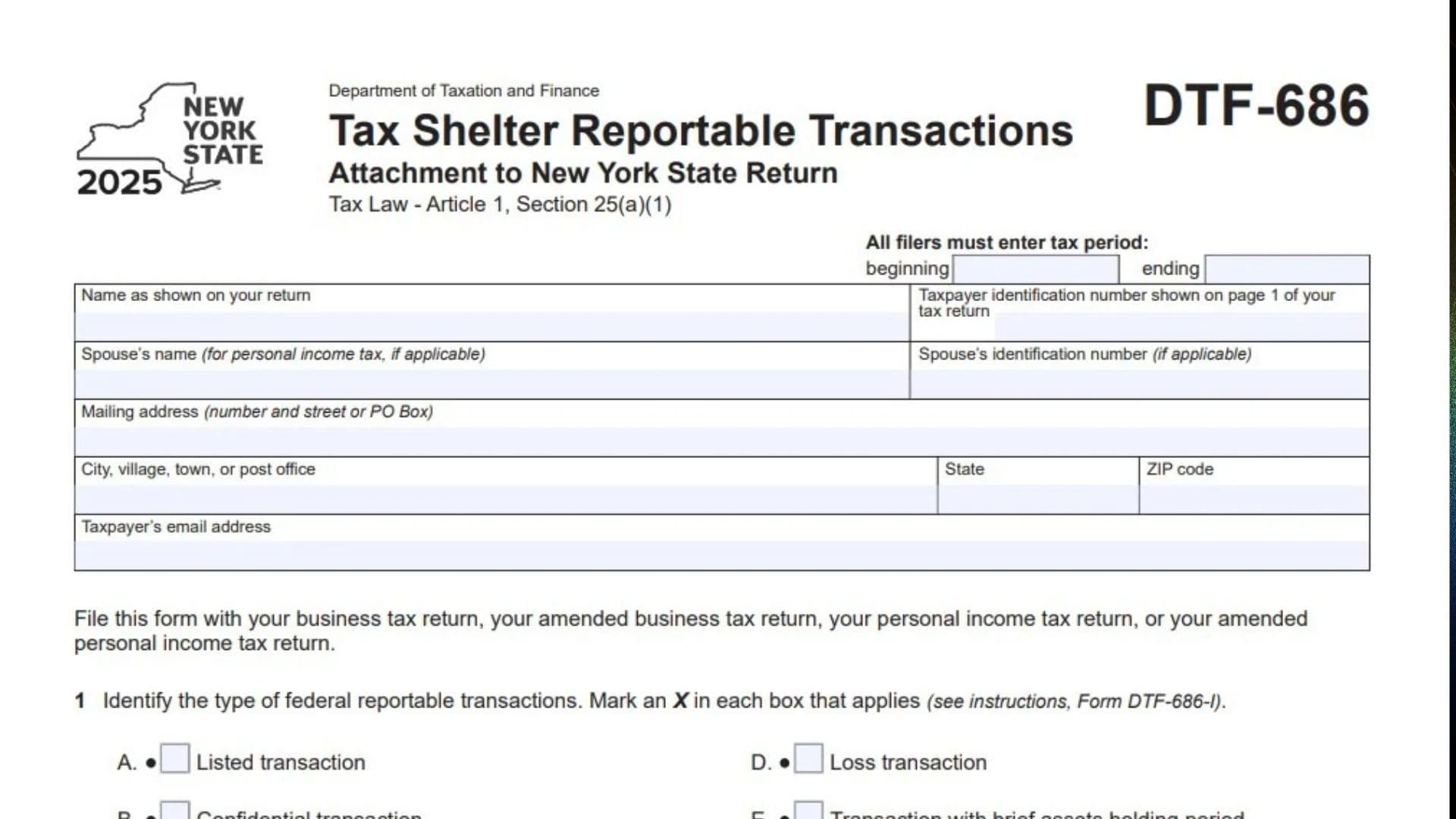
New York Form DTF-686, officially titled Tax Shelter Reportable Transactions, is a disclosure form issued by the New York State Department of Taxation and Finance. It is used by taxpayers to report certain federal and New York reportable transactions that may involve tax avoidance arrangements. The form serves as an attachment to a New York State business or personal income tax return and helps the state identify transactions that require additional tax disclosure. These reporting requirements are similar to the federal tax shelter disclosure rules administered by the Internal Revenue Service (IRS). Taxpayers who are required to disclose reportable transactions to the IRS may also have to provide the same information to New York State. The form identifies different categories of federal reportable transactions, including listed transactions, confidential transactions, transactions with contractual protection, loss transactions, transactions with brief asset holding periods, and transactions of interest. It also identifies New York reportable transactions, which include New York listed transactions, New York confidential transactions, and New York transactions with contractual protection.
Form DTF-686 collects taxpayer identification information, tax period dates, mailing address, email address, and information about the transactions being disclosed. It also records the number of federal IRS Forms 8886 and New York Forms DTF-686-ATT attached to the filing. For federal listed transactions, the form requires applicable transaction codes that identify the specific listed transaction being reported. A separate section addresses the waiver of certain New York tax confidentiality provisions for corporations participating in a consolidated disclosure. This section requires information and authorization from an appropriate corporate officer when applicable. The completed form must accompany the applicable original or amended New York business or personal income tax return. Taxpayers must also attach the relevant federal disclosure statements and New York transaction disclosure forms. Completing Form DTF-686 accurately is important because New York State imposes penalties for failing to disclose required transactions and for underpayments of tax connected with participation in reportable transactions. The state may also extend the period during which it can assess additional tax relating to these transactions.
How To File Form DTF-686
Form DTF-686 must be submitted as an attachment to the applicable New York State tax return or report.
The form can be filed with:
- An original business tax return.
- An amended business tax return.
- An original personal income tax return.
- An amended personal income tax return.
Attach the completed Form DTF-686 to the return for the applicable tax year.
Who Must File Form DTF-686?
Taxpayers who are required to disclose federal or New York reportable transactions under the applicable New York tax laws must complete Form DTF-686.
The reporting requirements cover individuals, sole proprietors, partnerships, certain limited liability companies, estates, trusts, S corporation shareholders, corporate taxpayers, and insurance corporations subject to the applicable tax provisions.
If you are required to file a disclosure statement with the IRS for a reportable transaction or listed transaction, you may also be required to disclose that transaction to New York State.
Corporations that are members of an affiliated group must generally make their own New York disclosure, even if another member submits a federal disclosure statement on behalf of the affiliated group.
A group agent authorized to file a New York group return for nonresident members must also submit the required disclosure with the group return.
However, a nonresident individual participating in an Article 22 group return is not required to file this disclosure individually. Such individuals are also not required to disclose transactions that do not affect New York source income.
Federal and New York Disclosure Requirements
Form DTF-686 covers two categories of reportable transactions.
Federal Reportable Transactions
If you are required to disclose a transaction to the IRS, you may also need to submit a duplicate of the federal disclosure statement with your New York return.
The federal disclosure statement is generally IRS Form 8886.
Attach a duplicate of the applicable Form 8886 and related information submitted to the IRS.
For the first New York return or report filed, additional disclosure statements may also be required for certain previously reported listed and reportable transactions.
New York Reportable Transactions
If you participated in a New York reportable transaction, you must disclose that participation when filing the applicable New York return.
Complete a separate Form DTF-686-ATT for each New York reportable transaction.
Attach each completed Form DTF-686-ATT to Form DTF-686.
Information To Prepare Before Completing Form DTF-686
Gather the following information before starting:
- Beginning and ending dates of the tax period.
- Taxpayer’s legal name as shown on the tax return.
- Taxpayer identification number.
- Spouse’s name, if applicable.
- Spouse’s identification number, if applicable.
- Complete mailing address.
- Taxpayer’s email address.
- Copies of applicable IRS Forms 8886.
- Information identifying each federal reportable transaction.
- Applicable codes for federal listed transactions.
- Completed New York Forms DTF-686-ATT, when required.
- Total number of federal disclosure statements attached.
- Total number of New York disclosure statements attached.
- Corporate authorization information, if the consolidated disclosure waiver applies.

How To Complete Form DTF-686
Tax Period and Taxpayer Identification Information
The first section identifies the taxpayer and the reporting period covered by the disclosure.
All filers must complete the tax period fields.
Beginning Tax Period
Enter the beginning date of the tax period covered by the filing.
Use the applicable beginning date for the original or amended New York tax return.
Ending Tax Period
Enter the ending date of the tax period.
Make sure the ending date matches the reporting period of the associated New York tax return.
Name as Shown on Your Return
Enter the taxpayer’s full name exactly as it appears on the corresponding New York tax return.
For an individual, use the name reported on the personal income tax return.
For a business, use the business name shown on the applicable business tax return.
Taxpayer Identification Number Shown on Page 1 of Your Tax Return
Enter the taxpayer identification number shown on page 1 of the associated tax return.
Use the same identification number reported on the original or amended return.
Verify the number before submitting the disclosure.
Spouse’s Name
For personal income tax filings, enter the spouse’s name if applicable.
Use the name shown on the joint income tax return.
If the taxpayer is not filing a joint return, this field may not apply.
Spouse’s Identification Number
Enter the spouse’s applicable identification number when required.
Make sure the number corresponds to the spouse identified in the preceding field.
Mailing Address
Enter the taxpayer’s complete mailing address.
Provide the street address and house or building number.
If the taxpayer uses a post office box, enter the applicable PO Box address instead.
City, Village, Town, or Post Office
Enter the city, village, town, or post office associated with the mailing address.
Use the appropriate mailing location.
State
Enter the two-letter state abbreviation for the mailing address.
ZIP Code
Enter the ZIP code associated with the mailing address.
Verify that the ZIP code matches the address used on the tax return.
Taxpayer’s Email Address
Enter the taxpayer’s current email address.
Use an email address that can be accessed if additional information or communication is needed regarding the disclosure.
Filing Instructions
The form states that it must be filed with the applicable original or amended business or personal income tax return.
Attach the supporting federal and New York disclosure forms as required.
The following sections identify the transaction types and supporting documents included with the filing.
Line 1: Federal Reportable Transaction Classification
Line 1 identifies the types of federal reportable transactions disclosed on the attached IRS Forms 8886.
Review all attached federal disclosure statements and mark an X in every box that applies.
The form provides six transaction classifications.
Line 1A: Listed Transaction
Select this box if the federal disclosure includes a listed transaction.
A listed transaction is a transaction identified by the IRS as a tax avoidance transaction or substantially similar to one identified by the IRS.
Review the attached IRS Forms 8886 to determine whether this classification applies.
If you select this box, you must also complete Line 3 by entering the applicable federal listed transaction codes.
Line 1B: Confidential Transaction
Select this box if the federal reportable transaction is classified as a confidential transaction.
Review the attached IRS disclosure statement to determine whether the transaction falls into this category.
Mark the box if this classification applies to any transaction being reported.
Line 1C: Transaction With Contractual Protection
Select this box if the federal transaction involves contractual protection.
This classification applies when the transaction is associated with contractual arrangements that provide protection relating to the expected tax treatment.
Use the classification identified on the applicable federal disclosure statement.
Line 1D: Loss Transaction
Select this box if the federal reportable transaction is classified as a loss transaction.
Review the attached IRS Form 8886 and identify whether the transaction meets the applicable federal reporting classification.
Line 1E: Transaction With Brief Asset Holding Period
Select this box if the transaction involves a brief asset holding period and is identified as a reportable transaction under the applicable federal rules.
Check the corresponding federal disclosure statement before selecting this classification.
Line 1F: Transaction of Interest
Select this box if the transaction is classified by the IRS as a transaction of interest.
Review the attached federal disclosure documentation to determine whether this category applies.
You may select more than one box if the attached federal disclosure statements identify multiple applicable transaction classifications.
Line 2: Total Number of IRS Forms 8886 Attached
Enter the total number of IRS Forms 8886 attached to Form DTF-686.
Count each federal disclosure statement included with the filing.
For example, if you attach three IRS Forms 8886, enter 3 on Line 2.
Make sure the number matches the actual number of federal disclosure statements included with the form.
Line 3: Applicable Codes for Federal Listed Transactions
Enter the applicable identification codes for each federal listed transaction being reported.
This line contains ten separate boxes for entering transaction codes.
Use the official code assigned to each listed transaction in the applicable Form DTF-686 instructions.
Enter the corresponding code in a separate box for each listed transaction.
The form instructions provide codes numbered 01 through 35.
These codes identify specific federal listed transactions, including transactions designated through IRS notices, revenue rulings, and Treasury regulations.
Use the applicable code table to identify the correct transaction.
If you selected Line 1A, you must complete Line 3.
Do not enter a code based only on the general type of transaction. Match the transaction with its specific federal listed transaction designation.
If you are reporting multiple listed transactions, enter the corresponding codes in separate boxes.
Line 4: New York Reportable Transaction Classification
Line 4 identifies the types of New York reportable transactions being disclosed.
Mark an X in each box that applies to the New York transactions reported through attached Forms DTF-686-ATT.
The form provides three classifications.
Line 4A: New York Listed Transaction
Select this box if you participated in a transaction identified as a New York listed transaction.
A New York listed transaction is a transaction specifically identified by New York State as requiring disclosure.
Review the applicable New York reportable transaction documentation before selecting this box.
Line 4B: New York Confidential Transaction
Select this box if the New York reportable transaction is classified as a New York confidential transaction.
Use the applicable transaction disclosure information to determine whether this classification applies.
Line 4C: New York Transaction With Contractual Protection
Select this box if the transaction is classified as a New York transaction with contractual protection.
Review the applicable disclosure documentation to verify that the transaction falls within this category.
You may select more than one classification if multiple New York reportable transaction types apply.
Line 5: Total Number of New York Forms DTF-686-ATT Attached
Enter the total number of New York Forms DTF-686-ATT attached to Form DTF-686.
Each New York reportable transaction requires a separate Form DTF-686-ATT.
Count all completed DTF-686-ATT forms included with the filing.
For example, if you are reporting four separate New York reportable transactions and have attached four Forms DTF-686-ATT, enter 4 on Line 5.
Make sure the number entered matches the actual number of attached disclosure statements.
Waiver of the Secrecy Provisions of the Tax Law for Purposes of a Consolidated Disclosure
The final section contains an authorization for certain corporations participating in a federal consolidated group disclosure.
This section addresses the waiver of specified New York tax confidentiality provisions for the purposes of consolidated disclosure.
The form includes a statement under which an authorized corporate officer consents to the waiver of the applicable secrecy provisions of:
- Tax Law Article 9, Section 202.
- Tax Law Article 9-A, Section 211.8.
- Tax Law Article 33, Section 1518.
The waiver applies to these provisions as they relate to the disclosure requirements under Tax Law Section 25.
For corporations participating in a federal consolidated group, the corporation designated as responsible for submitting the federal disclosure statement on behalf of the New York consolidated group members must sign the waiver when completing Form DTF-686.
Each corporation participating in the consolidated disclosure must also sign the waiver when completing its abbreviated Form DTF-686.
Printed Name of Authorized Officer
Enter the full printed name of the corporate officer authorized to approve the consolidated disclosure waiver.
The individual must have the appropriate authority to sign on behalf of the corporation.
Signature of Authorized Officer
The authorized corporate officer must sign the form.
The signature confirms consent to the waiver of the specified tax confidentiality provisions for the applicable consolidated disclosure.
Official Title
Enter the officer’s official corporate title.
Examples may include president, chief financial officer, treasurer, or another authorized corporate position.
Use the officer’s actual title.
Email Address of Authorized Officer
Enter the corporate officer’s current email address.
Provide an address where the officer can receive communications related to the consolidated disclosure.
Telephone Number
Enter the daytime telephone number of the authorized corporate officer.
Include the appropriate area code.
Provide a number where the officer can be contacted if additional information is required.
Date
Enter the date the authorized corporate officer signs the waiver.
Use the actual signing date.
Additional Tax Shelter Recordkeeping Requirements
Taxpayers required to disclose transactions under New York Tax Law Section 25 must retain supporting records for six years.
These records may include:
- Relevant correspondence.
- Memoranda.
- Notes.
- Valuation studies.
- Meeting minutes.
- Spreadsheets.
- Financial models.
- Tax opinions.
- Records required under Internal Revenue Code Section 6011.
- Other documents connected with transaction disclosure and reporting requirements.
Keep these records available for inspection if the New York State Department of Taxation and Finance conducts an examination.
Important Filing and Disclosure Requirements
Federal Disclosure Attachments
Attach a duplicate of the applicable IRS Form 8886 to Form DTF-686.
Include related information submitted to the IRS.
For the first New York return or report, additional historical federal disclosure statements may be required.
These include applicable disclosures for listed transactions and other reportable transactions for tax years covered by the relevant assessment statute of limitations.
New York Disclosure Attachments
Complete one Form DTF-686-ATT for each New York reportable transaction.
Attach all completed forms to Form DTF-686.
Submit Form DTF-686 with the corresponding New York tax return.
Reporting Requirements for Consolidated Groups
Corporations that participate in a federal consolidated group must follow the applicable New York disclosure requirements.
A corporation designated as responsible for filing the consolidated federal disclosure must complete the applicable waiver section.
Other participating corporations must also complete the waiver when submitting their abbreviated disclosure forms.
Final Review Before Filing
Before submitting Form DTF-686, review the taxpayer identification information, reporting period, federal transaction classifications, New York transaction classifications, supporting disclosure forms, and applicable corporate authorization.
Use this checklist to verify that the form is complete.
- The beginning tax period is entered correctly.
- The ending tax period is entered correctly.
- The taxpayer’s name matches the applicable New York tax return.
- The taxpayer identification number is correct.
- The spouse’s name is entered when applicable.
- The spouse’s identification number is correct when applicable.
- The complete mailing address is provided.
- City, state, and ZIP code information is accurate.
- The taxpayer’s email address is provided.
- Line 1 identifies all applicable federal reportable transaction classifications.
- Line 1A is selected when a federal listed transaction is being reported.
- Line 1B is selected when a federal confidential transaction applies.
- Line 1C is selected when a federal transaction with contractual protection applies.
- Line 1D is selected when a federal loss transaction applies.
- Line 1E is selected when a transaction with a brief asset holding period applies.
- Line 1F is selected when a federal transaction of interest applies.
- Line 2 includes the correct number of attached IRS Forms 8886.
- Line 3 includes the applicable codes for all federal listed transactions.
- Line 4 identifies all applicable New York reportable transaction classifications.
- Line 5 includes the correct number of attached Forms DTF-686-ATT.
- The applicable federal disclosure statements are attached.
- A separate Form DTF-686-ATT is prepared for each New York reportable transaction.
- The consolidated disclosure waiver is completed when applicable.
- The authorized corporate officer’s printed name and signature are provided when required.
- The officer’s official title, email address, and telephone number are entered.
- The waiver date is provided.
- Supporting tax shelter records are retained for six years.
- Form DTF-686 is attached to the appropriate original or amended New York tax return.
New York Form DTF-686 is an important disclosure document for taxpayers involved in federal or New York reportable transactions. Accurate transaction classification, complete supporting disclosure statements, correct transaction codes, and proper authorization are essential to meeting New York’s tax shelter reporting requirements. Review all applicable federal and New York disclosure information before submitting the completed form with your tax return.