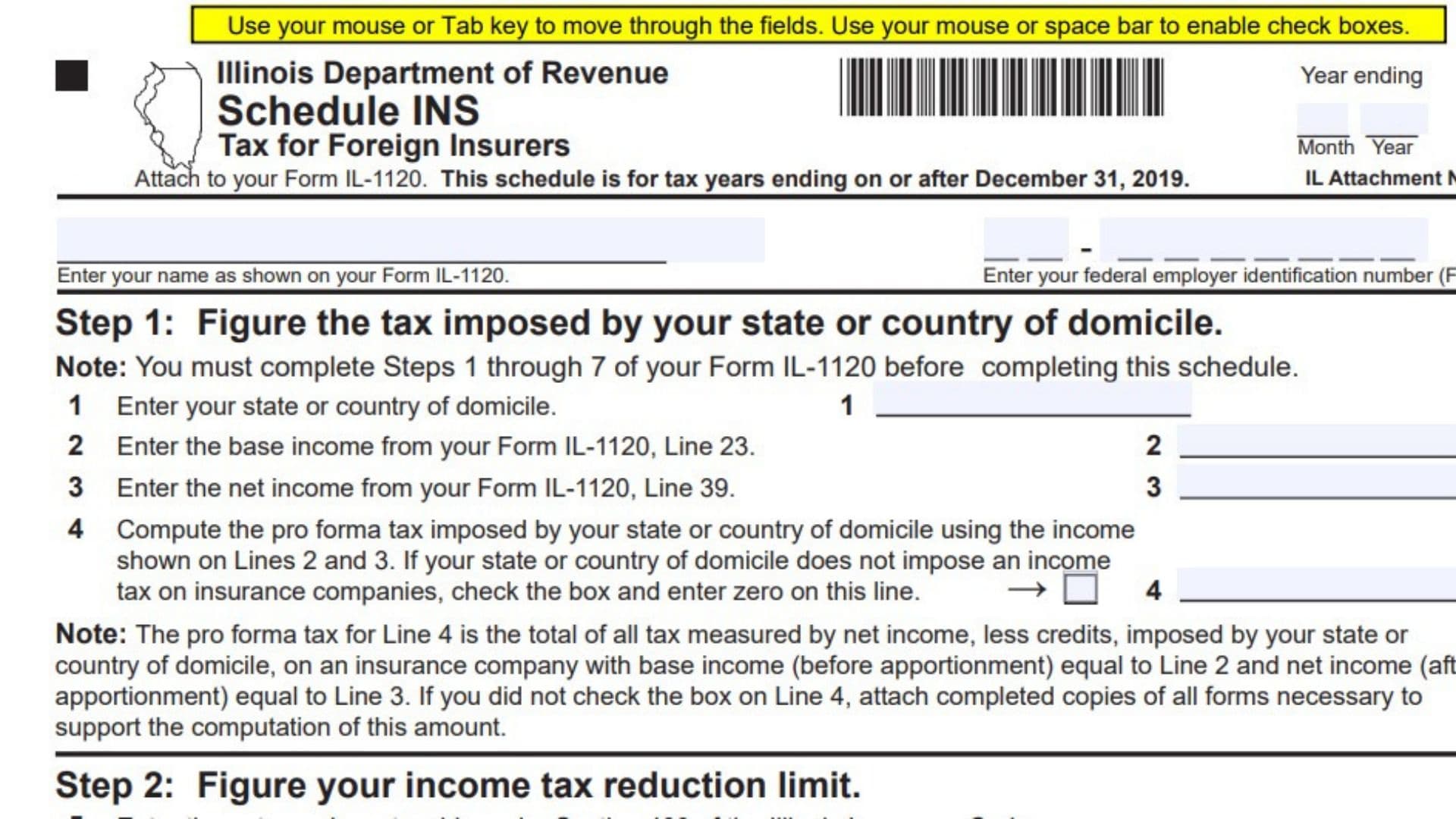
Illinois Schedule INS, also known as the Tax for Foreign Insurers schedule, is a tax form issued by the Illinois Department of Revenue. It is designed for foreign insurance companies that need to calculate certain tax reductions when filing their Illinois Corporation Income and Replacement Tax Return (Form IL-1120). The schedule compares the tax that an insurance company would pay in its state or country of domicile with specific Illinois tax amounts. It also calculates the maximum income tax reduction based on taxable insurance premiums and certain taxes deducted when determining federal taxable income. The form collects information about the insurance company’s legal name, Federal Employer Identification Number (FEIN), tax year, state or country of domicile, base income, net income, taxable premiums, and applicable tax amounts. Using this information, the company determines its replacement tax reduction and income tax reduction. Schedule INS must be attached to Form IL-1120 and applies to tax years ending on or after December 31, 2019. Completing the schedule accurately is important because its calculations determine whether the insurance company qualifies for a tax reduction and how much it can claim on its Illinois corporate tax return. Missing information, incorrect calculations, or insufficient supporting documents may affect the accuracy of the reported tax reduction.
How To File Illinois Schedule INS
Illinois Schedule INS must be completed and attached to Form IL-1120. It is identified as Illinois Attachment No. 7.
Before completing this schedule, you must finish Steps 1 through 7 of Form IL-1120. Several amounts required for Schedule INS come directly from specific lines of the main corporate tax return.
Information To Prepare Before Completing Schedule INS
Gather the following information before starting:
- The insurance company’s legal name as shown on Form IL-1120.
- The company’s Federal Employer Identification Number (FEIN).
- The tax year ending month and year.
- The state or country where the insurance company is domiciled.
- Base income from Form IL-1120, Line 23.
- Net income from Form IL-1120, Line 39.
- The pro forma tax imposed by the state or country of domicile.
- Net premiums taxable under Section 409 of the Illinois Insurance Code.
- Privilege tax imposed under Section 409 of the Illinois Insurance Code.
- Fire insurance company tax imposed under Section 12 of the Fire Investigation Act.
- Fire department tax imposed under Section 11-10-1 of the Illinois Municipal Code.
- Replacement tax from Form IL-1120, Line 44.
- Income tax from Form IL-1120, Line 49.
- Supporting tax forms required to verify the pro forma tax calculation.
Where To File Schedule INS
Attach the completed Schedule INS to Form IL-1120 when submitting your Illinois corporate income and replacement tax return.
The schedule does not provide a separate mailing address or independent filing destination. It is designed to accompany Form IL-1120 as part of the company’s Illinois tax filing.
The form applies to tax years ending on or after December 31, 2019.

How To Complete Illinois Schedule INS
Schedule INS contains three main steps. Each step includes specific calculations used to determine the insurance company’s eligibility for tax reductions and the amount it can claim.
The three steps are:
- Step 1: Calculate the tax imposed by the state or country of domicile.
- Step 2: Calculate the income tax reduction limit.
- Step 3: Calculate the replacement tax reduction and income tax reduction.
Follow the instructions below to complete each identification field and calculation.
Taxpayer Identification Information
Complete the identification fields at the top of Schedule INS before starting Step 1.
Name
Enter the insurance company’s full legal name exactly as it appears on Form IL-1120. Make sure the name matches the information provided on the main Illinois corporate tax return.
Federal Employer Identification Number (FEIN)
Enter the company’s complete Federal Employer Identification Number (FEIN). This number identifies the insurance company for federal and state tax reporting purposes.
Year Ending – Month
Enter the month in which the company’s tax year ends. Use the ending month associated with the reporting period covered by Form IL-1120.
Year Ending – Year
Enter the four-digit year in which the company’s tax year ends. Make sure it matches the tax year reported on Form IL-1120.
Step 1: Figure the Tax Imposed by Your State or Country of Domicile
Step 1 calculates the tax that the insurance company would be required to pay in its state or country of domicile using the income amounts reported on Form IL-1120.
You must complete Steps 1 through 7 of Form IL-1120 before completing this section.
Line 1: State or Country of Domicile
Enter the name of the state or country where the insurance company is legally domiciled. This identifies the jurisdiction whose tax rules will be used to calculate the pro forma tax.
Line 2: Base Income
Enter the base income reported on Form IL-1120, Line 23.
Transfer the amount directly from Line 23 of the main corporate tax return. This amount represents the company’s base income before apportionment.
Line 3: Net Income
Enter the net income reported on Form IL-1120, Line 39.
Transfer the amount directly from the corresponding line of the main return. This figure represents the company’s net income after apportionment.
Line 4: Pro Forma Tax Imposed by the State or Country of Domicile
Calculate the pro forma tax that the company’s state or country of domicile would impose on an insurance company using the base income from Line 2 and net income from Line 3.
The calculation must include all taxes measured by net income, after applicable credits, that the home jurisdiction would impose on an insurance company with the same income amounts.
If the state or country of domicile does not impose an income tax on insurance companies, check the box provided on Line 4 and enter zero.
If you do not check the box, attach completed copies of all forms necessary to support the pro forma tax calculation.
The supporting calculation must use the base income before apportionment from Line 2 and the net income after apportionment from Line 3.
Step 2: Figure Your Income Tax Reduction Limit
Step 2 calculates the company’s income tax reduction limit based on taxable insurance premiums and certain taxes deducted when calculating federal taxable income.
The calculation starts with 1.75% of the applicable taxable premiums. Certain taxes are then subtracted to determine the final reduction limit.
Line 5: Net Premiums Taxable Under Section 409
Enter the net premiums taxable under Section 409 of the Illinois Insurance Code that were included in Form IL-1120, Step 4, Line 29.
Transfer the applicable amount directly from Line 29 of the main return.
Line 6: Total Tax Reduction Limit
Multiply the amount reported on Line 5 by 1.75% (0.0175).
Use this calculation:
Line 5 × 0.0175 = Line 6
The result represents the initial tax reduction limit before subtracting the applicable taxes reported on Line 7.
Line 7a: Privilege Tax Under Section 409 of the Illinois Insurance Code
Enter the amount of privilege tax imposed under Section 409 of the Illinois Insurance Code that was deducted when calculating the company’s federal taxable income for the current tax year.
Do not include retaliatory tax in this amount.
Line 7b: Fire Insurance Company Tax
Enter the amount of fire insurance company tax imposed under Section 12 of the Fire Investigation Act that was deducted when calculating the company’s federal taxable income for the current tax year.
Use the applicable amount deducted for the reporting period.
Line 7c: Fire Department Tax
Enter any fire department tax imposed under Section 11-10-1 of the Illinois Municipal Code that was deducted when calculating the company’s federal taxable income for the current tax year.
Include the applicable deducted amount.
Line 8: Total Taxes Deducted
Add the amounts reported on Lines 7a, 7b, and 7c.
Use this calculation:
Line 7a + Line 7b + Line 7c = Line 8
The result represents the combined amount of the three specified taxes deducted when calculating federal taxable income.
Line 9: 1.75 Percent Income Tax Reduction Limit
Subtract the amount on Line 8 from the amount on Line 6.
Use this calculation:
Line 6 − Line 8 = Line 9
If the result is negative, enter zero instead.
The amount on Line 9 represents the company’s final 1.75% income tax reduction limit. You must also enter this amount on Line 14 in Step 3.
Step 3: Figure Your Tax
Step 3 determines the company’s replacement tax reduction and income tax reduction.
It compares the tentative tax with the pro forma tax and the income tax reduction limit calculated in the previous steps.
Line 10: Replacement Tax
Enter the replacement tax reported on Form IL-1120, Line 44.
Transfer the amount directly from the corresponding line of the main Illinois corporate tax return.
Line 11: Income Tax
Enter the income tax reported on Form IL-1120, Line 49.
Use the amount shown on the completed corporate tax return.
Line 12: Tentative Tax
Add the replacement tax from Line 10 and the income tax from Line 11.
Use this calculation:
Line 10 + Line 11 = Line 12
The result represents the company’s tentative tax before applying the reductions calculated in this schedule.
Line 13: Pro Forma Tax
Enter the pro forma tax amount calculated on Line 4.
Transfer the amount directly from Step 1.
Line 14: 1.75 Percent Income Tax Reduction Limit
Enter the income tax reduction limit calculated on Line 9.
This amount represents the 1.75% reduction limit after subtracting the applicable taxes reported on Lines 7a, 7b, and 7c.
Line 15: Greater of Pro Forma Tax or Income Tax Reduction Limit
Compare the amounts reported on Line 13 and Line 14.
Enter whichever amount is greater.
- If Line 13 is greater, enter the amount from Line 13.
- If Line 14 is greater, enter the amount from Line 14.
- If both amounts are equal, enter that amount.
Important eligibility rule: If the amount on Line 15 is greater than the amount on Line 12, the company is not entitled to a tax reduction. Do not continue using this schedule if this condition applies.
Line 16: Lesser of Replacement Tax or Line 15
Enter the smaller amount from Line 10 or Line 15.
Compare both figures and transfer the lower amount to Line 16.
Line 17: Replacement Tax Reduction
Subtract the amount on Line 16 from the amount on Line 10.
Use this calculation:
Line 10 − Line 16 = Line 17
The result represents the company’s replacement tax reduction.
Enter this amount on Form IL-1120, Step 8, Line 51.
Line 18: Maximum Net Income Tax After Applying Credits
If Line 15 is greater than Line 16, subtract the amount on Line 16 from the amount on Line 15.
Use this calculation:
Line 15 − Line 16 = Line 18
If Line 15 is not greater than Line 16, enter zero.
The resulting amount represents the maximum net income tax after applying credits.
Line 19: Lesser of Income Tax or Line 18
Compare the amounts on Line 11 and Line 18.
Enter the smaller amount.
Use the lower of the original income tax reported on Line 11 and the maximum net income tax calculated on Line 18.
Line 20: Income Tax Reduction
Subtract the amount on Line 19 from the amount on Line 11.
Use this calculation:
Line 11 − Line 19 = Line 20
The result represents the company’s income tax reduction.
Enter this amount on Form IL-1120, Step 8, Line 54.
Important Rules and Disclosures for Schedule INS
Before submitting Schedule INS, review the following requirements and disclosures included with the form.
Supporting Documents for Line 4
If you do not check the box indicating that your state or country of domicile does not impose an income tax on insurance companies, you must attach completed copies of all forms necessary to support the pro forma tax calculation.
These documents should support the tax amount calculated using the base income and net income reported on Lines 2 and 3.
Form IL-1120 Completion Requirement
Steps 1 through 7 of Form IL-1120 must be completed before you begin Schedule INS.
This is necessary because several amounts used in the schedule are transferred directly from the main corporate tax return.
Tax Reduction Eligibility
Line 15 determines whether the company can proceed with the tax reduction calculation.
If Line 15 is greater than Line 12, the insurance company is not entitled to a tax reduction and should not use the schedule further.
Required Disclosure of Information
The form is authorized under the Illinois Income Tax Act. Providing the requested information is mandatory.
Failure to provide the required information could result in a penalty.
Final Review Before Filing
Before attaching Schedule INS to Form IL-1120, review the following checklist to ensure that all identification information, supporting documents, and calculations are complete.
- Entered the insurance company’s name exactly as shown on Form IL-1120.
- Provided the correct Federal Employer Identification Number (FEIN).
- Entered the correct tax year ending month and year.
- Completed Steps 1 through 7 of Form IL-1120.
- Entered the correct state or country of domicile on Line 1.
- Transferred base income from Form IL-1120, Line 23, to Line 2.
- Transferred net income from Form IL-1120, Line 39, to Line 3.
- Correctly calculated the pro forma tax on Line 4.
- Checked the appropriate box and entered zero on Line 4 if the domicile jurisdiction does not impose an income tax on insurance companies.
- Attached the required supporting tax forms for Line 4, if applicable.
- Entered taxable net premiums from Form IL-1120, Step 4, Line 29, on Line 5.
- Multiplied Line 5 by 1.75% on Line 6.
- Reported the applicable privilege tax on Line 7a without including retaliatory tax.
- Entered the fire insurance company tax on Line 7b, if applicable.
- Entered the applicable fire department tax on Line 7c, if applicable.
- Added Lines 7a, 7b, and 7c on Line 8.
- Subtracted Line 8 from Line 6 and entered zero if the result was negative on Line 9.
- Transferred the replacement tax from Form IL-1120, Line 44, to Line 10.
- Transferred the income tax from Form IL-1120, Line 49, to Line 11.
- Correctly calculated tentative tax on Line 12.
- Entered the pro forma tax from Line 4 on Line 13.
- Transferred the income tax reduction limit from Line 9 to Line 14.
- Entered the greater amount of Lines 13 and 14 on Line 15.
- Checked the eligibility rule on Line 15 before proceeding.
- Correctly calculated the lesser amount on Line 16.
- Calculated the replacement tax reduction on Line 17.
- Entered the replacement tax reduction on Form IL-1120, Step 8, Line 51.
- Correctly calculated the maximum net income tax on Line 18.
- Entered the lesser amount of Lines 11 and 18 on Line 19.
- Calculated the income tax reduction on Line 20.
- Entered the income tax reduction on Form IL-1120, Step 8, Line 54.
- Attached the completed Schedule INS to Form IL-1120.
Review all figures and supporting documents before submitting your Illinois corporate tax return. Accurate calculations and complete information help ensure that the insurance company’s eligible tax reductions are properly reported.