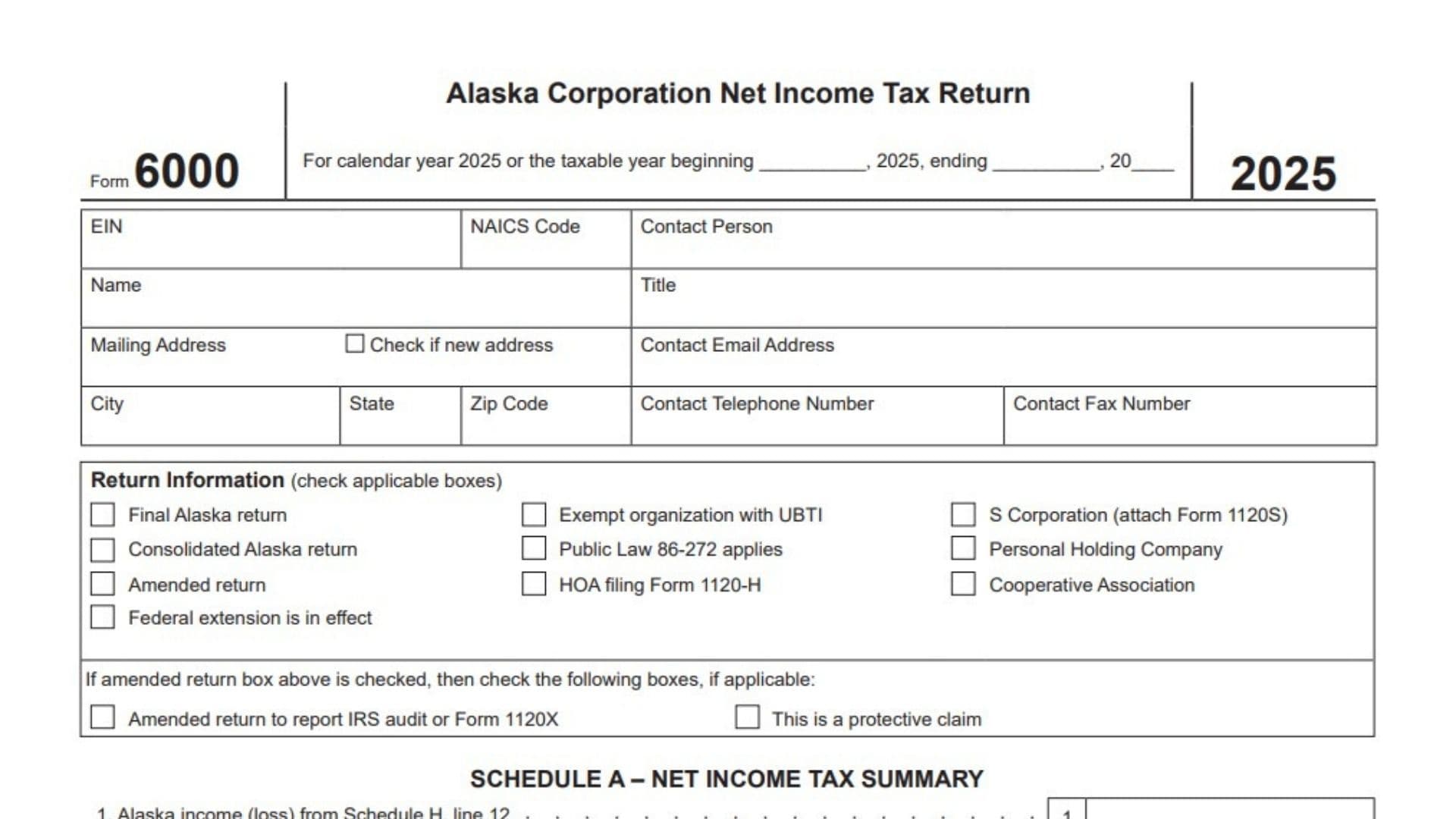
Alaska Form 6000, officially known as the Alaska Corporation Net Income Tax Return, is a state tax return used by corporations to report their taxable income and calculate their Alaska corporation income tax liability. The 2025 version applies to corporations filing for the calendar year 2025 or a fiscal tax year beginning during 2025 and ending in 2026.
The purpose of this form is to determine how much corporate income is subject to Alaska taxation after accounting for federal taxable income, state-specific additions and subtractions, business apportionment, Alaska-related income, available net operating losses, applicable tax credits, and other tax obligations. It also provides a record of estimated tax payments, extension payments, prior-year overpayments, and any remaining balance or refund.
Corporations operating entirely within Alaska and businesses conducting activities in multiple states may need to use different calculations when determining the portion of their income attributable to Alaska. The return therefore includes schedules for combined reporting, property, payroll and sales apportionment, capital gains and losses, charitable contribution deductions, and dividends-received deductions.
Form 6000 also accommodates certain special filing situations, including consolidated Alaska returns, amended returns, exempt organizations with unrelated business taxable income (UBTI), S corporations, personal holding companies, cooperative associations, and homeowners associations filing federal Form 1120-H. Additional information is requested when a federal consolidated return includes members of the Alaska filing group.
Completing the return correctly is important because the information entered on its schedules flows into the final tax calculation. An incorrect income adjustment, apportionment factor, deduction, credit, or payment amount can affect the corporation’s reported Alaska taxable income and final tax liability. Businesses should therefore reconcile their federal tax information, accounting records, supporting schedules, and payment history before submitting the completed return.
How To File Form 6000
Alaska Form 6000 is a state corporate income tax return administered by the Alaska Department of Revenue (DOR). It is separate from the corporation’s federal income tax return, although several calculations begin with amounts reported on federal tax forms.
The completed return should include the applicable schedules and supporting statements needed to explain the corporation’s income, deductions, adjustments, apportionment calculations, credits, and other tax liabilities.
Information to Prepare Before Completing the Return
Gather the following information before starting:
- The corporation’s federal Employer Identification Number (EIN).
- The corporation’s legal name, mailing address, and contact information.
- The applicable North American Industry Classification System (NAICS) code.
- Federal taxable income or loss information.
- Federal corporate income tax return and relevant supporting schedules.
- Information about corporations included in a combined or consolidated filing.
- Alaska property, payroll, and sales information.
- Records of capital gains, capital losses, and Section 1231 transactions.
- Charitable contribution records and applicable carryforwards.
- Dividend income and information needed to calculate the dividends-received deduction.
- Alaska estimated tax payment records.
- Extension payment information and prior-year overpayment records.
- Applicable Alaska incentive credit and federal-based credit information.
- Supporting calculations for other taxes and deductions.
Important Filing Considerations
The form identifies the 2025 tax year and provides spaces for fiscal-year beginning and ending dates. Corporations should use the applicable accounting period when preparing the return.
The form itself does not specify the filing deadline, submission address, electronic filing procedure, payment instructions, or complete eligibility requirements for each tax treatment. These details should be verified using the applicable Alaska Department of Revenue instructions for the 2025 tax year rather than assumed from the return.
A corporation filing an amended return should identify the reason for the amendment and indicate whether the amendment reports an IRS audit or Form 1120X adjustment, or represents a protective claim.

How To Complete Alaska Form 6000
The return contains several schedules that work together to calculate the corporation’s Alaska taxable income, tax liability, payments, and final refund or balance due. Complete the relevant supporting schedules first, then transfer the calculated amounts to Schedule A.
Tax Year And Corporation Identification
Tax Year
For a calendar-year corporation, use the 2025 tax year. For a fiscal-year corporation, enter the beginning and ending dates of the applicable accounting period in the spaces provided.
EIN
Enter the corporation’s federal Employer Identification Number. Use the EIN associated with the corporation filing the Alaska return.
NAICS Code
Enter the corporation’s North American Industry Classification System code identifying its primary business activity.
Contact Person
Provide the name of the individual responsible for responding to questions about the return.
Name
Enter the corporation’s legal name. For a consolidated Alaska return, the taxpayer identification should correspond to one corporation included in the Alaska filing group.
Title
Enter the professional or organizational position of the contact person.
Mailing Address
Provide the corporation’s complete mailing address, including the street address and any applicable suite or unit number.
Check If New Address
Select this checkbox if the corporation is reporting a new mailing address.
Contact Email Address
Enter the email address used for tax-related correspondence.
City
Enter the city associated with the mailing address.
State
Enter the two-letter state abbreviation.
ZIP Code
Enter the ZIP code associated with the mailing address.
Contact Telephone Number
Provide the telephone number where the tax contact can be reached.
Contact Fax Number
Enter the corporation’s fax number, if applicable.
Return Information
This section contains several checkboxes identifying the corporation’s filing circumstances and tax classification. Select all applicable options.
Final Alaska Return
Check this box if the corporation is filing its final Alaska corporation income tax return.
Consolidated Alaska Return
Select this option when the return includes multiple corporations filing together as an Alaska consolidated group. Complete Schedule B with the required information about the other corporations included in the return.
Amended Return
Check this box when correcting or updating a previously filed Alaska Form 6000.
Federal Extension Is In Effect
Select this box if the corporation has obtained an extension for filing its federal income tax return.
Exempt Organization With UBTI
Check this option if the organization is tax-exempt but has unrelated business taxable income (UBTI) that is subject to reporting.
Public Law 86-272 Applies
Select this box if the corporation is claiming that its activities qualify for the protection provided by Public Law 86-272. The applicability of this protection depends on the nature of the corporation’s activities.
HOA Filing Form 1120-H
Check this box if the corporation is a homeowners association filing federal Form 1120-H.
S Corporation (Attach Form 1120S)
Select this option if the corporation is an S corporation and provide the applicable federal Form 1120S information.
Personal Holding Company
Check this box if the corporation is classified as a personal holding company for the applicable tax year.
Cooperative Association
Select this option if the corporation is filing as a cooperative association.
Additional Information For Amended Returns
Complete this subsection only when the Amended Return checkbox has been selected.
Amended Return To Report IRS Audit Or Form 1120X
Check this option if the amendment is being filed to report changes resulting from an IRS audit or an adjustment made through federal Form 1120X.
This Is A Protective Claim
Select this checkbox when the amended return is being submitted as a protective claim rather than as an ordinary correction. The specific legal circumstances supporting the claim should be documented separately.
Schedule A: Net Income Tax Summary
Schedule A is the main tax calculation and reconciliation section of Form 6000. It brings together the Alaska income calculated on Schedule H, the net operating loss deduction, the tax calculated on Schedule D, other taxes from Schedule E, applicable credits, and payments from Schedule C.
The final lines determine whether the corporation owes additional tax or has an overpayment available for refund or credit toward the next tax year.
Line 1: Alaska Income (Loss) From Schedule H, Line 12
Enter the Alaska taxable income or loss calculated on Schedule H, line 12. This amount represents the corporation’s Alaska income before applying the net operating loss deduction shown on Schedule A, line 2.
Line 2: Alaska Net Operating Loss Utilized
Enter the Alaska net operating loss amounts used during the tax year. The form provides separate spaces for carryover and carryback amounts.
- Carryover: Enter the eligible net operating loss carried forward from an earlier tax year.
- Carryback: Enter the eligible loss applied to an earlier tax year, where permitted.
- Total: Combine the applicable carryover and carryback amounts.
The form indicates that carryback utilization is limited. Apply the relevant Alaska instructions when determining the allowable amount.
Line 3: Alaska Taxable Income
Add lines 1 and 2 to calculate Alaska taxable income. Because line 2 represents a deduction, the net operating loss amount should be entered as a negative adjustment where appropriate. The resulting amount is transferred to Schedule D, line 1.
Line 4: Alaska Income Tax From Schedule D, Line 2
Enter the Alaska corporation income tax calculated on Schedule D, line 2. This amount is determined using the applicable Alaska tax rate table.
Line 5: Other Taxes From Schedule E, Line 7
Transfer the total other taxes calculated on Schedule E, line 7. This may include apportioned alternative minimum tax, BEAT, personal holding company tax, and other applicable taxes.
Line 6: Total Tax
Add lines 4 and 5. This represents the corporation’s total tax before applying the incentive and federal-based credits reported on the following lines.
Line 7: Alaska Incentive Credits Applied Against Tax From Form 6300, Line 30
Enter the allowable Alaska incentive credits from Form 6300, line 30. Use the amount applicable to the corporation and tax year.
Line 8: Federal-Based Credits From Form 6390, Line 33
Enter the allowable federal-based credits calculated on Form 6390, line 33.
Line 9: Net Alaska Income Tax
Subtract the combined credits on lines 7 and 8 from line 6. The result is the corporation’s net Alaska income tax.
The form specifically instructs corporations to attach Form 6220 when the amount on this line exceeds $500.
Line 10: Payments From Schedule C
Enter the total net payments calculated on Schedule C. This includes applicable estimated tax payments, extension payments, prior-year overpayments, and other payment adjustments included in the schedule.
Line 11: Alaska Credit For Prior Minimum Tax
Enter the allowable Alaska credit for prior minimum tax, if applicable. Follow the relevant instructions when determining whether the corporation can claim this credit.
Line 12: Reserved
This line is reserved and should not be used for an independent tax calculation.
Line 13: Tax Due (Overpaid)
Subtract the total of lines 10 and 11 from line 9.
- A positive result generally represents tax remaining to be paid.
- A negative result represents an overpayment.
Transfer the calculated amount to this line without changing the sign.
Line 14: Penalty For Underpayment Of Estimated Tax
Enter any applicable penalty for underpaying estimated tax during the tax year. Use the required estimated tax penalty calculation and supporting instructions.
Line 15: Total Amount Due (Overpaid)
Add lines 13 and 14. The result represents the corporation’s total balance due or overpayment after considering the estimated tax penalty.
The form instructs taxpayers to stop if this amount is greater than zero. In that situation, the remaining lines for allocating an overpayment or calculating a refund are not applicable.
Line 16: Overpayment Credited To 2026 Estimated Tax
If the corporation has an overpayment available, enter the portion it wants credited toward its 2026 estimated tax payments. Enter this amount as a positive number.
Line 17: Refund
Add lines 15 and 16 to determine the refund amount reported on the return. This calculation reflects the overpayment remaining after the amount allocated to the following tax year’s estimated payments.
Declaration And Signature Section
This section confirms that the corporation’s return has been reviewed and that the information provided is accurate to the best of the signer’s knowledge and belief.
Declaration Under Penalty Of Perjury
The authorized signer confirms that the return, accompanying schedules, and statements have been examined and are believed to be true, correct, and complete.
Check If The DOR May Discuss This Return With The Preparer
Select this checkbox if the corporation authorizes the Alaska Department of Revenue to discuss the return with the tax preparer identified in the preparer section.
Officer’s Signature
An authorized corporate officer must sign the return.
Date
Enter the date the officer signs the return.
Title
Enter the officer’s official corporate title.
Preparer’s Signature
If a paid tax preparer completed the return, the preparer should sign in this field.
Preparer’s Date
Enter the date the preparer signs the return.
Preparer Firm’s Name
Provide the name of the accounting or tax preparation firm responsible for preparing the return.
Preparer’s SSN Or PTIN
Enter the preparer’s Social Security Number or Preparer Tax Identification Number, as applicable to the form’s requirements.
Preparer Firm’s Address
Enter the complete business address of the preparer’s firm.
EIN
Provide the Employer Identification Number of the preparer firm, where applicable.
Phone
Enter the telephone number of the preparer or preparation firm.
City, State, And ZIP Code
Complete the remaining address information for the preparer’s firm.
Schedule B: Alaska Taxpayer Information
Schedule B collects information about the corporations included in an Alaska consolidated return, the common parent of a federal consolidated group, and changes in the taxpayer’s business identity.
This schedule is particularly important when multiple corporations have Alaska nexus and are included in the same consolidated Alaska filing.
Part 1: Corporations Included In An Alaska Consolidated Return
Part 1: List All Corporations With Alaska Nexus
Complete this part when filing an Alaska consolidated return. List every corporation other than the taxpayer identified on page 1 that has Alaska nexus and is included in the return.
The form provides four corporation-information entries. If additional space is required, use an appropriate supporting statement.
Column A: Name Of Each Corporation With Nexus In Alaska
Enter the legal name of each additional corporation included in the consolidated return.
Address
Provide the corporation’s complete business or mailing address.
City
Enter the city where the corporation’s listed address is located.
State
Enter the applicable state abbreviation.
ZIP Code
Enter the corporation’s ZIP code.
Column B: Public Law 86-272 Applies
Check this box when Public Law 86-272 applies to the listed corporation. The determination should be based on the corporation’s qualifying activities and applicable rules.
Column C: Alaska Insurance Company
Check this box if the corporation is classified as an Alaska insurance company.
Column D: EIN
Enter the corporation’s federal Employer Identification Number.
Column E: NAICS Code
Enter the North American Industry Classification System code associated with the corporation’s business activity.
Factor Numerators To Be Reported: Property
Select this checkbox if property-related factor information for the corporation must be included in the apportionment calculation.
Factor Numerators To Be Reported: Payroll
Select this checkbox if payroll information for the corporation must be included in the apportionment calculation.
Factor Numerators To Be Reported: Sales
Select this checkbox if sales information for the corporation must be included in the apportionment calculation.
Complete these entries for every additional corporation covered by the consolidated return. The form warns that failure to complete this section properly may result in penalties.
Part 2: Common Parent Of Federal Consolidated Group
Part 2: Federal Consolidated Group Information
Complete this part if any taxpayer included in the Alaska return is also included in a federal consolidated income tax return filed using Form 1120.
EIN
Enter the federal Employer Identification Number of the common parent corporation of the federal consolidated group.
Name
Provide the legal name of the common parent corporation.
Address
Enter the common parent’s complete mailing address.
City
Enter the city associated with the address.
State
Provide the applicable state abbreviation.
ZIP Code
Enter the common parent’s ZIP code.
Part 3: Successor To A Previously Existing Business
Part 3: First Return And Successor Business Information
Complete this section when filing the corporation’s first Alaska return, if the corporation is a successor to a previously existing business.
Successor To Previously Existing Business
Check the box if the corporation is succeeding to a business that existed previously.
EIN
Enter the EIN of the previous business.
Name
Provide the legal name of the previous business.
Address
Enter the previous business’s address.
City
Provide the city associated with that address.
State
Enter the state abbreviation.
ZIP Code
Provide the ZIP code.
Part 4: Changes From The Previous Year’s Return
Part 4: Prior-Year Name And EIN
Complete this section if the corporation’s name or EIN differs from the information reported on its previous year’s Alaska return.
EIN
Enter the EIN reported on the prior-year return.
Name
Enter the corporation’s name as it appeared on the prior-year return.
Reason
Explain why the current information differs from the previous year’s filing. Examples provided by the form include a merger or a change in the corporation’s name.
Schedule C: Tax Payment Record
Schedule C records the payments and credits that the corporation has already made toward its Alaska income tax liability. The information from this schedule is transferred to Schedule A, line 10.
The schedule contains two sections: estimated payments and a payment summary.
Part 1: Estimated Tax Payments
First Estimated Payment
Enter the date and amount of the corporation’s first estimated tax payment for the applicable tax year.
Second Estimated Payment
Enter the payment date and amount for the second estimated tax installment.
Third Estimated Payment
Provide the date and amount of the third estimated tax payment.
Fourth Estimated Payment
Enter the date and amount of the fourth estimated tax payment.
Total Estimated Tax Payments
Add the amounts of all four estimated payments. Enter the combined amount in the total field.
Part 2: Payment Summary
Payment With Extension
Enter the amount paid when the corporation requested an extension to file its return. Provide the corresponding payment date.
Total Estimated Tax Payments
Transfer the total estimated payments calculated in the left-hand section. Enter the associated date information where applicable.
Overpayment From Prior Year
Enter any overpayment from the previous tax year that was carried forward and applied toward the current year’s Alaska tax liability.
Less: Quick Refund From Form 6230
Enter the amount of any quick refund received through Form 6230. This amount is deducted from the payments available for the current return.
Tax Paid With Original Return And Additional Tax Paid
For amended returns only, enter the tax paid with the originally filed return together with any additional tax payments made afterward.
Less: Overpayment Previously Credited To 2026
For amended returns, enter any portion of the original overpayment that was already applied toward the 2026 estimated tax liability. Deduct this amount from the payment total.
Less: Refund From Original Return And Additional Refunds
Enter the amount of any refund already issued in connection with the original return or subsequent amended returns. This prevents the same payment from being counted twice.
Total Net Payments To Schedule A, Line 10
Calculate the final payment amount after accounting for the estimated payments, extension payment, prior-year overpayment, quick refund, and applicable amended-return adjustments.
Transfer the resulting net payment total to Schedule A, line 10.
Schedule D: Alaska Tax Computation
Schedule D calculates the corporation’s Alaska income tax using its taxable income and the applicable Alaska tax rate table.
The schedule contains two lines. Complete it after calculating Alaska taxable income on Schedule A.
Line 1: Alaska Taxable Income From Schedule A, Line 3
Enter the corporation’s Alaska taxable income from Schedule A, line 3.
This amount represents income remaining after the applicable Alaska net operating loss adjustment.
Line 2: Tax
Use the Alaska corporation income tax rate table applicable to the 2025 tax year to calculate the tax on the amount reported on line 1.
Enter the calculated tax here and transfer the same amount to Schedule A, line 4.
Schedule E: Other Taxes
Schedule E calculates additional taxes that may apply to the corporation beyond its regular Alaska corporation income tax.
The schedule includes calculations for alternative minimum tax, Base Erosion and Anti-Abuse Tax (BEAT), personal holding company tax, tax relating to early cessation of certain LNG storage facility operations, and other applicable taxes.
Part 1: Alternative Minimum Tax
Line 1a: Alternative Minimum Tax From Federal Form 4626
Enter the alternative minimum tax amount reported on federal Form 4626. Use the applicable federal calculation for the corporation’s tax year.
Line 1b: Multiply Line 1a By 18%
Multiply the amount on line 1a by 18%.
The result represents the alternative minimum tax amount before applying the Alaska apportionment factor.
Line 1c: Apportionment Factor From Schedule I, Line 14
Enter the apportionment factor calculated on Schedule I, line 14. This factor is used to determine the portion attributable to Alaska.
Line 1d: Multiply Line 1b By Line 1c
Multiply the amount on line 1b by the factor reported on line 1c. Enter the resulting apportioned alternative minimum tax.
Part 2: Base Erosion And Anti-Abuse Tax
Line 2a: Base Erosion And Anti-Abuse Tax From Federal Form 8991
Enter the BEAT amount calculated on federal Form 8991.
Line 2b: Apportionment Factor From Schedule I, Line 14
Transfer the Alaska apportionment factor from Schedule I, line 14.
Line 2c: Multiply Line 2a By Line 2b
Multiply the BEAT amount on line 2a by the Alaska apportionment factor on line 2b. Enter the resulting apportioned amount.
Part 3: Additional Tax Calculations
Line 3: Add Lines 1d And 2c
Add the apportioned alternative minimum tax from line 1d and the apportioned BEAT from line 2c.
Line 4: Personal Holding Company Tax
Enter any applicable personal holding company tax. Corporations subject to this tax should calculate the amount using the relevant instructions.
Line 5: Tax On Early Cessation Of Operations – LNG Storage Facility
Enter any applicable tax arising from the early cessation of operations of an LNG storage facility.
Line 6: Other Taxes
Enter other Alaska taxes applicable to the corporation that are not already included in the preceding lines. Follow the applicable instructions and provide supporting calculations when required.
Line 7: Total Other Taxes
Add lines 3, 4, 5, and 6.
Transfer the resulting total to Schedule A, line 5.
Schedule H: Computation Of Alaska Income
Schedule H is one of the most important schedules in Form 6000 because it determines the corporation’s Alaska taxable income before applying the net operating loss deduction.
It begins with federal taxable income and then adjusts that amount for combined reporting, Alaska additions, allowable subtractions, apportionable income, non-business income, and other Alaska-specific tax items.
The schedule is divided into five main calculation areas:
- Combined reporting.
- Additions.
- Subtractions.
- Apportionment.
- Alaska items.
Part 1: Federal Income And Combined Reporting
Line 1: Federal Taxable Income (Loss)
Enter the corporation’s federal taxable income or loss, following the applicable Alaska instructions.
Use the relevant federal corporate income tax return as the starting point for this calculation.
Line 2a: Federal Taxable Income (Loss) Of Corporations Not Included In Line 1
Enter the federal taxable income or loss of corporations included in the combined reporting calculation but not already reflected in line 1.
This adjustment accounts for additional corporations included in the Alaska combined reporting calculation.
Line 2b: Foreign Corporations With 20% Or Greater U.S. Factors
Enter the applicable federal taxable income or loss associated with foreign corporations having U.S. factors of 20% or more.
Line 2c: Income From Tax Haven Corporations And Any FSC Profit
Enter income from tax haven corporations and any applicable foreign sales corporation (FSC) profit included in the combined reporting adjustments.
Line 2d: Federal Taxable (Income) Loss Of Non-Unitary Corporations
Enter the applicable federal taxable income or loss of non-unitary corporations. This adjustment identifies income or loss associated with corporations that are not part of the unitary business group.
Line 2e: Federal Taxable (Income) Loss Of Corporations With U.S. Factors Of Less Than 20%
Enter the applicable federal taxable income or loss of corporations whose U.S. factors are below 20%.
Line 2f: Intercompany Eliminations
Enter the adjustments needed to eliminate intercompany transactions, where applicable, in accordance with the Alaska combined reporting instructions.
Line 2g: Total Adjustments For Combined Reporting
Add lines 2a through 2f. Enter the total combined reporting adjustment.
Line 3: Net Income Before State Modifications And Adjustments
Add line 1 and line 2g. This establishes the corporation’s net income before applying the Alaska-specific additions and subtractions.
Part 2: Additions
The additions section identifies amounts that must be added to the income calculation when determining Alaska taxable income.
Line 4a: Taxes Based On Or Measured By Net Income
Enter taxes based on or measured by net income that must be added back under the applicable Alaska rules.
Line 4b: Expenses Incurred To Produce Non-Business Income
Enter expenses associated with generating non-business income when those expenses are required to be added back.
Line 4c: Federal Charitable Contributions From Federal Form 1120, Line 19
Enter the federal charitable contribution amount reported on federal Form 1120, line 19.
This amount is included in the additions calculation before determining the separate Alaska charitable contribution deduction.
Line 4d: Net Section 1231 Losses From Federal Form 4797, Line 11
Enter the applicable net Section 1231 loss reported on federal Form 4797, line 11.
Line 4e: Oil And Gas Service Industry Expenditures
Enter the amount calculated on Form 6327, line 2, when the corporation has applicable oil and gas service industry expenditures.
Line 4f: Expenditures From Form 6310
Enter the applicable expenditure amount from Form 6310. Follow the instructions governing the required adjustment.
Line 4g: Other Additions
Enter any other additions required under Alaska tax rules that are not already reported on lines 4a through 4f.
Attach a supporting schedule identifying the nature and calculation of each additional amount.
Line 4h: Total Additions
Add lines 4a through 4g. Enter the combined amount of all additions.
Part 3: Total Income Before Subtractions
Line 5: Total
Add line 3 and line 4h.
This calculation combines the net income before state adjustments with the additions reported in the preceding section.
Part 4: Subtractions
The subtractions section identifies income and other amounts that may be removed from the calculation of Alaska taxable income under the applicable rules.
Line 6a: Interest From Obligations Of The United States
Enter qualifying interest income from obligations of the United States that is eligible for subtraction under Alaska tax rules.
Line 6b: Intercompany Dividends
Enter the applicable intercompany dividend amount that qualifies for subtraction.
Line 6c: Section 78 Gross-Up Dividends
Enter the Section 78 gross-up dividend amount included in the federal income calculation.
Line 6d: 80% Of Dividends Received From Foreign Corporations
Enter the allowable 80% deduction for qualifying dividends received from foreign corporations.
Line 6e: 80% Of Royalties Accrued Or Received From Foreign Corporations
Enter 80% of qualifying royalties accrued or received from foreign corporations.
Line 6f: Non-Business Income
Enter income classified as non-business income that is eligible for subtraction from the apportionable income calculation.
Attach a supporting schedule identifying the non-business income and the related calculation.
Line 6g: Federal Form 1120, Line 8 Capital Gain Income
Enter the capital gain income reported on federal Form 1120, line 8, as required by the Alaska calculation.
Line 6h: Non-Recaptured Section 1231 Losses From Prior Years
Enter the eligible non-recaptured Section 1231 losses from previous years, using the amount reported on federal Form 4797, line 12.
Line 6i: Other Subtractions
Enter other qualifying subtraction adjustments that are not included in lines 6a through 6h.
Attach a supporting schedule explaining the amounts entered.
Line 6j: Total Subtractions
Add lines 6a through 6i. The result represents the total subtractions from the corporation’s income calculation.
Part 5: Apportionable Income
Line 7: Apportionable Income (Loss)
Subtract line 6j from line 5.
This amount represents the corporation’s income or loss available for apportionment between Alaska and other applicable jurisdictions.
Line 8: Apportionment Factor From Schedule I, Line 14
Enter the final Alaska apportionment factor calculated on Schedule I, line 14.
Line 9: Income (Loss) Apportioned To Alaska
Multiply line 7 by line 8.
The result represents the portion of the corporation’s apportionable income or loss assigned to Alaska.
Line 10: Non-Business Income (Loss) Net Of Expenses Allocable To Alaska
Enter non-business income or loss that is directly allocable to Alaska after deducting the associated expenses.
Attach a supporting schedule showing the income, related expenses, and resulting amount.
Part 6: Alaska Items
This section incorporates Alaska-specific capital gains and losses and deductions that affect the final income calculation.
Line 11a: Alaska Capital And Section 1231 Gain (Loss) From Schedule J, Line 20
Enter the Alaska capital gain or loss amount calculated on Schedule J, line 20.
Line 11b: Alaska Charitable Contribution Deduction From Schedule K, Line 10
Enter the allowable Alaska charitable contribution deduction calculated on Schedule K, line 10.
Because this amount is a deduction, the form provides a space to report it as a negative adjustment.
Line 11c: Alaska Dividends-Received Deduction
Enter the allowable Alaska dividends-received deduction calculated using Schedule L and the applicable instructions.
Report the amount as a negative adjustment in the space provided.
Line 11d: Total Alaska Items
Add lines 11a, 11b, and 11c.
This amount combines the applicable Alaska capital gains or losses and Alaska-specific deductions.
Line 12: Alaska Taxable Income (Loss) Before Net Operating Loss
Add lines 9, 10, and 11d.
This is the final Alaska income or loss amount calculated on Schedule H before applying the net operating loss deduction.
Transfer the amount to Schedule A, line 1.
Schedule I: Apportionment Factor
Schedule I determines the proportion of the corporation’s business activity attributable to Alaska.
It uses three categories of business activity:
- Property within Alaska compared with property everywhere.
- Payroll within Alaska compared with payroll everywhere.
- Sales within Alaska compared with sales everywhere.
Each category produces a separate factor. These factors are combined to calculate the final Alaska apportionment factor used in Schedule H and Schedule E.
Part 1: Property Apportionment
Line 1: Property Within Alaska
Report the corporation’s property located within Alaska.
The schedule provides five entries, identified as 1a through 1e.
Columns A And B: EIN And Name
For each property entry, enter the EIN and name of the corporation associated with the property.
Column C: Property Within Alaska
Enter the applicable value of the property located within Alaska for each corporation.
Line 1a: First Property Entry
Enter the EIN, corporation name, and applicable Alaska property amount for the first entry.
Line 1b: Second Property Entry
Provide the corresponding information and Alaska property amount for the second entry.
Line 1c: Third Property Entry
Report the EIN, corporation name, and Alaska property amount for the third entry.
Line 1d: Fourth Property Entry
Enter the information and property amount for the fourth entry.
Line 1e: Fifth Property Entry
Provide the final property entry, including the EIN, name, and Alaska property amount.
Line 2: Total Of Line 1, Column C
Add all amounts reported in column C for lines 1a through 1e.
Enter the total value of property within Alaska.
Line 3: Property Everywhere
Enter the corporation’s total property value everywhere, including property located both inside and outside Alaska.
Line 4: Property Factor
Divide line 2 by line 3.
The result represents the proportion of the corporation’s total property attributable to Alaska.
Part 2: Payroll Apportionment
Line 5: Payroll Within Alaska
Report payroll attributable to Alaska. The schedule provides five entries, identified as 5a through 5e.
Columns A And B: EIN And Name
Enter the EIN and name of each corporation associated with the reported payroll.
Column C: Payroll Within Alaska
Enter the applicable payroll amount attributable to Alaska for each listed corporation.
Line 5a: First Payroll Entry
Provide the EIN, corporation name, and Alaska payroll amount for the first entry.
Line 5b: Second Payroll Entry
Enter the corresponding information and payroll amount for the second entry.
Line 5c: Third Payroll Entry
Report the third corporation’s EIN, name, and Alaska payroll amount.
Line 5d: Fourth Payroll Entry
Enter the applicable information for the fourth payroll entry.
Line 5e: Fifth Payroll Entry
Provide the final payroll entry, including the corporation’s EIN, name, and Alaska payroll amount.
Line 6: Total Of Line 5, Column C
Add all payroll amounts reported in column C for lines 5a through 5e.
Line 7: Payroll Everywhere
Enter the corporation’s total payroll everywhere, including Alaska and all other applicable locations.
Line 8: Payroll Factor
Divide line 6 by line 7.
The resulting amount represents the proportion of the corporation’s total payroll attributable to Alaska.
Part 3: Sales Apportionment
Line 9: Sales Within Alaska
Enter the corporation’s sales attributable to Alaska. Five entries are available, identified as 9a through 9e.
Columns A And B: EIN And Name
Provide the EIN and legal name of each corporation associated with the reported sales.
Column C: Sales Within Alaska
Enter the amount of sales attributable to Alaska for each listed corporation.
Line 9a: First Sales Entry
Enter the EIN, corporation name, and applicable Alaska sales amount for the first entry.
Line 9b: Second Sales Entry
Provide the corresponding information for the second sales entry.
Line 9c: Third Sales Entry
Enter the EIN, name, and Alaska sales amount for the third entry.
Line 9d: Fourth Sales Entry
Provide the required information and Alaska sales amount for the fourth entry.
Line 9e: Fifth Sales Entry
Enter the final corporation’s EIN, name, and Alaska sales amount.
Line 10: Total Of Line 9, Column C
Add the amounts reported in column C for lines 9a through 9e.
Line 11: Sales Everywhere
Enter the corporation’s total sales everywhere, including sales within Alaska and outside the state.
Line 12: Sales Factor
Divide line 10 by line 11.
The resulting amount represents the proportion of the corporation’s total sales attributable to Alaska.
Part 4: Final Apportionment Calculation
Line 13: Add Lines 4, 8, And 12
Add the property factor from line 4, the payroll factor from line 8, and the sales factor from line 12.
Line 14: Apportionment Factor
Divide line 13 by 3 to calculate the final apportionment factor.
The form specifically notes that corporations using fewer than three factors should consult the applicable instructions before completing this calculation.
Transfer the final factor to the appropriate lines of Schedules H and E.
Schedule J: Alaska Capital And Section 1231 Gains And Losses
Schedule J calculates the capital gains and losses attributable to Alaska, including short-term capital transactions, long-term capital transactions, and Section 1231 gains and losses.
The schedule separates combined amounts from the portions attributable to Alaska. It also accounts for applicable capital loss carryovers and carrybacks.
For the Section 1231 portion, the form provides three columns:
- Column A: Combined – The combined amount before applying the Alaska factor.
- Column B: AK Factor – The applicable Alaska factor.
- Column C: Alaska Gain Or (Loss) – The resulting amount attributable to Alaska.
Part 1: Section 1231 Gains And Losses
Line 1: Current Section 1231 Gains And (Losses)
Enter the corporation’s current-year Section 1231 gains or losses.
Complete the combined amount and the corresponding Alaska factor and Alaska gain or loss columns. If the Alaska amount in column C is a loss, enter the result on line 19 as instructed by the form.
Line 2: Alaska Net Non-Recaptured Section 1231 Losses From Prior Years
Enter the amount of Alaska net Section 1231 losses from previous years that have not yet been recaptured.
The form requires this amount to be entered as a positive number.
Line 3: Section 1231 Gain After Prior-Year Loss Adjustment
If line 1, column C, shows a gain, subtract line 2 from that amount. Do not enter an amount below zero.
Enter the resulting amount here and carry it to line 15.
Line 4: Recaptured Section 1231 Loss Amount
If line 1, column C, shows a gain, enter the smaller of the amount on line 1, column C, or line 2.
Transfer this amount to line 19. If line 1, column C, does not show a gain, enter zero.
Part 2: Short-Term Capital Gains And Losses
This section calculates the corporation’s net short-term capital gain or loss after considering non-business income, Alaska allocation, and available capital loss adjustments.
Line 5: Total Current STCG/(L)
Enter the corporation’s total current-year short-term capital gains and losses.
Use the combined short-term capital transaction information for the applicable tax year.
Line 6: Non-Business STCG/(L)
Enter the portion of short-term capital gains or losses classified as non-business income or loss.
Line 7: Apportionable STCG/(L)
Subtract line 6 from line 5.
This calculation identifies the short-term capital gain or loss that remains subject to apportionment.
Line 8: Non-Business STCG/(L) Allocable To Alaska
Enter the portion of non-business short-term capital gains or losses directly allocable to Alaska.
Line 9: Alaska Capital Loss Carryover Utilized And Carryback Utilized
Enter the eligible Alaska capital loss carryover and carryback amounts used during the current tax year.
The form provides separate spaces for carryover and carryback amounts. Combine the applicable amounts and report the total as required.
Line 10: Net STCG/(L)
Add line 7, column C, line 8, and line 9.
Enter the resulting net short-term capital gain or loss attributable to Alaska.
Part 3: Long-Term Capital Gains And Losses
This section calculates the corporation’s net long-term capital gain or loss and determines the portion attributable to Alaska.
Line 11: Total Current LTCG/(L)
Enter the corporation’s total current-year long-term capital gains and losses.
Line 12: Non-Business LTCG/(L)
Enter the portion of long-term capital gains or losses classified as non-business income or loss.
Line 13: Apportionable LTCG/(L)
Subtract line 12 from line 11.
The resulting amount represents long-term capital gains or losses available for apportionment.
Line 14: Non-Business LTCG/(L) Allocable To Alaska
Enter the non-business long-term capital gain or loss directly allocable to Alaska.
Line 15: Enter Amount From Line 3
Transfer the amount calculated on line 3.
This amount represents the Section 1231 gain remaining after the adjustment for prior-year non-recaptured losses.
Line 16: Net LTCG/(L)
Add line 13, column C, line 14, and line 15.
Enter the resulting Alaska net long-term capital gain or loss.
Part 4: Capital Gain And Loss Summary
The final section compares the net short-term and long-term capital amounts and incorporates the remaining Section 1231 adjustment.
Line 17: Excess Net Short-Term Capital Gain Over Net Long-Term Capital Loss
Compare the amount on line 10 with the amount on line 16.
Enter the excess of net short-term capital gain over net long-term capital loss, if applicable.
Line 18: Excess Net Long-Term Capital Gain Over Net Short-Term Capital Loss
Compare line 16 with line 10.
Enter the excess of net long-term capital gain over net short-term capital loss, if applicable.
Line 19: Section 1231 Loss Or Recaptured Amount
If line 1, column C, shows a loss, enter that loss amount here.
If line 1, column C, does not show a loss, enter the amount calculated on line 4.
Line 20: Total Alaska Capital And Section 1231 Gains And Losses
Add lines 17, 18, and 19.
Enter the resulting amount here and transfer it to Schedule H, line 11a.
Schedule K: Alaska Charitable Contribution Deduction
Schedule K calculates the charitable contribution deduction available for Alaska corporation income tax purposes.
The calculation starts with current charitable contributions, removes education credit contributions, applies the Alaska apportionment factor, considers eligible carryforwards, and applies the deduction limitation.
Part 1: Charitable Contribution Calculation
Line 1: Current Charitable Contributions
Enter the corporation’s current-year charitable contributions included in the applicable federal income tax calculation.
Line 2: Education Credit Contributions From Form 6310
Enter the education credit contribution amount reported on Form 6310, where applicable.
These contributions are separately identified in the calculation.
Line 3: Subtract Line 2 From Line 1
Subtract the education credit contributions reported on line 2 from the current charitable contributions on line 1.
The result represents the charitable contribution amount remaining for the subsequent Alaska calculation.
Line 4: Apportionment Factor From Schedule I, Line 14
Enter the Alaska apportionment factor calculated on Schedule I, line 14.
Line 5: Current Alaska Charitable Contributions
Multiply line 3 by line 4.
The result represents the current charitable contribution amount attributable to Alaska.
Line 6: Alaska Charitable Contribution Carryover From Form 6385, Line 18
Enter the eligible charitable contribution carryover amount from Form 6385, line 18.
Use the amount applicable to the current tax year.
Line 7: Add Lines 5 And 6
Combine the current Alaska charitable contributions from line 5 with the eligible carryover from line 6.
Line 8: Taxable Income For Deduction Limitation Purposes
Enter the taxable income amount used to calculate the charitable contribution deduction limitation.
The applicable Alaska instructions should be followed when determining this amount.
Line 9: Multiply Line 8 By 10%
Multiply line 8 by 10%.
The resulting amount establishes the deduction limitation shown on the form.
Line 10: Alaska Charitable Contribution Deduction
Compare the amounts on lines 7 and 9.
Enter the smaller amount. This represents the allowable Alaska charitable contribution deduction.
Transfer the result to Schedule H, line 11b.
Schedule L: Alaska Dividends-Received Deduction (DRD)
Schedule L calculates the Alaska dividends-received deduction available to the corporation.
The calculation begins with dividend income included in Schedule H and identifies dividend categories that are not eligible for the deduction. The remaining eligible dividends are apportioned to Alaska and classified according to the applicable deduction percentages.
The schedule contains three main calculation stages:
- Identifying dividends that are not eligible for the deduction.
- Calculating dividends eligible for the deduction.
- Applying the applicable deduction percentages.
Part 1: Dividend Income
Line 1: Dividend Income Included In Schedule H, Line 3
Enter the dividend income included in Schedule H, line 3.
This amount provides the starting point for determining the dividends eligible for the Alaska dividends-received deduction.
Part 2: Dividends Not Eligible For DRD
This section identifies dividend amounts that must be excluded from the dividends-received deduction calculation.
Line 2a: Intercompany Dividends From Schedule H, Line 6b
Enter the intercompany dividend amount reported on Schedule H, line 6b.
The form identifies this category as not eligible for the dividends-received deduction.
Line 2b: Section 78 Gross-Up Dividends From Schedule H, Line 6c
Enter the Section 78 gross-up dividend amount reported on Schedule H, line 6c.
Line 2c: 100% Of Dividends From Foreign Corporations
Enter the full amount of qualifying foreign corporation dividends represented by the 80% deduction reported on Schedule H, line 6d.
To determine the amount, divide Schedule H, line 6d, by 80%.
Line 2d: Dividends Subtracted On Schedule H, Line 6f As Non-Business Income
Enter dividend amounts that were already subtracted on Schedule H, line 6f as non-business income.
Line 2e: Total Dividends Not Eligible For DRD
Add lines 2a through 2d.
This amount represents the total dividends excluded from the dividends-received deduction calculation.
Part 3: Eligible Dividends And Alaska Apportionment
Line 3: Total Dividends Eligible For DRD
Subtract line 2e from line 1.
The result represents the total dividend income remaining eligible for the deduction calculation.
Line 4: Apportionment Factor From Schedule I, Line 14
Enter the Alaska apportionment factor from Schedule I, line 14.
Line 5: Apportioned Dividends
Multiply line 3 by line 4.
This calculates the portion of eligible dividends attributable to Alaska through the apportionment process.
Line 6: Dividends Allocable To Alaska Included On Schedule H, Line 10
Enter dividends directly allocable to Alaska that are included in Schedule H, line 10.
Line 7: Total Dividends Included In Taxable Income
Add lines 5 and 6.
This amount represents the total dividends included in taxable income for the subsequent deduction calculation.
Part 4: Dividends-Received Deduction Calculation
The form divides eligible dividends into categories according to the applicable deduction percentages. It provides columns for apportioned dividends, the deduction percentage, and the resulting deduction amount.
- Column A: Enter the apportioned dividend amount assigned to the relevant deduction category.
- Column B: Use the deduction percentage applicable to that category.
- Column C: Calculate the deduction by multiplying the amount in column A by the percentage in column B.
Line 8a: Dividends Qualifying For 100% Deduction
Enter the apportioned dividends qualifying for the 100% deduction in column A.
Column B identifies the applicable deduction percentage as 100%.
Multiply column A by 100% and enter the resulting deduction in column C.
Line 8b: Dividends Qualifying For 65% Deduction
Enter the dividends qualifying for the 65% deduction in column A.
Use 65% in column B and multiply the apportioned dividend amount by this percentage.
Enter the resulting deduction in column C.
Line 8c: Dividends Qualifying For 50% Deduction
Enter the apportioned dividends qualifying for the 50% deduction.
Apply the 50% deduction percentage and report the resulting amount in column C.
Line 8d: Dividends Qualifying For 26.7% Deduction
Enter the applicable apportioned dividends qualifying for the 26.7% deduction.
Multiply the amount in column A by 26.7% and enter the result in column C.
Line 8e: Dividends Qualifying For 23.3% Deduction
Enter the apportioned dividends qualifying for the 23.3% deduction.
Apply the 23.3% percentage to determine the deduction amount in column C.
Line 8f: Other Dividends, If Applicable
Use this line for other applicable dividend categories not covered by lines 8a through 8e.
Enter the apportioned dividend amount in column A and specify the applicable deduction percentage in column B.
Calculate the deduction by multiplying the amount in column A by the percentage in column B. Report the result in column C.
Line 9: Tentative Dividends-Received Deduction
Add the deduction amounts reported in column C for lines 8a through 8f.
Enter the total tentative dividends-received deduction.
The form indicates that the applicable instructions should be consulted when completing this calculation.
Final Review Before Filing
Before submitting Alaska Form 6000, review the entire return and verify that all applicable schedules, calculations, and supporting information are complete.
Use the following checklist to conduct a final review.
Corporation Information
- Verify the corporation’s legal name and EIN.
- Confirm the NAICS code is correct.
- Check the mailing address, city, state, and ZIP code.
- Confirm the contact person’s name, title, email, and telephone number.
- Verify the correct calendar or fiscal tax year.
- Select all applicable return information checkboxes.
- Confirm whether the return is final, consolidated, or amended.
Schedule A: Net Income Tax Summary
- Verify that line 1 agrees with Schedule H, line 12.
- Confirm the net operating loss carryover and carryback calculations on line 2.
- Verify taxable income on line 3.
- Confirm the income tax amount transferred from Schedule D.
- Check other taxes transferred from Schedule E.
- Verify the incentive and federal-based credits.
- Recalculate the net Alaska income tax on line 9.
- Confirm payments and prior minimum tax credits.
- Review the tax due, overpayment, penalty, and refund calculations.
Schedule B: Alaska Taxpayer Information
- Confirm that all additional corporations included in the consolidated return are listed.
- Verify each corporation’s EIN and NAICS code.
- Check the Public Law 86-272 and insurance company classifications where applicable.
- Verify the federal consolidated group’s common parent information.
- Complete successor business information when required.
- Explain any differences between the current and previous year’s corporation information.
Schedule C: Tax Payment Record
- Verify all four estimated tax payment entries.
- Check the payment dates and amounts.
- Confirm extension payments.
- Include eligible prior-year overpayments.
- Account for any quick refund received.
- Complete amended-return payment adjustments when applicable.
- Reconcile the final net payment amount with Schedule A, line 10.
Schedule D: Alaska Tax Computation
- Confirm that taxable income agrees with Schedule A, line 3.
- Use the applicable 2025 Alaska tax rate table.
- Verify that the calculated tax agrees with Schedule A, line 4.
Schedule E: Other Taxes
- Verify alternative minimum tax information from federal Form 4626.
- Check the 18% calculation on line 1b.
- Confirm the apportionment factor used for alternative minimum tax.
- Verify BEAT information from federal Form 8991.
- Check personal holding company tax, if applicable.
- Review LNG storage facility tax, if applicable.
- Include other applicable taxes.
- Confirm that the total agrees with Schedule A, line 5.
Schedule H: Computation Of Alaska Income
- Verify federal taxable income.
- Review all combined reporting adjustments.
- Confirm additions and supporting calculations.
- Check all allowable subtractions.
- Verify apportionable income.
- Confirm the Alaska apportionment factor.
- Review non-business income allocated to Alaska.
- Verify capital gains and losses from Schedule J.
- Check charitable contribution deductions from Schedule K.
- Confirm the dividends-received deduction from Schedule L.
- Recalculate Alaska taxable income on line 12.
Schedule I: Apportionment Factor
- Verify property located within Alaska.
- Confirm total property everywhere.
- Check the property factor.
- Verify Alaska payroll information.
- Confirm total payroll everywhere.
- Check the payroll factor.
- Verify Alaska sales.
- Confirm total sales everywhere.
- Check the sales factor.
- Recalculate the final apportionment factor on line 14.
Schedule J: Capital Gains And Losses
- Verify current Section 1231 gains and losses.
- Review prior-year non-recaptured Section 1231 losses.
- Check short-term capital gains and losses.
- Verify capital loss carryovers and carrybacks.
- Review long-term capital gains and losses.
- Confirm the final calculations on lines 17–20.
- Verify that line 20 agrees with Schedule H, line 11a.
Schedule K: Charitable Contribution Deduction
- Confirm current charitable contributions.
- Verify education credit contributions from Form 6310.
- Check the Alaska apportionment factor.
- Include eligible charitable contribution carryovers.
- Verify the 10% deduction limitation calculation.
- Confirm the deduction transferred to Schedule H, line 11b.
Schedule L: Dividends-Received Deduction
- Verify total dividend income.
- Identify dividends excluded from the deduction.
- Check the eligible dividend calculation.
- Confirm the Alaska apportionment factor.
- Review each applicable deduction percentage.
- Verify the calculations in columns A, B, and C.
- Recalculate the tentative dividends-received deduction on line 9.
Signature And Supporting Information
- Confirm that an authorized corporate officer has signed the return.
- Enter the officer’s signature date and title.
- Complete the paid preparer information, if applicable.
- Check the DOR preparer discussion authorization box if permission is being granted.
- Include applicable supporting schedules and statements.
- Verify that all amounts transferred between schedules agree.
- Retain copies of the completed return and supporting tax records.
Important Reminder
Alaska Form 6000 is a multi-schedule corporate tax return. Not every corporation will need to complete every schedule or calculation. The applicable schedules depend on the corporation’s activities, income, tax classification, deductions, and filing circumstances.
The 2025 tax return should be prepared using the applicable Alaska Department of Revenue instructions. In particular, verify the filing requirements, payment deadlines, electronic submission requirements, and any additional forms required for the corporation’s circumstances.
Accurate completion of the supporting schedules is essential because their calculations determine the final Alaska taxable income, corporate tax liability, and refund or balance due reported on Schedule A.