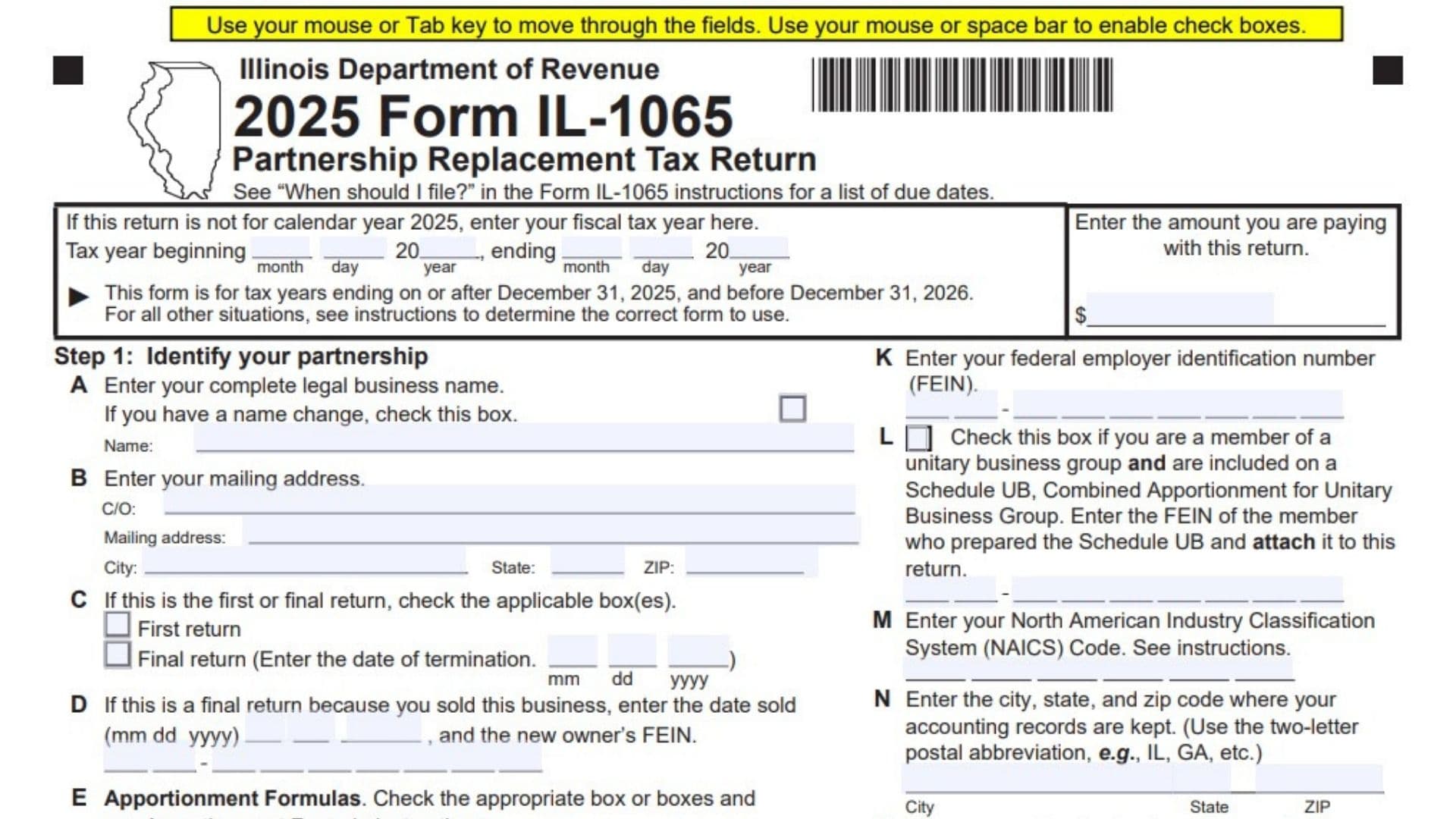
Form IL-1065, Partnership Replacement Tax Return, is an Illinois tax form used by partnerships to report their income, deductions, adjustments, credits, withholding obligations, and replacement tax liability to the Illinois Department of Revenue. The form helps determine the partnership’s Illinois taxable income, the portion of income attributable to Illinois, the amount of replacement tax owed, and whether the partnership has an overpayment or outstanding balance. It also collects identifying information about the partnership, its business activities, federal tax identification number, accounting records, and ownership structure. Partnerships use this return to report financial information derived from their federal Form 1065, together with Illinois-specific additions, subtractions, and adjustments required under state tax law. The return also accounts for pass-through entity tax elections, withholding obligations for partners, investment partnership withholding, and applicable tax credits. Businesses with income or activities outside Illinois may need to calculate an apportionment factor to determine how much income is taxable in the state. Form IL-1065 also includes supporting information about individual partners or shareholders through Schedule B, which identifies each member, their distributable income, withholding amounts, and pass-through entity tax credits. The 2025 version is intended for tax years ending on or after December 31, 2025, and before December 31, 2026. Completing the return accurately is important because errors in income calculations, apportionment, member information, or tax payments can affect the partnership’s replacement tax liability and the processing of its return.
Who Must File Form IL-1065?
Partnerships that are required to report Illinois replacement tax information use Form IL-1065 to calculate and report their applicable income and tax obligations.
The form also accommodates partnerships that elect to pay Pass-through Entity (PTE) Tax and partnerships classified as investment partnerships or publicly traded partnerships.
Depending on the partnership’s activities and ownership structure, additional schedules and supporting documents may be required.
Before filing, determine whether the partnership:
- Has income or loss that must be reported for Illinois tax purposes.
- Operates entirely within Illinois or conducts business in multiple states.
- Is part of a unitary business group.
- Has elected to pay Pass-through Entity Tax.
- Is classified as an investment partnership or publicly traded partnership.
- Has partners who are subject to Illinois replacement tax or pass-through withholding.
- Needs to report tax credits, special depreciation adjustments, or other Illinois-specific modifications.
The applicable filing requirements and due dates should be checked in the official Form IL-1065 instructions.
How To File Form IL-1065
Form IL-1065 is submitted to the Illinois Department of Revenue. The return may require supporting schedules and attachments depending on the partnership’s income, ownership, deductions, tax elections, and other reporting circumstances.
The form specifically identifies several supporting documents, including Schedule B, Schedule NB, Schedule F, Schedule NLD, Schedule 80/20, Schedule 1299-A, Form IL-4562, Form IL-477, and Form IL-2220.
Where to Submit Form IL-1065
For paper filing, the form provides two mailing addresses depending on whether a payment accompanies the return.
If a payment is enclosed, mail the return to:
Illinois Department of Revenue
PO Box 19053
Springfield, IL 62794-9053
If no payment is enclosed, mail the return to:
Illinois Department of Revenue
PO Box 19031
Springfield, IL 62794-9031
If you are submitting a payment, attach the payment and Form IL-1065-V in the designated area on Page 1.
For electronic filing, follow the applicable Illinois Department of Revenue and tax preparation software instructions.
Documents and Information to Prepare Before Filing
Gather the following information before completing the return:
- Partnership’s complete legal business name.
- Mailing address and business contact information.
- Federal Employer Identification Number (FEIN).
- North American Industry Classification System (NAICS) code.
- Federal Form 1065 and applicable Schedule K information.
- Partnership income, expenses, deductions, and other financial records.
- Information about partners and their distributable shares.
- Illinois sales and total sales everywhere, if apportionment is required.
- Information about Illinois replacement tax and PTE tax payments.
- Previous tax overpayments and available credits.
- Supporting Illinois tax schedules and federal attachments.
- Banking information if requesting a direct deposit refund.
- Paid preparer information, if a tax professional prepared the return.
You should also determine whether the partnership is filing its first return, final return, or a return following a business sale.

How To Complete Form IL-1065
The 2025 Form IL-1065 contains 11 main steps. These steps cover partnership identification, ordinary income, Illinois income adjustments, apportionment, net income, replacement tax, payments, refunds, and signatures.
The return also includes Schedule B, which provides detailed information about the partnership’s individual members.
Tax Year and Payment Information
Before completing Step 1, review the tax year and payment fields at the top of Page 1.
Tax Year Beginning
Enter the starting date of the partnership’s fiscal tax year if the return does not cover the calendar year 2025. Provide the beginning month, day, and year in the designated spaces.
Tax Year Ending
Enter the ending date of the fiscal tax year using the month, day, and year fields. The 2025 form is designed for tax years ending on or after December 31, 2025, and before December 31, 2026. For other tax periods, consult the applicable instructions to determine which form to use.
Amount You Are Paying With This Return
Enter the amount of payment being submitted with the return. Make sure this amount agrees with the payment you are enclosing.
If you are submitting a payment, attach it together with Form IL-1065-V in the designated payment area.
Step 1: Identify Your Partnership
Step 1 collects the partnership’s identifying information, business classification, tax elections, and supporting schedule details.
A: Complete Legal Business Name
Enter the partnership’s full legal business name. Use the official name associated with its tax records.
If the partnership’s legal name has changed, check the name-change box provided next to the business name field.
B: Mailing Address
Enter the partnership’s mailing address.
The form provides separate spaces for:
- C/O: Enter the care-of name or recipient, if applicable.
- Mailing address: Enter the street address or other mailing address.
- City: Enter the city.
- State: Enter the applicable state abbreviation.
- ZIP: Enter the postal ZIP code.
Make sure the address is complete so the Illinois Department of Revenue can send correspondence to the correct location.
C: First or Final Return
Check the appropriate box if this is the partnership’s first return or final return.
- First return: Select this box if the partnership is filing its first return.
- Final return: Select this box if the partnership is submitting its final return.
If you select Final Return, enter the business termination date in the month, day, and year format provided.
D: Final Return Because of a Business Sale
Complete this section when the partnership is filing a final return because the business was sold.
Enter the date the business was sold using the month, day, and year format.
Also enter the new owner’s Federal Employer Identification Number (FEIN). Check that the FEIN belongs to the new owner.
E: Apportionment Formulas
Select the appropriate apportionment formula or formulas that apply to the partnership’s business activities.
The form provides four choices:
- Financial organizations.
- Federally regulated exchanges.
- Transportation companies.
- Sales companies.
Check the applicable box or boxes and consult the apportionment formula instructions when determining which method applies.
F: Investment Partnership or Publicly Traded Partnership Classification
Select the appropriate box if the partnership is classified as either of the following:
- An investment partnership.
- A publicly traded partnership.
Check the applicable classification based on the partnership’s status.
G: IRC Section 761 Election
Check this box if the partnership made an election under Internal Revenue Code Section 761.
Only select this option if the partnership has made the applicable federal tax election.
H: 52/53-Week Filer
Check this box if the partnership uses a 52/53-week tax year instead of a conventional calendar or fiscal year.
I: Pass-Through Entity Tax Election
Check this box if the partnership elected to file and pay Pass-through Entity (PTE) Tax.
This identifies the partnership as an entity that has elected to use the PTE tax treatment. Consult the instructions for the applicable election and reporting requirements.
J: Annualized Income on Form IL-2220
Complete this item if the partnership is paying PTE Tax and annualized its income on Form IL-2220.
Check the box and attach Form IL-2220 to the return.
K: Federal Employer Identification Number
Enter the partnership’s complete Federal Employer Identification Number (FEIN).
Use the number assigned to the partnership by the Internal Revenue Service. Check the digits carefully before submitting the return.
L: Unitary Business Group Membership
Check this box if the partnership is a member of a unitary business group and is included on Schedule UB, Combined Apportionment for Unitary Business Group.
Enter the FEIN of the member that prepared Schedule UB.
Attach the completed Schedule UB to Form IL-1065.
M: North American Industry Classification System Code
Enter the partnership’s NAICS code.
This code identifies the primary type of business activity conducted by the partnership. Refer to the form instructions to determine the appropriate classification code.
N: Location of Accounting Records
Enter the city, state, and ZIP code where the partnership’s accounting records are maintained.
Use the two-letter postal abbreviation for the state. For example, Illinois is entered as IL and Georgia as GA.
This information identifies where the partnership’s financial and accounting records are kept.
O: Business Income Election
Check this box if the partnership is making the business income election to treat all nonbusiness income as business income.
If you make this election, enter zero on Step 6, Line 36, and Step 6, Line 44.
P: Federal Form 8886 and Federal Schedule M-3
Check the appropriate boxes if the partnership completed either of the following federal reporting documents:
- Federal Form 8886.
- Federal Schedule M-3, Part II, Line 10.
Attach the applicable federal form or forms to the Illinois return.
Q: Form IL-4562 Attachment
Check this box if you attached Form IL-4562 to report the applicable Illinois depreciation information.
R: Illinois Schedule M Attachment
Check this box if you attached Illinois Schedule M for businesses.
This schedule is used for applicable additional Illinois income or expense adjustments.
S: Schedule 80/20 Attachment
Check this box if you attached Schedule 80/20.
This schedule relates to the reporting of applicable related-party expense adjustments.
T: Schedule 1299-A Attachment
Check this box if you attached Schedule 1299-A.
This schedule is used for applicable Illinois tax credit and subtraction information.
U: Public Law 86-272 Protection
Check this box if the partnership’s business activity is protected under Public Law 86-272.
This identifies businesses claiming the applicable federal protection for certain activities.
V: Subgroup Schedule Attachment
Check this box if you attached the Subgroup Schedule to the return.
Step 2: Figure Your Ordinary Income or Loss
Step 2 establishes the partnership’s ordinary income or loss using information from federal Schedule K and other income and loss items.
The form specifies that this section must be completed using whole dollars only.
Line 1: Ordinary Income or Loss From Federal Schedule K
Enter the ordinary income or loss amount, or the equivalent amount, reported on federal Schedule K.
Use the amount applicable to the partnership’s federal reporting and transfer it to this line.
Line 2: Net Income or Loss From Rental Real Estate Activities
Enter the partnership’s net income or loss generated by rental real estate activities.
Use the relevant rental real estate income and expense information to determine the net amount.
Line 3: Net Income or Loss From Other Rental Activities
Report the net income or loss from rental activities other than rental real estate.
Calculate the applicable income after accounting for the related rental activity expenses.
Line 4: Portfolio Income or Loss
Enter the partnership’s portfolio income or loss.
Use the applicable portfolio income information reported in the partnership’s federal tax records.
Line 5: Net IRC Section 1231 Gain or Loss
Enter the partnership’s net gain or loss under Internal Revenue Code Section 1231.
Use the applicable Section 1231 information from the federal tax return.
Line 6: Other Income or Loss Items
Enter all other income or loss items that were not included when calculating the income or loss on Page 1 of federal Form 1065.
Identify the types of income or loss being included in the space provided. Make sure these amounts are not already included in Lines 1 through 5.
Line 7: Total Ordinary Income or Loss
Add the amounts reported on Lines 1 through 6.
Enter the combined amount on Line 7. This represents the partnership’s total ordinary income or loss for this step.
Step 3: Figure Your Unmodified Base Income or Loss
Step 3 adjusts the ordinary income or loss calculated in Step 2 by adding back certain expenses and deductions.
Line 8: Charitable Contributions
Enter the amount of charitable contributions made by the partnership that must be included in this calculation.
Use the applicable charitable contribution information from the partnership’s federal tax records.
Line 9: Expense Deduction Under IRC Section 179
Enter the expense deduction claimed under Internal Revenue Code Section 179.
Use the amount reported for the partnership’s Section 179 deduction.
Line 10: Interest on Investment Indebtedness
Enter the interest expense associated with investment indebtedness that must be included in the Illinois calculation.
Use the applicable amount from the partnership’s financial and tax records.
Line 11: Other Expense Items
Enter other expenses that were not deducted when calculating ordinary income or loss on Page 1 of federal Form 1065.
Identify the expenses included in the amount.
Do not duplicate expenses already reflected in the previous lines.
Line 12: Total Adjustments
Add the amounts reported on Lines 8 through 11.
Enter the combined total on Line 12.
Line 13: Total Unmodified Base Income or Loss
Subtract Line 12 from Line 7.
The result represents the partnership’s total unmodified base income or loss before the additional Illinois adjustments in the following steps.
Step 4: Figure Your Income or Loss
Step 4 begins with the unmodified base income or loss from Step 3 and applies the required Illinois additions.
Line 14: Unmodified Base Income or Loss
Transfer the amount from Step 3, Line 13, to Line 14.
Do not recalculate the amount. Use the previously calculated figure.
Line 15: Excluded Interest Income
Enter state, municipal, and other interest income that was excluded from the amount reported on Line 14.
Include the applicable interest income that must be added back for Illinois tax purposes.
Line 16: Illinois Taxes Deducted
Enter the amount of Illinois taxes that was deducted when calculating the amount on Line 14.
Refer to the applicable tax records and form instructions to determine the amount that must be added back.
Line 17: Illinois Special Depreciation Addition
Enter the applicable Illinois special depreciation addition.
Attach Form IL-4562 to provide the supporting depreciation information.
Line 18: Related-Party Expenses Addition
Enter the related-party expense amount that must be added back under the applicable Illinois rules.
Attach Schedule 80/20 to support this adjustment.
Line 19: Distributive Share of Additions
Enter the partnership’s distributive share of additions reported for its members.
Use the applicable information from Schedule K-1-P or Schedule K-1-T.
Attach the required schedules supporting the reported amounts.
Line 20: Guaranteed Payments to Partners
Enter the guaranteed payments made to partners as reported on federal Form 1065.
Use the partnership’s federal reporting information to determine the amount.
Line 21: Loss Distributable to a Partner Subject to Replacement Tax
Enter the amount of loss distributable to a partner who is subject to Illinois replacement tax.
Use Schedule B to determine the applicable partner information and supporting amount.
Attach Schedule B to the return.
Line 22: Other Additions
Enter other Illinois additions that are not included in Lines 15 through 21.
Attach Illinois Schedule M for businesses to support the reported adjustments.
Line 23: Total Income or Loss
Add all amounts reported on Lines 14 through 22.
Enter the total on Line 23. This amount represents the partnership’s income or loss after the additions reported in Step 4.
Step 5: Figure Your Base Income or Loss
Step 5 calculates the partnership’s Illinois base income or loss by subtracting applicable amounts from the income or loss calculated in Step 4.
Line 24: Interest Income From U.S. Treasury or Other Exempt Federal Obligations
Enter interest income received from U.S. Treasury securities or other federal obligations that qualify for the applicable subtraction.
Use the amount supported by the partnership’s financial records.
Line 25: August 1, 1969, Valuation Limitation Amount
Enter the applicable valuation limitation amount relating to the August 1, 1969, valuation provision.
Attach Schedule F to provide the required supporting information.
Line 26: Personal Service Income or Reasonable Compensation Allowance for Partners
Enter the amount of qualifying personal service income or the reasonable allowance for partner compensation.
Determine the appropriate amount using the applicable instructions and partnership records.
Line 27: Share of Income Distributable to a Partner Subject to Replacement Tax
Enter the partnership’s share of income distributable to a partner who is subject to Illinois replacement tax.
Use Schedule B to identify the relevant partner information and calculate the applicable distributable amount.
Attach Schedule B to the return.
Line 28: River Edge Redevelopment Zone Dividend Subtraction
Enter the qualifying dividend subtraction associated with the River Edge Redevelopment Zone.
Attach Schedule 1299-A to support the subtraction.
Line 29: High Impact Business Dividend Subtraction
Enter the applicable dividend subtraction associated with a qualifying High Impact Business.
Attach Schedule 1299-A with the supporting information.
Line 30: Illinois Special Depreciation Subtraction
Enter the Illinois special depreciation subtraction applicable to the partnership.
Attach Form IL-4562 to support the calculation.
Line 31: Related-Party Expenses Subtraction
Enter the applicable subtraction for related-party expenses.
Attach Schedule 80/20 to document the adjustment.
Line 32: Distributive Share of Subtractions
Enter the partnership’s distributive share of subtractions reported for its members.
Use the applicable information from Schedule K-1-P or Schedule K-1-T.
Attach the supporting schedules.
Line 33: Other Subtractions
Enter any other Illinois subtractions that are not already included in Lines 24 through 32.
Attach Illinois Schedule M for businesses to support the reported amount.
Line 34: Total Subtractions
Add all amounts reported on Lines 24 through 33.
Enter the combined total on Line 34.
Line 35: Base Income or Loss
Subtract Line 34 from Line 23.
The result is the partnership’s base income or loss before determining whether the income must be apportioned between Illinois and other states.
Determining Whether You Must Complete Step 6
After completing Line 35, review the two choices immediately below Step 5.
Your selection determines whether you can transfer the amount directly to Step 7 or must calculate Illinois income apportionment in Step 6.
Option A: Income Derived Entirely Within Illinois
Check this box if the entire amount reported on Line 35 is derived from activities inside Illinois only.
Transfer the amount from Step 5, Line 35, directly to Step 7, Line 47.
You must leave Step 6, Lines 36 through 46, blank.
An important exception applies to unitary filers. If the partnership is a unitary filer, do not select Option A. Instead, select Option B and complete Step 6.
Option B: Income Derived Partly Outside Illinois or Unitary Filing
Check this box if any portion of the amount reported on Line 35 is derived from outside Illinois.
Unitary filers must also select this option.
After selecting Option B, complete all applicable calculations in Step 6. The form specifically requires Lines 40, 41, and 42 to be completed.
Step 6: Figure Your Income Allocable to Illinois
Step 6 determines the portion of the partnership’s income or loss that can be allocated to Illinois.
Complete this section only if you selected Option B after Step 5.
Line 36: Nonbusiness Income or Loss
Enter the partnership’s nonbusiness income or loss that must be allocated to Illinois.
Attach Schedule NB to provide the supporting information.
If you made the business income election in Step 1, Option O, enter zero on this line.
Line 37: Business Income or Loss From Other Entities
Enter business income or loss included in Line 35 that comes from the following sources:
- Non-unitary partnerships.
- Partnerships included on Schedule UB.
- S corporations.
- Trusts.
- Estates.
Use the applicable information from the partnership’s tax records and supporting schedules.
Line 38: Total of Lines 36 and 37
Add the amounts reported on Lines 36 and 37.
Enter the combined result on Line 38.
Line 39: Business Income or Loss
Subtract Line 38 from Line 35.
This calculation identifies the business income or loss used in the Illinois apportionment calculation.
Line 40: Total Sales Everywhere
Enter the partnership’s total sales everywhere.
Include the applicable sales from all locations, not just Illinois.
The amount on this line cannot be negative.
Line 41: Total Sales Inside Illinois
Enter the partnership’s total sales attributable to Illinois.
Use the applicable Illinois sales information from the partnership’s records.
This amount also cannot be negative.
Line 42: Apportionment Factor
Calculate the partnership’s Illinois apportionment factor by dividing Line 41 by Line 40.
Round the result to six decimal places.
This percentage or decimal factor determines the portion of business income that is apportioned to Illinois.
Line 43: Business Income or Loss Apportionable to Illinois
Multiply the amount on Line 39 by the apportionment factor reported on Line 42.
Enter the result on Line 43.
This calculation identifies the portion of business income or loss attributable to Illinois.
Line 44: Nonbusiness Income or Loss Allocable to Illinois
Enter the amount of nonbusiness income or loss that must be allocated to Illinois.
Attach Schedule NB to support the reported amount.
If you made the business income election in Step 1, Option O, enter zero on this line.
Line 45: Business Income or Loss From Other Entities Allocable to Illinois
Enter the business income or loss apportionable to Illinois from the applicable non-unitary partnerships, partnerships included on Schedule UB, S corporations, trusts, or estates.
Use the applicable supporting information and follow the instructions for determining the amount.
Line 46: Base Income or Loss Allocable to Illinois
Add the amounts reported on Lines 43, 44, and 45.
Enter the combined result on Line 46.
This amount represents the partnership’s base income or loss allocated to Illinois.
Step 7: Figure Your Net Income
Step 7 determines the partnership’s net income after considering the Illinois net loss deduction and applicable exemption allowance.
Line 47: Base Income or Net Loss
Enter the appropriate base income or net loss amount.
Use Step 5, Line 35, if you selected Option A and the income was derived entirely within Illinois.
Use Step 6, Line 46, if you selected Option B and completed the apportionment calculation.
Line 48: Illinois Net Loss Deduction
Enter the applicable Illinois net loss deduction.
Attach Schedule NLD to support the deduction.
If Line 47 is zero or a negative amount, enter zero on Line 48.
If the partnership has merged losses, check the designated box and attach a detailed statement explaining the merged losses.
Line 49: Income After Net Loss Deduction
Subtract Line 48 from Line 47.
Enter the resulting amount on Line 49.
This represents the partnership’s income after applying the Illinois net loss deduction.
Line 50: Base Income or Loss From Step 5
Transfer the amount from Step 5, Line 35, to Line 50.
Use the original base income or loss amount rather than the apportioned amount from Step 6.
Line 51: Income Ratio
Divide the amount on Line 47 by the amount on Line 50.
Round the result to six decimal places.
The form specifies that this figure cannot be greater than one.
Line 52: Exemption Allowance
Enter the applicable exemption allowance.
Review the Form IL-1065 instructions before completing this line to determine the correct amount.
Line 53: Net Income
Subtract Line 52 from Line 49.
Enter the result on Line 53.
This is the partnership’s net income after applying the exemption allowance.
Step 8: Figure Your Net Replacement Tax
Step 8 calculates the partnership’s Illinois replacement tax after applicable investment credit adjustments.
Important: Investment partnerships should skip Step 8 as directed by the form.
Line 54: Replacement Tax
Multiply the amount reported on Line 53 by 1.5%, or 0.015.
Enter the calculated replacement tax amount on Line 54.
Line 55: Recapture of Investment Credits
Enter any applicable recapture of investment credits.
Attach Schedule 4255 to support the reported amount.
Line 56: Replacement Tax Before Investment Credits
Add the amounts reported on Lines 54 and 55.
Enter the total on Line 56.
Line 57: Investment Credits
Enter the applicable investment credits available to the partnership.
Attach Form IL-477 to provide the supporting credit information.
Line 58: Net Replacement Tax
Subtract Line 57 from Line 56.
If the result is negative, enter zero instead.
The amount reported on Line 58 represents the partnership’s net replacement tax before the withholding and PTE tax calculations in Step 9.
Step 9: Figure the Taxes, Withholding, and Penalty You Owe
Step 9 combines replacement tax, withholding obligations, pass-through entity tax, and any applicable estimated tax penalty.
Line 59a: Pass-Through Withholding Owed on Behalf of Members
Enter the pass-through withholding amount the partnership owes on behalf of its members.
Use the applicable withholding information reported in Schedule B.
Line 59b: Investment Partnership Withholding
Enter the applicable investment partnership withholding amount.
Use the supporting information from Schedule B and the partnership’s withholding records.
Line 59: Total Withholding
Add the amounts reported on Lines 59a and 59b.
Enter the combined withholding amount on Line 59.
Line 60: Pass-Through Entity Income
Enter the partnership’s applicable pass-through entity income.
Use the amount determined under the applicable PTE tax instructions.
Line 61: Pass-Through Entity Tax
Enter the amount of pass-through entity tax owed by the partnership.
Use the applicable PTE tax calculation and supporting records.
Line 62: Total Net Replacement Tax, Withholding, and Pass-Through Entity Tax
Add the amounts reported on Lines 58, 59, and 61.
Enter the total on Line 62.
This combines the partnership’s net replacement tax, withholding obligations, and PTE tax.
Line 63: Underpayment of Estimated Tax Penalty
Enter the applicable underpayment of estimated tax penalty calculated using Form IL-2220.
Attach or use the applicable Form IL-2220 information to determine the amount.
Line 64: Total Taxes, Withholding, Entity Tax, and Penalty
Add Lines 62 and 63.
Enter the combined amount on Line 64.
This represents the total tax and penalty obligation before applying the payments reported in Step 10.
Step 10: Figure Your Refund or Balance Due
Step 10 compares the partnership’s payments and available credits with its total tax obligations.
This calculation determines whether the partnership has an overpayment, a refund, or an outstanding tax balance.
Line 65a: Credits From Previous Overpayments
Enter any applicable credits carried forward from previous overpayments.
Use the amount available from the partnership’s previous tax filings.
Line 65b: Total Payments Made Before Filing
Enter the total payments the partnership made before submitting the current return.
Include the applicable payments made for the tax period being reported.
Line 65c: Pass-Through Withholding Reported to You
Enter pass-through withholding reported to the partnership.
Use the amounts shown on Schedule K-1-P or Schedule K-1-T.
Attach the applicable supporting schedules.
Line 65d: Illinois Income Tax Withholding
Enter the Illinois income tax withholding amount reported to the partnership.
Attach the applicable Form W-2G documents to support the reported withholding.
Line 66: Total Payments
Add the amounts reported on Lines 65a, 65b, 65c, and 65d.
Enter the combined amount on Line 66.
This represents the total payments and credits available to offset the partnership’s tax liability.
Line 67: Overpayment
Compare Line 66 with Line 64.
If Line 66 is greater than Line 64, subtract Line 64 from Line 66.
Enter the difference on Line 67.
If the total payments do not exceed the tax liability, there is no overpayment to report on this line.
Line 68: Amount to Be Credited Forward
Enter the portion of the overpayment you want credited toward a future tax period, as permitted under the applicable instructions.
If the carryforward is being transferred to a different FEIN, check the designated box and attach a detailed statement explaining the transfer.
Line 69: Refund
Subtract Line 68 from Line 67.
Enter the remaining amount on Line 69.
This is the amount of overpayment requested as a refund.
Line 70: Direct Deposit Information
Complete this section if you want your refund deposited directly into a bank account.
Provide the following information:
- Routing Number: Enter the bank’s routing number.
- Account Number: Enter the account number where the refund should be deposited.
- Checking or Savings: Select the appropriate account type.
Verify the banking information carefully to avoid problems with the refund deposit.
Line 71: Tax Due
Determine whether the total tax liability is greater than the total payments.
If Line 64 is greater than Line 66, subtract Line 66 from Line 64.
Enter the difference on Line 71.
This is the amount the partnership still owes.
If you are submitting payment with the return, enter the payment amount in the designated payment field at the top of Page 1.
Step 11: Sign the Return
Step 11 contains the partnership’s declaration, signature, and paid preparer information.
The person signing the return confirms under penalties of perjury that the return has been examined and is true, correct, and complete to the best of their knowledge.
Signature of Partner
The partner responsible for signing the return must provide their signature in the designated space.
Date
Enter the date the partner signs the return using the month, day, and year format.
Title
Enter the signer’s position or title within the partnership.
Phone
Provide the telephone number where the signing partner can be contacted.
Permission to Discuss the Return With the Paid Preparer
Check this box if you authorize the Illinois Department of Revenue to discuss the return with the paid preparer identified in Step 11.
This authorization relates to communication about the filed return.
Paid Preparer’s Name
Enter the printed or typed name of the individual who prepared the return for payment.
Paid Preparer’s Signature
The paid preparer must sign the return in the designated space.
Paid Preparer’s Date
Enter the date the paid preparer signed the return.
Self-Employed Preparer Checkbox
Check this box if the paid preparer is self-employed.
Paid Preparer’s PTIN
Enter the paid preparer’s Preparer Tax Identification Number (PTIN).
Firm’s Name
Enter the name of the tax preparation firm, if applicable.
Firm’s FEIN
Enter the firm’s Federal Employer Identification Number.
Firm’s Address
Provide the tax preparation firm’s complete business address.
Firm’s Phone
Enter the telephone number of the tax preparation firm.
If no paid preparer was involved, the paid preparer section does not apply.
Schedule B is an attachment used with Form IL-1065 or Form IL-1120-ST. It provides detailed information about the partnership’s individual members, their income allocations, withholding obligations, and pass-through entity tax credits.
This schedule is particularly important when a partnership has multiple partners or members with different tax classifications and withholding requirements.
Schedule B contains two sections:
- Section A: Total members’ information.
- Section B: Individual members’ information.
Although Section A appears first on the schedule, the form requires you to complete Section B before Section A.
Information to Prepare Before Completing Schedule B
Before starting Schedule B, follow these preparation requirements:
- Read the Schedule B instructions.
- Complete the applicable Schedule K-1-P forms.
- Complete Schedule K-1-P(3) or Schedule K-1-P(4), as applicable.
- Complete Section B of Schedule B.
- Prepare all required information about the partnership’s individual partners or shareholders.
Investment partnerships must also attach documentation supporting their classification as an investment partnership.
Incomplete information or failure to follow the required completion order may delay return processing or result in additional correspondence from the Illinois Department of Revenue.
Schedule B: Partnership Identification
Year Ending
Enter the month and year representing the end of the tax year covered by Schedule B.
Make sure the information agrees with the corresponding Form IL-1065 or Form IL-1120-ST.
Partnership or Business Name
Enter the partnership’s name exactly as it appears on Form IL-1065 or Form IL-1120-ST.
Use the same legal business name reported on the main tax return.
Federal Employer Identification Number
Enter the partnership’s FEIN.
This number must match the identification number reported on the corresponding Illinois tax return.
Section A: Total Members’ Information
Section A summarizes the information reported for all members on Schedule K-1-P and Schedule B, Section B.
Complete Section B first. Then use the totals from the applicable schedules to complete Section A.
Totals From Schedule K-1-P
Line 1: Total Nonbusiness Income or Loss
Enter the combined amount of all nonbusiness income or loss reported for the partnership’s members on Schedule K-1-P.
Add the applicable amounts reported for all members and enter the total.
Line 2: Total Income and Replacement Tax Credits
Enter the combined amount of income tax credits and replacement tax credits reported for the partnership’s members on Schedule K-1-P.
Use the applicable member credit information and calculate the total for all members.
Totals From Schedule B, Section B
Line 3: Members’ Distributable Amounts Subject to Replacement Tax or an ESOP
Add the amounts reported on Schedule B, Section B, Line E, for all partners or shareholders whose entity classification is marked as subject to Illinois replacement tax or an ESOP.
Include the applicable members across every page of Section B.
Enter the combined total on Line 3.
Line 4a: Withholding for Nonresident Individual Members
Enter the total pass-through withholding or investment partnership withholding reported for nonresident individual members.
Use the applicable amounts from Schedule B, Section B, Line J, across all pages.
Line 4b: Withholding for Nonresident Estate Members
Enter the total pass-through withholding or investment partnership withholding reported for nonresident estate members.
Use the applicable amounts from Section B, Line J.
Line 4c: Withholding for Partnership and S Corporation Members
Enter the total applicable pass-through withholding or investment partnership withholding for partnership and S corporation members.
Calculate the amount using the relevant Line J entries from Section B.
Line 4d: Withholding for Nonresident Trust Members
Enter the total pass-through withholding or investment partnership withholding reported for nonresident trust members.
Use the corresponding Line J amounts.
Line 4e: Withholding for C Corporation Members
Enter the total pass-through withholding or investment partnership withholding reported for C corporation members.
Use the applicable Line J information from Section B.
Line 5: Total Pass-Through or Investment Partnership Withholding
Add Lines 4a through 4e.
Enter the combined amount on Line 5.
This represents the total withholding owed on behalf of all applicable nonresident partners or shareholders.
The amount must also be reported on the applicable return line:
- Form IL-1120-ST or IL-1120-ST-X, Line 59.
- Form IL-1065 or IL-1065-X, Line 59a, for pass-through withholding.
- Form IL-1065 or IL-1065-X, Line 59b, for investment partnership withholding.
Use the appropriate destination based on the type of withholding being reported.
Line 6: Total PTE Tax Credit Paid to Members
Enter the total pass-through entity tax credit paid to members.
Add the applicable amounts reported on Schedule B, Section B, Line K, across all pages.
Line 7: Total PTE Tax Credit Received and Distributed to Members
Enter the total pass-through entity tax credit received and distributed to members.
Add the applicable amounts reported on Schedule B, Section B, Line L, across all pages.
Attaching Section B
Attach all completed pages of Schedule B, Section B, behind the Section A page.
Make sure every member is included and that the totals in Section A agree with the individual information reported in Section B.
Section B: Members’ Information
Section B collects individual information about the partnership’s partners or shareholders.
The schedule provides three member columns on each page, labeled Member 1, Member 2, and Member 3.
Complete a separate column for each applicable member. If the partnership has more members than the available space, attach additional copies of the Section B page.
Enter the partnership’s name and FEIN in the identification area before completing the member details.
A: Member’s Name and Address
Enter the member’s identifying and mailing information.
This section includes the following fields:
- Name: Enter the member’s complete legal name.
- C/O: Enter the care-of recipient, if applicable.
- Address 1: Enter the member’s primary street address.
- Address 2: Enter any additional address information, such as an apartment or unit number.
- City: Enter the member’s city.
- State: Enter the appropriate state abbreviation.
- ZIP: Enter the member’s ZIP code.
Make sure the address information is complete and corresponds to the correct member.
B: Entity Type
Enter the applicable entity classification for the member.
Identify whether the member is an individual, partnership, corporation, trust, estate, or another applicable entity type.
Use the Schedule B instructions to determine the correct classification and reporting format.
C: Social Security Number or FEIN
Enter the member’s appropriate taxpayer identification number.
Use the Social Security number (SSN) for an individual member or the Federal Employer Identification Number (FEIN) for an entity, as applicable.
Verify the identification number before submitting the schedule.
D: Subject to Illinois Replacement Tax or an ESOP
Indicate whether the member is subject to Illinois replacement tax or is an Employee Stock Ownership Plan (ESOP).
Use the appropriate classification for the member and follow the Schedule B instructions when completing this field.
This information is important when calculating the total distributable amounts reported in Section A, Line 3.
E: Member’s Distributable Amount of Base Income or Loss
Enter the member’s distributable amount of partnership base income or loss.
Use the member’s applicable allocation information to determine the amount.
The total of the qualifying amounts reported in this column is used in Section A, Line 3.
F: Excluded From Pass-Through Withholding
Indicate whether the member is excluded from pass-through withholding.
Determine the member’s withholding status using the applicable Illinois rules and Schedule B instructions.
G: Share of Illinois Income Subject to Pass-Through or Investment Partnership Withholding
Enter the member’s share of Illinois income that is subject to pass-through withholding or investment partnership withholding.
Use the applicable income allocation information to determine the amount attributable to that member.
H: Pass-Through or Investment Partnership Withholding Before Credits
Enter the withholding amount calculated for the member before applying any applicable credits.
This field reports the withholding obligation before credit adjustments.
I: Distributable Share of Credits
Enter the member’s distributable share of applicable credits.
Use the member’s credit allocation information from the partnership’s supporting tax records.
J: Pass-Through or Investment Partnership Withholding Amount
Enter the final pass-through withholding or investment partnership withholding amount for the member.
Use the applicable withholding calculations and credit information to determine the amount.
These figures are used when preparing Section A, Lines 4a through 4e, and Line 5.
K: PTE Tax Credit Paid to Members
Enter the amount of pass-through entity tax credit paid to the member.
Use the applicable PTE tax credit allocation information.
The total of these amounts is reported in Section A, Line 6.
L: PTE Tax Credit Received and Distributed to Members
Enter the amount of pass-through entity tax credit received and distributed to the member.
Use the applicable credit distribution records.
The total of these amounts is reported in Section A, Line 7.
Additional Schedule B Pages
If the partnership has more than three members, attach additional copies of the Section B page.
Continue listing members until all applicable partners or shareholders have been reported.
Make sure the information on every additional page is included when calculating the totals in Section A.
Important Attachments and Supporting Schedules
Form IL-1065 references several supporting documents throughout the return. The required attachments depend on the partnership’s specific tax circumstances.
The following list summarizes the schedules and forms identified on the return:
| Form or Schedule | Purpose |
|---|---|
| Form IL-1065-V | Payment voucher attached when submitting payment |
| Schedule B | Partners’ or shareholders’ income, withholding, and credit information |
| Schedule F | Supports the August 1, 1969, valuation limitation amount |
| Schedule NB | Reports nonbusiness income or loss |
| Schedule NLD | Supports the Illinois net loss deduction |
| Schedule 80/20 | Supports related-party expense adjustments |
| Schedule 1299-A | Supports applicable Illinois dividend subtractions and tax credit information |
| Schedule UB | Combined apportionment for a unitary business group |
| Subgroup Schedule | Supports applicable subgroup reporting |
| Illinois Schedule M | Reports other business income or expense adjustments |
| Form IL-4562 | Supports Illinois special depreciation adjustments |
| Form IL-477 | Supports investment credit claims |
| Form IL-2220 | Supports annualized income and underpayment of estimated tax penalty calculations |
| Schedule 4255 | Supports recapture of investment credits |
| Schedule K-1-P | Reports applicable member income, deductions, and credits |
| Schedule K-1-T | Provides applicable distributive share information |
| Schedule K-1-P(3) or K-1-P(4) | Supporting member schedules required before completing Schedule B |
Attach the applicable documents to the return as required by the form instructions.
Final Review Before Filing
Before submitting Form IL-1065, review every section and supporting schedule to ensure that all information is complete and accurate.
Use this checklist to review the return:
Partnership Identification
- The correct 2025 tax form has been used for the applicable tax year.
- The tax year beginning and ending dates are correct, if applicable.
- The payment amount at the top of Page 1 is accurate.
- The partnership’s complete legal name is entered.
- The name-change box is checked if applicable.
- The mailing address is complete.
- The first-return or final-return box is selected when applicable.
- The termination date is entered for a final return.
- The business sale date and new owner’s FEIN are entered when applicable.
- The correct apportionment formula boxes are selected.
- The investment partnership or publicly traded partnership classification is identified when applicable.
- The IRC Section 761 election box is checked when applicable.
- The 52/53-week filer box is checked when applicable.
- The PTE tax election and annualized income boxes are completed when applicable.
- The partnership’s FEIN and NAICS code are correct.
- The accounting records location is provided.
- The business income election is correctly reported.
- All applicable federal and Illinois attachment boxes are checked.
Income and Deduction Calculations
- Step 2, Lines 1 through 7, are complete.
- Other income and loss items are properly identified on Line 6.
- Step 3, Lines 8 through 13, are complete.
- The amounts on Lines 12 and 13 are calculated correctly.
- Step 4, Lines 14 through 23, include all applicable additions.
- Step 5, Lines 24 through 35, include all applicable subtractions.
- Supporting schedules are attached for depreciation, related-party expenses, and other adjustments.
Illinois Income Apportionment
- The correct Option A or Option B box is selected after Step 5.
- Option A is selected only when the income is derived entirely within Illinois and the partnership is not a unitary filer.
- Option B is selected when any portion of the income is derived outside Illinois or the partnership is a unitary filer.
- Step 6 is completed when required.
- Lines 40, 41, and 42 are completed when Step 6 applies.
- The apportionment factor is rounded to six decimal places.
- The amounts reported on Lines 43 through 46 are calculated correctly.
Net Income and Replacement Tax
- Step 7 uses the correct amount from Line 35 or Line 46.
- The Illinois net loss deduction is correctly reported.
- The merged-loss statement is attached if required.
- The income ratio on Line 51 is rounded to six decimal places and does not exceed one.
- The exemption allowance is correctly calculated.
- Step 8 is completed when applicable.
- Investment partnerships have skipped Step 8 as instructed.
- The replacement tax rate of 1.5% is applied correctly.
- Applicable investment credits and recapture amounts are included.
Withholding, Payments, and Refund
- Lines 59a and 59b include the applicable withholding amounts.
- Line 59 reflects the combined withholding.
- PTE income and PTE tax are reported correctly.
- The underpayment penalty is included when applicable.
- Line 64 reflects the total tax and penalty obligation.
- Previous overpayment credits are reported correctly.
- All applicable payments and withholding credits are included on Line 65.
- Line 66 reflects total payments.
- The overpayment on Line 67 is calculated correctly.
- Any amount credited forward is entered on Line 68.
- The required statement is attached if a carryforward goes to a different FEIN.
- The refund amount on Line 69 is correct.
- Direct deposit information is accurate if requesting a bank deposit.
- The tax due on Line 71 is calculated correctly.
- The payment amount at the top of Page 1 agrees with the payment being submitted.
Schedule B and Final Submission
- The partnership name and FEIN on Schedule B match the main return.
- The correct tax year is entered on Schedule B.
- Applicable Schedule K-1-P and K-1-P(3) or K-1-P(4) forms have been completed.
- Section B has been completed before Section A.
- All partners and shareholders are included.
- Each member’s name, address, entity type, and taxpayer identification number are correct.
- Member income allocations and withholding amounts are properly reported.
- PTE tax credits paid and distributed are included.
- Section A totals agree with the corresponding Section B amounts.
- All additional Section B pages are attached when needed.
- Investment partnership documentation is attached when applicable.
- All other required schedules and supporting forms are included.
- The partner has signed and dated the return.
- The partner’s title and phone number are provided.
- The paid preparer’s information is complete when applicable.
- The paid preparer discussion authorization box is selected if permission is granted.
- The correct mailing address is used based on whether payment is enclosed.
Completing Form IL-1065 carefully helps partnerships report their Illinois income, replacement tax, withholding obligations, and applicable credits accurately. Review the income calculations, apportionment requirements, member information, and supporting schedules before submitting the return to the Illinois Department of Revenue. A complete and properly prepared return helps reduce processing delays and the possibility of additional requests for information.