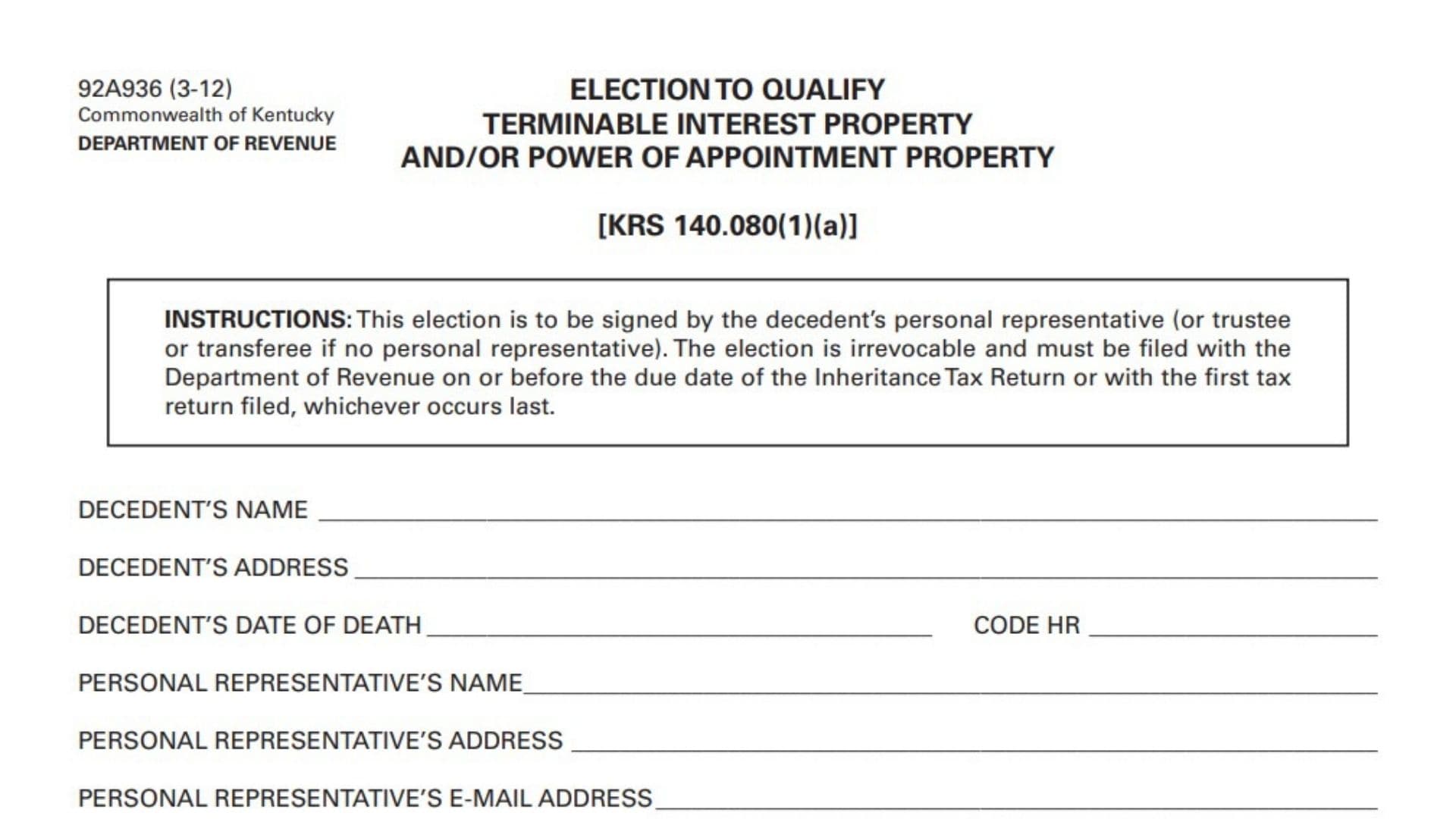
The Kentucky Election to Qualify Terminable Interest Property and/or Power of Appointment Property, Form 92A936, is used to make an irrevocable Kentucky inheritance tax election for certain property interests created for a surviving spouse. The election may apply when a decedent’s will creates a qualifying life income interest in a trust or life estate that would satisfy the federal estate tax marital deduction requirements described in Section 2056(b)(5) or Section 2056(b)(7) of the Internal Revenue Code, as incorporated by the form. By making the election, the personal representative, trustee, or transferee chooses to treat the entire qualifying property interest as property transferred to the surviving spouse for purposes of Kentucky’s spousal inheritance tax exemption. This treatment can allow the property to receive the applicable spouse exemption in the first decedent’s estate, even though the surviving spouse may receive only a life income interest rather than complete ownership. The election has an important future consequence. The remaining value of the trust or life estate will be included in the surviving spouse’s estate for Kentucky inheritance and estate tax purposes when the surviving spouse dies, regardless of where the surviving spouse is domiciled at that time. The election cannot be withdrawn after it is made, so the representative should review the will, trust terms, beneficiary interests, property values, marital deduction requirements, and expected future tax effects before signing. The election must be signed by the decedent’s personal representative or, when no personal representative exists, by the trustee or transferee. It must be submitted to the Kentucky Department of Revenue by the applicable filing deadline.
Who Should Use This Election?
This election may be appropriate when all of the following conditions apply:
- The decedent’s will creates a trust or life estate for the surviving spouse.
- The surviving spouse receives a qualifying life income interest.
- The property arrangement would qualify for the federal estate tax marital deduction under the applicable provisions identified on the form.
- The estate wants the qualifying property treated as transferred to the surviving spouse for the Kentucky spousal exemption.
- The personal representative, trustee, or transferee understands that the election is irrevocable.
- The parties understand that the remaining trust or life estate value will be included in the surviving spouse’s Kentucky taxable estate at the surviving spouse’s death.
The person making the election should confirm that the specific will provisions and property interests satisfy the required conditions. Merely leaving property in trust for a spouse does not automatically mean the election is available.
Who Must Sign The Election?
The decedent’s personal representative should sign the election.
When the estate does not have a personal representative, the trustee or transferee may sign it.
The surviving spouse does not sign merely because the election concerns property passing for the spouse’s benefit, unless the surviving spouse is also the properly authorized personal representative, trustee, or transferee.
When To File The Election
The election must be filed with the Kentucky Department of Revenue by the later of these two dates:
- The due date of the Kentucky Inheritance Tax Return.
- The date on which the estate’s first inheritance tax return is filed.
Because the election is irrevocable, it should be completed only after the representative has confirmed the relevant will provisions, qualifying property, and tax consequences.
How To File The Election
Gather the following information before completing the form:
- The decedent’s complete legal name.
- The decedent’s final address.
- The decedent’s date of death.
- The estate’s Kentucky HR code, when available.
- The personal representative’s full name and address.
- The personal representative’s email address and telephone number.
- The complete name of the person making the election.
- The estate’s full legal name.
- The item numbers or article numbers in the decedent’s will that create the qualifying interest.
- The surviving spouse’s complete legal name.
- A complete copy of the decedent’s will.
- Trust documents or other records describing the qualifying property interest.
- Valuation information for the trust or life estate property.
- The related Kentucky inheritance tax return.
Review the identified will provisions to make sure they create the qualifying life income interest described in the election. Enter every requested name, address, date, and will item number. The authorized person must then sign and date the election.
Submit the election to the Kentucky Department of Revenue by the required deadline. Include it with the inheritance tax return when practical and retain a complete copy with the estate’s permanent tax records.

How To Complete The Kentucky Election
Decedent Information
Line 1: Decedent’s Name: Enter the decedent’s complete legal name. Use the same name entered on the Kentucky inheritance tax return and other estate documents.
Include the first name, middle name or initial, and last name. Add a suffix when applicable.
Line 2: Decedent’s Address: Enter the decedent’s complete address.
Use the decedent’s permanent residence or domicile at the time of death. Include the street address, apartment or unit number, city, state, and ZIP code.
Line 3: Decedent’s Date Of Death: Enter the complete month, day, and year on which the decedent died.
The date should match the death certificate and inheritance tax return.
Line 4: Code HR: Enter the estate’s Kentucky HR code or number when it has been assigned.
Review notices or correspondence from the Kentucky Department of Revenue for the correct code. Leave this field blank when no code is known or assigned.
Personal Representative Information
Line 5: Personal Representative’s Name: Enter the complete legal name of the executor, administrator, or other personal representative responsible for the estate.
When no personal representative exists and a trustee or transferee is making the election, enter the appropriate person’s name and clearly identify that person’s capacity.
Line 6: Personal Representative’s Address: Enter the personal representative’s complete mailing address.
Include the street address, apartment or office number, city, state, and ZIP code. Use an address where official tax correspondence can be received.
Line 7: Personal Representative’s Email Address: Enter a current email address for the personal representative, trustee, or transferee.
Review the address carefully to avoid missing communications concerning the election or inheritance tax return.
Line 8: Personal Representative’s Telephone Number: Enter a current telephone number, including the area code.
Use a number at which the representative can be reached during normal business hours.
Election Statement Instructions
The main election statement identifies the person making the election, the estate, the relevant provisions of the will, and the surviving spouse receiving the qualifying interest.
Person Making The Election
Line 9: Name Of Person Making The Election: Enter the complete legal name of the person formally making the election.
This person should be the decedent’s personal representative. When no personal representative exists, enter the name of the trustee or transferee authorized to make the election.
The name should match the name entered in the representative information section unless another authorized trustee or transferee is completing the election.
Estate Name
Line 10: Estate Of: Enter the decedent’s complete legal name after the words referring to the estate.
The entry should identify the estate in the same manner used on the Kentucky inheritance tax return, such as “Estate of Jane M. Smith.”
Will Provisions Creating The Qualifying Interest
Line 11: Item Or Items Of The Last Will And Testament: Enter the exact item numbers, article numbers, paragraph numbers, or section references in the decedent’s will that create the qualifying trust or life estate.
Examples may include:
- Item IV.
- Article Five.
- Section 6.2.
- Items III and VII.
- Paragraph 4(b).
Do not enter a general description such as “spouse’s trust” when the will provides a specific numbered reference. Use the precise references so the Department of Revenue can locate the provisions efficiently.
When more than one provision creates or affects the qualifying interest, list every relevant item.
Qualifying Life Income Interest
Line 12: Qualifying Life Income Interest Confirmation: By completing and signing the election, the representative confirms that the identified will provisions create a qualifying life income interest in a trust or life estate.
The surviving spouse should generally be entitled to the required income interest for life, and the arrangement must otherwise satisfy the applicable marital deduction conditions identified on the form.
Review the following matters before signing:
- Who receives the trust income.
- Whether the spouse’s income rights continue for life.
- How often income must be distributed.
- Whether another person may receive the property during the spouse’s lifetime.
- Whether the spouse has a power to appoint the property.
- What happens to the remaining property after the spouse’s death.
- Whether the interest would qualify under the applicable marital deduction provision.
The form does not provide space for a property description. Keep supporting schedules, trust records, and valuation documents with the estate records.
Federal Marital Deduction Qualification
Line 13: Section 2056(b)(5) Or Section 2056(b)(7): Confirm which federal marital deduction provision applies to the property arrangement.
Section 2056(b)(5) generally concerns certain qualifying life interests coupled with a power of appointment.
Section 2056(b)(7) generally concerns qualified terminable interest property.
The form identifies the Internal Revenue Code of 1954 as amended through December 31, 1984. The representative should determine whether the property arrangement meets the qualifications incorporated into the Kentucky election.
No separate blank is provided for selecting one of the two provisions. The signer confirms qualification by signing the completed election.
Irrevocable Election
Line 14: Irrevocable Election: Understand that completing and signing this form creates an irrevocable election.
After the election is made, the estate cannot ordinarily cancel it simply because property values, beneficiary circumstances, or expected tax results later change.
Before signing, review:
- The value of the qualifying property.
- The surviving spouse’s age and interest.
- The identity of remainder beneficiaries.
- The expected treatment when the surviving spouse dies.
- The effect on the current Kentucky inheritance tax return.
- The effect on the surviving spouse’s future Kentucky estate.
Surviving Spouse Information
Line 15: Property Transferred To: Enter the surviving spouse’s complete legal name.
The named person must be the decedent’s surviving spouse and the recipient of the qualifying trust or life estate interest.
Use the spouse’s first name, middle name or initial, last name, and any applicable suffix.
Do not enter “spouse,” “wife,” “husband,” “widow,” or “widower” without the person’s full legal name.
Line 16: Surviving Spouse Status: By completing this part of the statement, the representative confirms that the named person is the decedent’s surviving spouse for purposes of the Kentucky spousal exemption.
Future Inclusion In The Surviving Spouse’s Estate
Line 17: Remainder Or Balance Of The Trust Or Life Estate: Understand that the remaining value of the elected trust or life estate will be included in the surviving spouse’s estate when the spouse dies.
The amount included will be based on the property’s value at the surviving spouse’s date of death, not necessarily its value when the first decedent died.
Line 18: Kentucky Inheritance And Estate Tax Treatment: The elected property will be considered when determining Kentucky inheritance and estate tax consequences following the surviving spouse’s death.
The person administering the surviving spouse’s estate should retain a copy of this election and records identifying the elected property.
Line 19: Surviving Spouse’s Domicile: The future inclusion applies regardless of where the surviving spouse is domiciled at death.
Moving outside Kentucky after the election does not remove the stated future inclusion requirement.
Filing Instruction Lines
Line 20: Authorized Signer: Confirm that the person signing is the decedent’s personal representative.
When no personal representative exists, confirm that the signer is the trustee or transferee authorized to make the election.
Line 21: Irrevocable Status: Confirm once more that the election cannot be withdrawn after it is made.
Do not sign an incomplete form or make the election before reviewing its current and future consequences.
Line 22: Filing With The Department Of Revenue: Submit the completed election to the Kentucky Department of Revenue.
Keep evidence showing when and how the election was submitted.
Line 23: Inheritance Tax Return Due Date: Determine the due date of the related Kentucky Inheritance Tax Return.
The election must be filed by that date unless the estate’s first inheritance tax return is filed later.
Line 24: First Return Filing Rule: When the estate’s first inheritance tax return is filed after the ordinary due date, the election may be filed with that first return because the form uses whichever event occurs last.
This rule should not be interpreted as permission to file the inheritance tax return late without possible interest, penalties, or other consequences.
Signature Section
Line 25: Signature Of Person Making The Election: The personal representative, trustee, or transferee making the election must sign this line.
The signature confirms that the signer:
- Has authority to make the election.
- Identified the correct estate and will provisions.
- Intends to treat the qualifying property as transferred to the surviving spouse.
- Understands that the election is irrevocable.
- Understands the future inclusion of the property in the surviving spouse’s estate.
A tax preparer, attorney, or accountant should not sign in place of the authorized person solely because that professional prepared the form.
Line 26: Date: Enter the date on which the authorized person signs the election.
Use the actual signing date. Confirm that the form will be submitted by the applicable filing deadline.
Line 27: Telephone Number Area: Enter the signer’s telephone number, including the area code, when the blank associated with the telephone symbol is intended for contact information.
Use the same current telephone number entered in the personal representative information section unless a different appropriate contact number should be used.
Supporting Documents And Records
Although the form itself is brief, the estate should maintain documents supporting the election.
Last Will And Testament
Retain a complete copy of the decedent’s will, including every codicil and amendment.
Mark or identify the provisions entered on the election so they can be found easily.
Trust Documents
When the will creates or funds a separate trust, retain the trust agreement, trustee acceptance, funding records, and related schedules.
Property Description
Prepare a list identifying every asset included in the election. The list should include:
- A clear description of the property.
- The date-of-death value.
- The valuation method.
- The account, parcel, or other identifying number.
- The trustee or person holding the property.
- The surviving spouse’s rights.
- The remainder beneficiaries.
Valuation Records
Retain appraisals, account statements, business records, real estate valuations, and other materials supporting the property’s value.
These records may also be needed when the surviving spouse dies.
Inheritance Tax Return
Keep the election with the Kentucky inheritance tax return on which the elected treatment is reported.
The property and beneficiary reporting on the return should be consistent with the election.
Final Review Checklist
Before filing the election, confirm that:
- The decedent’s complete name is correct.
- The decedent’s final address is complete.
- The date of death matches the death certificate.
- The HR code is entered when known.
- The personal representative’s name and contact information are complete.
- The person making the election has legal authority to do so.
- The estate name is entered correctly.
- Every relevant will item or article is identified.
- The will creates a qualifying life income interest.
- The property arrangement satisfies the applicable marital deduction conditions.
- The surviving spouse’s complete legal name is entered.
- The representative understands that the election is irrevocable.
- The representative understands that the remaining property will be included in the surviving spouse’s estate at its value when the spouse dies.
- The representative understands that future inclusion applies regardless of the surviving spouse’s domicile.
- The authorized person has signed and dated the election.
- The election will be submitted by the required deadline.
- A complete copy is retained with the estate records.
- Records identifying and valuing the elected property are preserved for the surviving spouse’s future estate administration.