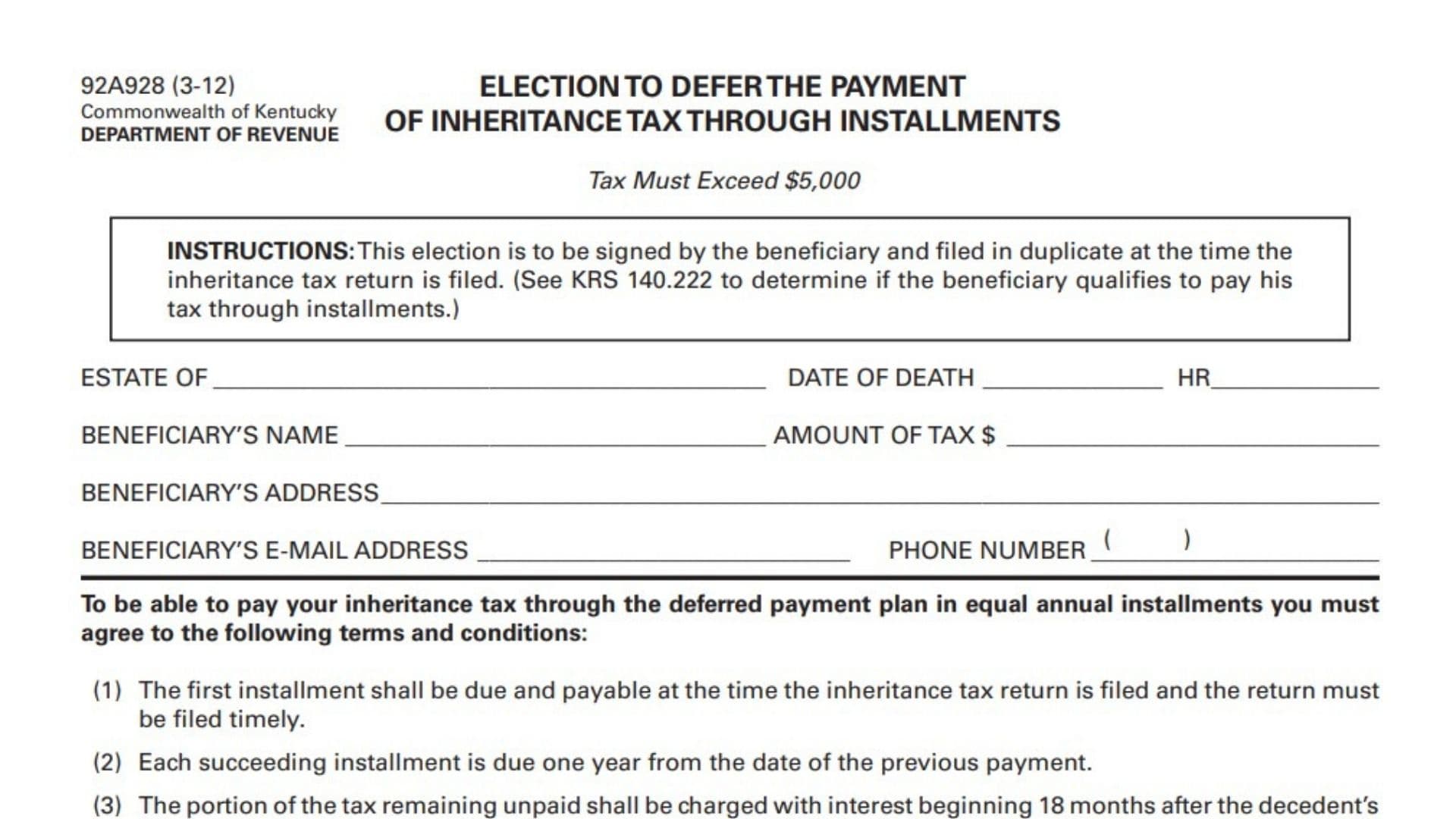
The Election to Defer the Payment of Inheritance Tax Through Installments, Form 92A928, allows a qualifying beneficiary to request an installment arrangement for Kentucky inheritance tax when the beneficiary’s individual share of the tax exceeds $5,000. Instead of paying the entire qualifying tax liability at once, the beneficiary elects to pay it in ten equal annual installments under the requirements of KRS 140.222. The election applies to the tax owed by the beneficiary making the election, rather than automatically covering every beneficiary or the estate’s entire inheritance tax liability. The first installment must be paid when the inheritance tax return is timely filed, and each later installment is due one year after the preceding payment. Interest begins to apply to the unpaid portion of the tax 18 months after the decedent’s date of death. By filing the election and paying the first installment, the beneficiary accepts personal responsibility for the remaining deferred tax. The estate’s personal representative is then relieved from further liability for those deferred payments and from the related bond requirements. The Department of Revenue must determine all inheritance tax liabilities before the election receives final approval, and it may require security when collection appears to be at risk. A missed installment or failure to provide required security can cause every unpaid installment to become immediately due. The beneficiary must also keep the department informed of address changes throughout the installment period.
Who Can Use This Installment Election?
The installment election is intended for a beneficiary who meets the applicable requirements under KRS 140.222 and whose individual inheritance tax liability exceeds $5,000.
The $5,000 requirement applies to the electing beneficiary’s share of the inheritance tax. It is not enough for the estate’s combined inheritance tax to exceed $5,000 when the particular beneficiary making the election owes $5,000 or less.
The beneficiary should confirm eligibility before submitting the election. The Department of Revenue does not finally approve the arrangement until the estate’s inheritance tax liabilities have been determined.
How To File The Installment Election
The beneficiary must sign the election and submit it in duplicate at the same time the Kentucky inheritance tax return is filed.
The inheritance tax return must be filed on time. The first of the ten equal annual installments must accompany the filing. Submitting the election without the first required payment does not satisfy the stated installment conditions.
Before filing, gather the following information:
- The decedent’s full legal name.
- The decedent’s date of death.
- The estate’s HR number, when available.
- The beneficiary’s full legal name.
- The beneficiary’s inheritance tax liability.
- The beneficiary’s complete mailing address.
- The beneficiary’s email address.
- The beneficiary’s telephone number.
- The calculated amount of the first installment.
- The completed Kentucky inheritance tax return.
Prepare two identical copies of the signed election. Submit both copies with the timely filed inheritance tax return and the first installment payment.
Keep a complete copy of the election, inheritance tax return, payment record, and supporting calculations. The beneficiary should also maintain a schedule showing the due date and amount of each remaining annual installment.

How To Complete The Installment Election
Form Identification And Filing Instructions
Line 1: Form Purpose: Use this election to request payment of qualifying Kentucky inheritance tax through annual installments.
Line 2: Minimum Tax Requirement: Confirm that the inheritance tax owed by the beneficiary making the election exceeds $5,000.
Line 3: Beneficiary Signature Requirement: The beneficiary who owes the tax and wants the installment arrangement must personally sign the election.
Line 4: Duplicate Filing Requirement: Prepare and file two matching copies of the completed election.
Line 5: Filing Time: Submit the election when the related Kentucky inheritance tax return is filed.
Line 6: Eligibility Review: Confirm that the beneficiary qualifies for installment payments under KRS 140.222 before submitting the election.
Estate Information
Line 7: Estate Of: Enter the decedent’s complete legal name. Use the same name reported on the Kentucky inheritance tax return.
Line 8: Date Of Death: Enter the decedent’s complete date of death.
Line 9: HR Number: Enter the estate’s HR number when one has been assigned or is known. Review estate correspondence for this number. Leave the field blank when no HR number is available.
Beneficiary Information
Line 10: Beneficiary’s Name: Enter the full legal name of the beneficiary electing to use the installment payment method.
Only the beneficiary named on this line is making the election and accepting responsibility for the deferred tax.
Line 11: Amount Of Tax: Enter the beneficiary’s total Kentucky inheritance tax liability before applying the installment arrangement.
Confirm that this amount exceeds $5,000. Do not enter only the first installment amount in this field.
Line 12: Beneficiary’s Address: Enter the beneficiary’s complete current mailing address.
Include the street number, street name, apartment or unit number, city, state, and ZIP code. The department may use this address for installment notices and tax correspondence.
Line 13: Beneficiary’s Email Address: Enter an active email address for the beneficiary.
Line 14: Phone Number: Enter a current telephone number, including the area code, where the beneficiary can be reached.
Installment Terms And Conditions
By signing the election, the beneficiary agrees to all of the following conditions.
Line 15: Equal Annual Installments: The inheritance tax covered by the election will be paid through ten equal annual installments.
Calculate the annual installment by dividing the qualifying deferred tax by ten, subject to any department adjustments and applicable interest.
Line 16: First Installment Due With Return: Pay the first installment when the Kentucky inheritance tax return is filed.
The return must be filed on time. A late return may prevent the election from meeting this condition.
Line 17: Later Installment Due Dates: Pay each succeeding installment one year after the date of the previous installment payment.
For example, when the first installment is paid on August 15, the next installment is due one year later, followed by another installment on the corresponding date each year.
Line 18: Interest On Unpaid Tax: Interest applies to the portion of the inheritance tax that remains unpaid beginning 18 months after the decedent’s date of death.
Interest does not necessarily begin 18 months after the election date or the first payment date. The starting point is based on the decedent’s date of death.
Line 19: Interest Rate: Calculate interest using the rate established under the Kentucky law identified in the election.
Because the rate may change, use the rate that applies to the relevant interest period or the amount calculated by the Department of Revenue.
Line 20: Tax Must Exceed $5,000: Confirm again that the electing beneficiary’s inheritance tax share is more than $5,000.
A tax amount of exactly $5,000 does not meet the form’s stated requirement that the tax exceed $5,000.
Line 21: Release Of Personal Representative: Filing the election together with the first installment relieves the estate’s personal representative from further responsibility for the beneficiary’s deferred tax payments.
This release applies to the deferred payments covered by the accepted election.
Line 22: Bond Requirement: Filing the election and paying the first installment also relieves the personal representative from the bond requirements associated with the deferred tax under KRS 140.210.
Line 23: Final Department Approval: Understand that submitting the election does not create immediate final approval.
The election becomes finally approved only after the Department of Revenue determines all applicable Kentucky inheritance tax liabilities.
Line 24: Beneficiary’s Personal Liability: The beneficiary electing installment payments becomes personally liable for the entire deferred tax balance that remains unpaid.
The beneficiary should not assume that the estate, executor, or administrator remains responsible for future installments.
Line 25: Suspension Of Collection Limitation Period: The legal time limit for actions to collect the tax is suspended while the tax remains deferred.
The installment period does not reduce the department’s collection rights merely because several years pass between the original filing and the final payment.
Line 26: Possible Security Requirement: The Department of Revenue may require the beneficiary to provide sufficient security when it reasonably believes collection of the deferred tax may be in jeopardy.
Security may be requested after the election is filed. The beneficiary must comply with the department’s instructions and deadlines.
Line 27: Missed Installment: Failure to pay an installment when it becomes due causes all remaining unpaid installments to become immediately due and payable.
A missed payment may therefore end the installment arrangement and accelerate the full outstanding balance.
Line 28: Failure To Provide Security: Failure to post security required by the Department of Revenue also causes all unpaid installments to become immediately due.
Line 29: Possible Penalties: A late or missed installment may result in penalties under the applicable Kentucky penalty provisions.
These penalties may be imposed in addition to the unpaid tax and interest.
Line 30: Address Change Responsibility: The beneficiary must notify the designated Department of Revenue section whenever the beneficiary’s mailing address changes.
Send address changes to:
Financial Tax Section
Department of Revenue
Station 61
501 High Street
Frankfort, Kentucky 40601-2103
Do not rely only on mail-forwarding services. The beneficiary remains responsible for ensuring that the department receives the updated address.
Beneficiary Election Statement
Line 31: Electing Beneficiary’s Printed Name: Print the full legal name of the beneficiary making the election in the blank within the election statement.
The name should match the beneficiary name entered near the top of the form.
Line 32: Election To Pay In Ten Installments: By completing the statement, the beneficiary formally chooses to pay the qualifying inheritance tax through ten equal annual installments.
Line 33: Acceptance Of Conditions: Signing the election confirms that the beneficiary accepts every term and condition stated on the form.
The beneficiary should read all conditions before signing, particularly the personal liability, interest, security, acceleration, and penalty provisions.
Signature And Date
Line 34: Signature Of The Electing Beneficiary: The beneficiary making the installment election must sign this line.
The executor, administrator, attorney, accountant, or return preparer should not sign in place of the beneficiary unless legally authorized and accepted by the department.
Line 35: Beneficiary Signature Date: Enter the date on which the beneficiary signs the election.
Use the actual signing date and confirm that the election will be filed with the timely inheritance tax return.
Department Approval Section
Line 36: Approved: Leave the approval area blank. It is reserved for the Department of Revenue.
Line 37: Department Approval Signature: Do not sign or write in the department approval signature space.
Line 38: Department Approval Date: Leave the department’s date field blank.
Line 39: Additional Department Approval Space: Leave any additional lines associated with department approval blank unless the department instructs otherwise.
Calculating The Installments
Begin with the beneficiary’s total inheritance tax liability covered by the election.
Divide that amount by ten to determine the base amount of each equal annual installment.
For example, when the qualifying tax liability is $20,000:
$20,000 ÷ 10 = $2,000 per annual installment
The first $2,000 installment is due when the timely inheritance tax return is filed. Each later base installment is due one year after the previous payment.
The remaining unpaid tax begins accruing interest 18 months after the decedent’s date of death. As a result, later payments may include interest in addition to the base installment amount. Follow the Department of Revenue’s billing information or applicable calculation instructions when determining the full amount due.
Final Review Checklist
Before submitting the election, confirm that:
- The beneficiary’s inheritance tax liability exceeds $5,000.
- The beneficiary qualifies under the applicable installment provisions.
- The estate name and date of death are correct.
- The HR number is entered when known.
- The beneficiary’s name matches the inheritance tax return.
- The total beneficiary tax liability is entered.
- The beneficiary’s mailing address is complete.
- The email address and telephone number are current.
- The election has been prepared in duplicate.
- The inheritance tax return is being filed on time.
- The first equal annual installment is included.
- The beneficiary has read and accepted every condition.
- The beneficiary has signed and dated both copies.
- The Department of Revenue approval fields remain blank.
- A copy of the complete filing is retained for the beneficiary’s records.
- The beneficiary has recorded the expected due dates for the remaining nine installments.