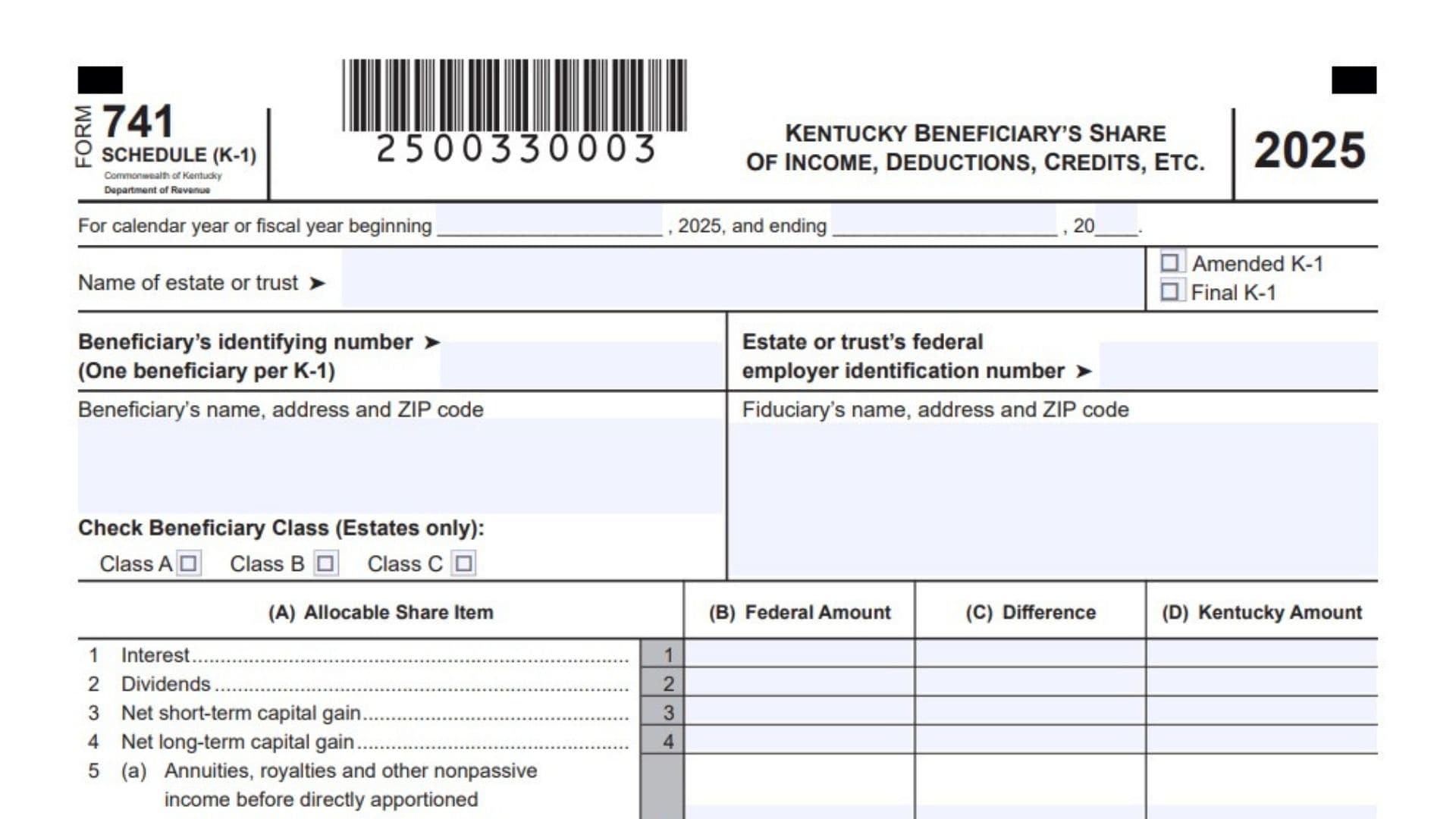
Kentucky Schedule K-1, Form 741, reports a beneficiary’s allocated share of income, deductions, losses, adjustments, withholding, and tax credits from a Kentucky estate or trust. The fiduciary prepares a separate Schedule K-1 for each beneficiary who receives or is treated as receiving reportable items from the entity. The schedule begins with the estate’s or trust’s tax year, identifying information for the entity and beneficiary, and the beneficiary’s classification when the entity is an estate. Its main table compares the beneficiary’s federal allocated amounts with the adjustments needed under Kentucky tax law. Column B reports the federal amount, column C reports the difference between the federal and Kentucky treatment, and column D reports the resulting Kentucky amount. The items listed on the schedule include interest, dividends, capital gains, nonpassive income, business and rental income, depreciation, depletion, amortization, the federal estate tax deduction, foreign taxes, final-year deductions, and other separately identified amounts. The schedule also calculates the Kentucky resident adjustment that a resident beneficiary may need to report on Schedule M of Form 740. In addition, it identifies any limited liability entity tax credit, Kentucky nonresident withholding, or pass-through entity tax credit allocated to the beneficiary. A beneficiary uses the information to complete a Kentucky individual income tax return for the year in which the estate’s or trust’s tax year ends. Kentucky residents generally report applicable adjustments on Form 740, while nonresidents and part-year residents generally use Form 740-NP and report only the income taxable to Kentucky. Schedule K-1 does not replace the beneficiary’s personal income tax return. Instead, it supplies the amounts needed to correctly report the beneficiary’s share of the estate’s or trust’s Kentucky tax items.
Who Must Prepare Kentucky Schedule K-1?
The fiduciary of an estate or trust should prepare a separate Kentucky Schedule K-1 for each beneficiary who is allocated income, deductions, losses, withholding, or credits.
Only one beneficiary may be listed on each Schedule K-1. When an estate or trust has multiple beneficiaries, prepare an individual schedule for each person or entity.
The fiduciary should provide the beneficiary with a completed copy and include the required copies with the estate’s or trust’s Kentucky Form 741.
How To File Kentucky Schedule K-1
Complete the estate’s or trust’s federal fiduciary return and Kentucky Form 741 before finalizing the beneficiary schedules. Use the federal beneficiary allocation information as the starting point, then calculate the differences required under Kentucky law.
Prepare one Schedule K-1 for each beneficiary. Enter the beneficiary’s federal amounts, Kentucky adjustments, Kentucky amounts, and applicable credits or withholding. Make sure the total amounts allocated among all beneficiaries agree with the related amounts reported by the estate or trust.
Include copies of the completed schedules with Kentucky Form 741. Give each beneficiary a copy containing only that beneficiary’s information.
The beneficiary generally reports the Schedule K-1 items on the Kentucky return for the year in which the estate’s or trust’s taxable year ends. A beneficiary should keep the schedule with personal tax records rather than sending it separately without an income tax return.

How To Complete Kentucky Schedule K-1 Form 741
Tax Year And Return Status
Taxable Year Beginning: Enter the first day of the estate’s or trust’s taxable year. For a calendar-year entity, this will generally be January 1, 2025. For a fiscal-year entity, enter the actual beginning date that falls in 2025.
Taxable Year Ending: Enter the final day of the estate’s or trust’s taxable year. A calendar-year entity generally enters December 31, 2025. A fiscal-year entity should enter its actual ending date and year.
Name Of Estate Or Trust: Enter the complete legal name of the estate or trust. Use the same name reported on Kentucky Form 741 and the federal fiduciary income tax return.
Amended K-1: Check this box when the schedule corrects a Schedule K-1 that was previously issued to the beneficiary. Provide the beneficiary with the corrected schedule and clearly explain any changes when necessary.
Final K-1: Check this box when the estate or trust has terminated or when the beneficiary will not receive another Schedule K-1 from the entity.
Beneficiary And Fiduciary Information
Beneficiary’s Identifying Number: Enter the identifying number belonging to the beneficiary. For an individual, this will generally be the Social Security number or other applicable taxpayer identification number. For an entity beneficiary, enter its federal employer identification number. Do not list more than one beneficiary.
Estate Or Trust’s Federal Employer Identification Number: Enter the FEIN assigned to the estate or trust. Verify that it matches the number reported on Form 741.
Beneficiary’s Name, Address, And ZIP Code: Enter the beneficiary’s complete legal name and current mailing address, including the ZIP Code. Use the information associated with the beneficiary’s tax identification number.
Fiduciary’s Name, Address, And ZIP Code: Enter the name and mailing address of the executor, administrator, trustee, personal representative, or other fiduciary responsible for the estate or trust.
Beneficiary Class For Estates
Complete the beneficiary class section only when Schedule K-1 is being prepared for an estate. A trust generally leaves these boxes blank.
Class A: Check this box when the beneficiary belongs to Kentucky beneficiary Class A under the applicable estate and inheritance tax classification rules.
Class B: Check this box when the beneficiary belongs to Kentucky beneficiary Class B.
Class C: Check this box when the beneficiary belongs to Kentucky beneficiary Class C.
Select only the class that applies to the beneficiary. The classification should be based on the beneficiary’s relationship to the decedent and the applicable Kentucky rules.
Schedule K-1 Columns
Each allocable item is reported using the columns provided in the main table.
Column A, Allocable Share Item: This column identifies the type of income, deduction, loss, adjustment, or credit allocated to the beneficiary. The descriptions are already provided for most lines. Use the blank lines to identify other items.
Column B, Federal Amount: Enter the beneficiary’s share of the amount determined under federal tax law. These amounts should generally agree with the federal Schedule K-1 issued by the estate or trust.
Column C, Difference: Enter the adjustment needed to convert the federal amount into the amount recognized by Kentucky. Enter an increase as a positive number and a decrease as a negative number. For losses and deductions, follow the sign treatment needed to produce the correct Kentucky amount.
Column D, Kentucky Amount: Enter the beneficiary’s amount after applying the Kentucky adjustment in column C to the federal amount in column B. This is the amount determined under Kentucky tax rules.
Lines 1 Through 10
Line 1: Enter the beneficiary’s allocated interest income. Report the federal amount in column B, any Kentucky adjustment in column C, and the resulting Kentucky interest amount in column D. Kentucky adjustments may be needed for interest that receives different federal and state tax treatment.
Line 2: Enter the beneficiary’s allocated dividend income. Use column C to report any difference between the federal dividend amount and the amount taxable by Kentucky.
Line 3: Enter the beneficiary’s allocated net short-term capital gain. Report a net short-term capital loss using the appropriate negative amount when applicable.
Line 4: Enter the beneficiary’s allocated net long-term capital gain. Apply any Kentucky-specific capital gain adjustment in column C and report the final Kentucky amount in column D.
Nonpassive Income
Line 5(a): Enter the beneficiary’s allocated annuity income, royalties, and other nonpassive income before subtracting directly apportioned deductions. The federal rules should be used to identify which income belongs on this line. Do not include business or rental income that belongs on line 6(a).
Line 5(b): Enter depreciation directly connected with the nonpassive income reported on line 5(a). Report the beneficiary’s federal share, the Kentucky depreciation adjustment, and the Kentucky amount.
Line 5(c): Enter depletion directly associated with the income on line 5(a). Use column C for any Kentucky difference in the depletion deduction.
Line 5(d): Enter amortization associated with the nonpassive income on line 5(a). Report any adjustment needed to convert the federal deduction to the Kentucky deduction.
Business And Rental Income
Line 6(a): Enter the beneficiary’s allocated trade or business income, rental real estate income, and other rental income before directly apportioned deductions. Include the beneficiary’s share of losses as negative amounts when applicable. Follow the federal instructions when determining which activities and income items belong on this line.
Line 6(b): Enter depreciation directly associated with the business or rental activities reported on line 6(a). Report the Kentucky adjustment separately in column C.
Line 6(c): Enter depletion associated with the business or rental income reported on line 6(a).
Line 6(d): Enter amortization directly connected with the business or rental activities reported on line 6(a).
Other Deductions And Taxes
Line 7: Enter the beneficiary’s allocated federal estate tax deduction. Enclose a computation showing how the amount was calculated and allocated to the beneficiary. Report any Kentucky difference in column C.
Line 8: Enter foreign taxes allocated to the beneficiary. Enclose a schedule identifying the foreign tax amounts and explaining the allocation.
Final-Year Deductions
Complete line 9 when the estate or trust is in its final taxable year and deductible items are passed through to the beneficiary.
Line 9(a): Enter the beneficiary’s allocated excess deductions on termination. Enclose a computation showing the total deductions, applicable limitations, and the beneficiary’s allocated share.
Line 9(b): Enter the beneficiary’s allocated short-term capital loss carryover from the terminating estate or trust.
Line 9(c): Enter the beneficiary’s allocated long-term capital loss carryover.
Line 9(d): Enter the beneficiary’s allocated net operating loss carryover. Apply the appropriate federal and Kentucky limitations when determining the available amount.
Line 9(e): Identify and enter another final-year deduction that is not listed on lines 9(a) through 9(d). Write a clear description of the item on the blank line and report the amounts in the appropriate columns.
Line 9(f): Use this line for an additional final-year deduction. Describe the item and enter the beneficiary’s federal and Kentucky amounts.
Other Allocable Items
Use line 10 for separately stated items that do not belong on lines 1 through 9. Clearly identify each item so the beneficiary knows how to report it.
Line 10(a): Describe the first additional allocable item and enter its federal amount, Kentucky adjustment, and Kentucky amount.
Line 10(b): Describe the second additional item and complete columns B, C, and D as applicable.
Line 10(c): Describe the third additional item and enter the related amounts. Enclose a supporting schedule if more explanation or additional items are needed.
Resident Adjustment
Line 11: Combine the Kentucky differences in column C from lines 1 through 6 and the applicable portions of lines 9 and 10. Add adjustments relating to income. Subtract adjustments relating to losses and deductions. Do not automatically include every amount from lines 9 and 10. Include only the portions that affect the beneficiary’s Kentucky resident adjustment.
If the result is positive, a Kentucky resident beneficiary reports the amount as an addition on Form 740, Schedule M, line 2.
If the result is negative, a Kentucky resident beneficiary reports the amount as a subtraction on Form 740, Schedule M, line 11.
Enter the result using the correct positive or negative sign. This calculation generally applies to resident beneficiaries because Kentucky residents are taxed on income from all sources.
Pass-Through Credits
Line 12(a): Enter the beneficiary’s allocated limited liability entity tax credit. The beneficiary uses this amount when completing the Kentucky Limited Liability Entity Tax Credit Worksheet included with the instructions for Form 740 or Form 740-NP. The amount is entered on line 7 of that worksheet.
Line 12(b): Enter Kentucky nonresident withholding from Form PTE-WH and any pass-through entity tax credit allocated to the beneficiary that was not claimed by the estate or trust on Form 741, line 20(c). Maintain records that separately identify the withholding amount and the pass-through entity tax credit because the beneficiary reports them on different lines of the individual return.
A beneficiary reports the nonresident withholding amount on Form 740, line 31(a), or Form 740-NP, line 31(h), as applicable.
A beneficiary reports the pass-through entity tax credit on Form 740 or Form 740-NP, line 31(g).
Instructions For The Beneficiary
Who Must File A Kentucky Income Tax Return?
A full-year Kentucky resident determines the filing requirement by reviewing family size, modified gross income, Kentucky adjusted gross income, and any self-employment income.
Resident beneficiaries should use both Chart A and Chart B. Nonresident beneficiaries use Chart A and must also consider whether they received income taxable to Kentucky.
A Kentucky resident is generally subject to Kentucky tax on income from all sources, including income received from an estate or trust located outside Kentucky.
Family Size
For purposes of the filing requirement, family size generally includes:
The taxpayer.
The taxpayer’s spouse, when the couple is married and lives in the same household.
Children who meet the definition of a qualifying child.
Qualifying Child
A qualifying child is determined under Internal Revenue Code Section 152(c). The beneficiary should consider the applicable relationship, age, residency, support, and joint return requirements when deciding whether a child is included in family size.
Modified Gross Income
Modified gross income generally includes:
The beneficiary’s federal adjusted gross income.
The spouse’s federal adjusted gross income when the spouses live in the same household.
Tax-exempt interest from municipal bonds issued outside Kentucky.
Any lump-sum distribution amount taxed on Kentucky Form 4972-K.
Use the combined amount when comparing income with the family-size threshold in Chart A.
Kentucky Adjusted Gross Income
Kentucky adjusted gross income begins with federal adjusted gross income and includes the additions and subtractions reported on Kentucky Schedule M.
A resident beneficiary may need to use the adjustment from Schedule K-1, line 11, when calculating Kentucky adjusted gross income.
Chart A, Modified Gross Income Limits
Compare modified gross income with the threshold for the beneficiary’s family size.
Family Size Of One: The modified gross income threshold is $15,650.
Family Size Of Two: The modified gross income threshold is $21,150.
Family Size Of Three: The modified gross income threshold is $26,650.
Family Size Of Four Or More: The modified gross income threshold is $32,150.
A full-year resident generally considers Chart A together with Chart B when determining whether a Kentucky return is required.
Chart B, Kentucky Adjusted Gross Income Limits
Compare Kentucky adjusted gross income with the amount for the beneficiary’s filing status, age, and blindness status.
Single, Under Age 65: The Kentucky adjusted gross income threshold is $3,270.
Single, Age 65 Or Older Or Blind: The threshold is $4,270.
Single, Age 65 Or Older And Blind: The threshold is $5,270.
Taxpayer And Spouse, Both Under Age 65: The threshold is $3,270.
Taxpayer And Spouse, One Age 65 Or Older: The threshold is $4,270.
Taxpayer And Spouse, Both Age 65 Or Older: The threshold is $5,270.
Nonresident And Part-Year Resident Beneficiaries
A nonresident who receives Kentucky-source income may be required to file Kentucky Form 740-NP.
A part-year resident may also need to file Form 740-NP when the person received income while living in Kentucky or received Kentucky-source income while living outside Kentucky.
A person who moved into Kentucky during the year generally reports:
Income from Kentucky sources received before becoming a resident.
Income from all sources received after becoming a Kentucky resident.
A person who moved out of Kentucky during the year generally reports:
Income from all sources received while a Kentucky resident.
Kentucky-source income received after becoming a nonresident.
Nonresident and part-year resident beneficiaries may qualify for the Kentucky family size tax credit.
Kentucky Income Of Nonresident Beneficiaries
The Schedule K-1 may show all income included in the estate’s or trust’s income distribution deduction. However, a nonresident beneficiary is generally subject to Kentucky tax only on income connected with Kentucky.
This may include income:
From Kentucky sources.
From activities conducted in Kentucky.
From services performed in Kentucky.
From real or tangible property located in Kentucky.
From a partnership or S corporation doing business in Kentucky.
The fiduciary should carefully determine the Kentucky amount reported in column D so the nonresident beneficiary can identify the portion reportable on Form 740-NP.
When The Beneficiary Reports The Schedule K-1 Items
The beneficiary reports the allocated income, deductions, losses, credits, and withholding on the Kentucky return for the year in which the estate’s or trust’s taxable year ends.
For example, assume an individual beneficiary files on a calendar-year basis and the estate’s or trust’s taxable year ends on January 31, 2025. The beneficiary reports the Schedule K-1 items on the beneficiary’s 2025 Kentucky income tax return.
The beneficiary should not base the reporting year only on when the schedule was received or when a distribution was paid. Use the year in which the estate’s or trust’s taxable year ended.
Passive Activity Limitations
A resident filing Form 740 should review Kentucky Form 8582-K and its instructions when the Schedule K-1 includes income or losses from passive activities.
A nonresident beneficiary filing Form 740-NP must complete Form 8582-K and federal Schedule E using the applicable Kentucky amounts.
A passive activity loss shown on Schedule K-1 may not be fully deductible in the current year. The beneficiary must apply the passive activity limitations before entering the deductible amount on the Kentucky return.
Self-Employment Income Filing Requirement
A beneficiary with self-employment income may be required to file a Kentucky individual income tax return even when Kentucky adjusted gross income does not exceed the amount listed in Chart B.
A return is required when gross receipts from self-employment exceed the modified gross income threshold for the beneficiary’s family size in Chart A.
The beneficiary should review this rule separately from the regular income thresholds.
Final Kentucky Schedule K-1 Checklist
Confirm that the estate’s or trust’s tax year and legal name match Form 741. Verify the entity’s FEIN and the beneficiary’s identifying number, name, and address.
Make sure only one beneficiary is listed on the schedule. For an estate, select the correct beneficiary class.
Reconcile the federal amounts in column B with the federal Schedule K-1. Review every Kentucky adjustment in column C and confirm that each amount in column D reflects the proper Kentucky treatment.
Complete every applicable line from 1 through 10, including depreciation, depletion, amortization, final-year deductions, and separately stated items. Calculate line 11 using only the required column C amounts.
Report limited liability entity tax credits, nonresident withholding, and pass-through entity tax credits on the appropriate parts of line 12. Keep separate supporting records for withholding and credits.
Mark the schedule as amended or final when applicable. Include the required copy with Form 741, provide a completed copy to the beneficiary, and retain a copy with the estate’s or trust’s tax records.