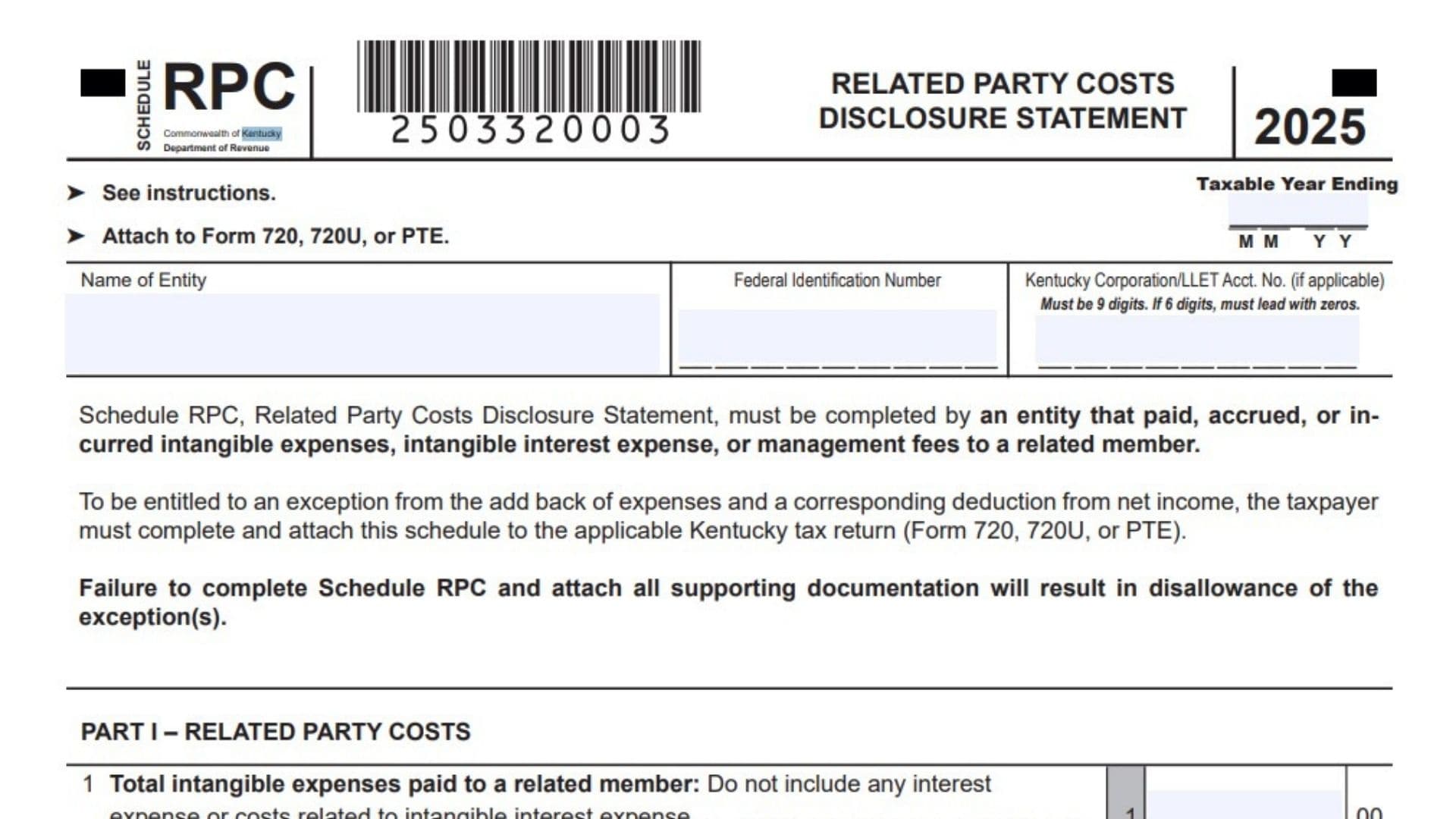
Kentucky Schedule RPC, also called the Related Party Costs Disclosure Statement, is a Kentucky tax schedule used by an entity that paid, accrued, or incurred certain costs to a related member during the taxable year. These costs generally include intangible expenses, intangible interest expenses, management fees, and other related party transaction costs. The purpose of Kentucky Schedule RPC is to disclose those related party costs and calculate how much must be added back to income unless the taxpayer qualifies for an allowed exception. In simple terms, if a business deducted payments made to a related company, owner-related entity, affiliate, or foreign related corporation, Kentucky may require those deductions to be added back unless the taxpayer can prove that an exception applies. The schedule separates the process into three main parts. Part I reports the total related party costs. Part II reports exceptions that may reduce the required add-back. Part III provides detailed support for those exceptions, including related member details, identical third-party transaction terms, alternative apportionment agreements, domestic tax treatment, and foreign treaty information. Kentucky Schedule RPC is important because failing to complete it properly, or failing to attach the required support, can cause the claimed exception to be denied. A complete schedule helps the taxpayer show the amount deducted, identify the related member, explain the qualifying exception, and transfer the final add-back amount to the correct Kentucky return.
How To File Kentucky Schedule RPC
File Kentucky Schedule RPC with the Kentucky tax return that applies to the entity. It is attached to Form 720, Form 720U, or Form PTE, depending on the taxpayer’s filing situation. The schedule should be completed before the return is finalized because the total add-back after exceptions must be carried to the proper line of the main Kentucky return. Use accurate books, federal tax records, related party payment records, contracts, tax domicile information, and supporting agreements before filling it out. If you are claiming an exception, attach the required documentation with the return. This may include contracts, written agreements, proof of identical transaction terms with unrelated parties, an alternative apportionment agreement, or other records that support the claimed exception. Do not file the schedule only as a summary if support is required, because unsupported exceptions may be denied.

How To Complete Kentucky Schedule RPC
Top Of Schedule
Taxable Year Ending: Enter the month and year that match the end of the taxable year. Use the MM/YY format shown on the schedule.
Name Of Entity: Enter the full legal name of the entity filing the Kentucky return.
Federal Identification Number: Enter the entity’s federal employer identification number.
Kentucky Corporation/LLET Account Number: Enter the Kentucky Corporation/LLET account number if the entity has one. The number should be 9 digits. If the number has only 6 digits, add leading zeros so that it becomes 9 digits.
Attach To Form 720, 720U, Or PTE: Attach the completed schedule to the Kentucky return that applies to the entity.
Who Must Complete This Schedule: Complete the schedule if the entity paid, accrued, or incurred intangible expenses, intangible interest expenses, or management fees to a related member.
Exception Requirement: Complete the schedule and provide support if the taxpayer wants an exception from the required add-back of related party costs and the related deduction from net income.
Supporting Documentation Warning: Attach all required supporting documents. If the schedule or support is incomplete, the exception may be disallowed.
Key Terms Before You Start
Related Party Costs: This generally means intangible expenses, intangible interest expenses, management fees, and costs connected with other related party transactions.
Recipient: A recipient is the related member or foreign corporation that received the income connected to the intangible expense, intangible interest expense, or management fee.
Intangible Expenses: These include deductible expenses, losses, fees, and costs related to intangible property. Examples may include royalty fees, patent fees, technical fees, copyright fees, licensing fees, factoring or discounting transaction losses, and similar costs connected to acquiring, using, managing, owning, selling, exchanging, or disposing of intangible property.
Intangible Interest Expense: This means deductible interest expense connected directly or indirectly to intangible property, including interest tied to the acquisition, use, maintenance, management, ownership, sale, exchange, or disposal of intangible property.
Management Fees: These include deductible costs paid for management or administrative services such as accounts receivable, accounts payable, employee benefit plans, insurance, legal services, payroll, data processing, purchasing, tax, finance, securities, accounting, reporting, compliance, and similar services.
Part I: Related Party Costs
Line 1: Total Intangible Expenses Paid To A Related Member: Enter the total intangible expenses paid, accrued, or incurred to a related member. Do not include interest expense here, and do not include costs that belong with intangible interest expense.
Line 2: Total Intangible Interest Expenses Paid To A Related Member: Enter the total intangible interest expenses paid, accrued, or incurred to a related member.
Line 3: Total Management Fees Paid To A Related Member: Enter the total management fees paid, accrued, or incurred to a related member.
Line 4: Total Related Party Costs: Add Line 1, Line 2, and Line 3. This is the total related party cost amount before any exceptions are applied.
Part II: Exceptions To Add Back
Section A: Exceptions To Expenses
Line 1: Amount From Part III, Section A, Line 5: Enter the exception amount from Part III, Section A, Line 5. This is for related party costs where the entity and recipient are both included in the same consolidated Kentucky corporation income tax return.
Line 2: Amount From Part III, Section B, Line 5: Enter the exception amount from Part III, Section B, Line 5. This is for identical third-party transaction terms and alternative apportionment exceptions.
Line 3: Amount From Part III, Section C, Line 14: Enter the exception amount from Part III, Section C, Line 14. This is for qualifying related party costs paid to related members that are subject to tax in their state or country of domicile.
Line 4: Total Exceptions: Add Section A Line 1, Line 2, and Line 3. This is the total exception amount that may reduce the related party cost add-back.
Section B: Total Required Related Party Cost Add Back After Exceptions
Line 1: Total Add Back After Exceptions: Subtract Part II, Section A, Line 4 from Part I, Line 4. Enter the result here. Also carry this amount to the correct Kentucky return line, Form 720, Part I, Line 6, Form 720U, Schedule U4, Line 6, or Form PTE, Part I, Line 4.
Part III: Detail Of Exceptions To Add Back
Section A: Same Consolidated Kentucky Corporation Income Tax Return Exception
Use this section when the entity and the recipient are both included in the same consolidated Kentucky corporation income tax return.
Line 1: First Related Member: Enter the first related member’s name, federal identification number, Kentucky Corporation/LLET account number, and the amount deducted by the taxpayer.
Line 2: Second Related Member: Enter the second related member’s name, federal identification number, Kentucky Corporation/LLET account number, and the amount deducted by the taxpayer.
Line 3: Third Related Member: Enter the third related member’s name, federal identification number, Kentucky Corporation/LLET account number, and the amount deducted by the taxpayer.
Line 4: Fourth Related Member: Enter the fourth related member’s name, federal identification number, Kentucky Corporation/LLET account number, and the amount deducted by the taxpayer.
Additional Related Members: If there are more than four related members, attach a separate statement that includes the same information for each additional related member.
Line 5: Total Of Lines 1 Through 4: Add the amounts from Lines 1 through 4, plus any additional supported amounts from an attached statement if applicable. Enter the total here and on Part II, Section A, Line 1.
Section B: Identical Terms And Alternative Apportionment Exceptions
Use this section for two possible exception types. The first applies when the recipient regularly enters into identical transactions with unrelated parties. The second applies when there is a written alternative apportionment agreement with the Department.
Line 1: Identical Terms With Unrelated Parties: Check Yes if the recipient regularly engaged in transactions with one or more unrelated parties on terms identical to the related party transaction. Check No if the recipient did not have such identical unrelated-party transactions.
Line 2: Identical Terms Exception Amount: If Line 1 is Yes and the exception is supported, enter the exception amount for the identical terms transaction.
Line 3: Written Alternative Apportionment Agreement: Check Yes if there is a written agreement between the taxpayer and the Department allowing an alternative apportionment method under KRS 141.120(12). Check No if there is no such agreement.
Line 4: Alternative Apportionment Exception Amount: If Line 3 is Yes and the exception is supported, enter the exception amount connected to the alternative apportionment agreement.
Line 5: Total Of Line 2 And Line 4: Add Line 2 and Line 4. Enter the total here and on Part II, Section A, Line 2.
Section B Attachment Requirement: If Line 1 is Yes, attach copies of the written agreement between the taxpayer and the recipient, and the written agreement between the recipient and the unrelated party. If Line 3 is Yes, attach the written agreement between the taxpayer and the Department. If required written agreements are missing, the exception may be denied. If any required Yes or No answer is No, the taxpayer does not qualify for that specific exception.
Section C: Related Members Subject To Tax In Their State Or Country Of Domicile
Use this section when the related member receiving the related party cost is subject to tax in its state or country of commercial domicile.
Line 1, Domestic Column: Taxed In State Of Commercial Domicile: Check Yes if the intangible expense, intangible interest expense, or management fee was paid, accrued, or incurred to a domestic recipient and the payment was subject to a net income tax or a franchise tax measured in whole or in part by net income in the related member’s state of commercial domicile. Check No if this condition is not met.
Line 1, Foreign Column: Taxed In Country Of Commercial Domicile: Check Yes if the payment was made to a foreign recipient and was subject to a qualifying net income tax or franchise tax measured in whole or in part by net income in the recipient’s country of commercial domicile. The foreign country must have a comprehensive income tax treaty with the United States if the recipient is a foreign corporation. Check No if this condition is not met.
Line 2, Domestic Column: Substantial Separate Business Activity: Check Yes if the domestic recipient has substantial business activities that are separate from simply acquiring, using, licensing, managing, owning, selling, exchanging, or disposing of intangible property, or financing related members. The recipient should show real business activity through permanent office space and full-time employees dedicated to the maintenance and protection of intangible property. Check No if this requirement is not met.
Line 2, Foreign Column: Substantial Separate Business Activity: Check Yes if the foreign recipient meets the same substantial business activity standard, including business activity separate from intangible property activity or related member financing, supported by permanent office space and full-time employees. Check No if this requirement is not met.
Line 3, Domestic Column: Commercially Reasonable And Arm’s Length Terms: Check Yes if the domestic related party transaction was made at a commercially reasonable rate and on terms comparable to an arm’s length transaction. Check No if the transaction does not meet this standard.
Line 3, Foreign Column: Commercially Reasonable And Arm’s Length Terms: Check Yes if the foreign related party transaction was made at a commercially reasonable rate and on terms comparable to an arm’s length transaction. Check No if the transaction does not meet this standard.
Domestic Section Requirement: If Lines 1, 2, and 3 in the Domestic column are all Yes, complete Lines 4 through 8 and attach the relevant contract sections or other documents that support the exception. If any Domestic answer is No, the taxpayer does not qualify for the domestic exception.
Line 4: First Domestic Related Member: Enter the first domestic related member’s name, federal identification number, state of commercial domicile, name of tax, and amount deducted.
Line 5: Second Domestic Related Member: Enter the second domestic related member’s name, federal identification number, state of commercial domicile, name of tax, and amount deducted.
Line 6: Third Domestic Related Member: Enter the third domestic related member’s name, federal identification number, state of commercial domicile, name of tax, and amount deducted.
Line 7: Fourth Domestic Related Member: Enter the fourth domestic related member’s name, federal identification number, state of commercial domicile, name of tax, and amount deducted.
Additional Domestic Related Members: If there are more than four domestic related members, attach a statement that includes the same required details for each additional member and include those amounts in the domestic total.
Line 8: Total Of Lines 4 Through 7: Add the domestic amounts from Lines 4 through 7, plus any properly supported additional domestic amounts. Enter the total on Line 8.
Foreign Section Requirement: If Lines 1, 2, and 3 in the Foreign column are all Yes, complete Lines 9 through 13 and attach the relevant contract sections or other documents that support the exception. If any Foreign answer is No, the taxpayer does not qualify for the foreign exception.
Line 9: First Foreign Related Member: Enter the first foreign related member’s name, name of foreign nation, description of the treaty, and amount deducted.
Line 10: Second Foreign Related Member: Enter the second foreign related member’s name, name of foreign nation, description of the treaty, and amount deducted.
Line 11: Third Foreign Related Member: Enter the third foreign related member’s name, name of foreign nation, description of the treaty, and amount deducted.
Line 12: Fourth Foreign Related Member: Enter the fourth foreign related member’s name, name of foreign nation, description of the treaty, and amount deducted.
Additional Foreign Related Members: If there are more than four foreign related members, attach a statement that includes the same required details for each additional member and include those amounts in the foreign total.
Line 13: Total Of Lines 9 Through 12: Add the foreign amounts from Lines 9 through 12, plus any properly supported additional foreign amounts. Enter the total on Line 13.
Line 14: Total Domestic And Foreign Exception Amount: Add Line 8 and Line 13. Enter the total here and on Part II, Section A, Line 3.
Final Review Before Filing
Review the taxable year ending, entity name, federal identification number, and Kentucky account number before filing. Confirm that Part I includes all related party costs, Part II correctly reports all claimed exceptions, and Part III fully supports every exception amount used in Part II. Make sure every Yes or No box is answered where required. Attach all contracts, agreements, statements, and supporting records needed for the claimed exceptions. Finally, confirm that the amount from Part II, Section B, Line 1 is transferred to the correct line of the Kentucky return.