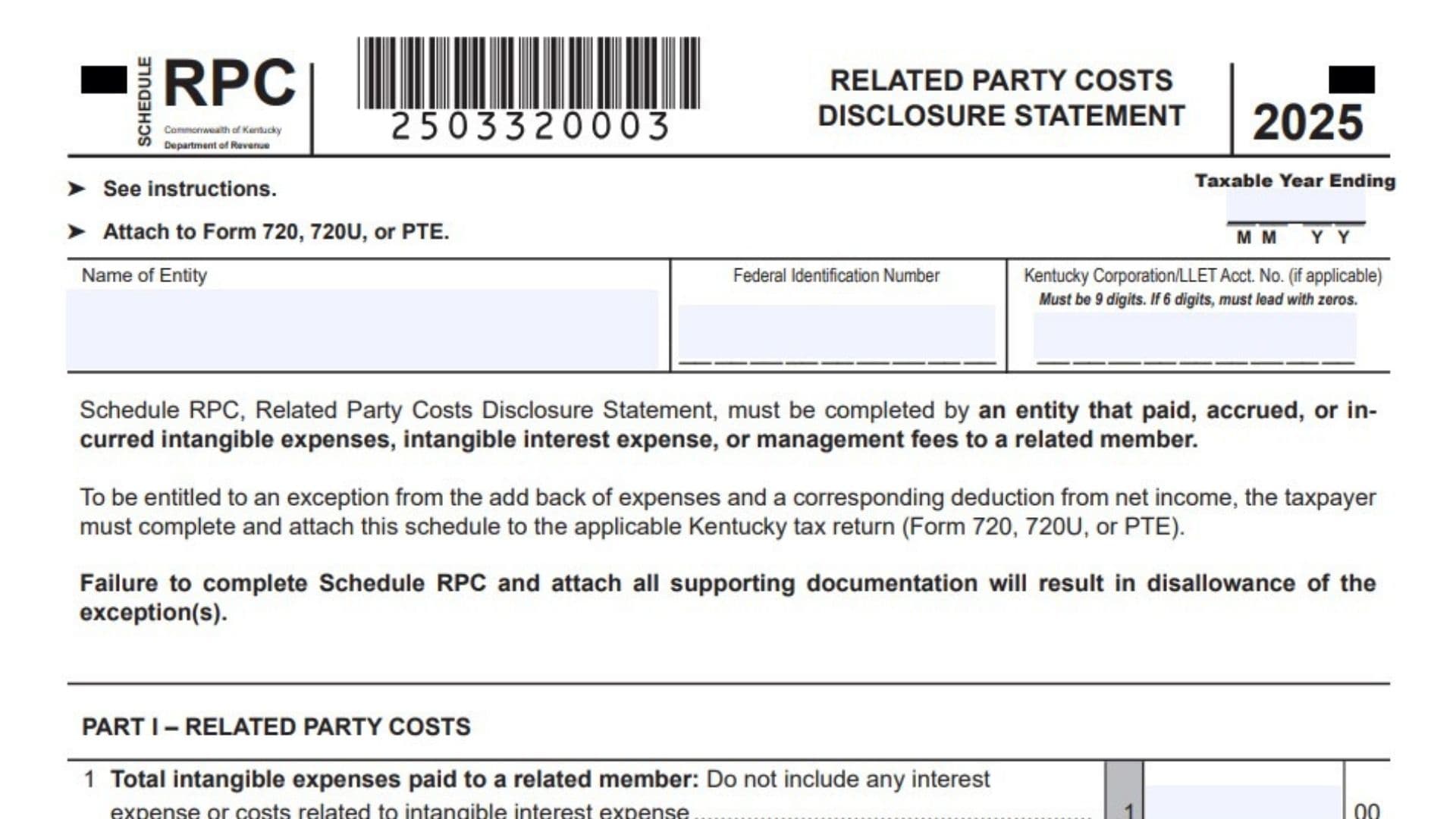
Kentucky Schedule RPC, officially called the Related Party Costs Disclosure Statement, is used by an entity that paid, accrued, or incurred certain costs involving a related member during the taxable year. These costs include intangible expenses, intangible interest expenses, and management fees. Kentucky generally requires affected taxpayers to add these related-party costs back when calculating taxable net income unless the taxpayer qualifies for a specific exception. Schedule RPC identifies the total related-party costs, reports the amount covered by each allowable exception, and calculates the remaining amount that must be added back on the applicable Kentucky tax return. The available exceptions may apply when the taxpayer and recipient are included in the same Kentucky consolidated corporation income tax return, when the related member conducts identical transactions with unrelated parties, when the taxpayer has an approved alternative apportionment agreement, or when the related member is subject to qualifying tax in its domestic or foreign commercial domicile and meets the other required conditions. A taxpayer seeking an exception must complete the appropriate section and attach all required agreements, contracts, tax information, and supporting records. An exception may be denied when Schedule RPC is incomplete or the required documentation is missing.
Who Must Complete Kentucky Schedule RPC?
Complete Schedule RPC when an entity paid, accrued, or incurred any of the following amounts to a related member:
- Intangible expenses
- Intangible interest expenses
- Management fees
The schedule is required when the taxpayer seeks an exception from Kentucky’s related-party expense add-back requirement and the corresponding treatment in calculating net income.
The taxpayer must attach the completed schedule and supporting documents to the applicable Kentucky return.
How To File Kentucky Schedule RPC
Attach Schedule RPC to the applicable Kentucky return:
- Form 720
- Form 720U
- Form PTE
The schedule should not be filed separately from the related return.
Follow these general steps:
- Gather records for all intangible expenses, intangible interest expenses, and management fees involving related members.
- Separate the expenses into the three categories reported in Part I.
- Determine whether any amount qualifies for an exception.
- Complete the applicable exception details in Part III.
- Transfer the Part III totals to Part II, Section A.
- Calculate the remaining add-back in Part II, Section B.
- Transfer the add-back to the applicable line of Form 720, Form 720U, or Form PTE.
- Attach every required contract, agreement, schedule, and supporting document.
- File Schedule RPC with the Kentucky return.
Failure to complete the schedule and provide the required supporting documents may result in the denial of the claimed exceptions.
What Are Related Party Costs?
Related party costs may include intangible expenses, intangible interest expenses, management fees, and other costs associated with transactions between related parties.
Schedule RPC specifically calculates the add-back for intangible expenses, intangible interest expenses, and management fees.
What Are Intangible Expenses?
Intangible expenses generally include deductible expenses, losses, or costs connected directly or indirectly with acquiring, using, maintaining, managing, owning, selling, exchanging, or otherwise disposing of intangible property.
Examples may include:
- Royalties
- Patent fees
- Copyright fees
- Technical fees
- Licensing fees
- Factoring transaction losses
- Discounting transaction losses
- Similar intangible-property expenses
Include an amount only to the extent it was allowed as a deduction or cost in determining federal taxable net income before any net operating loss deduction.
Do not include intangible interest expenses in the intangible expense total reported on Part I, Line 1.
What Are Intangible Interest Expenses?
Intangible interest expense generally means interest deductible under Internal Revenue Code Section 163 that is directly or indirectly related to acquiring, using, maintaining, managing, owning, selling, exchanging, or otherwise disposing of intangible property.
Report these amounts separately from other intangible expenses.
What Are Management Fees?
Management fees may include deductible costs paid for related-party services involving:
- Accounts receivable
- Accounts payable
- Employee benefit plans
- Insurance
- Legal services
- Payroll
- Data processing
- Purchasing
- Tax services
- Financial services
- Securities services
- Accounting
- Reporting
- Compliance
- Similar administrative or management services
Report only the amounts treated as deductions or costs when determining federal taxable net income before any net operating loss deduction.
Who Is The Recipient?
The recipient is the related member or foreign corporation to which the payment corresponding to the intangible expense, intangible interest expense, or management fee was made.
The recipient information may be required in Part III, including the related member’s name, federal identification number, commercial domicile, and Kentucky account number when applicable.
How To Complete The Schedule RPC Identification Section
Taxable Year Ending: Enter the ending month and year of the taxable period covered by the schedule. Use the same taxable year ending date shown on the related Kentucky return.
Name Of Entity: Enter the taxpayer’s complete legal name. Use the same entity name reported on Form 720, Form 720U, or Form PTE.
Federal Identification Number: Enter the entity’s federal employer identification number.
Kentucky Corporation/LLET Account Number: Enter the Kentucky Corporation or LLET account number when applicable. The number must contain nine digits. If the assigned number contains six digits, add three zeros at the beginning. For example, enter 123456 as 000123456.

Kentucky Schedule RPC Line-By-Line Instructions
Part I, Related Party Costs
Part I reports the total intangible expenses, intangible interest expenses, and management fees paid, accrued, or incurred to related members.
Report the full amount of the related-party costs before subtracting any exception.
Part I, Line 1: Enter the total intangible expenses paid, accrued, or incurred to related members during the taxable year.
Include qualifying expenses connected with intangible property, such as royalties, licensing fees, patent fees, copyright fees, technical fees, factoring losses, discounting losses, and similar costs.
Do not include interest expense or costs classified as intangible interest expense. Those amounts belong on Line 2.
Part I, Line 2: Enter the total intangible interest expenses paid, accrued, or incurred to related members.
Include deductible interest directly or indirectly connected with acquiring, using, maintaining, managing, owning, selling, exchanging, or otherwise disposing of intangible property.
Do not combine this amount with the general intangible expenses reported on Line 1.
Part I, Line 3: Enter the total management fees paid, accrued, or incurred to related members.
Include qualifying related-party charges for management and administrative services, such as payroll, accounting, legal, tax, data processing, insurance, purchasing, compliance, financial reporting, and similar services.
Part I, Line 4: Add Lines 1, 2, and 3.
Use this calculation:
Line 1 + Line 2 + Line 3 = Line 4
Line 4 represents the taxpayer’s total related-party costs before applying any allowable exceptions.
Part II, Exceptions To Add Back
Part II calculates the total expenses covered by allowable exceptions and determines the remaining related-party cost add-back.
Part II, Section A, Exceptions To Expenses
Part II, Section A, Line 1: Enter the total from Part III, Section A, Line 5.
This is the exception for related-party costs involving entities included in the same consolidated Kentucky corporation income tax return.
Part II, Section A, Line 2: Enter the total from Part III, Section B, Line 5.
This amount may include an exception for transactions conducted with unrelated parties on identical terms and an exception covered by a written alternative apportionment agreement.
Part II, Section A, Line 3: Enter the amount from Part III, Section C, Line 14.
This is the combined domestic and foreign exception for qualifying related members subject to tax in their commercial domicile.
Part II, Section A, Line 4: Add Lines 1, 2, and 3.
Use this calculation:
Line 1 + Line 2 + Line 3 = Line 4
Line 4 is the total amount of related-party costs covered by the claimed exceptions.
Part II, Section B, Required Add Back After Exceptions
Part II, Section B, Line 1: Subtract Part II, Section A, Line 4 from Part I, Line 4.
Use this calculation:
Part I, Line 4 minus Part II, Section A, Line 4 = Part II, Section B, Line 1
This is the related-party cost amount that must be added back after allowable exceptions.
Transfer the result to the applicable return:
- Form 720, Part I, Line 6
- Form 720U, Schedule U4, Line 6
- Form PTE, Part I, Line 4
The exception total should not exceed the total related-party costs reported in Part I.
Part III, Details Of Exceptions To Add Back
Part III provides the supporting details for each exception included in Part II.
Complete only the sections that apply, but provide all required documentation for every exception claimed.
Part III, Section A, Same Kentucky Consolidated Return Exception
Use Section A when the taxpayer and the related-party recipient are both included in the same consolidated Kentucky corporation income tax return.
Report each related member and the related-party cost deducted by the taxpayer.
Section A Column Instructions
Name Of Related Member: Enter the complete legal name of the related member receiving the payment.
Federal Identification Number: Enter the related member’s federal employer identification number.
Kentucky Corporation/LLET Account Number: Enter the related member’s Kentucky Corporation or LLET account number.
Amount Deducted: Enter the related-party cost deducted by the taxpayer that qualifies for this exception.
Section A Line Instructions
Part III, Section A, Line 1: Enter the name, FEIN, Kentucky account number, and qualifying amount for the first related member.
When the taxpayer has more than four related members, attach a statement containing the same required information for each additional member. Include the additional amounts in the Section A total as directed.
Part III, Section A, Line 2: Enter the required information and qualifying amount for the second related member.
Part III, Section A, Line 3: Enter the required information and qualifying amount for the third related member.
Part III, Section A, Line 4: Enter the required information and qualifying amount for the fourth related member.
Part III, Section A, Line 5: Add the qualifying amounts reported on Lines 1 through 4, including applicable amounts shown on an attached statement.
Transfer the Line 5 total to Part II, Section A, Line 1.
Do not claim this exception for a recipient that is not included in the same consolidated Kentucky corporation income tax return.
Part III, Section B, Identical Terms And Alternative Apportionment Exceptions
Section B contains two possible exceptions.
The first applies when a recipient regularly conducts transactions with unrelated parties on terms identical to the related-party transaction.
The second applies when the taxpayer and the Kentucky Department of Revenue have a written agreement permitting an alternative apportionment method.
Part III, Section B, Line 1: Indicate whether the recipient regularly enters into transactions with one or more unrelated parties on terms identical to the transaction between the taxpayer and the recipient.
Check Yes only when the transaction terms are identical and the recipient regularly conducts those transactions with unrelated parties.
Check No when the requirement is not satisfied.
When Yes is checked, attach:
- The written agreement between the taxpayer and the recipient
- The written agreement between the recipient and the unrelated party
The agreements should support that the terms are identical.
Failure to attach the required agreements may result in denial of the exception.
Part III, Section B, Line 2: Enter the amount of related-party costs qualifying for the identical-terms exception.
Do not enter an amount when Line 1 is answered No or when the required agreements are unavailable.
Alternative Apportionment
Part III, Section B, Line 3: Indicate whether a written agreement exists between the taxpayer and the Kentucky Department of Revenue allowing an alternative apportionment method.
Check Yes only when the agreement is valid and applies to the transaction or taxable period.
Check No when no applicable agreement exists.
Attach a copy of the written agreement when Yes is checked. Failure to attach it may result in denial of the exception.
Part III, Section B, Line 4: Enter the related-party cost amount covered by the approved alternative apportionment agreement.
Do not enter an amount when Line 3 is answered No.
Part III, Section B, Line 5: Add Line 2 and Line 4.
Use this calculation:
Line 2 + Line 4 = Line 5
Transfer the total to Part II, Section A, Line 2.
Part III, Section C, Taxed Related Members Exception
Use Section C for qualifying related-party costs paid to related members subject to tax in their state or country of commercial domicile.
Section C separates domestic recipients from foreign recipients.
To claim the domestic exception, all three Domestic questions must be answered Yes.
To claim the foreign exception, all three Foreign questions must be answered Yes.
Section C Qualification Questions
Part III, Section C, Question 1, Domestic: Check Yes when the payment or expense was subject to a net income tax or a franchise tax measured wholly or partly by net income in the related member’s domestic state of commercial domicile.
Check No when the payment was not subject to such a tax.
Part III, Section C, Question 1, Foreign: Check Yes when the payment or expense was subject to a qualifying net income tax or income-based franchise tax in the recipient’s foreign country of commercial domicile.
For a foreign corporate recipient, the foreign country must have a comprehensive income tax treaty in force with the United States.
Check No when the tax or treaty requirements are not met.
Part III, Section C, Question 2, Domestic: Check Yes when the domestic recipient conducts substantial business activities separate from acquiring, using, licensing, managing, owning, selling, exchanging, or otherwise disposing of intangible property and separate from financing related members.
The recipient should have supporting business substance, including permanent office space and full-time employees associated with its operations and intangible-property responsibilities.
Check No when the recipient lacks the required separate business activities or supporting substance.
Part III, Section C, Question 2, Foreign: Apply the same substantial-business-activity test to the foreign recipient.
Check Yes only when the foreign recipient maintains qualifying separate operations, permanent office space, and appropriate full-time employees.
Part III, Section C, Question 3, Domestic: Check Yes when the transaction was conducted at a commercially reasonable rate and on terms comparable to an arm’s-length transaction.
Check No when the price, rate, or terms are not commercially reasonable or comparable with an independent transaction.
Part III, Section C, Question 3, Foreign: Apply the same commercially reasonable and arm’s-length standard to the foreign transaction.
Check Yes only when the taxpayer can support the rate and terms with contracts, comparable transactions, pricing studies, or similar evidence.
Domestic Related Member Details
Complete Lines 4 through 8 only when Questions 1, 2, and 3 in the Domestic column are all answered Yes.
Attach the relevant parts of contracts and other documents supporting the domestic exception.
Domestic Column Instructions
Name Of Related Member: Enter the complete legal name of the domestic related member.
Federal Identification Number: Enter the related member’s FEIN.
State Of Commercial Domicile: Enter the state where the related member is commercially domiciled.
Name Of Tax: Identify the net income tax or income-based franchise tax imposed by the state of commercial domicile.
Amount Deducted: Enter the related-party cost deducted by the taxpayer that qualifies for the domestic exception.
Domestic Line Instructions
Part III, Section C, Line 4: Enter the required information and qualifying amount for the first domestic related member.
Part III, Section C, Line 5: Enter the required information and qualifying amount for the second domestic related member.
Part III, Section C, Line 6: Enter the required information and qualifying amount for the third domestic related member.
Part III, Section C, Line 7: Enter the required information and qualifying amount for the fourth domestic related member.
When there are more than four domestic related members, attach a statement containing the same information for every additional member and include those amounts in the total.
Part III, Section C, Line 8: Add Lines 4 through 7 and any additional qualifying amounts from an attached statement.
Line 8 is the total domestic exception amount.
Do not complete the domestic detail lines when any Domestic answer to Questions 1 through 3 is No.
Foreign Related Member Details
Complete Lines 9 through 13 only when Questions 1, 2, and 3 in the Foreign column are all answered Yes.
Attach relevant contracts and documentation supporting the foreign exception, including information about the applicable comprehensive income tax treaty.
Foreign Column Instructions
Name Of Related Member: Enter the complete legal name of the foreign related member.
Name Of Foreign Nation: Enter the country where the related member is commercially domiciled.
Description Of Treaty: Identify or briefly describe the comprehensive income tax treaty in force between the foreign nation and the United States.
Amount Deducted: Enter the related-party cost deducted by the taxpayer that qualifies for the foreign exception.
Foreign Line Instructions
Part III, Section C, Line 9: Enter the required information and qualifying amount for the first foreign related member.
Part III, Section C, Line 10: Enter the required information and qualifying amount for the second foreign related member.
Part III, Section C, Line 11: Enter the required information and qualifying amount for the third foreign related member.
Part III, Section C, Line 12: Enter the required information and qualifying amount for the fourth foreign related member.
When there are more than four foreign related members, attach a statement listing the same required information for each additional member and include those amounts in the total.
Part III, Section C, Line 13: Add Lines 9 through 12 and any additional qualifying amounts reported on an attached statement.
Line 13 is the total foreign exception amount.
Do not complete the foreign detail lines when any Foreign answer to Questions 1 through 3 is No.
Part III, Section C, Line 14: Add the domestic total from Line 8 and the foreign total from Line 13.
Use this calculation:
Line 8 + Line 13 = Line 14
Transfer the Line 14 amount to Part II, Section A, Line 3.
Supporting Documents For Schedule RPC
The documents required depend on the exception being claimed.
Same Consolidated Return Exception Documents
Maintain records showing that:
- The taxpayer and related member are part of the same affiliated group
- Both entities are included in the same Kentucky consolidated corporation income tax return
- The reported cost was deducted by the taxpayer
- The recipient and amount agree with the consolidated return records
Identical Terms Exception Documents
Attach:
- The agreement between the taxpayer and the related member
- The agreement between the related member and the unrelated party
- Documents showing the recipient regularly performs the same transaction
- Records showing that the transaction terms are identical
Alternative Apportionment Documents
Attach the written agreement between the taxpayer and the Kentucky Department of Revenue that permits the alternative apportionment method.
The agreement should apply to the taxable year and transaction for which the exception is claimed.
Domestic Taxed Recipient Documents
Attach relevant records such as:
- Contracts
- State tax returns
- Tax payment records
- Commercial domicile records
- Office lease or ownership records
- Payroll and employee records
- Organizational records
- Transfer-pricing or comparable-rate documentation
- Evidence that the payment was subject to a qualifying state tax
Foreign Taxed Recipient Documents
Attach relevant records such as:
- Contracts
- Foreign tax returns
- Foreign tax payment records
- Commercial domicile information
- Permanent office records
- Full-time employee records
- Transfer-pricing documentation
- Treaty information
- Evidence that the foreign nation has a qualifying comprehensive income tax treaty with the United States
The Kentucky Department of Revenue may deny an exception when the taxpayer does not provide enough information to verify it.
How To Calculate The Required Add Back
Assume the taxpayer reports the following related-party costs:
- Intangible expenses: $100,000
- Intangible interest expenses: $40,000
- Management fees: $60,000
Part I, Line 4 would be:
$100,000 + $40,000 + $60,000 = $200,000
Assume the taxpayer qualifies for the following exceptions:
- Same consolidated return exception: $50,000
- Identical-terms exception: $20,000
- Taxed related member exception: $30,000
Part II, Section A, Line 4 would be:
$50,000 + $20,000 + $30,000 = $100,000
The required add-back would be:
$200,000 minus $100,000 = $100,000
Enter $100,000 on Part II, Section B, Line 1 and transfer it to the applicable Kentucky return.
Common Kentucky Schedule RPC Mistakes
Do not combine intangible interest expense with the intangible expenses reported on Part I, Line 1.
Do not omit management fees paid or accrued to related members.
Do not report only the nonexception amount in Part I. Part I should show the total related-party costs before exceptions.
Do not claim an exception without completing the corresponding Part III section.
Do not claim the identical-terms exception without attaching both required agreements.
Do not claim alternative apportionment without an applicable written agreement with the Department.
Do not complete the domestic exception details unless all three Domestic questions are answered Yes.
Do not complete the foreign exception details unless all three Foreign questions are answered Yes.
Do not claim a foreign exception when the applicable foreign country lacks the required comprehensive income tax treaty with the United States.
Do not omit contracts or other documentation supporting the rate and terms of the transaction.
Do not transfer the Part III totals to the wrong Part II lines.
Do not subtract more in exceptions than the total related-party costs reported in Part I.
Do not forget to transfer the final add-back to Form 720, Form 720U, or Form PTE.
Do not enter a six-digit Kentucky account number without adding the required leading zeros.
Kentucky Schedule RPC Filing Checklist
Before filing, confirm that:
- The taxable year ending date is complete
- The entity’s legal name is entered
- The FEIN is correct
- The Kentucky account number contains nine digits when applicable
- Part I includes all related-party intangible expenses
- Part I includes all related-party intangible interest expenses
- Part I includes all related-party management fees
- Part I, Line 4 equals Lines 1 through 3
- Every claimed exception is supported in Part III
- Section A lists members included in the same Kentucky consolidated return
- Section B Yes or No questions are answered
- Required identical-terms agreements are attached
- Any alternative apportionment agreement is attached
- Section C domestic and foreign questions are answered separately
- Domestic recipient information is complete when applicable
- Foreign recipient and treaty information is complete when applicable
- Contracts and supporting documentation are attached
- Part III totals are transferred correctly to Part II
- Part II, Section A, Line 4 equals Lines 1 through 3
- Part II, Section B, Line 1 is calculated correctly
- The add-back is transferred to the correct Kentucky return line
- Schedule RPC is attached to Form 720, Form 720U, or Form PTE