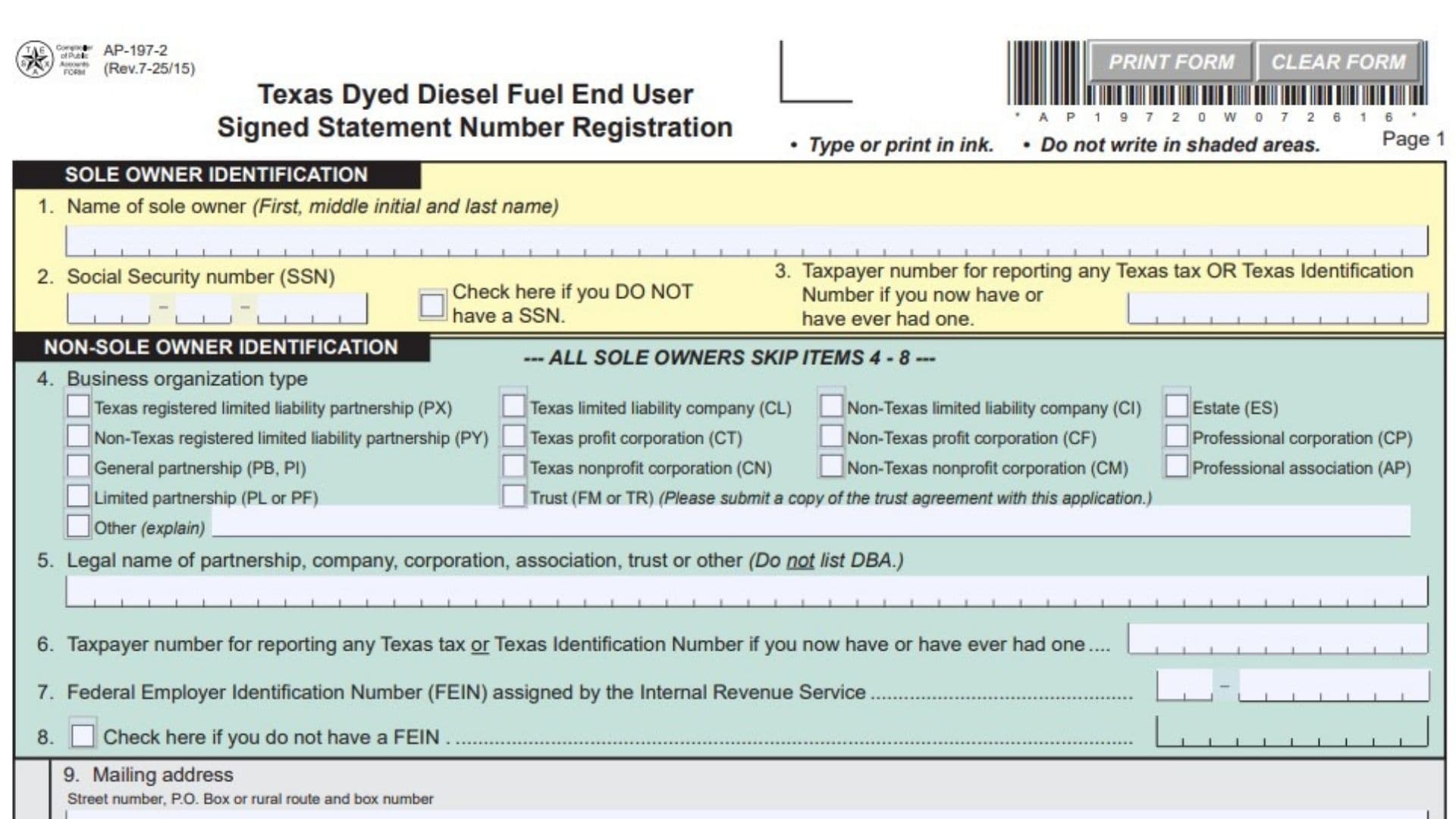
Form AP-197, officially titled the Texas Dyed Diesel Fuel End User Signed Statement Number Registration, is an application issued by the Texas Comptroller of Public Accounts that allows qualifying businesses and individuals located within Texas to buy dyed diesel fuel exempt from state motor fuel taxes for legitimate off-highway operations. Motor fuels utilized on public roadways include state taxes earmarked for highway infrastructure, whereas red-dyed diesel is chemically marked for non-highway machinery and equipment, making it legally impermissible for road vehicles. By completing this form, qualifying off-road operators obtain an End User Signed Statement Number, enabling them to present a signed certificate to authorized fuel distributors or suppliers to buy tax-free fuel without paying standard road taxes at the point of sale. The registration collects essential identity verification, business ownership structures, physical operating sites, vehicle counts, bulk storage details, and fuel consumption classifications. Filing this application completely and truthfully is critical, as misrepresenting fuel usage or improperly fueling highway vehicles carries severe state financial penalties, loss of tax-exempt privileges, and criminal liability under the Texas Tax Code.
How To File Form AP-197
Applicants have three primary submission methods available through the Texas Comptroller of Public Accounts:
- By Mail: Send the signed and completed paper application to the Texas Comptroller of Public Accounts, 111 E. 17th St., Austin, TX 78774-0100.
- By Fax: Transmit the completed application pages directly to (512) 936-0012.
- By Email: Scan the signed document and send it as an attachment to FuelsTax@cpa.texas.gov.
The Comptroller processes applications in the chronological order received. Before starting the form, assemble all foundational organization records: your Federal Employer Identification Number (FEIN) confirmation letter, Social Security numbers or Individual Taxpayer Identification Numbers (ITIN) for all governing persons, Texas Secretary of State formation documents and file numbers, physical addresses and driving directions for all operating locations, bulk fuel storage container capacities, and on-road diesel vehicle inventories. If an entity was involved in a corporate merger within the past seven years, prepare a written explanatory addendum. If registering on behalf of a trust, obtain a full copy of the executed trust agreement. If an authorized agent files on behalf of an owner, prepare a legally executed power of attorney.

How To Complete Form AP-197
Complete the registration clearly in black or blue ink, or enter information electronically before printing. Leave all shaded processing fields blank for Comptroller administrative use.
Sole Owner Identification
Sole proprietorships must complete this opening segment. All applicants that are not sole proprietorships skip lines 1 through 3 and advance directly to line 4.
Line 1: Name Of Sole Owner
Print the full legal personal name of the individual proprietor, arranged as first name, middle initial, and last name. Do not list trade names or doing-business-as (DBA) labels here.
Line 2: Social Security Number (SSN)
Provide the nine-digit Social Security number of the sole proprietor. If the owner does not possess an SSN, leave the numerical blocks empty and mark the adjacent checkbox stating you do not have a Social Security number.
Line 3: Texas Taxpayer Number Or Texas Identification Number
Enter the eleven-digit taxpayer number previously assigned for reporting any state tax in Texas, or your Texas Identification Number if you currently have or previously held one. If you possess both numbers, report the first eleven digits of your Texas Identification Number. Leave this item blank if you have never had an account with the Texas Comptroller.
Non-Sole Owner Identification
All partnerships, corporations, limited liability companies, associations, trusts, and other legal organizations must complete lines 4 through 8. Sole proprietors must skip this segment entirely.
Line 4: Business Organization Type
Select the single checkbox that corresponds precisely with the legal entity classification of your organization:
- Texas profit corporation (CT)
- Non-Texas profit corporation (CF)
- Texas nonprofit corporation (CN)
- Non-Texas nonprofit corporation (CM)
- Professional corporation (CP)
- Professional association (AP)
- Texas limited liability company (CL)
- Non-Texas limited liability company (CI)
- Texas registered limited liability partnership (PX)
- Non-Texas registered limited liability partnership (PY)
- General partnership (PB, PI)
- Limited partnership (PL or PF)
- Estate (ES)
- Trust (FM or TR), which requires attaching a complete copy of the underlying trust instrument
- Other, which requires writing a concise explanation of the organizational format, such as a social club, independent school district, or family trust
Line 5: Legal Name Of Organization
State the official registered name of the company, partnership, corporation, association, or trust. For corporate and LLC entities, write the title exactly as recorded in registration filings with the Secretary of State. Do not include DBA aliases.
Line 6: Organization Texas Taxpayer Number Or Identification Number
Provide your assigned eleven-digit Texas taxpayer number or Texas Identification Number if one was previously created for any state tax responsibility. When holding both identifiers, record the initial eleven digits of the Texas Identification Number. Leave empty if no prior Texas tax account exists.
Line 7: Federal Employer Identification Number (FEIN)
Enter the nine-digit federal identification number issued to your business entity by the Internal Revenue Service.
Line 8: Checkbox For No FEIN
Check this designated box if your business organization has not been issued a Federal Employer Identification Number by the IRS.
General Business Information
Every applicant must complete the contact and operational profile fields in this segment.
Line 9: Mailing Address
List the complete physical street address, postal box, or rural mail route where you want the Comptroller of Public Accounts to deliver official notices. Specify the city, two-letter state or Canadian province abbreviation, five-digit ZIP code, and the Texas county (or international country for entities situated abroad). If your enterprise receives mail at distinct addresses for alternative tax programs, include a separate cover letter listing those specific addresses.
Line 10: Operational Contact Person
Record the full name and daytime telephone number, including area code, of the specific employee or representative responsible for day-to-day operations and capable of resolving application questions.
Line 11: Principal Type Of Business
Select the primary commercial category that accurately mirrors your primary revenue operations:
- Agriculture
- Mining
- Construction
- Manufacturing
- Transportation
- Communications
- Utilities
- Wholesale Trade
- Retail Trade
- Finance
- Insurance
- Real Estate
- Services
- Public Administration
- Other, followed by a specific written description
If you know your four-digit Standard Industrial Classification (SIC) code, write it inside the labeled entry block.
Line 12: Primary Business Activities And Products Or Services
Describe in narrative prose the day-to-day activities performed by your enterprise, along with the concrete products manufactured, goods marketed, or specialized services rendered.
Entity Registration And Officer Details
Sole proprietorships skip lines 13 through 17 and move straight to Page 2. All other entity formats must complete these structural background questions.
Line 13: Texas Corporation Registration Information
Domestic Texas corporations must provide the official charter or file number assigned by the Texas Secretary of State, followed by the exact date of incorporation entered as month, day, and year.
Line 14: Non-Texas Entity Formation Record
Foreign corporations, out-of-state LLCs, and foreign professional associations must enter the home state or foreign country of initial organization, the original formation charter or file number, and the formation date. In the adjacent spaces, provide the foreign authority registration file number granted by the Texas Secretary of State along with the Texas qualification date.
Line 15: Merger History Within Seven Years
Review past corporate restructuring. If the legal entity participated in any merger during the preceding seven-year timeframe, mark the YES checkbox and enclose a detailed supplemental written statement outlining the transaction history, merging entities, and effective dates. Otherwise, check the NO box.
Line 16: Limited Partnership Registration Record
Limited partnerships and registered limited liability partnerships must disclose the original domicile state where the partnership agreement was established, accompanied by the registered certificate identification number granted by the Secretary of State.
Line 17: General Partners, Officers, Directors, And Managers
List every governing stakeholder. For partnerships, every general partner must be documented. For corporate entities, detail the primary executive officers, including the president, vice president, and secretary. Use separate sheets if listing more than two individuals. For each individual record:
- Full name, corporate title, and contact telephone number
- Percentage of ownership interest held in the organization
- Complete residential home street address, city, state, ZIP code, and county or country
- Social Security number (SSN) or federal Individual Taxpayer Identification Number (ITIN)
- Personal driver license number and the issuing state
- Organizational positions held, marked via checkboxes for Partner, Officer, Director, Corporate Stockholder, or Record Keeper
Business Location Details
All applicants must supply the operating site data on Page 2.
Line 18: Legal Name And Tax Identification Header
Transcribe the identical legal name supplied earlier on Line 1 (for sole owners) or Line 5 (for organizations). Enter the corresponding nine-digit Social Security number or Federal Employer Identification Number into the adjacent blocks.
Line 19: Physical Business Location
Provide the operational facility name, commercial telephone number, and precise geographic address within Texas where operations take place or where a project contract is being actively performed. Provide the street name and building number, city, state, ZIP code, and county. Do not list a post office box or bare rural route. If the work site sits along an unmarked rural route, provide clear directional instructions, such as citing intersecting farm-to-market roads and mileage markers. If you run operations across multiple sites, attach extra pages detailing every location.
Fuel Utilization And Operational Profile
Line 20: Fuel Use Type
Choose only one operational classification between the two available options:
- Non-Agricultural Use (DD): Check this box to authorize purchasing dyed diesel for off-highway industrial and commercial equipment operated within Texas. Examples include heavy highway and building construction machinery, industrial manufacturing forklifts, stationary welding rigs, site heaters, electric generators, earthmoving equipment, land-clearing tractors, commercial trucking yard movers, and commercial mowing contractors. This designation also includes farm supply retail outlets, agricultural cooperatives, cotton gins, feed merchants, and veterinary clinics. Note that dyed fuel consumed in initial oil and gas production or reservoir enhancement (such as fracturing, perforating, acidizing, squeeze cementing, logging, drilling deeper, swabbing, and workover procedures) falls under non-agricultural use, but requires a Comptroller-issued Letter of Exception to buy up to 25,000 gallons per month. Standard maintenance tasks, routine pumping, weed control around tank batteries, and fuel transport do not qualify as extraction production. Check the designated YES or NO sub-box to confirm whether the fuel will be utilized in oil and gas production.
- Agricultural Use (AG): Check this box if dyed diesel will be used exclusively in off-highway farming and ranching machinery, such as agricultural tractors, combines, and harvesters operating on a working farm or ranch. A qualifying agricultural property must be used in whole or in part to produce crops, livestock, or commercial timber for sale in the ordinary course of business. Qualifying properties include commercial feedlots, livestock auctions, dairy farms, poultry barns, commercial orchards, tree nurseries, and qualified wildlife management land. Home residential gardens do not qualify. Processing, packaging, or marketing activities conducted by third parties other than the original agricultural producer are excluded. Agricultural certificate holders are permitted to purchase up to 25,000 gallons per month.
Line 21: Diesel-Powered On-Road Motor Vehicle Fleet Size
Enter the total count of licensed, street-legal, diesel-powered trucks, vans, and passenger vehicles owned or operated by your enterprise. Write zero if your business does not maintain on-road diesel vehicles.
Line 22: Bulk Fuel Storage Containers In Texas
Indicate whether your business maintains on-site bulk storage containers inside Texas by checking YES or NO. Under Texas Tax Code Section 162.001, bulk storage is defined as any stationary or skid-mounted fuel container holding more than 10 gallons.
Line 23: Exclusive Off-Highway Consumption In Texas
Verify whether all purchased dyed diesel fuel will be used strictly inside off-highway machinery operating within the borders of Texas by checking YES or NO. An affirmative answer is required to preserve registration eligibility.
Signature Certification
Line 24: Declarations, Signatures, And Execution Dates
The registration must be formally executed by the business owner or an authorized corporate officer. For sole proprietorships, the sole owner must sign. For general partnerships, all partners must execute the document. For corporations and associations, the signature must belong to the president, vice president, secretary, treasurer, or managing director. If an external representative signs, attach an executed power of attorney.
Signing the registration certifies three mandatory statutory declarations:
- Every gallon of dyed diesel purchased using a signed statement will be consumed directly by the buyer and will never be resold.
- No fuel procured through the signed statement will ever be introduced into the supply tank of any vehicle driven on public Texas roadways.
- Total purchases under the signed statement will not surpass 10,000 gallons per calendar month, unless holding specific statutory authorization up to 25,000 gallons for agricultural producers or oil and gas operators with an approved Letter of Exception.
If an applicant cannot confirm all three points, they cannot buy dyed diesel under an End User Signed Statement Number and must instead obtain a Dyed Diesel Fuel Bonded User License.
Every signing party must provide their handwritten signature, printed full name, official corporate or management title, and execution date formatted by month, day, and year.
Final Review Before Filing
Before sending your completed Form AP-197 registration to the Texas Comptroller of Public Accounts, review this checklist to prevent processing delays or administrative rejections:
- Verify that non-sole owners skipped lines 1 through 3 and that sole owners skipped lines 4 through 8 and lines 13 through 17.
- Ensure the legal entity name entered on line 18 matches line 1 or line 5 word-for-word.
- Confirm your eleven-digit Texas Taxpayer Number or Texas Identification Number is entered correctly if an account was previously issued.
- Check that an explanatory merger history addendum is attached if you marked YES on line 15.
- Include a full copy of the trust agreement if you registered as a trust under line 4.
- Ensure only one fuel usage box is checked on line 20, and that oil and gas operators marked the supplemental production inquiry.
- Double-check that physical work sites on line 19 list real street locations or detailed rural road directions rather than post office boxes.
- Confirm every general partner or required corporate officer has signed, printed their name and title, and dated line 24.
- Attach a valid power of attorney document if an authorized agent signs in place of an owner or officer.