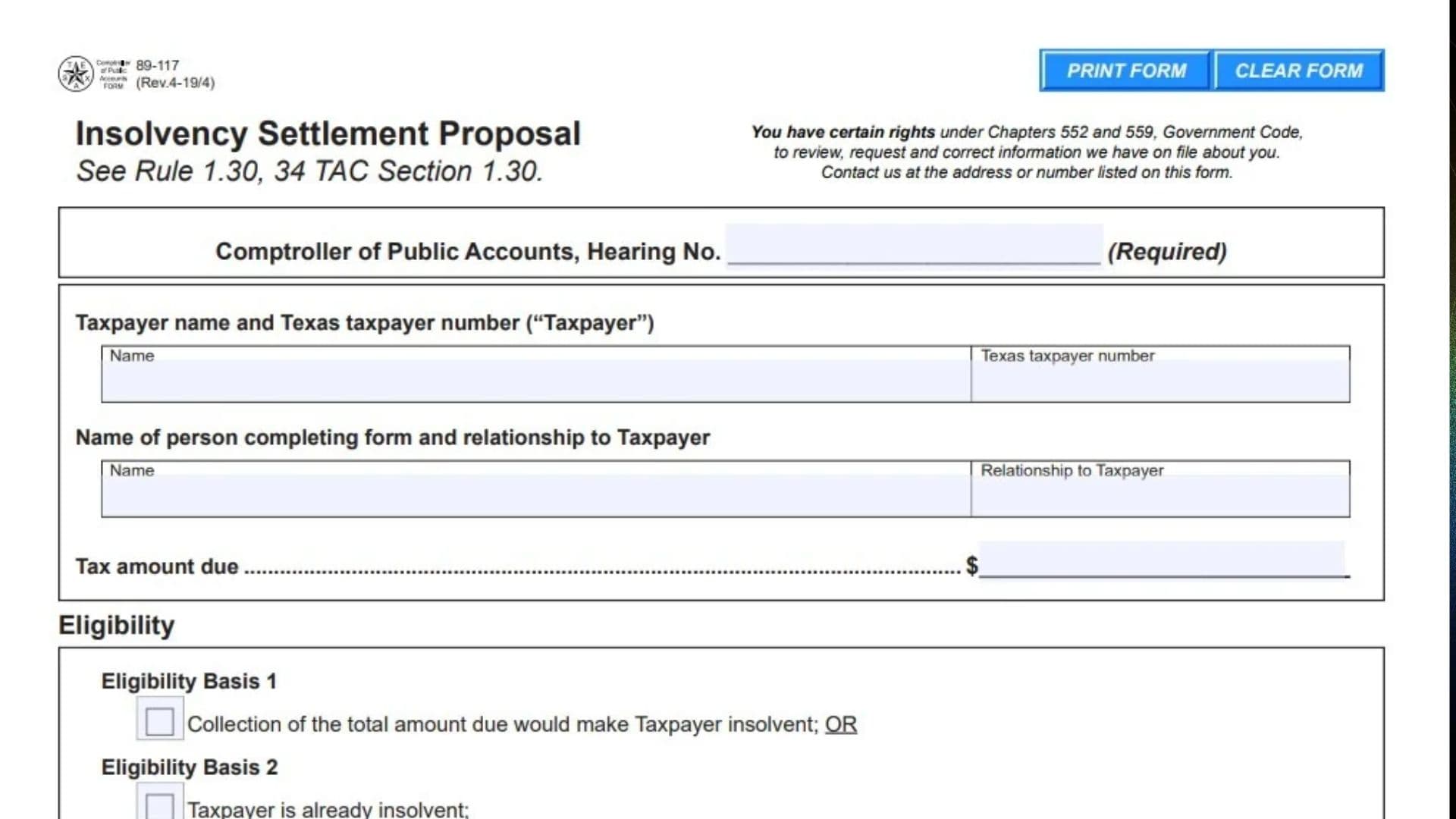
Texas Form 89-117, Insolvency Settlement Proposal, is a document used by taxpayers who want to request that the Texas Comptroller of Public Accounts consider settling an outstanding tax liability because of financial hardship or insolvency. The form is associated with Rule 1.30 of Title 34 of the Texas Administrative Code and provides a way for eligible taxpayers to ask the Comptroller to exercise discretion and enter into a settlement agreement. It is intended for situations in which collecting the full amount of outstanding taxes would make the taxpayer insolvent or where the taxpayer is already insolvent and meets additional financial and business conditions. The application collects the taxpayer’s legal name, Texas taxpayer number, outstanding tax amount, and information about the person preparing the proposal. It also requires the applicant to identify the applicable eligibility basis and provide supporting financial documentation. These records include federal income tax returns, historical and current financial statements, bank or financial institution statements covering the six months before the settlement request, and detailed evidence of assets, liabilities, ongoing financial obligations, and any claimed insolvency, liquidation, or business closure. The Comptroller uses this information to evaluate the taxpayer’s financial position and determine whether a settlement should be considered. The form also includes a separate section where the taxpayer can propose specific settlement terms, explaining the arrangement being requested. This section is intended to support the taxpayer’s request for discretionary settlement consideration and is not submitted to the State Office of Administrative Hearings (SOAH) as part of the hearing record. Both sections require an authorized individual to provide their printed name, telephone number, signature, and date. By signing the proposal, the individual declares under penalty of perjury that the information and accompanying documents are true, correct, and complete. Submitting Form 89-117 does not automatically guarantee that the Comptroller will accept the proposal. The taxpayer must establish the applicable eligibility conditions and provide sufficient financial evidence to support the request.
Who Should Submit Form 89-117?
Form 89-117 is intended for taxpayers who owe taxes to the State of Texas and want the Comptroller to consider settling the outstanding amount because of insolvency or financial circumstances.
The form provides two alternative eligibility bases.
Eligibility Basis 1: Collection Would Cause Insolvency
A taxpayer may qualify for consideration if collecting the entire outstanding tax amount would make the taxpayer insolvent.
Eligibility Basis 2: Existing Insolvency
A taxpayer may qualify for consideration under the second basis if all the following conditions apply:
- The taxpayer is already insolvent.
- The taxpayer has stopped conducting business.
- The taxpayer is undergoing liquidation.
- The taxpayer has no property that courts in Texas or another state could seize, or the value of the taxpayer’s property is lower than the total debts secured against that property.
Applicants should carefully evaluate which eligibility basis applies to their financial circumstances.
How To File Form 89-117
Complete both applicable sections of Form 89-117, gather the required financial records, and submit the proposal to the Texas Comptroller of Public Accounts, Administrative Hearings Section.
The form provides two submission methods:
Mailing Address:
Texas Comptroller of Public Accounts
ATTN: Administrative Hearings Section
P.O. Box 13528
Austin, TX 78711-3528
Fax Number: 512-463-4617
Before completing the form, prepare the following information:
- Comptroller hearing number.
- Taxpayer’s complete legal name.
- Texas taxpayer number.
- Name of the individual preparing the proposal.
- Relationship of the preparer to the taxpayer.
- Total outstanding tax amount.
- Information supporting the applicable insolvency eligibility basis.
- Federal income tax returns.
- Historical and current financial statements.
- Bank and financial institution statements.
- Documentation of assets and liabilities.
- Records of ongoing financial obligations.
- Evidence supporting insolvency, liquidation, or business closure, where applicable.
- Proposed settlement terms.
- Authorized representative’s contact information and signature.
Required Supporting Financial Records
The Records section identifies the financial documents that must accompany the settlement request.
Prepare the following:
Federal Income Tax Returns
Include all federal income tax returns beginning with the year immediately before the assessment date and continuing through the most recent federal income tax return.
Financial Statements
Provide financial statements covering the year immediately before the assessment date through the year of the most recent federal income tax return.
Also include year-to-date financial statements covering the period after the taxpayer’s most recent federal income tax return.
Bank And Financial Institution Statements
Attach statements from all bank accounts and financial institutions, including active and closed accounts.
The statements must cover the six months immediately before the date of the insolvency settlement request.
Assets, Liabilities, And Financial Obligations
Provide documentation showing the taxpayer’s financial position.
Include:
- An inventory of all property owned, regardless of where the property is located.
- Documentation of assets.
- Records of outstanding liabilities.
- Details of ongoing financial obligations.
- Evidence supporting the claimed insolvency, liquidation, or business cessation.
Other Supporting Records
If additional documents are relevant to the settlement request, identify them in the Other section and attach the corresponding records.

How To Complete Form 89-117
Form 89-117 consists of two pages. The first page collects taxpayer information, eligibility details, supporting financial records, and the main declaration. The second page provides space for the taxpayer’s proposed settlement terms and a separate signature.
Taxpayer And Hearing Information
Comptroller of Public Accounts Hearing Number
Enter the hearing number assigned by the Texas Comptroller of Public Accounts.
This is a required field.
Use the exact hearing number associated with the taxpayer’s outstanding tax matter.
Do not leave this field blank when submitting the proposal.
Taxpayer Name
Enter the complete legal name of the individual or business responsible for the outstanding tax liability.
For a business entity, use its registered legal name. For an individual taxpayer, provide the individual’s full legal name.
Make sure the name matches the taxpayer’s Texas tax registration records.
Texas Taxpayer Number
Enter the Texas taxpayer identification number assigned to the individual or business.
Use the number associated with the tax liability being considered for settlement.
Verify that the identification number is accurate before proceeding.
Name Of Person Completing Form
Enter the full name of the individual preparing the insolvency settlement proposal.
This may be the taxpayer, an authorized representative, or another person responsible for completing the application.
Relationship To Taxpayer
Identify the relationship between the person completing the form and the taxpayer.
For example, indicate whether the person is the business owner, an officer, or an authorized representative.
Use an accurate description of the individual’s role.
Tax Amount Due
Enter the total outstanding tax amount owed by the taxpayer.
Use the amount associated with the tax liability for which settlement is being requested.
Make sure the figure is consistent with the Comptroller’s records and the supporting tax documentation.
Eligibility Requirements
The Eligibility section allows the taxpayer to identify the financial circumstances supporting the settlement request.
There are two alternative eligibility bases.
Eligibility Basis 1: Collection Of The Full Amount Would Cause Insolvency
Select this checkbox if collecting the entire outstanding tax amount would make the taxpayer insolvent.
This option applies when the taxpayer’s current financial condition would deteriorate to insolvency if the full tax liability were collected.
You should be prepared to support this claim with financial records demonstrating the taxpayer’s assets, liabilities, income, and financial obligations.
This is an alternative to Eligibility Basis 2.
Eligibility Basis 2: Taxpayer Is Already Insolvent
This eligibility basis requires the taxpayer to satisfy all four listed conditions.
Select the applicable checkboxes only when the corresponding statements accurately describe the taxpayer’s circumstances.
Taxpayer Is Already Insolvent
Check this box if the taxpayer is currently insolvent.
The taxpayer must provide financial evidence supporting the insolvency claim.
Taxpayer Has Ceased To Do Business
Select this option if the taxpayer has stopped conducting business operations.
The condition concerns the cessation of business activity, not simply a temporary reduction in operations.
Taxpayer Is In Liquidation
Check this box if the taxpayer is undergoing liquidation.
The financial records and supporting documentation should demonstrate the taxpayer’s liquidation status.
Taxpayer Has No Seizable Property Or Property Value Is Insufficient To Cover Debts
Select this checkbox if the taxpayer has no property that courts in Texas or another state could seize to satisfy the outstanding liability.
Alternatively, this condition may be satisfied if the value of the taxpayer’s property is less than the total debts against that property.
Provide supporting documentation showing the property owned, its value, and the related debts.
Important: Eligibility Basis 1 and Eligibility Basis 2 are alternative routes. Under Basis 2, all four listed conditions must apply. Do not treat the four Basis 2 conditions as separate alternatives.
Supporting Records
The Records section identifies the documents attached to support the insolvency settlement request.
Check each applicable box to confirm that the corresponding records are included with the submission.
Federal Income Tax Returns
Check this box if you have attached all federal income tax returns covering the required period.
The records must begin with the year immediately before the assessment date and continue through the most recent federal income tax return.
Make sure no required tax year is missing.
Financial Statements
Check this box if you have included the required financial statements.
The documents should cover the year immediately before the assessment date through the year of the most recent federal income tax return.
Also include year-to-date statements for the period after the most recent federal income tax return.
Bank Or Financial Institution Statements
Check this box if you have attached statements from all relevant financial institutions.
Include both active and closed accounts.
The required period is the six months immediately preceding the date of the insolvency settlement request.
Documentation Of Assets, Liabilities, And Ongoing Financial Obligations
Check this box if you have provided documentation describing the taxpayer’s financial position.
Include an inventory of all property owned, regardless of location.
Also provide evidence of liabilities, ongoing financial commitments, and any claimed insolvency, liquidation, or business cessation.
Make sure the documentation gives a clear picture of the taxpayer’s financial circumstances.
Other
Check this box if you are submitting additional supporting documents that do not fall into the previously listed categories.
Describe the additional records in the space provided.
Attach the corresponding documents to the settlement request.
Declaration And Signature
The Declaration and Signature section confirms that the individual submitting the proposal has reviewed the application and its supporting documents.
By signing, the individual makes a declaration under penalty of perjury that the information is true, correct, and complete to the best of their knowledge.
Complete the following fields:
Name (Print Or Type)
Enter the full printed name of the individual making the declaration.
Use the name of the person who will sign the proposal.
Phone (Area Code And Number)
Provide a telephone number where the individual can be contacted.
Include the area code and complete telephone number.
Signature
The responsible individual must sign the form to certify the accuracy of the information and accompanying records.
Do not sign until the application and supporting documents have been reviewed.
Date
Enter the date the declaration is signed.
Use the actual signing date.
How To Complete The Proposed Settlement Terms Page
The second page of Form 89-117 is specifically intended to explain the settlement arrangement the taxpayer wants the Comptroller to consider.
It is separate from the first page and contains its own taxpayer identification fields, proposed settlement terms, and signature section.
Importantly, this page is used to request the Comptroller’s discretionary decision to enter into a settlement. It is not submitted to the State Office of Administrative Hearings (SOAH) as part of the hearing record.
Taxpayer Identification
Taxpayer Name
Enter the complete legal name of the taxpayer.
Use the same name provided on the first page.
Texas Taxpayer Number
Enter the taxpayer’s Texas identification number.
Make sure it matches the number entered on the first page.
Proposed Specific Settlement Terms
Taxpayer Offers The Following Specific Terms In This Matter
Use this section to describe the specific settlement arrangement you are proposing to the Texas Comptroller of Public Accounts.
Clearly explain the terms you want the Comptroller to consider.
Your proposal should describe the settlement arrangement in practical and understandable language.
Depending on the proposal, you may explain:
- The amount you are offering to settle the outstanding liability.
- The proposed payment arrangement.
- The timing of any proposed payments.
- Other specific settlement conditions you are requesting the Comptroller to consider.
These are examples of information that may help explain a proposed arrangement, not additional mandatory fields listed on the form.
Make sure the proposed terms are consistent with the financial information and supporting records provided with the first page.
The available space allows you to write a detailed settlement proposal. If additional space is needed, prepare a separate attachment clearly identifying the taxpayer and hearing number.
Signature For Proposed Settlement Terms
The second page contains a separate signature section. Complete it independently of the declaration on the first page.
Name (Print Or Type)
Enter the full printed name of the individual submitting or authorizing the proposed settlement terms.
Phone (Area Code And Number)
Provide the individual’s daytime telephone number, including the area code.
Signature
The responsible individual must sign the proposed settlement terms page.
The signature confirms the submission of the proposed arrangement for the Comptroller’s consideration.
Date
Enter the date the second page is signed.
Make sure the signature and date are completed even if the first page has already been signed.
Important Filing And Settlement Information
Settlement Requests Are Subject To Comptroller Review
Submitting Form 89-117 allows the taxpayer to request consideration of an insolvency settlement under the applicable administrative rule.
The form does not state that submitting a proposal automatically results in approval or cancellation of the outstanding tax liability.
The taxpayer should provide complete and accurate financial information so the Comptroller can evaluate the request.
Understanding The Two Eligibility Bases
The form provides two different circumstances under which a taxpayer may request settlement consideration.
Under Basis 1, collecting the full amount due would make the taxpayer insolvent.
Under Basis 2, the taxpayer must already be insolvent, have stopped doing business, be in liquidation, and have no seizable property or property whose value is sufficient to cover the debts against it.
Carefully identify the eligibility basis that reflects your actual financial circumstances.
Financial Documentation Is Essential
The supporting records are an important part of the settlement request.
The Comptroller needs financial information covering the periods specified in the form to evaluate the taxpayer’s financial position.
Incomplete financial records may make it difficult to assess the insolvency claim.
Pay particular attention to:
- Federal income tax return coverage.
- Historical financial statements.
- Current year-to-date financial statements.
- Statements from active and closed financial accounts.
- Complete property and asset inventories.
- Outstanding liabilities.
- Ongoing financial obligations.
- Evidence of business closure or liquidation, where applicable.
Separate Purpose Of The Second Page
The second page is intended specifically for the taxpayer’s request that the Comptroller exercise discretion to enter into a settlement.
It provides space for the taxpayer to present the specific terms being proposed.
The form expressly states that this page will not be submitted to SOAH as part of the hearing record.
Make sure the proposed settlement terms are clearly presented and that the second page is signed separately.
Privacy And Information Rights
The form explains that taxpayers have certain rights under Chapters 552 and 559 of the Texas Government Code.
These rights include reviewing information maintained by the Comptroller, requesting access to applicable records, and seeking corrections to inaccurate information.
For assistance, contact the Texas Comptroller using the contact information provided on the form.
Contact Information For Assistance
If you have questions about Form 89-117 or the insolvency settlement process, contact the Texas Comptroller of Public Accounts, Administrative Hearings Section.
Email: AHS.Service@cpa.texas.gov
Telephone: 512-463-3830
Fax: 512-463-4617
Mailing Address:
Texas Comptroller of Public Accounts
ATTN: Administrative Hearings Section
P.O. Box 13528
Austin, TX 78711-3528
Final Review Before Filing
Before submitting Form 89-117, carefully review both pages and make sure all required information and supporting financial records are included.
Use the following checklist:
- Enter the required Comptroller hearing number.
- Provide the taxpayer’s complete legal name.
- Enter the correct Texas taxpayer number.
- Identify the person completing the form.
- Describe the person’s relationship to the taxpayer.
- Enter the total outstanding tax amount.
- Review Eligibility Basis 1 and Basis 2 carefully.
- Select Eligibility Basis 1 if collecting the full amount would make the taxpayer insolvent.
- If using Eligibility Basis 2, confirm that all four listed conditions apply.
- Provide evidence supporting the insolvency claim.
- Attach all required federal income tax returns.
- Include the required historical financial statements.
- Include year-to-date financial statements for the period after the latest federal tax return.
- Attach bank and financial institution statements for the six months before the settlement request.
- Include statements for both active and closed accounts.
- Provide a complete inventory of all property owned, regardless of location.
- Document the taxpayer’s assets and liabilities.
- Include records of ongoing financial obligations.
- Attach evidence of liquidation or business cessation, if applicable.
- Describe and attach any additional supporting records in the Other section.
- Complete the declaration section on the first page.
- Enter the declarant’s printed name and telephone number.
- Obtain the required signature.
- Enter the signature date.
- Complete the taxpayer name and Texas taxpayer number on the second page.
- Clearly explain the proposed specific settlement terms.
- Attach additional pages if the available proposal space is insufficient.
- Complete the second page’s printed name and telephone number fields.
- Obtain the separate signature on the second page.
- Enter the second-page signature date.
- Verify that the information is consistent across both pages.
- Make sure all supporting financial records are included.
- Mail the completed proposal to the Administrative Hearings Section or fax it to 512-463-4617.
A complete Form 89-117 provides the Texas Comptroller with the taxpayer’s financial information, eligibility details, supporting records, and proposed settlement terms. Before submitting the request, carefully verify the hearing number, outstanding tax amount, insolvency evidence, and financial documentation. Ensure that both signature sections are completed so the proposal can be properly considered.