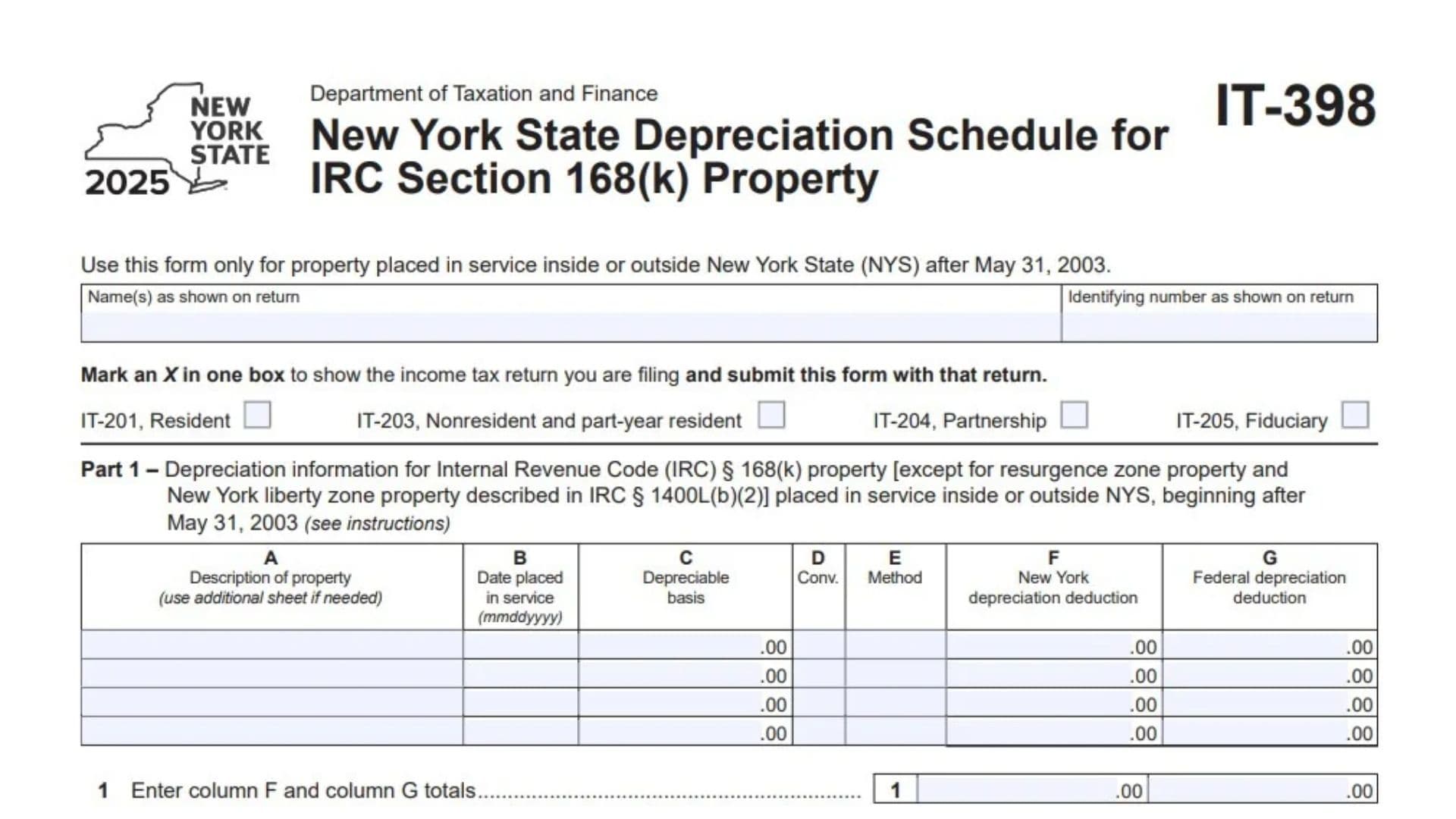
Form IT-398, officially called the New York State Depreciation Schedule for IRC Section 168(k) Property, is a tax form issued by the New York State Department of Taxation and Finance. It is used to calculate and report differences between New York State depreciation deductions and federal depreciation deductions for certain business and investment properties. These differences arise because New York State does not generally allow the federal special depreciation deduction under Internal Revenue Code (IRC) Section 168(k) for qualifying property placed in service after May 31, 2003. Instead, New York State generally calculates its allowable depreciation deduction under IRC Section 167, using the rules that would have applied if the property had been acquired on September 10, 2001. The form helps taxpayers determine the appropriate New York depreciation deduction, compare it with the depreciation claimed on their federal tax return, and report the resulting tax adjustments. Form IT-398 applies to qualifying property placed in service either inside or outside New York State, subject to specific exclusions for resurgence zone property and New York Liberty Zone property described in IRC Section 1400L(b)(2). It may be required by resident taxpayers, nonresidents, part-year residents, partnerships, and fiduciaries filing applicable New York State income tax returns. The form contains two main parts. Part 1 calculates the New York and federal depreciation deductions for qualifying property placed in service. Part 2 calculates the adjustment required when qualifying property is disposed of. The completed calculations are transferred to Form IT-225, New York State Modifications, using the applicable addition or subtraction modification codes. Completing Form IT-398 correctly is important because differences between federal and New York depreciation rules can affect taxable income and the amount of New York State tax owed. Taxpayers must report the appropriate adjustments even when federal depreciation deductions are subject to certain passive activity loss limitations.
How To File Form IT-398
Form IT-398 must be submitted with the applicable New York State income tax return. It is not intended to be filed as a standalone tax return.
The form supports four types of New York State income tax returns. Before completing it, identify which return you are filing.
- Form IT-201: New York State Resident Income Tax Return.
- Form IT-203: Nonresident and Part-Year Resident Income Tax Return.
- Form IT-204: Partnership Return.
- Form IT-205: Fiduciary Income Tax Return.
Mark the appropriate checkbox at the top of Form IT-398 and attach the completed schedule to that return.
Information to Prepare Before Completing Form IT-398
Gather the following information before starting:
- Taxpayer identification: Your name and identifying number as shown on your New York State tax return. The identifying number may be your Social Security number (SSN) or employer identification number (EIN).
- Property information: A description of each qualifying business or investment property.
- Acquisition and service information: The date each property was placed in service.
- Depreciable basis: The amount of the property’s cost or other basis eligible for depreciation.
- Depreciation details: The applicable depreciation convention and method used to calculate the New York deduction.
- Federal depreciation records: The depreciation deduction claimed on your federal tax return.
- Disposition information: For property disposed of during the tax year, prepare the disposition date, method of disposition, and total New York and federal depreciation deductions.
- Investment credit information: Determine whether you claimed an investment credit on Form IT-212 for any property reported in Part 2.
- Form IT-225: Prepare the New York State Modifications schedule because the calculated adjustments from Form IT-398 must be transferred to it.
Important Eligibility Rules
Before completing Form IT-398, understand the following rules.
Property Placed in Service After May 31, 2003
This form generally applies to qualifying IRC Section 168(k) property placed in service inside or outside New York State after May 31, 2003.
Resurgence Zone Property
Qualified resurgence zone property described in IRC Section 168(k) is subject to different treatment. The general depreciation adjustments described in this form exclude qualifying resurgence zone property.
For property to qualify, the instructions specify that:
- Substantially all of its use must take place in the resurgence zone.
- The property must be used in the active conduct of a trade or business by the taxpayer in that zone.
- The taxpayer’s original use of the property must begin after December 31, 2002.
The resurgence zone is a defined area of New York County in Manhattan, with boundaries described in the form instructions.
New York Liberty Zone Property
New York Liberty Zone property described in IRC Section 1400L(b)(2) is also excluded from the general depreciation adjustments covered by Form IT-398.
The property generally must have been placed in service by December 31, 2006. For nonresidential real property and residential rental property, the applicable deadline is December 31, 2009.
Special Rules for Certain Residential Properties
New York State does not allow depreciation deductions on certain covered residential properties owned by institutional real estate investors when the depreciation was required to be added back to federal adjusted gross income using modification A-223 on Form IT-225.
Covered property means residential property located in New York State that contains no more than two dwelling units.
Do not use Form IT-398 to report depreciation amounts for these covered properties.
How To Complete Form IT-398
Form IT-398 contains two main parts:
- Part 1: Depreciation information for qualifying IRC Section 168(k) property.
- Part 2: Year-of-disposition adjustment for qualifying IRC Section 168(k) property.
Each part requires different property information and calculations. Follow the instructions below to complete every field.
Taxpayer Information and Income Tax Return Selection
Start by completing the identification section at the top of the form.
Name(s) as Shown on Return
Enter the taxpayer’s name exactly as it appears on the New York State income tax return.
If the form is being filed by a partnership or fiduciary, use the name associated with the applicable return.
Identifying Number as Shown on Return
Enter the identifying number associated with the tax return.
This may be:
- Your Social Security number (SSN).
- Your employer identification number (EIN).
Make sure the number matches the identifying information on the corresponding New York State tax return.
Income Tax Return Selection
Mark an X in exactly one checkbox to identify the type of New York State income tax return being filed.
Choose the appropriate option:
- IT-201, Resident: Select this option if you are filing a New York State resident income tax return.
- IT-203, Nonresident and Part-Year Resident: Select this option if you are filing as a nonresident or part-year resident.
- IT-204, Partnership: Select this option if the form accompanies a partnership return.
- IT-205, Fiduciary: Select this option if the form accompanies a fiduciary income tax return.
Submit Form IT-398 with the selected income tax return.
Part 1: Depreciation Information for IRC Section 168(k) Property
Part 1 is used to calculate the New York State depreciation deduction and federal depreciation deduction for qualifying IRC Section 168(k) property placed in service after May 31, 2003.
This section generally applies to qualifying property placed in service inside or outside New York State, excluding qualifying resurgence zone property and New York Liberty Zone property described in IRC Section 1400L(b)(2).
You must provide information about each qualifying property in the table.
The table contains seven columns, labeled A through G.
Property Information and Depreciation Columns
Column A: Description of Property
Enter a clear description of each qualifying business or investment property.
Identify the asset in enough detail to distinguish it from other properties reported on the form.
If you have more properties than the available spaces allow, use an additional sheet to provide the remaining information.
Column B: Date Placed in Service
Enter the date when the property was first placed in service.
Use the required date format:
MMDDYYYY
For example, if the property was placed in service on July 15, 2025, enter 07152025.
The placed-in-service date is important because depreciation generally begins when the property is first used in a business or for the production of income.
Column C: Depreciable Basis
Enter the depreciable basis of each property placed in service during the tax year.
Depreciable basis generally means the property’s original cost or other tax basis, reduced by:
- Any portion of the basis elected to be amortized or expensed under IRC Section 179.
- Any federal investment credit subtracted when calculating the property’s federal unadjusted basis.
Only the amount eligible for depreciation should be included.
Column D: Convention
Enter the depreciation convention used for the property.
The convention determines the portion of the tax year for which depreciation is allowed when an asset is placed in service or disposed of.
Use the convention reported in Column E of federal Form 4562.
Make sure the convention entered here matches the information used in your federal depreciation calculation.
Column E: Method
Enter the depreciation method selected to calculate the allowable New York State depreciation deduction.
New York State allows a consistent depreciation method that would have been permitted under IRC Section 167, assuming the property had been acquired on September 10, 2001, without applying the special depreciation provisions of IRC Section 168(k).
Use the appropriate method consistently when calculating the New York depreciation deduction.
Column F: New York Depreciation Deduction
Enter the New York State depreciation deduction calculated using the depreciation method selected in Column E.
This amount represents the depreciation deduction allowed under New York State rules.
Calculate the deduction based on the property’s depreciable basis, applicable convention, and selected depreciation method.
Column G: Federal Depreciation Deduction
Enter the depreciation deduction claimed for the same property on your federal income tax return.
Use the federal depreciation amount rather than the New York State depreciation calculation.
The amount in this column is used to determine the federal depreciation adjustment that must be reported on Form IT-225.
Line 1: Total New York and Federal Depreciation Deductions
Calculate the total amounts reported in Column F and Column G.
Enter the combined New York State depreciation deduction from Column F in the first amount field.
Enter the combined federal depreciation deduction from Column G in the second amount field.
Use the following calculations:
- First amount: Add all amounts in Column F.
- Second amount: Add all amounts in Column G.
These totals are used to calculate the corresponding New York State tax modifications.
Transfer of Column F Total to Form IT-225
Transfer the total from Column F, as reported on Line 1, to Form IT-225, Line 10, in the Total amount column.
Enter subtraction modification code S-213 in the Number column of Form IT-225.
This adjustment reports the New York State depreciation deduction that differs from the federal depreciation treatment.
Transfer of Column G Total to Form IT-225
Transfer the total from Column G, as reported on Line 1, to Form IT-225, Line 1, in the Total amount column.
Enter addition modification code A-209 in the Number column of Form IT-225.
This adjustment accounts for the federal depreciation deduction that New York State does not allow under the applicable rules.
Part 2: Year-of-Disposition Adjustment for IRC Section 168(k) Property
Part 2 is used when qualifying IRC Section 168(k) property placed in service after May 31, 2003, is disposed of during the tax year.
A disposition may include:
- Sale of property.
- Exchange of property.
- Transfer of property.
- Disposal because the property has become obsolete.
This section calculates the difference between the total New York State depreciation deduction and the total federal depreciation deduction claimed on the disposed property.
As in Part 1, qualifying resurgence zone property and New York Liberty Zone property described in IRC Section 1400L(b)(2) are excluded from these general adjustments.
Investment Credit Checkbox
Before completing the property table, review the investment credit question.
Investment Credit Checkbox: Form IT-212
Mark an X in this checkbox if you claimed an investment credit on Form IT-212, Investment Credit, for any property listed in Part 2.
Check the information on your Form IT-212 before making this selection.
This question is important because disposing of certain property before the end of its useful life or specified holding period may require an additional tax adjustment.
If an investment credit, retail enterprise credit, or research and development credit was claimed and the property is disposed of or removed from qualified use before the applicable period ends, the difference between the credit originally claimed and the credit allowed for actual use must be added to income tax in the year of disposition.
Refer to Form IT-212 and its instructions for the applicable credit calculation.
Property Disposition Information
The Part 2 table contains five columns, labeled A through E.
Complete a separate entry for each qualifying property disposed of during the tax year.
Column A: Description of Property
Enter a description of the property that was disposed of during the tax year.
Use a clear description that identifies the asset and distinguishes it from other properties.
If additional space is needed, attach a separate sheet containing the remaining property information.
Column B: Date of Disposition
Enter the date when the property was disposed of.
This is the date associated with the event that ended your ownership or use of the property, such as a sale, exchange, transfer, or disposal due to obsolescence.
Use the applicable disposition date for the tax year being reported.
Column C: Method of Disposition
Enter the method used to dispose of the property.
Examples include:
- Sale.
- Exchange.
- Transfer.
- Obsolescence.
Choose the description that accurately explains how the property was disposed of.
Column D: Total New York Depreciation Deduction
Enter the total New York State depreciation deduction claimed on the property being disposed of.
Include the total New York depreciation deductions claimed for that property over the applicable period.
Use your depreciation records to determine the correct amount.
Column E: Total Federal Depreciation Deduction
Enter the total federal depreciation deduction claimed for the disposed property on your federal income tax return.
Include the total federal depreciation deductions claimed for the property.
Use your federal depreciation records to verify the amount.
Year-of-Disposition Calculations
After completing the property information table, calculate the totals and adjustment using Lines 2 through 5.
Line 2: Total New York and Federal Depreciation Deductions
Add all amounts reported in Column D and Column E.
Enter the total New York State depreciation deduction from Column D in the first amount field.
Enter the total federal depreciation deduction from Column E in the second amount field.
Use these calculations:
- First amount: Total of Column D.
- Second amount: Total of Column E.
These amounts provide the starting figures for the year-of-disposition adjustment.
Line 3: Total Federal Depreciation Deduction
Enter the amount reported on Line 2, Column E.
This is the total federal depreciation deduction claimed on the disposed property.
Copy the amount directly from the federal depreciation total calculated on Line 2.
Line 4: Total New York Depreciation Deduction
Enter the amount reported on Line 2, Column D.
This is the total New York State depreciation deduction claimed on the disposed property.
Copy the amount directly from the New York depreciation total calculated on Line 2.
Line 5: Year-of-Disposition Adjustment
Subtract the amount on Line 4 from the amount on Line 3.
Use the following calculation:
Line 5 = Line 3 − Line 4
The result represents the difference between the total federal depreciation deduction and the total New York State depreciation deduction for the disposed property.
Enter the calculated amount on Line 5.
Transfer Line 5 to Form IT-225
Transfer the amount reported on Line 5 to Form IT-225, Line 10, in the Total amount column.
Enter subtraction modification code S-214 in the Number column of Form IT-225.
This adjustment reports the difference between the total federal and New York State depreciation deductions for the property disposed of during the tax year.
Special Tax Rules and Additional Filing Considerations
In addition to the two main parts, Form IT-398 includes several important rules for specific taxpayers and property situations.
Understanding these rules can help determine who must complete the form and how the depreciation adjustments should be handled.
New York State Depreciation Rules
For tax years beginning after December 31, 2002, New York State generally does not allow the federal special depreciation deduction under IRC Section 168(k) for qualifying property placed in service after May 31, 2003.
Instead, New York State calculates depreciation under IRC Section 167, using the rules that would have applied if the property had been acquired on September 10, 2001.
The New York depreciation deduction may continue until the property is fully depreciated or disposed of.
If you claimed accelerated cost recovery system (ACRS) depreciation on your federal return for qualifying property placed in service after May 31, 2003, complete Part 1.
When Depreciation Begins and Ends
Depreciation is an annual deduction that allows taxpayers to recover the cost or other basis of qualifying business or investment property over its useful life.
Land is not depreciable.
Depreciation generally begins when the property is first placed in service for business purposes or for the production of income.
Depreciation ends when one of the following occurs:
- The property is disposed of.
- The entire depreciable cost or other basis has been deducted.
- The property is no longer used in the business or for the production of income.
If qualifying property is disposed of during the tax year, Part 2 is used to calculate the applicable year-of-disposition adjustment.
Passive Activity Income and Loss Rules
Taxpayers with an interest in a passive activity must make the required New York State adjustments for the full amounts of federal and New York depreciation deductions allowed.
These adjustments must reflect 100% of the allowable depreciation amounts, even if the passive activity is subject to federal loss deduction limitations.
The limitation on passive activity loss deductions is governed by IRC Section 469.
Therefore, federal passive activity loss limitations do not reduce the depreciation amounts used to calculate the required New York State modifications.
Special Rules for Partnerships
When a partnership uses IRC Section 168 to determine depreciation, the partnership must calculate the New York State and federal depreciation adjustments.
Form IT-398 should be completed by the partnership, not by each individual partner.
Each partner must report their distributive share of the applicable New York State and federal depreciation adjustments on their personal income tax return.
The distributive share is determined by the partnership as of the end of the partnership year that falls within the partner’s tax year.
The same treatment applies to a beneficiary of an estate or trust that operates on a fiscal-year basis.
If you are a shareholder of an electing New York State S corporation, the corporation should provide you with your proportionate share of its depreciation deduction.
Use the information provided by the S corporation when reporting the applicable depreciation adjustments on your individual New York State income tax return.
Special Rules for Nonresidents and Part-Year Residents
If you are a nonresident or part-year resident of New York State, complete Form IT-398 as though you were a New York State resident for the entire tax year.
This means the depreciation calculations should be prepared using the full-year resident treatment specified in the form instructions.
Married Taxpayers Filing Separate New York Returns
If you are married, file a joint federal income tax return, but are required to file separate New York State income tax returns, follow the special reporting procedure.
Complete only one Form IT-398 using the depreciation amounts from the joint federal income tax return.
However, attach a separate schedule to each New York State income tax return showing each spouse’s individual share of the depreciation amounts.
Calculate each spouse’s share as though separate federal income tax returns had been filed.
Explain any differences between the joint federal amounts and the separate New York State amounts in the attached schedules.
Final Review Before Filing
Before submitting Form IT-398, carefully review all property descriptions, depreciation calculations, disposition information, and tax modifications.
Use the following checklist to verify that the form is complete and consistent with your New York State and federal tax records.
Taxpayer Information
- Your name matches the information on your New York State income tax return.
- Your SSN or EIN is correct.
- You have selected the correct income tax return type.
- Form IT-398 is attached to the appropriate Form IT-201, IT-203, IT-204, or IT-205.
Part 1: Depreciation Information
- You have included all applicable qualifying properties placed in service after May 31, 2003.
- Each property has a clear description in Column A.
- The placed-in-service dates in Column B are correct.
- The depreciable basis in Column C reflects the applicable reductions.
- The depreciation conventions in Column D match federal Form 4562, Column E.
- The depreciation methods in Column E follow the applicable New York State rules.
- The New York depreciation deductions in Column F are correct.
- The federal depreciation deductions in Column G match your federal tax records.
- Line 1 includes the correct Column F and Column G totals.
- You have transferred the Column F total to Form IT-225, Line 10, using modification S-213.
- You have transferred the Column G total to Form IT-225, Line 1, using modification A-209.
Part 2: Year-of-Disposition Adjustment
- You have included all applicable qualifying properties disposed of during the tax year.
- The investment credit checkbox is marked correctly, if applicable.
- Each property description in Column A is accurate.
- The disposition dates in Column B are correct.
- The disposition methods in Column C are properly identified.
- The New York depreciation totals in Column D are correct.
- The federal depreciation totals in Column E are correct.
- Line 2 contains the correct Column D and Column E totals.
- Line 3 matches Line 2, Column E.
- Line 4 matches Line 2, Column D.
- Line 5 correctly subtracts Line 4 from Line 3.
- You have transferred the Line 5 amount to Form IT-225, Line 10, using modification S-214.
Additional Filing Requirements
- You have reviewed the special rules for resurgence zone and New York Liberty Zone property.
- You have checked whether any special residential property exclusion applies.
- You have followed the applicable partnership, S corporation, fiduciary, or nonresident filing rules.
- You have included additional property schedules if the available spaces were insufficient.
- All calculations agree with your supporting depreciation records and federal tax return.
- The applicable Form IT-225 adjustments are included with your New York State income tax return.
Final Reminder: Form IT-398 is used to calculate New York State depreciation adjustments for qualifying IRC Section 168(k) property. Make sure you complete both parts when applicable and transfer the calculated amounts to the correct lines of Form IT-225 using the appropriate modification codes. Review the instructions for your specific New York State income tax return before filing.