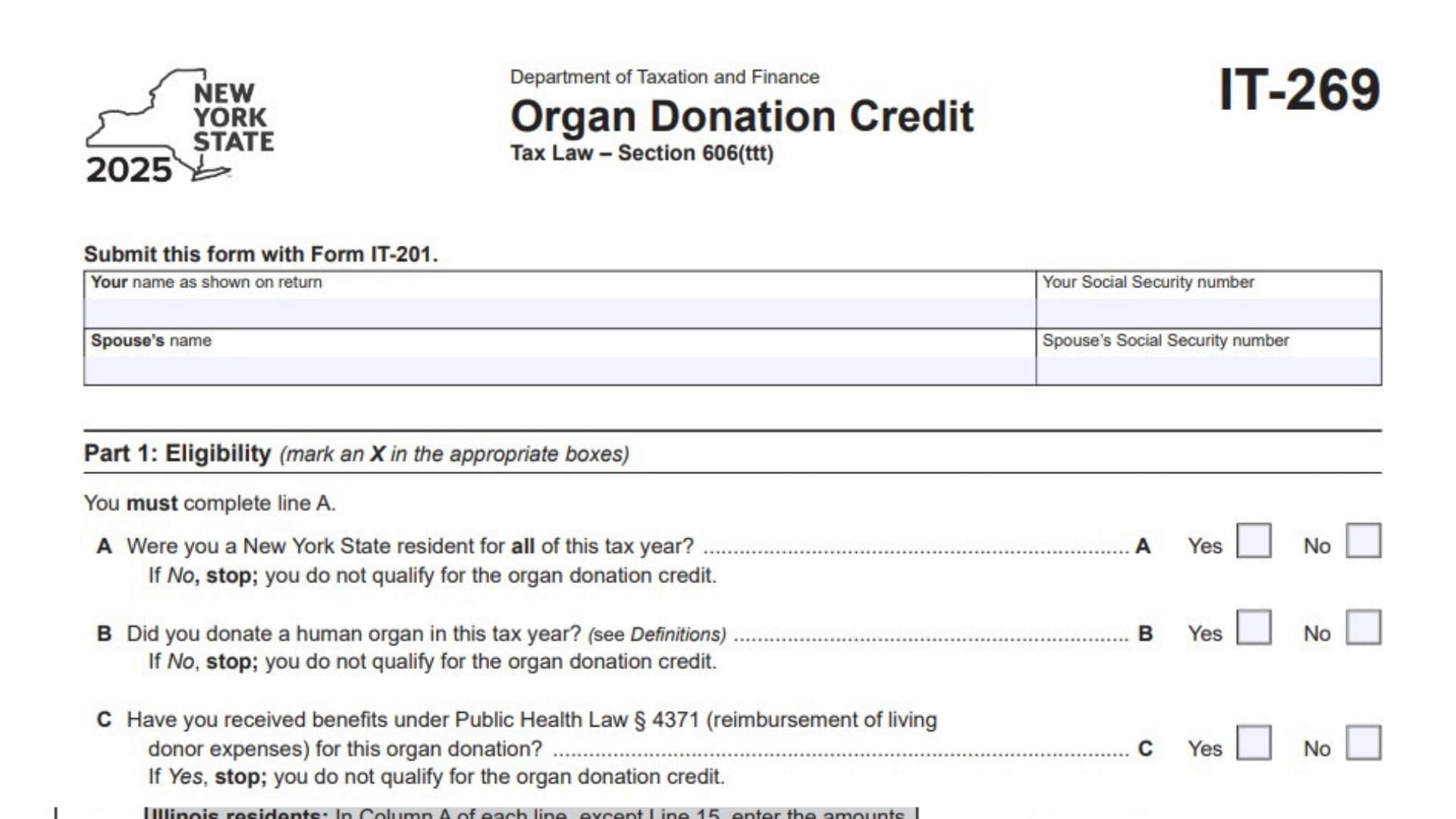
New York Form IT-269, officially titled Organ Donation Credit, is a tax form used by eligible New York State residents to claim a tax credit for certain unreimbursed expenses associated with donating a human organ to another person for transplantation. The credit is authorized under Section 606(ttt) of New York Tax Law and is intended to help offset qualifying financial costs incurred by living organ donors. To qualify, an individual must have been a full-year New York State resident during the tax year in which the organ donation occurred, donated one or more qualifying human organs to another person for transplantation, and incurred eligible expenses related to the donation. The qualifying organs include all or part of a liver, pancreas, kidney, intestine, lung, or bone marrow. Eligible expenses include unreimbursed travel costs, lodging expenses, and lost wages directly related to the organ donation. Form IT-269 collects the taxpayer’s name, Social Security number, spouse’s information, residency and donation eligibility details, donor name, transplant date, and total qualifying expenses. It also includes questions about whether the taxpayer received reimbursement benefits under New York Public Health Law Section 4371, which can affect eligibility for the credit. The credit is equal to the eligible expenses incurred, up to a maximum of $10,000. However, the credit may only be claimed once during the taxpayer’s lifetime. Individuals who have received benefits under Public Health Law Section 4371 for the organ donation cannot claim this credit. The credit must be claimed in the tax year in which the human organ transplant occurs, and the completed form must be submitted with Form IT-201, New York State Resident Income Tax Return. Married couples may each claim a separate credit if both spouses independently qualify, but each spouse must complete a separate Form IT-269. Completing the form accurately is important because the credit is subject to residency requirements, qualifying organ donation rules, expense limitations, reimbursement restrictions, and a lifetime claim restriction.
How To File Form IT-269
Form IT-269 is used by eligible full-year New York State residents who donated a qualifying human organ during the tax year and incurred eligible unreimbursed expenses.
The taxpayer must complete the eligibility questions in Part 1 before calculating the credit in Part 2. The completed form must accompany the applicable New York State income tax return.
Where to File Form IT-269
Submit Form IT-269 with:
- Form IT-201: New York State Resident Income Tax Return.
The form specifically instructs taxpayers to submit it with Form IT-201.
After calculating the credit on Line 2, transfer the amount and code 269 to Form IT-201-ATT, line 12.
What Information to Prepare Before Completing Form IT-269
Gather the following information before starting the form:
- Taxpayer’s full name as shown on Form IT-201.
- Taxpayer’s Social Security number.
- Spouse’s name, if applicable.
- Spouse’s Social Security number, if applicable.
- Confirmation of full-year New York State residency.
- Information identifying the donated human organ.
- Name of the organ donor.
- Date of the transplant.
- Records of unreimbursed travel expenses related to the donation.
- Records of eligible lodging expenses.
- Documentation of lost wages related to the organ donation.
- Information about any benefits received under Public Health Law Section 4371.
- Supporting records showing the amount of eligible expenses incurred.
Having these details available will help determine eligibility and calculate the correct credit amount.

How To Complete Form IT-269
Form IT-269 contains two main parts:
- Part 1: Eligibility.
- Part 2: Calculation of Credit.
Complete the taxpayer identification section first, then answer all eligibility questions before calculating the credit.
Taxpayer Identification Information
The top portion of Form IT-269 collects the taxpayer’s personal identification information.
Your Name as Shown on Return
Enter your full name exactly as it appears on your New York State income tax return, Form IT-201.
For married taxpayers filing jointly, ensure that the taxpayer’s name matches the information reported on the return.
Your Social Security Number
Enter your Social Security number as shown on Form IT-201.
Verify that the number is accurate and corresponds to the individual claiming the Organ Donation Credit.
Spouse’s Name
If applicable, enter your spouse’s full name in the designated field.
Use the name associated with your spouse’s tax information.
Spouse’s Social Security Number
Enter your spouse’s Social Security number in the appropriate field.
Make sure the number is accurate and corresponds to the spouse identified above.
Part 1: Eligibility
Part 1 determines whether the taxpayer qualifies for the New York Organ Donation Credit.
You must complete Line A. The form then requires answers to additional questions concerning the organ donation and reimbursement benefits.
Mark an X in the appropriate Yes or No box for each applicable question.
Line A: New York State Resident for the Entire Tax Year
Answer Yes or No to indicate whether you were a New York State resident for the entire tax year.
- Select Yes if you maintained New York State residency throughout the entire tax year.
- Select No if you were not a New York State resident for the full year.
If you answer No, stop completing the form because you do not qualify for the Organ Donation Credit.
This is a full-year residency requirement, so part-year New York residents are not eligible under the form’s instructions.
Line B: Donated a Human Organ During the Tax Year
Answer Yes or No to indicate whether you donated a qualifying human organ during the tax year.
- Select Yes if you donated one or more qualifying human organs to another human being for organ transplantation while you were living.
- Select No if you did not make a qualifying living organ donation during the tax year.
If you answer No, stop completing the form because you do not qualify for the credit.
The form defines qualifying human organs as all or part of a liver, pancreas, kidney, intestine, lung, or bone marrow.
The donation must be made to another human being for human organ transplantation.
Line C: Benefits Received Under Public Health Law Section 4371
Answer Yes or No to indicate whether you received benefits under New York Public Health Law Section 4371 for the organ donation.
These benefits relate to reimbursement of living donor expenses.
- Select Yes if you received benefits under Section 4371 for the organ donation.
- Select No if you did not receive these benefits.
If you answer Yes, stop completing the form because you do not qualify for the Organ Donation Credit.
Receiving these benefits makes the taxpayer ineligible for the credit under the form’s requirements.
Line D: Name of Donor
Enter the full name of the person who donated the human organ.
Provide the donor’s name clearly so that the individual associated with the organ donation can be identified.
Line E: Date of Transplant
Enter the date on which the human organ transplant occurred.
Use the required month, day, and year format (MMDDYYYY).
The transplant date is important because the credit must be claimed in the tax year in which the human organ transplant occurs.
Part 2: Calculation of Credit
Part 2 calculates the amount of the Organ Donation Credit available to the eligible taxpayer.
The credit is based on qualifying unreimbursed expenses associated with the organ donation. The maximum allowable credit is $10,000.
Line 1: Eligible Expenses
Enter the total amount of eligible expenses incurred in connection with the human organ donation.
Eligible expenses include:
- Travel Expenses: Unreimbursed transportation and travel costs related to the organ donation.
- Lodging Expenses: Unreimbursed accommodation expenses incurred in connection with the donation.
- Lost Wages: Income lost because of the time associated with the organ donation.
Only unreimbursed expenses related to the organ donation should be included.
Add together all qualifying expenses and enter the total on Line 1.
Keep supporting records showing the expenses incurred and any amounts reimbursed.
Line 2: Total Credit
Calculate the total Organ Donation Credit by entering the lesser of the amount reported on Line 1 or $10,000.
The credit cannot exceed the maximum limit of $10,000.
Calculation:
Line 2 = Lesser of Line 1 or $10,000.
For example:
- If eligible expenses are $4,500, the allowable credit is $4,500.
- If eligible expenses are $8,000, the allowable credit is $8,000.
- If eligible expenses are $12,000, the allowable credit is limited to $10,000.
Enter the resulting amount on Line 2.
Reporting the Line 2 Amount
After calculating the credit, transfer the amount from Line 2 and enter code 269 on Form IT-201-ATT, line 12.
Make sure the amount reported on Form IT-201-ATT agrees with the credit calculated on Form IT-269.
Additional Information About the Organ Donation Credit
Before claiming the credit, taxpayers should understand the qualifying organ donation requirements, eligible expenses, lifetime restriction, and special rules for married couples.
Definition of a Qualifying Human Organ
For purposes of this credit, a human organ includes all or part of the following:
- Liver.
- Pancreas.
- Kidney.
- Intestine.
- Lung.
- Bone marrow.
The organ must be donated while the taxpayer is living to another human being for human organ transplantation.
Eligible Expenses
The credit covers qualifying unreimbursed expenses associated with the organ donation.
These expenses are limited to:
- Travel expenses.
- Lodging expenses.
- Lost wages.
The expenses must be related to the organ donation and must not have been reimbursed.
Only eligible expenses should be included when calculating Line 1.
Maximum Credit Limitation
The Organ Donation Credit cannot exceed $10,000.
If the taxpayer’s eligible expenses are less than $10,000, the credit is limited to the actual eligible expenses.
If eligible expenses exceed $10,000, the maximum allowable credit remains $10,000.
Lifetime Claim Restriction
A taxpayer may claim the Organ Donation Credit only once during their lifetime.
This means an individual who has already claimed the credit in a previous tax year cannot claim it again for another organ donation.
Taxpayers should consider their previous credit history before submitting Form IT-269.
Reimbursement Under Public Health Law Section 4371
Taxpayers who received benefits under New York Public Health Law Section 4371 for the organ donation cannot claim the Organ Donation Credit.
This restriction applies to benefits relating to reimbursement of living donor expenses.
If you received these benefits, answer Yes to Line C and stop completing the form.
Claiming the Credit in the Correct Tax Year
The credit must be claimed in the tax year in which the human organ transplant occurs.
Use the transplant date entered on Line E to identify the applicable tax year.
Do not claim the credit in a different year merely because some related expenses were incurred or paid during another period.
Special Rules for Married Couples
Married couples have separate claiming requirements.
If both spouses independently qualify for the Organ Donation Credit, each spouse must complete a separate Form IT-269.
Each qualifying spouse may claim a credit of up to $10,000.
However, one spouse cannot claim any unused portion of the other spouse’s eligible expenses.
Each spouse must calculate their own qualifying credit based on their respective eligible expenses.
Refund or Overpayment Treatment
If the taxpayer cannot use the full amount of the Organ Donation Credit against their tax liability for the current year, they may request a refund or apply the overpayment to the following year’s tax.
However, the New York Tax Department will not pay interest on the refund or overpayment.
Final Review Before Filing
Before submitting Form IT-269 with Form IT-201, review the taxpayer information, eligibility answers, transplant details, and expense calculations.
Use the following checklist:
- Enter the taxpayer’s name exactly as shown on Form IT-201.
- Enter the taxpayer’s correct Social Security number.
- Provide the spouse’s name, if applicable.
- Enter the spouse’s Social Security number, if applicable.
- Complete Line A regarding full-year New York State residency.
- Stop completing the form if you were not a New York State resident for the entire tax year.
- Answer Line B regarding the qualifying human organ donation.
- Stop completing the form if no qualifying organ donation occurred.
- Answer Line C regarding benefits received under Public Health Law Section 4371.
- Stop completing the form if you received the specified reimbursement benefits.
- Enter the donor’s name on Line D.
- Enter the transplant date on Line E using the MMDDYYYY format.
- Confirm that the donated organ is included in the qualifying organ definition.
- Verify that the donation was made while living to another human being for transplantation.
- Calculate unreimbursed travel expenses.
- Calculate unreimbursed lodging expenses.
- Calculate eligible lost wages.
- Exclude expenses that were reimbursed.
- Enter the total eligible expenses on Line 1.
- Apply the $10,000 maximum credit limitation.
- Enter the allowable credit on Line 2.
- Confirm that the credit has not previously been claimed during your lifetime.
- If both spouses qualify, prepare a separate Form IT-269 for each spouse.
- Do not transfer unused eligible expenses from one spouse to the other.
- Transfer the Line 2 amount and code 269 to Form IT-201-ATT, line 12.
- Attach Form IT-269 to the appropriate Form IT-201.
- Retain supporting documentation for eligible expenses and organ donation records.
Completing Form IT-269 accurately helps eligible New York residents claim the Organ Donation Credit for qualifying unreimbursed expenses associated with living organ donation. Carefully review the full-year residency requirement, qualifying organ definition, reimbursement restrictions, lifetime claim limitation, and $10,000 maximum before submitting the form with your New York State income tax return.