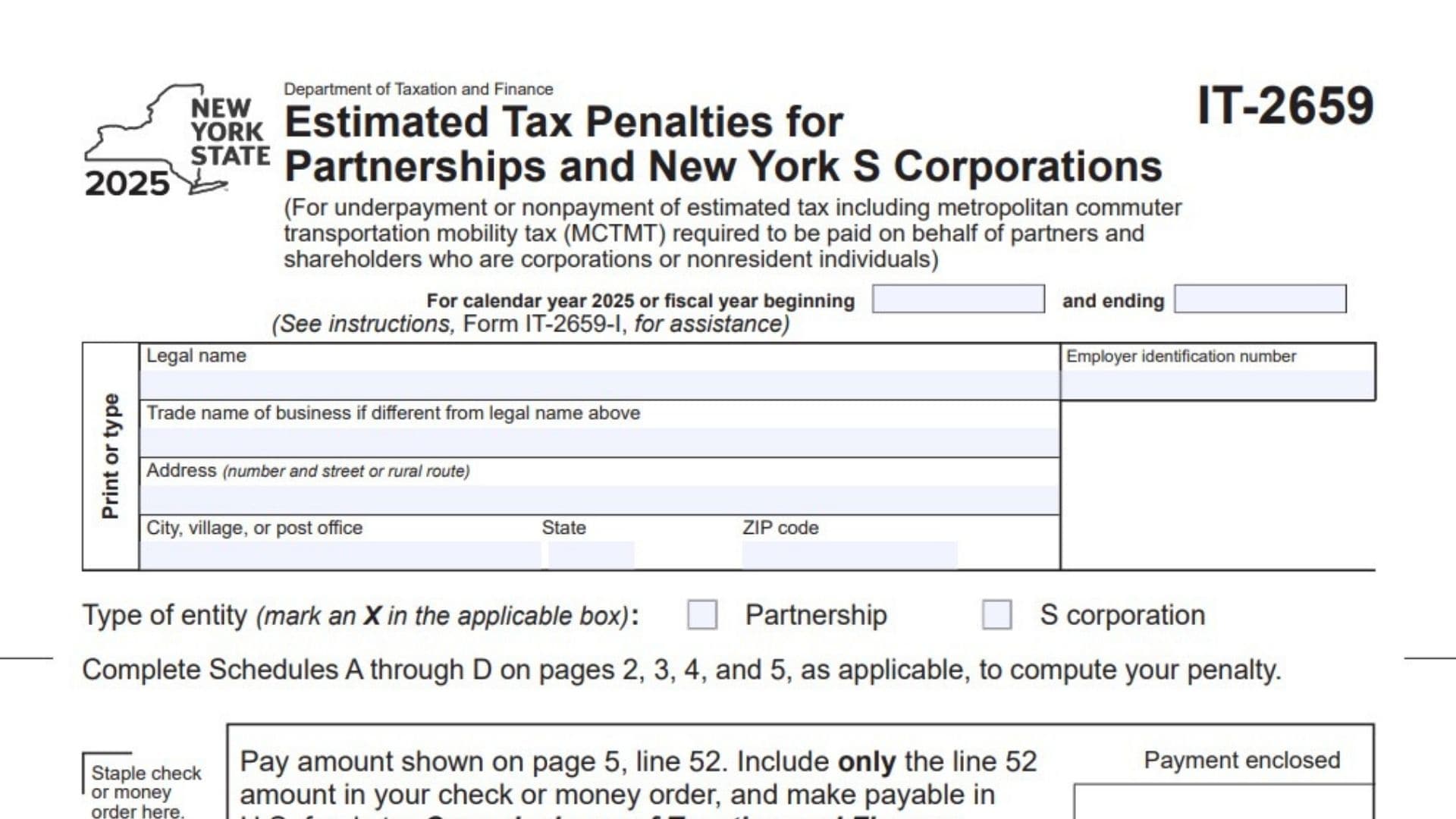
New York Form IT-2659, Estimated Tax Penalties for Partnerships and New York S Corporations, is a tax form used by partnerships and New York S corporations to calculate penalties for underpaying or failing to pay required estimated taxes on behalf of certain partners and shareholders. These estimated tax obligations may include New York State income tax and Metropolitan Commuter Transportation Mobility Tax (MCTMT) payments required for corporate partners and nonresident individual partners or shareholders. The form covers the 2025 calendar tax year or an applicable fiscal year beginning and ending during the specified reporting period. It provides a structured method for calculating the estimated tax obligation for the current year, comparing it with the prior year’s tax information, determining whether estimated payments were insufficient, and calculating any resulting penalty. The form contains four schedules. Schedule A calculates the estimated tax requirement using current-year and prior-year income, deductions, credits, and applicable tax rates. Schedule B provides a simplified penalty calculation for qualifying filers who made four equal estimated tax payments on their required dates or made no estimated tax payments. Schedule C provides the regular method for calculating underpayments and penalties separately for each installment period. Schedule D calculates additional penalties when estimated tax was not paid on behalf of partners or shareholders who are corporations or nonresident individuals. The final penalty amount is reported on Page 5, Line 52, and transferred to the payment section on Page 1. Partnerships and S corporations must provide their identifying information, select the correct entity classification, complete the applicable schedules, certify the return, and submit the required payment. The form must be filed by the later of April 15, 2026, or the applicable due date of the partnership or S corporation tax return for the year, taking into account any extension of time to file. Form IT-2659 must be filed separately and must not be attached to or submitted with another form.
Who Needs to File Form IT-2659?
Form IT-2659 is intended for the following business entities:
- Partnerships: Partnerships that have estimated tax payment responsibilities on behalf of qualifying partners.
- New York S Corporations: S corporations that have estimated tax payment responsibilities on behalf of qualifying shareholders.
The form addresses estimated tax obligations involving:
- Nonresident individual partners or shareholders.
- Corporate partners.
- Certain nonresident individual partners subject to MCTMT.
The form specifically states that only partners and shareholders who are subject to estimated tax being paid on their behalf by the partnership or New York S corporation should be included in the applicable calculations and schedules.
All filers must complete Schedule A, regardless of whether they ultimately owe a penalty.
The instructions for determining individual eligibility and other detailed filing requirements are provided in Form IT-2659-I, Instructions for Form IT-2659.
When Is Form IT-2659 Due?
The completed form must be filed by the later of:
- April 15, 2026.
- The due date of the partnership or S corporation tax return for the applicable year, determined after considering any extension of time to file.
This means that the applicable filing deadline depends on the entity’s tax return due date and whether an extension applies.
Where to Mail Form IT-2659
Mail the completed form and payment to:
NYS TAX DEPARTMENT – IT-2659
PO BOX 15179
ALBANY NY 12212-5179
Important Filing Requirement
Do not attach Form IT-2659 to any other tax form.
It must be submitted separately with the required payment.
Information to Prepare Before Completing Form IT-2659
Gather the following information before starting:
- Legal name of the partnership or S corporation.
- Employer Identification Number (EIN).
- Business trade name, if different from the legal name.
- Complete business mailing address.
- Applicable calendar or fiscal tax year.
- Entity classification.
- Current-year New York-source income information.
- Prior-year New York-source income information.
- Partnership deductions allocated to New York.
- Applicable partnership or S corporation credits.
- Corporate partners’ distributive shares of New York income.
- Self-employment earnings allocated to MCTD Zones 1 and 2.
- Estimated tax payments made during the year.
- Required estimated tax installment amounts.
- Dates when estimated payments were made.
- Names and identification numbers of affected partners or shareholders.
- Number of quarters in which required estimated payments were not made.
- Information needed to calculate applicable penalties.
- Paid preparer’s information, if applicable.
- Authorized person’s signature and contact details.
Having these records available will help you complete the calculations and identify any underpayment penalties accurately.

How to Complete Form IT-2659
Form IT-2659 contains five pages.
- Page 1: Business identification, entity classification, payment, and signature information.
- Page 2: Schedule A – Computation of estimated tax underpayment.
- Page 3: Schedule B and Schedule C, Part 1.
- Page 4: Schedule C, Part 2.
- Page 5: Schedule D and final penalty calculation.
Complete the schedules in the order presented and transfer the final penalty amount to the payment section on Page 1.
Page 1: Business and Taxpayer Information
The first page identifies the partnership or S corporation responsible for filing Form IT-2659.
Tax Year Information
Calendar Year 2025 or Fiscal Year Beginning and Ending
The form is designed for the 2025 calendar year or an applicable fiscal year.
For a calendar-year filer, the reporting period is the 2025 calendar year.
For a fiscal-year filer, enter the beginning and ending dates of the applicable fiscal year in the designated spaces.
Make sure the reporting period agrees with the entity’s tax records.
Legal Name
Enter the complete legal name of the partnership or S corporation filing Form IT-2659.
Use the official business name associated with the entity’s tax registration and EIN.
Do not substitute a shortened business name or trade name for the legal name.
Employer Identification Number (EIN)
Enter the federal Employer Identification Number assigned to the partnership or S corporation.
Verify the number against the entity’s official tax records before submitting the form.
Trade Name of Business
If the business operates under a trade name that differs from its legal name, enter that trade name here.
For example, a partnership may have a registered legal name but conduct business under a different public-facing name.
If the business does not use a different trade name, this field does not require separate trade-name information.
Address (Number and Street or Rural Route)
Enter the complete business mailing address.
Include the building or house number and street name.
If the business uses a rural route address, provide that information instead.
City, Village, or Post Office
Enter the city, village, or post office associated with the business address.
State
Enter the appropriate two-letter postal abbreviation for the state.
ZIP Code
Enter the ZIP code corresponding to the business mailing address.
Verify that the complete address is accurate so that correspondence can reach the business.
Type of Entity
The form requires the filer to identify the type of business entity.
Mark an X in one of the following boxes:
Partnership
Select this option if the entity filing Form IT-2659 is a partnership.
S Corporation
Select this option if the entity filing Form IT-2659 is a New York S corporation.
Select only the classification that applies to the entity.
Schedule Completion Requirement
The form instructs filers to complete Schedules A through D on Pages 2, 3, 4, and 5, as applicable, to calculate the penalty.
Schedule A must be completed by all filers.
The remaining schedules are completed according to the applicable estimated tax payment circumstances.
Payment Section: Payment Enclosed
The payment section appears on Page 1.
It instructs the filer to pay the amount calculated on Page 5, Line 52.
Payment Amount
Enter the total penalty amount reported on Line 52.
Do not use an estimated tax calculation from another line as the payment amount.
Only the Line 52 amount should be included in the check or money order.
Check or Money Order Attachment
Staple the check or money order in the designated area of the form.
The payment must:
- Be made in U.S. funds.
- Be payable to Commissioner of Taxation and Finance.
- Match the amount reported on Page 5, Line 52.
The payment section includes a separate space for the amount enclosed.
Enter the amount accurately, including the cents portion where applicable.
Signature and Paid Preparer Information
The bottom of Page 1 contains the certification and preparer information.
Paid Preparer Section
The form identifies this area with the instruction that the paid preparer must complete it.
Preparer’s Signature
The individual who prepared the return must sign this field.
Preparer’s Date
Enter the date the preparer signs the form.
Preparer’s NYTPRIN
Enter the New York Tax Preparer Registration Identification Number (NYTPRIN) when applicable.
Firm’s Name (or Yours, If Self-Employed)
Enter the name of the tax preparation firm.
If the preparer operates independently, enter the preparer’s business name or applicable individual business identification.
Preparer’s PTIN or SSN
Enter the preparer’s Preparer Tax Identification Number (PTIN) or Social Security number, as applicable.
Address
Enter the complete business address of the preparer or tax preparation firm.
Employer Identification Number
Enter the EIN associated with the tax preparation firm when applicable.
NYTPRIN Exclusion Code
Enter the applicable NYTPRIN exclusion code if the preparer qualifies for an exclusion.
Preparer’s Email
Enter the email address of the individual preparing the return.
Sign Your Return Here
The authorized person representing the partnership or S corporation must complete this section.
Signature of General Partner or Member, Elected Officer, or Authorized Person
The form must be signed by an authorized individual representing the entity.
Depending on the business structure, this may be:
- A general partner.
- A member.
- An elected officer.
- Another authorized person.
The signature certifies the return on behalf of the entity.
Date
Enter the date the authorized person signs the return.
Daytime Phone Number
Provide a telephone number where the authorized person can be contacted during normal business hours.
Include the appropriate area code.
Enter the email address of the authorized person representing the entity.
Make sure the contact information is accurate and current.
Schedule A: Computation of Estimated Tax Underpayment
Schedule A appears on Page 2.
All filers must complete this schedule.
The form instructs filers to include only partners and shareholders who are subject to estimated tax paid on their behalf by the partnership or New York S corporation.
Schedule A contains two main sections:
- Current year – 2025.
- Prior year – 2024.
These calculations establish the estimated tax requirements used in determining whether a penalty applies.
Current Year Calculations: Lines 1–14
Enter the total of all nonresident individual partners’ or shareholders’ distributive or pro rata shares of 2025 income earned from New York sources.
Include the applicable income allocated to these nonresident individuals.
This amount represents the combined New York-source income used in the individual estimated tax calculation.
Line 2: Partnership Deductions Allocated to New York
Enter the total of all nonresident individual partners’ or shareholders’ shares of 2025 partnership deductions allocated to New York.
Use the applicable deductions allocated to New York under the form’s instructions.
Line 3: Income After Allocated Deductions
Subtract Line 2 from Line 1.
Calculation:
Line 1 − Line 2 = Line 3.
Enter the result on Line 3.
This amount is used to calculate the estimated individual tax obligation.
Line 4: Individual Tax Rate
The form provides a preprinted individual tax rate of 10.9%.
Enter or retain the rate shown:
10.9% = 0.109.
This rate is used in the calculation on Line 5.
Line 5: Individual Tax Before Credits
Multiply Line 3 by Line 4.
Calculation:
Line 3 × 0.109 = Line 5.
Enter the result on Line 5.
Enter the total of all nonresident individual partners’ or shareholders’ distributive or pro rata shares of 2025 partnership or S corporation credits.
Include the applicable credits used in determining the estimated tax obligation.
Line 7: Estimated Tax Required for Nonresident Individuals
Subtract Line 6 from Line 5.
Calculation:
Line 5 − Line 6 = Line 7.
Enter the result on Line 7.
This amount represents the 2025 estimated tax required to be paid on behalf of nonresident individuals.
Line 8: Corporate Partners’ New York Income
Enter the total of all corporate partners’ distributive shares of 2025 income earned from New York sources.
Use the combined applicable New York-source income allocated to corporate partners.
Line 9: Corporation Tax Rate
The form provides a corporation tax rate of 7.25%.
Enter or retain the preprinted rate:
7.25% = 0.0725.
Use this rate for the calculation on Line 10.
Line 10: Corporate Tax Before Credits
Multiply Line 8 by Line 9.
Calculation:
Line 8 × 0.0725 = Line 10.
Enter the result on Line 10.
Line 11: Corporate Partners’ Partnership Credits
Enter the total of all corporate partners’ distributive shares of 2025 partnership credits.
Include the applicable partnership credits allocated to the corporate partners.
Line 12: Estimated Tax Required for Corporations
Subtract Line 11 from Line 10.
Calculation:
Line 10 − Line 11 = Line 12.
Enter the result on Line 12.
This amount represents the estimated tax required to be paid on behalf of corporations.
Line 12a: Nonresident Individual Partners’ Self-Employment Earnings in MCTD Zone 1
Enter the total of all nonresident individual partners’ distributive shares of 2025 net earnings from self-employment allocated to the Metropolitan Commuter Transportation District (MCTD) in Zone 1.
Use the applicable Zone 1 earnings information.
Line 12b: MCTMT Zone 1 Rate
The form provides a preprinted Zone 1 MCTMT rate of 0.60%.
Enter or retain:
0.60% = 0.0060.
Line 12c: Estimated MCTMT for Zone 1
Multiply Line 12a by Line 12b.
Calculation:
Line 12a × 0.0060 = Line 12c.
Enter the result on Line 12c.
This amount represents the 2025 estimated MCTMT required to be paid on behalf of nonresident individual partners for Zone 1.
Line 12d: Nonresident Individual Partners’ Self-Employment Earnings in MCTD Zone 2
Enter the total of all nonresident individual partners’ distributive shares of 2025 net earnings from self-employment allocated to the MCTD in Zone 2.
Use the applicable Zone 2 earnings information.
Line 12e: MCTMT Zone 2 Rate
The form provides a preprinted Zone 2 MCTMT rate of 0.34%.
Enter or retain:
0.34% = 0.0034.
Line 12f: Estimated MCTMT for Zone 2
Multiply Line 12d by Line 12e.
Calculation:
Line 12d × 0.0034 = Line 12f.
Enter the result on Line 12f.
This represents the estimated MCTMT required to be paid on behalf of nonresident individual partners for Zone 2.
Line 13: Total Estimated Tax Required for 2025
Add Lines 7, 12, 12c, and 12f.
Calculation:
Line 7 + Line 12 + Line 12c + Line 12f = Line 13.
Enter the combined amount on Line 13.
This amount includes the estimated tax obligations for nonresident individuals, corporations, and applicable MCTMT amounts for both zones.
Line 14: 90% of Estimated Tax Required for 2025
Multiply Line 13 by 90%, or 0.90.
Calculation:
Line 13 × 0.90 = Line 14.
Enter the result on Line 14.
This amount is used in the prior-year comparison and penalty calculation.
Prior Year Calculations: Lines 15–28
The second half of Schedule A calculates estimated tax information using the 2024 tax year.
These amounts are used to establish the prior-year comparison for determining the applicable estimated tax requirement.
Enter the total of all nonresident individual partners’ or shareholders’ distributive or pro rata shares of 2024 income earned from New York sources.
Use the applicable 2024 New York-source income figures.
Line 16: 2024 Partnership Deductions Allocated to New York
Enter the total of all nonresident individual partners’ or shareholders’ shares of 2024 partnership deductions allocated to New York.
Use the applicable deductions allocated to New York.
Line 17: Income After Allocated Deductions
Subtract Line 16 from Line 15.
Calculation:
Line 15 − Line 16 = Line 17.
Enter the result on Line 17.
Line 18: Individual Tax Rate
The form provides an individual tax rate of 10.9%.
Enter or retain:
10.9% = 0.109.
Line 19: Individual Tax Before Credits
Multiply Line 17 by Line 18.
Calculation:
Line 17 × 0.109 = Line 19.
Enter the result on Line 19.
Line 20: 2024 Partnership or S Corporation Credits
Enter the total of all nonresident individual partners’ or shareholders’ distributive or pro rata shares of 2024 partnership or S corporation credits.
Line 21: 2024 Estimated Tax for Individuals
Subtract Line 20 from Line 19.
Calculation:
Line 19 − Line 20 = Line 21.
Enter the result on Line 21.
This amount represents the 2024 estimated tax computed for individuals.
Line 22: Corporate Partners’ 2024 New York Income
Enter the total of all corporate partners’ distributive shares of 2024 income earned from New York sources.
Line 23: Corporation Tax Rate
The form provides a corporate tax rate of 7.25%.
Enter or retain:
7.25% = 0.0725.
Line 24: Corporate Tax Before Credits
Multiply Line 22 by Line 23.
Calculation:
Line 22 × 0.0725 = Line 24.
Enter the result on Line 24.
Line 25: Corporate Partners’ 2024 Partnership Credits
Enter the total of all corporate partners’ distributive shares of 2024 partnership credits.
Line 26: 2024 Estimated Tax for Corporations
Subtract Line 25 from Line 24.
Calculation:
Line 24 − Line 25 = Line 26.
Enter the result on Line 26.
This amount represents the 2024 estimated tax computed for corporations.
Line 26a: Self-Employment Earnings Allocated to MCTD Zone 1
Enter the total of all nonresident individual partners’ distributive shares of 2024 net earnings from self-employment allocated to the MCTD in Zone 1.
Line 26b: MCTMT Zone 1 Rate
Enter or retain the preprinted Zone 1 rate:
0.60% = 0.0060.
Line 26c: 2024 MCTMT for Zone 1
Multiply Line 26a by Line 26b.
Calculation:
Line 26a × 0.0060 = Line 26c.
Enter the result on Line 26c.
Line 26d: Self-Employment Earnings Allocated to MCTD Zone 2
Enter the total of all nonresident individual partners’ distributive shares of 2024 net earnings from self-employment allocated to the MCTD in Zone 2.
Line 26e: MCTMT Zone 2 Rate
Enter or retain the preprinted Zone 2 rate:
0.34% = 0.0034.
Line 26f: 2024 MCTMT for Zone 2
Multiply Line 26d by Line 26e.
Calculation:
Line 26d × 0.0034 = Line 26f.
Enter the result on Line 26f.
Line 27: Total Estimated Tax Computed for 2024
Add Lines 21, 26, 26c, and 26f.
Calculation:
Line 21 + Line 26 + Line 26c + Line 26f = Line 27.
Enter the result on Line 27.
Follow the form’s instructions when determining the applicable amount.
Line 28: 110% of Prior-Year Estimated Tax
Multiply Line 27 by 110%, or 1.10.
Calculation:
Line 27 × 1.10 = Line 28.
Enter the result on Line 28.
This amount is used when determining the applicable required estimated tax under the short method on Schedule B.
Page 3: Schedule B – Short Method for Computing the Penalty
Schedule B provides a simplified method for calculating the estimated tax underpayment penalty.
The form instructs filers to complete Lines 29 through 34 if either of the following conditions applies:
- The entity paid four equal estimated tax installments on the required due dates.
- The entity made no estimated tax payments.
If neither condition applies, the entity must complete Schedule C instead.
Line 29: Required Estimated Tax Amount
The amount entered on Line 29 depends on whether an amount was required on Line 28.
If you were not required to make an entry on Line 28, enter the smaller of Line 14 or Line 27.
If you were required to make an entry on Line 28, enter the smaller of Line 14 or Line 28.
Compare the applicable amounts and enter the lesser figure on Line 29.
Line 30: Total Estimated Tax Payments Made for 2025
Enter the total amount of estimated tax payments made for the 2025 tax year.
Include the applicable estimated payments made during the year.
Use the payment records to determine the total amount.
Line 31: Total Underpayment for the Year
Subtract Line 30 from Line 29.
Calculation:
Line 29 − Line 30 = Line 31.
Enter the result on Line 31.
If the result is zero or less, the form states that no underpayment penalty is owed under this calculation.
Line 32: Initial Penalty Calculation
Multiply Line 31 by 0.06313.
Calculation:
Line 31 × 0.06313 = Line 32.
Enter the result on Line 32.
This line calculates the initial penalty amount using the factor printed on the form.
Line 33: Adjustment for Payment Made Before April 15, 2026
This line adjusts the penalty calculation based on when the underpayment amount was paid.
If the Line 31 amount was paid on or after April 15, 2026, enter zero.
If the amount was paid before April 15, 2026, calculate the adjustment using:
Line 31 × Number of days before April 15, 2026 × 0.00026.
Enter the resulting amount on Line 33.
Use the applicable number of days based on the payment date.
Line 34: Final Penalty Under the Short Method
Subtract Line 33 from Line 32.
Calculation:
Line 32 − Line 33 = Line 34.
Enter the result on Line 34.
Transfer this amount to Schedule D, Line 51, on Page 5.
Schedule C: Regular Method for Computing the Penalty
Schedule C appears on Pages 3 and 4.
It must be completed when the entity does not qualify to use the short method under Schedule B.
Schedule C calculates underpayment separately for each estimated tax installment period and then determines the applicable penalty.
It contains two parts:
- Part 1: Computing the underpayment.
- Part 2: Computing the penalty.
Schedule C, Part 1: Computing the Underpayment
The form provides four payment periods with the following due dates:
| Column | Payment due date |
|---|---|
| A | April 15, 2025 |
| B | June 15, 2025 |
| C | September 15, 2025 |
| D | January 15, 2026 |
Complete the calculations separately for each column.
Line 35: Required Installments
Enter the required estimated tax installment amount for each payment period.
The form provides four separate columns corresponding to the installment due dates.
Use the applicable required installment amounts determined under the instructions.
Line 36: Estimated Tax Paid
Enter the estimated tax payments made for each installment period.
Report the amount paid in the corresponding column.
Use the actual payment records to identify the applicable amounts and periods.
Line 37: Overpayment or Underpayment From Prior Period
Enter the overpayment or underpayment carried forward from the preceding installment period.
Complete the applicable columns beginning with the second installment period.
This line reflects the remaining overpayment or underpayment from the previous period.
Line 38: Adjusted Amount Available for the Current Period
The calculation depends on whether Line 37 shows an overpayment or underpayment.
If Line 37 shows an overpayment, add Lines 36 and 37.
Calculation:
Line 36 + Line 37 = Line 38.
If Line 37 shows an underpayment, subtract Line 37 from Line 36.
Calculation:
Line 36 − Line 37 = Line 38.
Follow the instructions for the applicable situation and enter the result in the corresponding column.
Line 39: Underpayment or Overpayment
Compare Line 38 with Line 35.
If the required installment on Line 35 is greater than Line 38, subtract Line 38 from Line 35.
Calculation:
Line 35 − Line 38 = Underpayment.
If Line 38 is greater than Line 35, subtract Line 35 from Line 38.
Calculation:
Line 38 − Line 35 = Overpayment.
Enter the applicable result in the corresponding column.
Complete Lines 37 through 39 one column at a time, starting with Column A.
Schedule C, Part 2: Computing the Penalty
Part 2 appears on Page 4.
It uses the underpayment amounts calculated on Line 39 to determine the penalty for each installment period.
The form applies an annual penalty rate of 9.5% in the printed calculations.
Line 40: Amount of Underpayment
Transfer the underpayment amount from Line 39 into the corresponding column.
Enter the amounts separately for Columns A, B, C, and D.
Each amount will be used to calculate the penalty for its respective installment period.
First Installment Penalty Period
The first penalty period runs from April 15, 2025, through June 15, 2025.
Line 41: First Installment Penalty Rate
The form provides the following standard calculation:
April 15 – June 15 = 61 days.
Calculation:
(61 ÷ 365) × 9.5% = 0.01587.
Use the printed factor of 0.01587 when the full standard penalty period applies.
The form also provides an alternative calculation area for entering a different ending date and the applicable number of days.
Use that alternative calculation when the applicable period is shorter.
Line 42: First Installment Penalty
Multiply Line 40, Column A, by Line 41.
Calculation:
Line 40, Column A × Line 41 = Line 42.
Enter the result on Line 42.
Second Installment Penalty Period
The second penalty period runs from June 15, 2025, through September 15, 2025.
Line 43: Second Installment Penalty Rate
The standard period is 92 days.
Calculation:
(92 ÷ 365) × 9.5% = 0.02394.
Use the printed factor of 0.02394 when the full period applies.
The form also provides an alternative calculation area for an adjusted ending date and number of days.
Line 44: Second Installment Penalty
Multiply Line 40, Column B, by Line 43.
Calculation:
Line 40, Column B × Line 43 = Line 44.
Enter the result on Line 44.
Third Installment Penalty Period
The third penalty period runs from September 15, 2025, through January 15, 2026.
Because this period crosses the end of the calendar year, the form divides the calculation into two parts.
Line 45: Third Installment Penalty Rate
The form provides the following calculation for the first part:
September 15 through December 31, 2025:
107 days.
Calculation:
(107 ÷ 365) × 9.5% = 0.02784.
The second part covers January 1 through January 15, 2026:
15 days.
Calculation:
(15 ÷ 365) × 9.5% = 0.00389.
Add both amounts:
0.02784 + 0.00389 = 0.03173.
The standard total factor is 0.03173.
The form also provides separate alternative calculation spaces for the two periods when an adjusted ending date applies.
Enter the applicable number of days and calculated amounts, then add them to determine the total factor for Line 45.
Line 46: Third Installment Penalty
Multiply Line 40, Column C, by Line 45.
Calculation:
Line 40, Column C × Line 45 = Line 46.
Enter the result on Line 46.
Fourth Installment Penalty Period
The fourth penalty period runs from January 15, 2026, through April 15, 2026.
Line 47: Fourth Installment Penalty Rate
The standard period is 90 days.
Calculation:
(90 ÷ 365) × 9.5% = 0.02341.
Use the printed factor of 0.02341 when the full period applies.
The form also provides an alternative calculation area for a different ending date and the applicable number of days.
Line 48: Fourth Installment Penalty
Multiply Line 40, Column D, by Line 47.
Calculation:
Line 40, Column D × Line 47 = Line 48.
Enter the result on Line 48.
Line 49: Total Penalty Under the Regular Method
Add the penalty amounts from Lines 42, 44, 46, and 48.
Calculation:
Line 42 + Line 44 + Line 46 + Line 48 = Line 49.
Enter the total on Line 49.
This represents the penalty calculated using the regular method for the four installment periods.
Transfer this amount to the final penalty calculation on Page 5.
Schedule D calculates penalties when a partnership or New York S corporation fails to pay required estimated tax on behalf of partners or shareholders who are corporations or nonresident individuals.
Only include partners and shareholders who are subject to estimated tax being paid on their behalf by the partnership or New York S corporation.
The schedule provides six columns for reporting information about each affected partner or shareholder.
If you need to list more than six partners or shareholders, attach additional sheets using the same six-column format.
Include all Column F totals from the additional sheets in the designated space on Page 5.
Enter the full name of each partner or shareholder for whom required estimated tax was not paid.
Use the name that corresponds to the individual’s or entity’s tax identification information.
Enter each affected partner or shareholder on a separate row.
Column B: Identifying Number (EIN/SSN)
Enter the appropriate identification number for each partner or shareholder.
Use:
- SSN for an individual.
- EIN for a corporation.
Make sure the identification number corresponds to the person or entity listed in Column A.
Column C: Number of New York State Quarters Estimated Tax Was Not Paid
Enter the number of quarters, from 1 through 4, in which the required New York State estimated tax was not paid for the listed partner or shareholder.
Use the applicable number of quarters for each person or entity.
Column D: Number of MCTMT Quarters Estimated Tax Was Not Paid
Enter the number of quarters, from 1 through 4, in which the required MCTMT estimated tax was not paid.
This column applies to the applicable MCTMT estimated tax obligation.
Report the number of unpaid quarters for each affected partner or shareholder.
Column E: Total of Columns C and D
Add the number of unpaid New York State quarters in Column C and the number of unpaid MCTMT quarters in Column D.
Calculation:
Column C + Column D = Column E.
Enter the combined number on Column E.
Column F: Penalty Calculation
Multiply the amount in Column E by $50.
Calculation:
Column E × $50 = Column F.
Enter the resulting penalty amount in Column F.
Repeat this process for each applicable partner or shareholder.
Column F Total From Attached Sheets
If additional sheets are attached because more than six partners or shareholders are being reported, enter the combined Column F totals from those sheets in the designated space.
Make sure the additional-sheet totals are included in the overall penalty calculation.
Line 50: Penalty From Schedule D
Enter the total of Column F.
Calculation:
Total of Column F amounts = Line 50.
Include the applicable totals from additional sheets.
This amount represents the penalty calculated under Schedule D.
Line 51: Penalty From Schedule B
Transfer the penalty amount from Schedule B, Line 34, to Line 51.
If Schedule B does not apply and Schedule C was used instead, follow the applicable instructions for completing the final penalty calculation.
Line 52: Total Penalty
Add Lines 49, 50, and 51, as applicable.
Calculation:
Line 49 + Line 50 + Line 51 = Line 52.
Enter the total on Line 52.
This is the final penalty amount calculated on Form IT-2659.
Transfer the Line 52 amount to the Payment Enclosed section on Page 1.
Use this amount when preparing the check or money order.
Important Tax Rates and Calculation Factors on Form IT-2659
The form includes several preprinted tax rates and penalty calculation factors.
The following table summarizes the rates appearing on the 2025 form.
| Calculation | Rate or factor |
|---|---|
| Individual tax rate | 10.90% |
| Corporation tax rate | 7.25% |
| MCTMT Zone 1 rate | 0.60% |
| MCTMT Zone 2 rate | 0.34% |
| Prior-year comparison multiplier | 110% |
| Current-year comparison multiplier | 90% |
| Regular-method annual penalty rate | 9.5% |
| Short-method factor | 0.06313 |
| Short-method payment adjustment factor | 0.00026 |
| Schedule D penalty per unpaid quarter | $50 |
Use the applicable rates and factors shown on the form when performing the corresponding calculations.
Do not substitute a rate from a different tax year or a different tax calculation.
Important Filing Instructions for Form IT-2659
Before submitting Form IT-2659, keep the following requirements in mind.
1. All Filers Must Complete Schedule A
Schedule A is mandatory for every filer.
It calculates the current-year and prior-year estimated tax amounts used in determining the applicable underpayment penalty.
2. Choose the Correct Penalty Calculation Method
Schedule B is available when the entity paid four equal estimated tax installments on their required dates or made no estimated tax payments.
Otherwise, complete Schedule C using the regular method.
3. Complete Schedule D When Applicable
Schedule D addresses failures to pay required estimated tax on behalf of qualifying corporate partners and nonresident individual partners or shareholders.
Include the applicable unpaid New York State and MCTMT quarters.
4. Attach Additional Sheets When Necessary
If more than six partners or shareholders must be listed on Schedule D, attach additional sheets using the same six-column format.
Include all additional Column F totals in the designated space on Page 5.
5. Use Line 52 for the Payment Amount
The amount payable is the final penalty shown on Page 5, Line 52.
Do not include amounts from other calculation lines in the payment amount.
6. Make the Check or Money Order Payable to the Correct Recipient
The payment must be made in U.S. funds and payable to:
Commissioner of Taxation and Finance.
7. File by the Applicable Deadline
File Form IT-2659 by the later of April 15, 2026, or the partnership or S corporation tax return due date for the year, taking any filing extension into account.
8. Submit the Form Separately
Do not attach Form IT-2659 to any other form.
Mail the completed form and payment to the address provided on Page 1.
Final Review Checklist Before Submitting Form IT-2659
Use this checklist to review the entire form before filing.
Page 1: Business Information
- Legal business name is entered correctly.
- EIN is accurate.
- Trade name is entered if different from the legal name.
- Complete business address is provided.
- City, state, and ZIP code are correct.
- Calendar or fiscal year information is completed.
- Partnership or S corporation classification is selected.
- Payment amount agrees with Page 5, Line 52.
Schedule A: Estimated Tax Underpayment
- Line 1 includes applicable 2025 New York-source income.
- Line 2 includes applicable 2025 deductions allocated to New York.
- Line 3 correctly subtracts Line 2 from Line 1.
- Line 4 uses the 10.9% individual tax rate.
- Line 5 is calculated correctly.
- Line 6 includes applicable individual partner or shareholder credits.
- Line 7 is calculated correctly.
- Line 8 includes corporate partners’ New York-source income.
- Line 9 uses the 7.25% corporation tax rate.
- Line 10 is calculated correctly.
- Line 11 includes applicable corporate partnership credits.
- Line 12 is calculated correctly.
- Lines 12a–12c contain the applicable Zone 1 MCTMT calculation.
- Lines 12d–12f contain the applicable Zone 2 MCTMT calculation.
- Line 13 includes all applicable current-year estimated tax amounts.
- Line 14 correctly calculates 90% of Line 13.
- Lines 15–27 contain the applicable prior-year information and calculations.
- Line 28 correctly calculates 110% of Line 27.
Schedule B: Short Method
- The entity qualifies to use the short method.
- Line 29 contains the applicable lesser amount.
- Line 30 includes total estimated tax payments made.
- Line 31 correctly calculates the underpayment.
- Line 32 is calculated using 0.06313.
- Line 33 includes the applicable payment-date adjustment.
- Line 34 contains the final short-method penalty.
Schedule C: Regular Method
- Line 35 contains the required installments.
- Line 36 includes estimated tax payments.
- Lines 37–39 are completed for the applicable installment periods.
- Line 40 agrees with the underpayment amounts from Line 39.
- Line 41 uses the correct first-period penalty factor.
- Line 42 is calculated correctly.
- Line 43 uses the correct second-period penalty factor.
- Line 44 is calculated correctly.
- Line 45 includes both applicable third-period calculations.
- Line 46 is calculated correctly.
- Line 47 uses the correct fourth-period penalty factor.
- Line 48 is calculated correctly.
- Line 49 contains the total regular-method penalty.
- All applicable partners and shareholders are listed.
- Each name is entered correctly.
- Each SSN or EIN is accurate.
- Column C contains the applicable unpaid New York State quarters.
- Column D contains the applicable unpaid MCTMT quarters.
- Column E correctly adds Columns C and D.
- Column F correctly multiplies Column E by $50.
- Additional sheets are attached if more than six partners or shareholders are listed.
- Additional Column F totals are included.
- Line 50 contains the total Schedule D penalty.
Final Penalty Calculation
- Line 51 includes the applicable penalty from Line 34.
- Line 52 correctly adds Lines 49, 50, and 51, as applicable.
- The Line 52 amount agrees with the payment amount on Page 1.
Signature and Payment
- The paid preparer section is completed when applicable.
- The authorized person’s signature is provided.
- The signature date is entered.
- The daytime telephone number is provided.
- The authorized person’s email address is entered.
- The check or money order is made payable to Commissioner of Taxation and Finance.
- Payment is made in U.S. funds.
- The payment amount agrees with Line 52.
- The form and payment are mailed to the correct address.
- The filing deadline has been checked.
- Form IT-2659 is submitted separately and is not attached to another form.
Conclusion
New York Form IT-2659 is used by partnerships and New York S corporations to calculate estimated tax underpayment penalties involving qualifying partners and shareholders. Completing the form requires accurate business information, current-year and prior-year tax figures, applicable credits, MCTMT calculations, estimated payment records, and partner or shareholder information. Schedule A establishes the estimated tax amounts, Schedule B or Schedule C determines the applicable underpayment penalty, and Schedule D calculates additional penalties for certain unpaid estimated tax obligations. The final penalty is reported on Line 52 and transferred to the payment section on Page 1. Before filing, review every applicable schedule, verify the calculations, obtain the required signature, and submit the form with the correct payment by the applicable deadline. For detailed eligibility rules and calculations not explained on the form itself, consult the official Instructions for Form IT-2659-I.