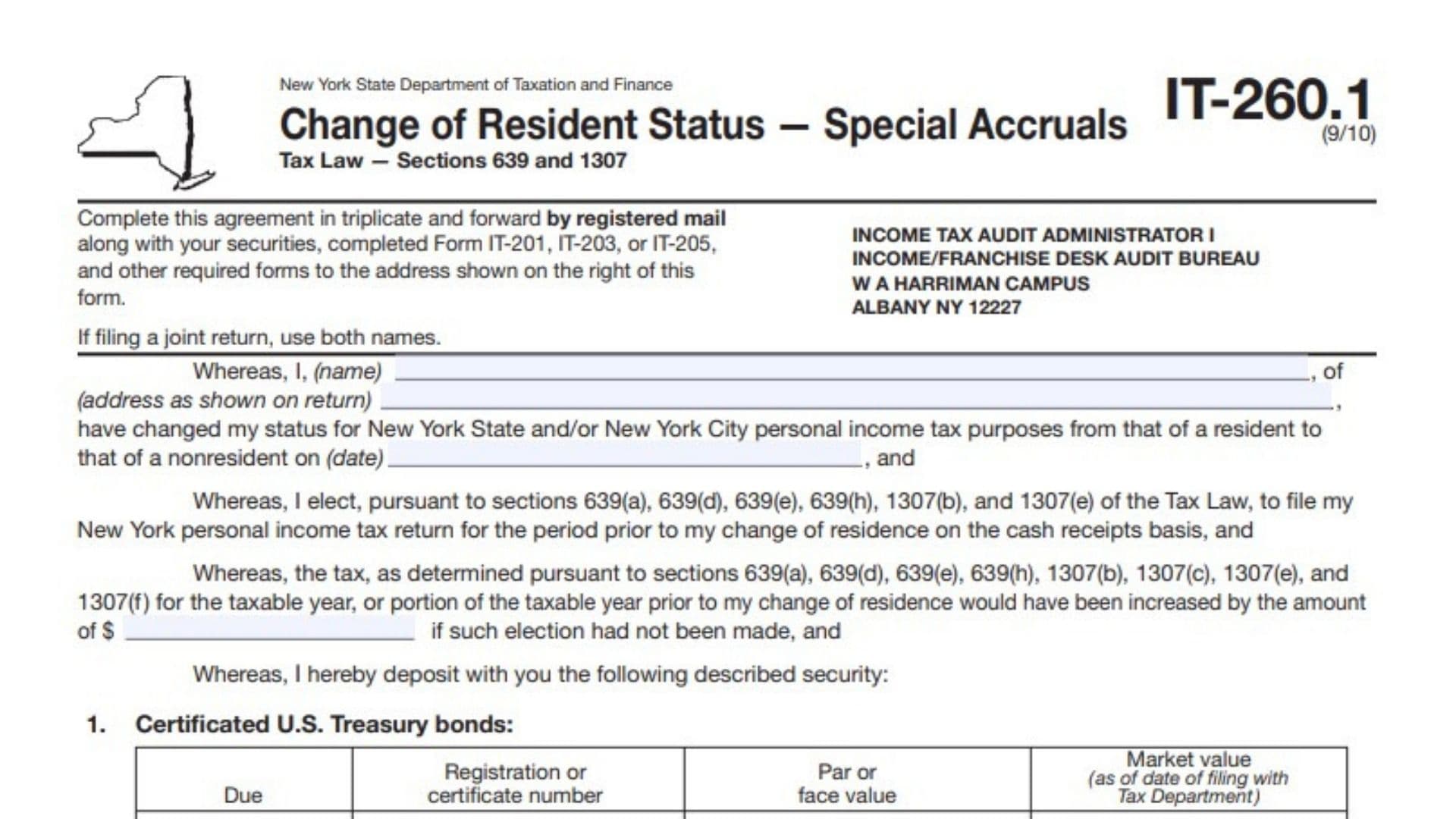
New York Form IT-260.1, officially titled Change of Resident Status – Special Accruals, is an agreement issued by the New York State Department of Taxation and Finance under Sections 639 and 1307 of the New York Tax Law. It is used by individuals who change their residency status from New York State residents to nonresidents and elect to report certain income and gains on the cash receipts basis rather than recognizing them before the change of residence.
When an individual changes from being a New York resident to a nonresident, certain income and gains accrued before the residency change may be subject to special tax treatment. Under the special accrual rules, certain income that has accrued before the individual becomes a nonresident may need to be recognized in the tax year of the residency change. Form IT-260.1 provides a mechanism for eligible taxpayers to elect to report qualifying income and gains when they are actually received, rather than including them in the taxable period before the residency change.
This election is not simply a change in the taxpayer’s filing status. It involves an agreement with the New York State Department of Taxation and Finance under which the taxpayer agrees to report qualifying accrued income and gains in subsequent New York personal income tax returns. In exchange, the taxpayer deposits acceptable security to protect the state’s interest in collecting the deferred tax.
The form collects the taxpayer’s name, address, date of residency change, and information about the tax that would have been increased if the special election had not been made. It also requires detailed information about the security being deposited. Acceptable security categories identified on the form include certificated U.S. Treasury bonds, New York State bonds or bonds issued by political subdivisions, bank passbooks or certificates of deposit, and irrevocable standby letters of credit. The form also includes a section for Form W-2G documentation showing New York State tax withholding on lottery payments.
A significant part of Form IT-260.1 is the taxpayer’s agreement concerning future reporting obligations. The taxpayer agrees to include income and gains accrued before changing residency in subsequent New York personal income tax returns when those amounts are received. The agreement also addresses the extension of the period during which the state may assess tax, the consequences of failing to report deferred income, and the department’s authority to dispose of deposited security if the security becomes inadequate or the taxpayer fails to meet the agreement’s requirements.
The application must be completed in triplicate and forwarded by registered mail along with the securities, the completed Form IT-201, IT-203, or IT-205, and other required forms. The destination is the Income Tax Audit Administrator I, Income/Franchise Desk Audit Bureau, W. A. Harriman Campus, Albany, New York 12227.
Form IT-260.1 is therefore an agreement supporting a special tax election rather than an ordinary standalone income tax return. Completing it accurately is important because it establishes the taxpayer’s obligations concerning deferred income, deposited security, future tax reporting, and the state’s rights to collect tax if the agreement is not followed.
How To File New York Form IT-260.1
New York Form IT-260.1 must be completed in triplicate and submitted by registered mail to the New York State Department of Taxation and Finance.
The form specifically requires taxpayers to forward the agreement together with their securities, completed income tax return, and other required forms.
Where To Mail Form IT-260.1
Send the completed agreement to:
Income Tax Audit Administrator I
Income/Franchise Desk Audit Bureau
W. A. Harriman Campus
Albany, NY 12227
The application instructions specify registered mail.
Tax Returns And Documents To Include
The form identifies the following documents and materials for submission:
- Three completed copies of Form IT-260.1.
- The securities being deposited as collateral.
- Completed New York Form IT-201, IT-203, or IT-205, as applicable.
- Required supporting forms.
- Applicable security assignment documents.
- Bank or financial institution confirmation letters, where applicable.
- An irrevocable standby letter of credit, where applicable.
- Federal Form W-2G, where applicable.
- Other supporting documentation required for the agreement.
Information To Prepare Before Completing Form IT-260.1
Gather the following information:
- Taxpayer’s full legal name.
- Spouse’s name, if filing jointly.
- Mailing address as shown on the income tax return.
- Date the taxpayer changed residency from New York resident to nonresident.
- Amount by which the tax would have increased if the special election had not been made.
- Details of U.S. Treasury bonds, if used as security.
- Registration or certificate numbers for Treasury securities.
- Par or face value of securities.
- Market value of securities as of the filing date.
- Details of New York State bonds or political subdivision bonds, if applicable.
- Bank or financial institution details, if using passbooks or certificates of deposit.
- Account numbers and deposit amounts.
- Certificate of deposit maturity dates.
- Bank confirmation letter.
- Standby letter of credit details, if applicable.
- Issuing or confirming bank information.
- Credit amount and expiration date.
- Federal Form W-2G, if applicable.
- Taxpayer signature and date.
- Spouse’s signature for a joint return.
Important Filing Considerations
Complete The Agreement In Triplicate
The form expressly requires three completed copies.
Use Registered Mail
The application must be forwarded by registered mail to the designated department address.
Include The Applicable Tax Return
Submit the completed Form IT-201, IT-203, or IT-205, depending on the taxpayer’s filing circumstances.
Provide Acceptable Security
The agreement requires the taxpayer to deposit the applicable security described in the form.
Use Both Names For Joint Returns
If filing a joint return, include both taxpayer and spouse names in the agreement.
Understand The Special Accrual Election
The taxpayer agrees to report qualifying accrued income and gains in subsequent New York personal income tax returns when received.
Original Scannable Form
The form instructs taxpayers to file the original scannable form with the Tax Department.

How To Complete New York Form IT-260.1
Form IT-260.1 contains two pages. The first page establishes the change in residency, records the special accrual election, and identifies the security being deposited. The second page contains additional security information, the taxpayer’s legal agreement, and signature fields.
Complete the sections in the order presented.
Taxpayer Identification And Change Of Residency Information
The opening section establishes the taxpayer’s identity and the date on which the individual changed from New York resident to nonresident status.
Taxpayer Name
Enter the taxpayer’s full legal name.
Use the name shown on the applicable New York income tax return.
If filing a joint return, include both spouses’ names as instructed.
Address As Shown On Return
Enter the taxpayer’s mailing address exactly as it appears on the applicable income tax return.
Include the street address, apartment or unit number, city, state, and ZIP code as applicable.
The address should correspond to the return being submitted with the agreement.
Date Of Change In Residency
Enter the date on which the taxpayer changed residency status from a New York State resident to a nonresident.
Use the actual date the taxpayer’s residency status changed for New York State and/or New York City personal income tax purposes.
This date is important because it establishes the point before which the income and gains covered by the special accrual agreement may have accrued.
Special Accrual Election
The agreement contains a declaration that the taxpayer elects, under the specified provisions of Sections 639 and 1307 of the New York Tax Law, to file the New York personal income tax return for the period before the residency change using the cash receipts basis.
This is an election statement rather than a separate numerical entry.
By proceeding with the agreement, the taxpayer accepts the reporting treatment described in the form.
Amount Of Tax Increase Without The Election
Enter the amount by which the tax for the taxable year, or the portion of the taxable year before the residency change, would have increased if the special election had not been made.
Use the amount determined under the applicable special accrual tax calculation.
Enter the dollar amount in the space provided.
This figure identifies the tax impact associated with making the election.
Security Deposit
The security section identifies the property or financial instrument being deposited with the New York State Department of Taxation and Finance to secure the tax deferred under the agreement.
The form provides five security categories.
Taxpayers should complete the section corresponding to the type of security being offered.
1. Certificated U.S. Treasury Bonds
This section is used when the taxpayer deposits certificated U.S. Treasury bonds as security.
The form provides a table with four columns.
Due
Enter the maturity or due date of the U.S. Treasury bond.
Use the date shown on the security documentation.
Registration Or Certificate Number
Enter the registration number or certificate number identifying the Treasury bond.
Verify the number against the original security certificate.
Par Or Face Value
Enter the bond’s par or face value.
This is the stated principal value of the bond, rather than its current market value.
Market Value
Enter the market value of the Treasury bond as of the date it is filed with the Tax Department.
Use the applicable market valuation for the filing date.
Required Supporting Document
U.S. Treasury Form PDF 1832
The form requires a properly completed U.S. Treasury Form PDF 1832, titled Special Form of Assignment for U.S. Registered Definitive Securities.
This assignment document must be attached to the agreement.
It assigns the described securities to the New York State Department of Taxation and Finance.
Ensure that the assignment documentation corresponds to the Treasury securities listed in the table.
2. Certificated New York State Bonds Or Bonds Of Any Political Subdivision Thereof
This section is used when the taxpayer offers certificated New York State bonds or bonds issued by a political subdivision of New York State as security.
The table contains five columns.
Description
Enter the description of the bond being deposited.
Identify the security clearly enough to distinguish it from other bonds.
Due
Enter the bond’s maturity or due date.
Use the information shown on the bond certificate.
Registration Or Certificate Number
Enter the registration number or certificate number associated with the bond.
Verify the number against the security documentation.
Par Or Face Value
Enter the bond’s stated principal or face value.
Use the amount shown on the bond documentation.
Market Value
Enter the market value of the bond as of the date it is filed with the Tax Department.
Use the applicable market valuation rather than automatically entering the par value.
Required Supporting Document
New York State Form AU-217
The form requires a properly completed New York State Form AU-217, titled Assignment Separate from Bond.
Attach this document to the agreement.
The assignment must transfer the identified securities to the New York State Department of Taxation and Finance.
Make sure the bond details and assignment information match.
3. Bank Passbooks And/Or Certificates Of Deposit
This section is used when the taxpayer deposits bank passbooks or certificates of deposit as security.
The table contains three columns.
Bank/Financial Institution
Enter the name of the bank or financial institution holding the passbook or certificate of deposit.
Use the institution’s official name.
Amount
Enter the amount deposited or represented by the applicable passbook or certificate of deposit.
Ensure that the amount corresponds to the supporting financial documentation.
Maturity Date
If the security is a certificate of deposit, enter its maturity date.
Use the maturity date provided by the financial institution.
Required Supporting Document
Bank Or Financial Institution Confirmation Letter
The form requires a letter prepared on the bank’s or financial institution’s official letterhead and signed by one of its officers.
The letter must contain two important confirmations.
Account Identification And Withdrawal Restriction
The financial institution must identify the passbooks or certificates of deposit by account number.
It must also confirm that the principal cannot be withdrawn without written consent from the New York State Department of Taxation and Finance.
This condition ensures that the deposited funds remain available as security.
Subordination Of The Bank’s Right Of Set-Off
The financial institution must state that any right of set-off it may have against the taxpayer because of a defaulted obligation will be subordinate to the department’s interest in the deposited passbook or certificate of deposit.
This confirms that the department’s interest in the security takes priority over the bank’s applicable set-off rights.
Attach the signed bank confirmation letter to the agreement.
4. Standby Letter Of Credit
This section is used when the taxpayer provides a standby letter of credit as security.
The form contains three columns.
Issuer Or Confirming Bank
Enter the name of the bank or financial institution issuing or confirming the standby letter of credit.
Use the official institution name appearing on the document.
Amount
Enter the amount of the standby letter of credit.
Ensure that the amount matches the issued credit document.
Expiration Date
Enter the expiration date of the standby letter of credit.
Use the date specified in the instrument.
Required Supporting Document
Irrevocable Standby Letter Of Credit
Attach the irrevocable standby letter of credit made payable to the New York State Department of Taxation and Finance.
The document must identify the department as the beneficiary.
Ensure that the attached instrument corresponds to the issuer, amount, and expiration date entered in the table.
5. Form W-2G: Certain Gambling Winnings
This section addresses lottery payments for which New York State income tax has been withheld.
Federal Form W-2G
Attach a copy of the completed federal Form W-2G, titled Certain Gambling Winnings.
The form must show that New York State taxes were withheld on the lottery payments.
Use the applicable W-2G documentation supporting the withholding information.
This section does not contain a separate numerical calculation. Its purpose is to identify the required supporting document.
Taxpayer Agreement And Legal Obligations
The second page contains the taxpayer’s agreement concerning the reporting of deferred income, payment of tax, maintenance of security, and the department’s rights if the agreement is not followed.
Read this section carefully before signing because it establishes important legal obligations.
1. Reporting Accrued Income And Gains In Future Tax Years
The taxpayer agrees to include income and gains accrued before the residency change in subsequent New York personal income tax returns.
The income or gain must be reported when actually received, as though the taxpayer had not changed residency status.
The taxpayer also agrees to pay the tax due on those amounts when required.
This provision establishes the continuing reporting responsibility associated with the special accrual election.
2. Extension Of The Tax Assessment Period
The agreement provides for an extension of the period during which the New York State Department of Taxation and Finance may assess tax.
It refers to Tax Law Section 683 and the applicable provisions governing the assessment limitation period.
The taxpayer agrees that the tax due may be assessed for a taxable year or period at any time within three years after the return for the last taxable year during which the previously accrued income or gain is actually received has been filed.
This provision extends the department’s assessment period in connection with the deferred income covered by the agreement.
3. Failure To Report Income Or Maintain Adequate Security
The agreement explains what happens if the department determines that the taxpayer has failed to meet the requirements.
Two circumstances are specifically identified.
Failure To Report Deferred Income Or Pay The Required Tax
If the department determines that the taxpayer has omitted an item of income or gain required to be reported under the agreement, or has failed to pay the applicable tax, the full amount of income that can be accrued under the specified Tax Law provisions must be accrued to the portion of the taxable year before the residency change.
The additional tax for that period is then recomputed and becomes immediately due.
Inadequate Security
The agreement also applies if the department determines that the security deposited with the application has become or will become inadequate to secure payment of the deferred tax.
In that situation, the taxpayer must replace the security with adequate security acceptable to the department.
30-Day Compliance Period
The agreement establishes a 30-day period following the mailing of notice by ordinary mail.
The taxpayer must comply with the applicable requirement within this period.
- If the issue concerns omitted income or unpaid tax, the amount due must be paid within 30 days after the notice is mailed.
- If the issue concerns inadequate security, acceptable replacement security must be provided within 30 days after the notice is mailed.
Department’s Authority To Dispose Of Security
If the taxpayer fails to pay the tax within the specified period or does not replace inadequate security, the New York State Department of Taxation and Finance may sell, assign, transfer, withdraw, or otherwise dispose of the deposited security.
The proceeds may be applied toward:
- Unpaid tax deferred under the election.
- Applicable interest.
- Applicable penalties.
If any balance remains after these obligations are satisfied, the remaining proceeds must be paid to the taxpayer.
Conditions Governing The Return Of Deposited Security
The agreement also explains the conditions under which the taxpayer may receive the deposited security back.
Return Of Security
If the department does not dispose of the security under the agreement, it will be returned when the department determines that it is no longer needed to secure the deferred tax.
This may occur after the deferred tax has been paid in full or partially paid to an extent that the department considers the security no longer necessary.
Interest Earned On Security
Any interest accruing on the deposited security belongs to the taxpayer.
This provision applies to the security deposited under the agreement.
Bond Coupons
For certificated bonds in coupon form, the coupons will be detached and forwarded to the taxpayer as they become due.
This ensures that the taxpayer receives the applicable bond coupon payments according to the agreement.
Signature Section
The final section of Form IT-260.1 contains the taxpayer’s signature and date fields, together with a separate signature field for a spouse when filing jointly.
Signature Of Taxpayer
The taxpayer must sign the agreement.
The signature confirms acceptance of the terms and conditions described in the document, including the obligation to report deferred income and maintain the required security.
Date
Enter the date the taxpayer signs the agreement.
Use the designated date field.
Spouse’s Signature (If Joint Return)
If the taxpayer is filing a joint return, the spouse must also sign the agreement in the designated field.
The form specifically identifies this signature as applicable to joint returns.
Ensure that both required signatures are present before submitting the agreement.
Final Review Before Filing
Before sending New York Form IT-260.1, review both pages and confirm that the taxpayer information, special accrual election, security details, supporting documents, legal agreement, and signatures are complete.
Use the following checklist to conduct a final review.
Taxpayer Information And Residency Change
- Enter the taxpayer’s full legal name.
- Include both names if filing jointly.
- Enter the address exactly as shown on the income tax return.
- Verify the date of the change from resident to nonresident status.
- Review the special accrual election statement.
- Enter the amount by which tax would have increased without the election.
Section 1: U.S. Treasury Bonds
- Enter the bond due date.
- Provide the registration or certificate number.
- Enter the par or face value.
- Enter the market value as of the filing date.
- Attach properly completed U.S. Treasury Form PDF 1832.
- Verify that the assignment corresponds to the listed securities.
Section 2: New York State Bonds
- Describe each bond.
- Enter the maturity or due date.
- Provide the registration or certificate number.
- Enter the par or face value.
- Enter the market value as of the filing date.
- Attach completed New York State Form AU-217.
- Confirm that the securities are assigned to the department.
Section 3: Bank Passbooks And Certificates Of Deposit
- Enter the bank or financial institution name.
- Report the applicable amount.
- Enter the certificate of deposit maturity date, if applicable.
- Attach the bank’s official confirmation letter.
- Confirm that the letter identifies the applicable accounts.
- Verify the restriction on principal withdrawals without written departmental consent.
- Confirm that the bank’s applicable set-off rights are subordinate to the department’s interest.
Section 4: Standby Letter Of Credit
- Enter the issuing or confirming bank.
- Enter the credit amount.
- Enter the expiration date.
- Attach the irrevocable standby letter of credit.
- Verify that it is payable to the New York State Department of Taxation and Finance.
Section 5: Form W-2G
- Attach the completed federal Form W-2G where applicable.
- Confirm that it shows New York State tax withholding on lottery payments.
Taxpayer Agreement
- Review the obligation to report accrued income and gains in subsequent New York tax returns.
- Understand the tax payment requirements.
- Review the extension of the tax assessment period.
- Understand the consequences of failing to report deferred income.
- Review the department’s rights concerning inadequate security.
- Understand the 30-day compliance requirements.
- Review the conditions for returning deposited security.
- Confirm the treatment of interest earned on the security.
- Review the provisions concerning bond coupons.
Signatures
- Obtain the taxpayer’s signature.
- Enter the signature date.
- Obtain the spouse’s signature when filing jointly.
Final Submission Requirements
- Complete Form IT-260.1 in triplicate.
- Include the original scannable form.
- Include the securities being deposited.
- Attach all applicable security assignment documents.
- Include the required bank confirmation letter, if applicable.
- Attach the standby letter of credit, if applicable.
- Include Form W-2G, if applicable.
- Include completed Form IT-201, IT-203, or IT-205.
- Include other required forms.
- Send the agreement by registered mail.
- Use the correct Albany mailing address.
Mailing Address
Income Tax Audit Administrator I
Income/Franchise Desk Audit Bureau
W. A. Harriman Campus
Albany, NY 12227
Important Filing Reminder
New York Form IT-260.1 is a special agreement for taxpayers changing their residency status from New York residents to nonresidents who elect the cash receipts reporting treatment described in the agreement.
Its most important requirements involve identifying the date of the residency change, reporting the tax increase associated with the election, depositing acceptable security, and agreeing to report qualifying accrued income and gains in subsequent New York personal income tax returns.
Taxpayers should pay particular attention to the security requirements in Sections 1 through 5. Each security type has its own supporting documentation requirements, and the submitted documents must correspond to the security identified in the agreement.
The taxpayer should also carefully review the legal provisions concerning future tax reporting, the extended assessment period, inadequate security, and the department’s authority to recover unpaid tax from the deposited security.
Completing Form IT-260.1 accurately and submitting the required security and supporting documents is essential for establishing the special accrual election associated with a change from New York resident to nonresident status.