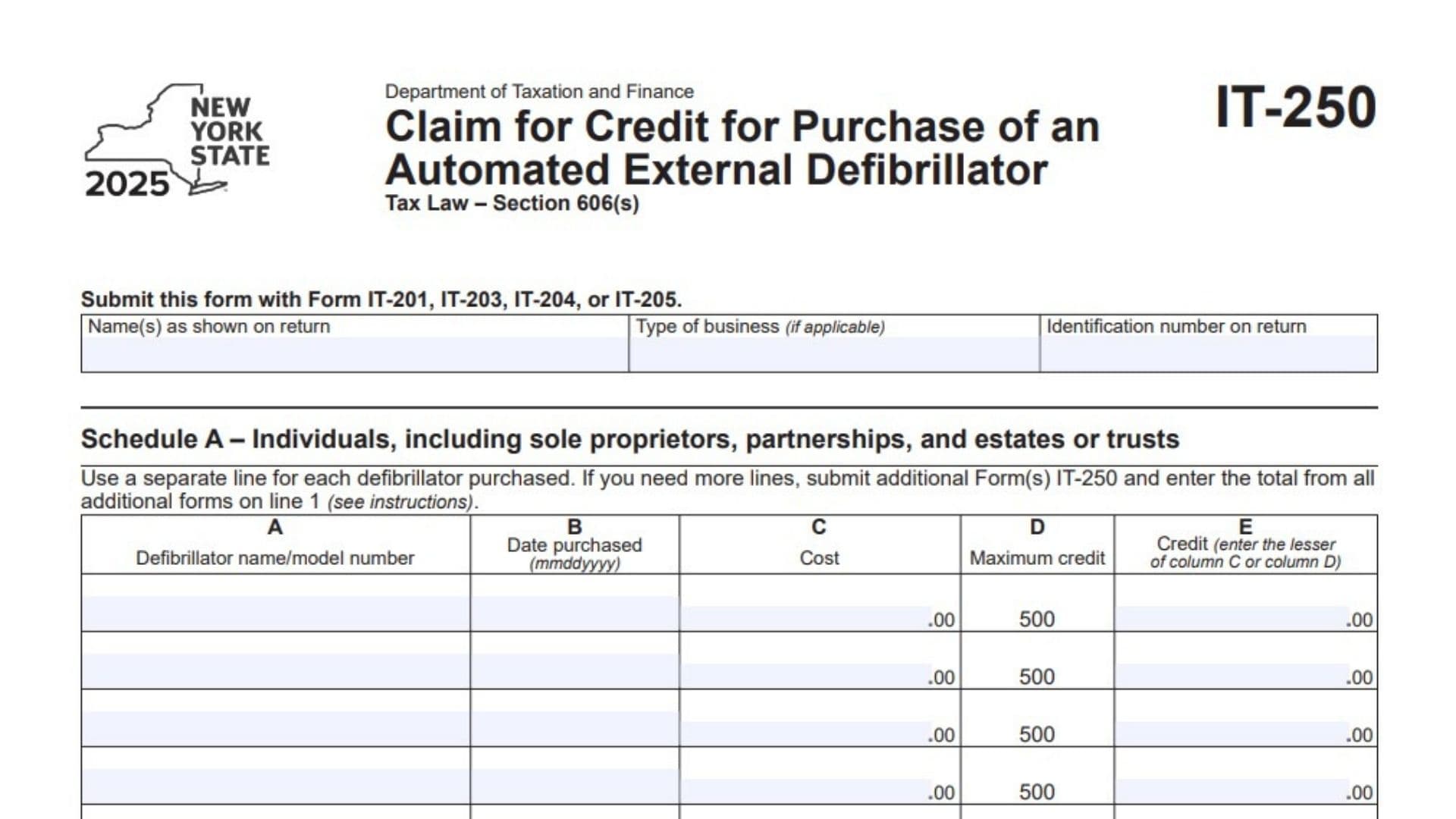
New York Form IT-250, Claim for Credit for Purchase of an Automated External Defibrillator, is a tax form issued by the New York State Department of Taxation and Finance under Section 606(s) of the New York Tax Law. It allows eligible taxpayers to calculate and claim a tax credit for purchasing an automated external defibrillator (AED). An AED is a medical device designed to help respond to sudden cardiac emergencies. The form is intended for individuals, sole proprietors, partnerships, S corporation shareholders, and estates or trusts that qualify to claim the credit or receive an allocated share from another business or entity. It collects information about purchased defibrillators, including their names or model numbers, purchase dates, costs, and allowable credit amounts. It also provides sections for reporting credits received through partnerships, New York S corporations, and estates or trusts. The form contains six schedules that organize the purchase information, identify the entities providing allocated credits, calculate beneficiaries’ and fiduciaries’ shares, and determine the amount of credit available for the current tax year. The maximum credit shown for each defibrillator is $500, and the allowable credit for an individual purchase is limited to the lesser of its cost or $500. Completing Form IT-250 correctly is important because the purchase details, credit allocations, and tax calculations determine how much of the AED credit can be applied against the taxpayer’s New York tax liability. Errors in the purchase information, entity identification, beneficiary allocations, or calculations may result in an incorrect credit claim. The completed form must accompany the appropriate New York income tax return, depending on whether the taxpayer files as an individual, partnership, nonresident, or fiduciary.
How To File Form IT-250
Form IT-250 must be submitted with the appropriate New York State income tax return. It is an attachment to the main return and should not be filed as a completely separate income tax return.
The form can be submitted with one of the following returns:
- Form IT-201: New York State Resident Income Tax Return.
- Form IT-203: New York State Nonresident and Part-Year Resident Income Tax Return.
- Form IT-204: New York Partnership Return.
- Form IT-205: New York State Fiduciary Income Tax Return.
Choose the return that applies to your filing situation and include Form IT-250 with it.
Information To Prepare Before Filing
Gather the following information before completing the form:
- Taxpayer identification information: Your name and identification number as reported on the associated tax return.
- Business information: The type of business, if applicable.
- Defibrillator purchase records: The name or model number, purchase date, and cost of each AED.
- Additional purchase schedules: If you purchased more than five defibrillators, prepare additional Form IT-250 forms.
- Partnership information: The name, entity type, and employer identification number of each partnership from which you received a credit.
- S corporation information: Details of each New York S corporation that allocated an AED credit to you.
- Estate or trust information: Details of any estate or trust through which you received a share of the credit.
- Beneficiary information: Names and identifying numbers for beneficiaries receiving allocated credits.
- Tax liability information: The figures needed to calculate tax due before credits and other credits applied before the AED credit.
Keep your supporting purchase and tax records available when completing the schedules.

How To Complete Form IT-250
Form IT-250 contains taxpayer identification fields and six schedules. Each schedule serves a different purpose in calculating the AED purchase credit and determining how much can be used during the current tax year.
Taxpayer Information Section
Name(s) as Shown on Return
Enter the taxpayer’s name exactly as it appears on the associated New York State income tax return. If multiple taxpayers are listed on the return, use the same names and order.
Type of Business (If Applicable)
Enter the type of business associated with the tax credit claim, if applicable. Provide the appropriate business classification or description.
If this field does not apply to your filing situation, follow the applicable filing instructions.
Identification Number on Return
Enter the identification number shown on the associated income tax return. Make sure the number matches the information reported on Form IT-201, IT-203, IT-204, or IT-205.
Schedule A: Individuals, Sole Proprietors, Partnerships, and Estates or Trusts
Schedule A is used to report individual automated external defibrillator purchases and calculate the allowable credit for each device.
Use a separate row for every defibrillator purchased. The schedule provides five rows. If you purchased more than five defibrillators, complete additional Form IT-250 forms and transfer the combined credit from those additional forms to line 1.
Purchase Information Columns
Column A: Defibrillator Name or Model Number
Enter the name or model number of the automated external defibrillator purchased.
Use the appropriate product identification information so that each device can be distinguished from the others.
Column B: Date Purchased
Enter the date on which the defibrillator was purchased.
Use the required MMDDYYYY format.
For example, a purchase made on March 15, 2025, should be entered as 03152025.
Column C: Cost
Enter the purchase cost of the individual defibrillator.
Report the cost for each device separately. This amount will be compared with the maximum credit in column D.
Column D: Maximum Credit
The maximum credit allowed in this column is $500 for each defibrillator.
Use the $500 limit when determining the allowable credit for the corresponding purchase.
Column E: Credit Amount
Enter the smaller of the purchase cost reported in column C or the maximum credit shown in column D.
The calculation is:
Credit Amount = Lesser of Column C or Column D
For example:
- If the defibrillator costs $350, enter $350.
- If the defibrillator costs $650, enter $500.
- If the defibrillator costs $500, enter $500.
Repeat this calculation separately for every device listed in Schedule A.
Line 1: Total Credit From Additional Form IT-250 Schedules
If you purchased more defibrillators than the five available rows allow, complete additional Form IT-250 schedules.
Add the credit amounts reported in column E on all additional forms and enter their combined total on line 1 of the main form.
If you did not use additional forms, there is no additional credit amount to report here.
Line 2: Total Automated External Defibrillator Credit
Add all credit amounts entered in column E on the current Schedule A to the amount reported on line 1, if applicable.
The calculation is:
Total Column E Amounts + Line 1 = Line 2
Enter the combined amount on line 2.
The reporting location depends on your filing situation:
- Fiduciaries: Include the line 2 amount on the Total line of Schedule D, column C.
- All others: Enter the line 2 amount on Schedule E, line 7.
Schedule B: Partnership, S Corporation, and Estate or Trust Information
Schedule B is used when you receive an allocated AED credit through a partnership, New York S corporation, or estate or trust.
If you are a partner, shareholder, or beneficiary and received a share of the credit from one of these entities, provide the requested information for each applicable entity.
Complete the following fields for every partnership, S corporation, or estate or trust from which you received a credit.
Name
Enter the name of the partnership, S corporation, or estate or trust that provided your share of the AED credit.
Use the entity’s correct legal name.
Type
Enter the appropriate abbreviation identifying the entity.
Use one of these codes:
- P: Partnership.
- S: S corporation.
- ET: Estate or trust.
Select the code that corresponds to the entity listed in the Name field.
Employer Identification Number
Enter the employer identification number (EIN) assigned to the partnership, S corporation, or estate or trust.
Make sure the EIN belongs to the entity from which you received the credit.
Schedule C calculates the portion of the AED credit received through a partnership, S corporation, or estate or trust.
The schedule contains separate entries for partners, S corporation shareholders, and beneficiaries.
Line 3: Partner’s Share of Credit From a Partnership
If you are a partner in a partnership and received an allocated AED credit, enter your share of the credit on line 3.
Use the amount allocated to you by the partnership.
Line 4: Shareholder’s Share of Credit From an S Corporation
If you are a shareholder of a New York S corporation and received a portion of the AED credit, enter that amount on line 4.
Use the credit amount allocated to you by the S corporation.
Line 5: Beneficiary’s Share of Credit From a Fiduciary
If you are a beneficiary of an estate or trust and received a share of the AED credit, enter the amount allocated to you from the fiduciary’s Form IT-250, Schedule D, column C.
Make sure the amount agrees with the beneficiary allocation reported by the fiduciary.
Line 6: Total Share of Credit
Add the amounts reported on lines 3, 4, and 5.
The calculation is:
Line 3 + Line 4 + Line 5 = Line 6
Enter the combined amount on line 6.
The reporting location depends on your filing situation:
- Fiduciaries: Include the line 6 amount on the Total line of Schedule D, column C.
- All others: Enter the line 6 amount on Schedule E, line 8.
Schedule D is used by fiduciaries to report how the AED credit is allocated between beneficiaries and the fiduciary of an estate or trust.
The schedule contains three columns for identifying beneficiaries, their identifying numbers, and their allocated shares of the credit.
Schedule D Columns
Column A: Beneficiary’s Name
Enter the name of each beneficiary exactly as it appears on Form IT-205, Schedule C.
The name must match the information reported on that schedule.
Column B: Identifying Number
Enter the identifying number associated with each beneficiary listed in column A.
Make sure the number corresponds to the correct individual.
Column C: Share of Automated External Defibrillator Credit
Enter the amount of AED credit allocated to each beneficiary or retained by the fiduciary.
Use the applicable credit allocation for each person or entity.
Schedule D Entries
Total: Combined Credit Available for Allocation
In the Total row, fiduciaries must enter the amount from Schedule A, line 2, plus the amount from Schedule C, line 6.
The calculation is:
Schedule A, Line 2 + Schedule C, Line 6 = Schedule D Total
Enter the combined amount in column C of the Total row.
Beneficiary Entries: Individual Shares of Credit
For each beneficiary, enter the beneficiary’s name in column A, identifying number in column B, and allocated credit amount in column C.
Use the available rows to identify the beneficiaries receiving a share of the AED credit.
Fiduciary: Fiduciary’s Share of Credit
Enter the portion of the AED credit allocated to the fiduciary in the Fiduciary row, column C.
This amount represents the fiduciary’s share rather than the amounts allocated to individual beneficiaries.
Make sure the allocations are consistent with the total credit reported in the Total row.
Schedule E: Computation of Credit
Schedule E combines the applicable AED credit amounts from the previous schedules to determine the total credit available for the taxpayer.
The appropriate entry depends on whether you are an individual, partner, S corporation shareholder, beneficiary, or fiduciary.
Line 7: Credit From Schedule A
This line applies to individuals and partnerships.
Enter the amount reported on Schedule A, line 2.
This represents the total AED purchase credit calculated from the individual defibrillator purchases, including additional purchase schedules.
Line 8: Credit From Schedule C
This line applies to partners, S corporation shareholders, and beneficiaries.
Enter the total amount reported on Schedule C, line 6.
Use the amount representing your allocated share of the AED credit.
Line 9: Credit From Schedule D
This line applies to fiduciaries.
Enter the amount reported on the Fiduciary line of Schedule D, column C.
Use the fiduciary’s allocated share of the credit.
Line 10: Total Credit
Add the amounts reported on lines 7, 8, and 9.
The calculation is:
Line 7 + Line 8 + Line 9 = Line 10
Enter the combined amount on line 10.
This represents the total AED credit calculated for the taxpayer using the applicable schedules.
Schedule F: Computation of Credit Used
Schedule F determines how much of the available AED credit can be applied against the taxpayer’s current-year tax liability.
The calculation considers the total credit available, the tax due before credits, and other credits applied before the AED credit.
Line 11: Tax Due Before Credits
Enter the amount of tax due before applying the AED credit and other applicable credits.
Use the relevant instructions for your associated New York income tax return to determine the correct amount.
The form refers taxpayers to separate instructions for this calculation. Do not estimate the figure or substitute an unrelated amount.
Line 12: Credits Applied Against the Tax Before This Credit
Enter the amount of other tax credits applied against your tax liability before the AED credit.
Include the applicable credits that must be considered before calculating the amount of AED credit available for use.
Follow the relevant tax instructions to determine which credits are applied first and how their amounts should be calculated.
Line 13: Net Tax
Subtract the amount on line 12 from the amount on line 11.
The calculation is:
Line 11 − Line 12 = Line 13
Enter the result on line 13.
This represents the remaining tax liability after accounting for the credits applied before the AED credit.
Line 14: Credit Used for the Current Tax Year
Enter the smaller of the amounts reported on line 10 or line 13.
The calculation is:
Line 14 = Lesser of Line 10 or Line 13
For example:
- If line 10 shows $900 and line 13 shows $700, enter $700 on line 14.
- If line 10 shows $500 and line 13 shows $800, enter $500 on line 14.
The amount on line 14 represents the AED credit applied against the current year’s tax liability.
You cannot use more credit than the total amount available or more than the remaining tax liability.
Example: How To Calculate the Form IT-250 Credit
The following example illustrates how the AED purchase credit is calculated and applied against the current year’s tax.
Assume an individual purchases two automated external defibrillators.
| Purchase | Purchase cost | Maximum credit | Allowable credit |
|---|---|---|---|
| Defibrillator 1 | $400 | $500 | $400 |
| Defibrillator 2 | $750 | $500 | $500 |
| Total | $1,150 | $1,000 | $900 |
The total allowable credit is $900, which is entered on Schedule A, line 2, assuming there are no additional purchase schedules.
Now assume the taxpayer has the following amounts in Schedule F:
| Line | Description | Amount |
|---|---|---|
| Line 10 | Total available credit | $900 |
| Line 11 | Tax due before credits | $1,200 |
| Line 12 | Other credits applied first | $500 |
| Line 13 | Net tax | $700 |
| Line 14 | Credit used for current year | $700 |
The taxpayer can apply $700 of the available $900 credit because the remaining tax liability is $700.
The amount used is limited to the smaller of the available credit or the remaining tax liability.
Final Review Before Filing
Before submitting Form IT-250 with your New York State income tax return, review every schedule, identification field, and calculation to ensure that the information is complete and accurate.
Use the following checklist:
- Confirm that you are completing the correct 2025 version of Form IT-250.
- Enter the taxpayer’s name exactly as shown on the associated income tax return.
- Complete the business type field if applicable.
- Verify that the identification number matches the associated return.
- In Schedule A, enter the correct name or model number for each defibrillator.
- Enter each purchase date using the MMDDYYYY format.
- Verify the purchase cost reported in column C.
- Check that column D reflects the $500 maximum credit for each defibrillator.
- Confirm that column E contains the lesser of the purchase cost or $500.
- Complete additional Form IT-250 schedules if more than five defibrillators were purchased.
- Transfer the total column E amounts from additional forms to line 1.
- Verify that line 2 includes all applicable purchase credit amounts and the amount on line 1.
- Transfer the Schedule A credit to the appropriate schedule based on your filing situation.
- If applicable, complete Schedule B with each entity’s name, type, and EIN.
- Use the correct entity codes: P, S, or ET.
- In Schedule C, verify the partnership credit reported on line 3.
- Check the S corporation credit reported on line 4.
- Verify the beneficiary credit reported on line 5 against the fiduciary’s Schedule D, column C.
- Confirm that line 6 correctly adds lines 3, 4, and 5.
- If filing as a fiduciary, complete Schedule D with the correct total credit and allocation information.
- Enter each beneficiary’s name exactly as shown on Form IT-205, Schedule C.
- Verify each beneficiary’s identifying number and allocated credit amount.
- Enter the fiduciary’s share in the appropriate row.
- Complete Schedule E using the applicable amounts from Schedules A, C, and D.
- Verify that line 10 correctly adds lines 7, 8, and 9.
- In Schedule F, determine the correct tax due before credits for line 11.
- Enter the applicable credits applied before this credit on line 12.
- Confirm that line 13 correctly subtracts line 12 from line 11.
- Verify that line 14 is the lesser of line 10 or line 13.
- Review all purchase information and credit allocation details.
- Confirm that the completed form accompanies the appropriate Form IT-201, IT-203, IT-204, or IT-205.
Form IT-250 provides a structured way to calculate and claim the New York tax credit for purchasing automated external defibrillators. By accurately reporting each purchase, identifying allocated credit shares, completing the applicable schedules, and calculating the amount available for the current tax year, taxpayers can ensure that the AED credit is properly reported on their New York State income tax return.