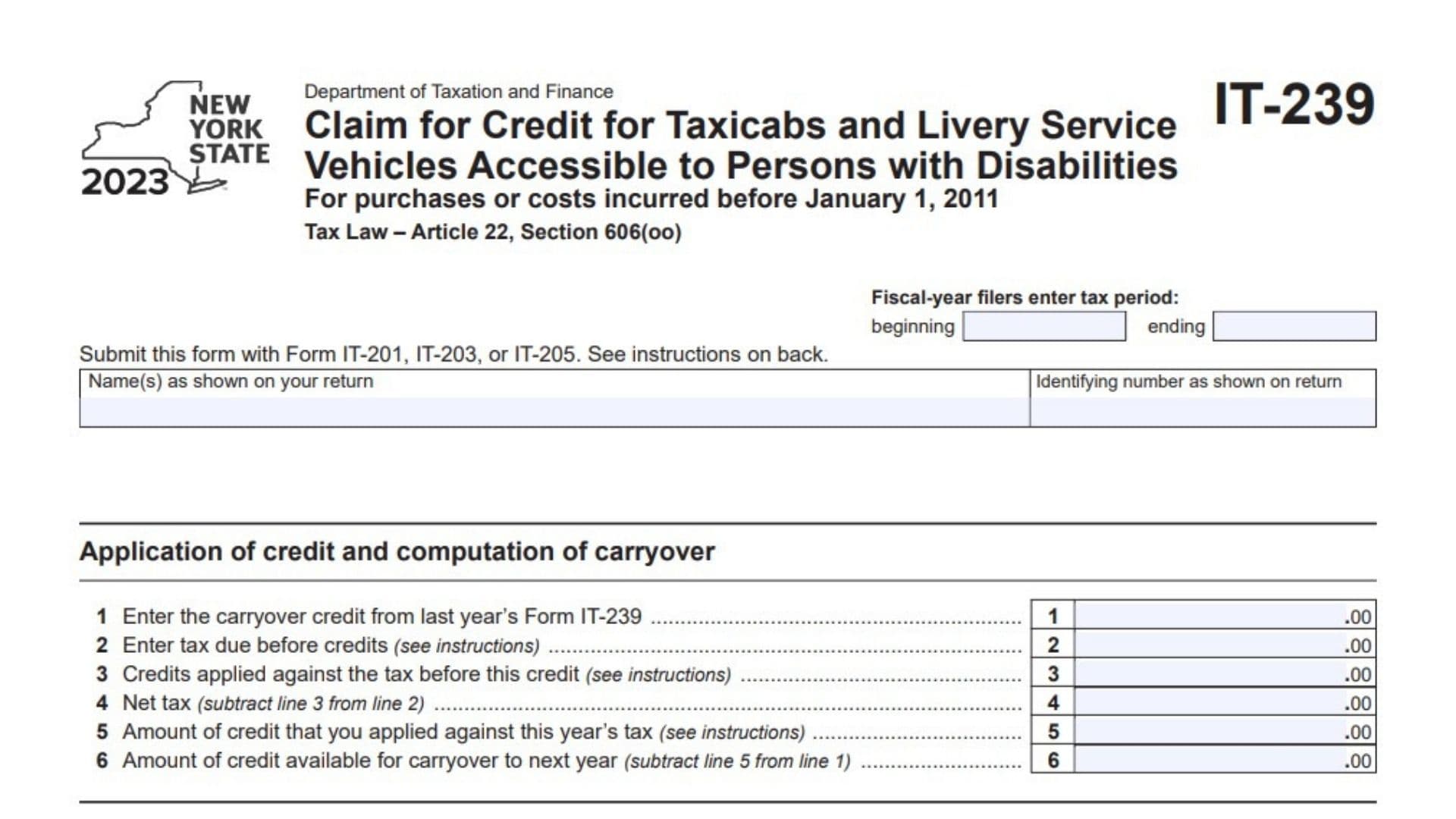
New York Form IT-239, Claim for Credit for Taxicabs and Livery Service Vehicles Accessible to Persons with Disabilities, is a tax form issued by the New York State Department of Taxation and Finance. It was created to allow eligible taxpayers to claim a tax credit associated with purchasing or incurring qualifying costs for taxicabs and livery service vehicles designed to be accessible to individuals with disabilities. The credit was authorized under Section 606(oo) of Article 22 of the New York Tax Law.
The form is specifically intended for purchases or qualifying costs incurred before January 1, 2011. Tax year 2010 was the final year in which taxpayers could claim this credit for new qualifying purchases or costs. However, taxpayers who were previously allowed the credit but could not use the entire amount may carry the unused portion forward indefinitely. Form IT-239 helps these taxpayers calculate how much of their remaining credit can be applied against their current year’s tax liability and how much can be carried into a future tax year.
The form is relevant to individuals and fiduciaries filing certain New York income tax returns, including Form IT-201, Form IT-203, and Form IT-205, when they have an eligible unused credit from a previous year. It collects identifying information, the remaining credit from the preceding year, the taxpayer’s tax liability before credits, other credits applied against that liability, and the amount of the disability-accessible vehicle credit used during the current year.
Completing Form IT-239 correctly is important because the amount of credit that can be applied depends on the taxpayer’s available tax liability and the credit balance carried forward. Incorrect calculations may result in applying more credit than permitted or reporting an inaccurate amount for future years. The form also helps maintain an accurate record of unused credit that remains available under the applicable carryforward rules.
Important: Although Form IT-239 appears in the 2023 tax form series, the original credit for new qualifying purchases or costs ended after tax year 2010. The form is relevant to taxpayers managing eligible unused credits from earlier years. For purchases or incremental costs incurred on or after January 1, 2011, the instructions direct taxpayers to use Form IT-236 instead.
How To File Form IT-239
Form IT-239 must be submitted together with the applicable New York State income tax return. It is not intended to be filed as a completely separate tax return.
The form can accompany any of the following returns:
- Form IT-201: New York State Resident Income Tax Return.
- Form IT-203: New York State Nonresident and Part-Year Resident Income Tax Return.
- Form IT-205: New York State Fiduciary Income Tax Return.
The appropriate return depends on the taxpayer’s filing circumstances. The completed IT-239 must be included with the corresponding return so that the credit can be applied against the correct tax liability.
Information To Prepare Before Completing Form IT-239
Gather the following information before starting:
- Previous year’s Form IT-239: You need the unused credit amount carried forward from the previous tax year.
- Current year’s income tax return: Have the applicable IT-201, IT-203, or IT-205 available to determine your tax before credits.
- Supporting tax schedules: Depending on the return type, you may need Form IT-201-ATT, Form IT-203-ATT, or the applicable Form IT-205 Addbacks worksheet.
- Other available tax credits: Identify credits that must be applied before the IT-239 credit.
- Taxpayer identification information: Prepare the name and identifying number exactly as they appear on the associated tax return.
- Fiscal-year information: If you file using a fiscal year rather than a calendar year, have the beginning and ending dates of your tax period available.
Important Rules For Applying Credits
Before calculating the amount of IT-239 credit that can be used, taxpayers must follow the credit application order provided in the instructions.
Apply available credits in this sequence:
- Apply any household credit first.
- Apply credits that cannot be carried forward or refunded.
- Apply credits that can be carried forward for a limited period.
- Apply credits that can be carried forward indefinitely.
- Apply refundable credits last.
This order is important because it determines how much tax remains available for the IT-239 credit.

How To Complete Form IT-239
Form IT-239 contains taxpayer identification fields and six numbered lines under the section for applying the credit and calculating the carryover. Each field and line serves a specific purpose in determining how much of the unused credit can be applied during the current tax year.
Taxpayer Information Section
Complete the identification fields at the top of the form before entering the credit calculations.
Name(s) as Shown on Your Return
Enter the taxpayer’s name exactly as it appears on the associated New York State income tax return. If the return includes more than one taxpayer, enter the names in the same manner as they appear on that return.
For fiduciary filings, use the appropriate name information associated with the Form IT-205 return.
Identifying Number as Shown on Return
Enter the identifying number used on the corresponding income tax return. Make sure the number matches the information reported on Form IT-201, IT-203, or IT-205, as applicable.
Fiscal-Year Filers: Tax Period Beginning
If you file using a fiscal year, enter the starting date of the tax period covered by the return. This should match the beginning date reported for your fiscal-year tax return.
Fiscal-Year Filers: Tax Period Ending
Enter the ending date of the fiscal-year tax period. Together, the beginning and ending dates identify the reporting period covered by the form.
Calendar-year filers generally do not need to complete these fiscal-year date fields.
Application of Credit and Computation of Carryover
This section contains six numbered lines. Use the instructions below to calculate the credit applied against the current year’s tax and the amount remaining for future years.
Line 1: Credit Carried Forward From the Previous Year
Enter the unused IT-239 credit carried forward from the previous year’s Form IT-239.
Use the carryover amount reported on the previous year’s form. This represents the portion of the previously allowed credit that was not used against tax and remains available for the current year.
Make sure the amount agrees with your previous year’s tax records. Do not enter the original credit amount if some of it has already been used in an earlier year.
Line 2: Tax Due Before Applying Credits
Enter the amount of tax due before applying the tax credits that reduce the taxpayer’s liability.
The amount comes from the corresponding income tax return and supporting schedules. The exact calculation depends on which return you file.
- Form IT-201 filers: Add the tax reported on Form IT-201, line 39, to the amount reported on Form IT-201-ATT, line 21.
- Form IT-203 filers: Add the tax reported on Form IT-203, line 46, to the amount reported on Form IT-203-ATT, line 20.
- Form IT-205 filers: Enter the tax from Form IT-205, line 8, for residents, or line 9, for nonresidents. Add any credits reported on line 1 of the Addbacks worksheet in the instructions for Form IT-205, line 12.
Use the calculation that applies to your specific return. Do not substitute a figure from a different return or schedule.
Line 3: Other Credits Applied Before the IT-239 Credit
Enter the total amount of other tax credits that you are applying against your tax liability before using the credit reported on Form IT-239.
This line accounts for credits that must be used first under the required application order.
When determining the amount, follow these rules:
- Household credit must be applied first.
- Credits that cannot be carried forward or refunded come next.
- Credits with limited carryforward periods are applied after those credits.
- Credits with unlimited carryforward periods are applied next.
- Refundable credits must be applied last.
Enter the applicable total of the credits that come before the IT-239 credit in this calculation.
Line 4: Net Tax After Other Credits
Calculate your remaining tax liability by subtracting the amount on line 3 from the amount on line 2.
The calculation is:
Line 2 − Line 3 = Line 4
This amount represents the net tax remaining after accounting for the credits applied before the IT-239 credit.
For example, if line 2 shows $5,000 and line 3 shows $1,200, the net tax on line 4 is $3,800.
This remaining tax amount helps determine how much of the unused vehicle accessibility credit can be applied during the current year.
Line 5: Credit Applied Against the Current Year’s Tax
Enter the amount of the IT-239 credit that you can apply against your current year’s tax liability.
To determine the correct amount, compare line 1 with line 4. Enter whichever amount is smaller.
The calculation is:
Line 5 = The smaller of line 1 or line 4.
For example, if line 1 shows $4,500 and line 4 shows $3,000, enter $3,000 on line 5. You cannot apply more credit than the remaining tax liability or the available carryover balance.
After calculating line 5, report this amount with the appropriate credit code on your income tax return:
- Form IT-201 filers: Enter the amount and code 299 on Form IT-201-ATT, line 6.
- Form IT-203 filers: Enter the amount and code 299 on Form IT-203-ATT, line 7.
- Form IT-205 filers: Include the amount on Form IT-205, line 10.
Use the reporting location that corresponds to your tax return.
Line 6: Credit Available for Carryover to the Next Year
Calculate the remaining unused credit that can be carried forward to the following tax year.
Subtract line 5 from line 1.
The calculation is:
Line 1 − Line 5 = Line 6
For example, if line 1 contains $4,500 and line 5 contains $3,000, the remaining carryover credit is $1,500.
Enter the result on line 6. This is the amount that remains available for future use. Under the applicable rules for this credit, unused amounts from previously allowed credits may be carried forward indefinitely.
Keep this amount with your tax records because it will be needed when completing Form IT-239 for a subsequent tax year.
Understanding the Form IT-239 Credit Carryover Calculation
The six lines work together to determine how much of the previously unused credit can be applied against the current year’s tax and how much remains available for future years.
Here is a simple example illustrating the calculation:
| Form IT-239 line | Description | Example amount |
|---|---|---|
| Line 1 | Previous year’s credit carryover | $4,500 |
| Line 2 | Tax before credits | $5,000 |
| Line 3 | Other credits applied first | $1,200 |
| Line 4 | Net tax after other credits | $3,800 |
| Line 5 | IT-239 credit applied | $3,800 |
| Line 6 | Remaining credit carryover | $700 |
In this example, the taxpayer has $4,500 in available credit but only $3,800 in remaining tax liability. Therefore, $3,800 is applied during the current year, leaving $700 available for a future tax year.
The calculation ensures that the taxpayer does not apply more credit than either the available carryover balance or the remaining tax liability.
Final Review Before Filing
Before submitting Form IT-239 with your New York State income tax return, review the completed form carefully.
Use the following checklist to verify that all required information and calculations are correct.
- Confirm that you are dealing with an eligible unused credit from a previous year.
- Verify that the original qualifying purchase or cost relates to the period before January 1, 2011.
- Enter the taxpayer’s name exactly as it appears on the associated income tax return.
- Check that the identifying number matches the return.
- Complete the beginning and ending tax period fields if you are a fiscal-year filer.
- Verify that line 1 matches the unused credit carried forward from the previous year’s Form IT-239.
- Confirm that line 2 is calculated using the correct tax return and supporting schedules.
- Make sure line 3 includes the applicable credits that must be applied before the IT-239 credit.
- Check that line 4 correctly subtracts line 3 from line 2.
- Verify that line 5 is the smaller of the amounts reported on lines 1 and 4.
- Confirm that the amount on line 5 is reported using credit code 299 in the correct location on the associated tax return.
- Make sure line 6 correctly subtracts line 5 from line 1.
- Confirm that the remaining carryover amount is recorded for future tax reporting.
- Attach Form IT-239 to the appropriate Form IT-201, IT-203, or IT-205.
Form IT-239 is an important record for taxpayers who still have unused credit from previously qualifying taxicab and livery service vehicle accessibility costs. By following the line-by-line instructions, applying other credits in the required order, and checking the carryover calculation, you can report the available credit accurately and maintain the correct balance for future tax years.