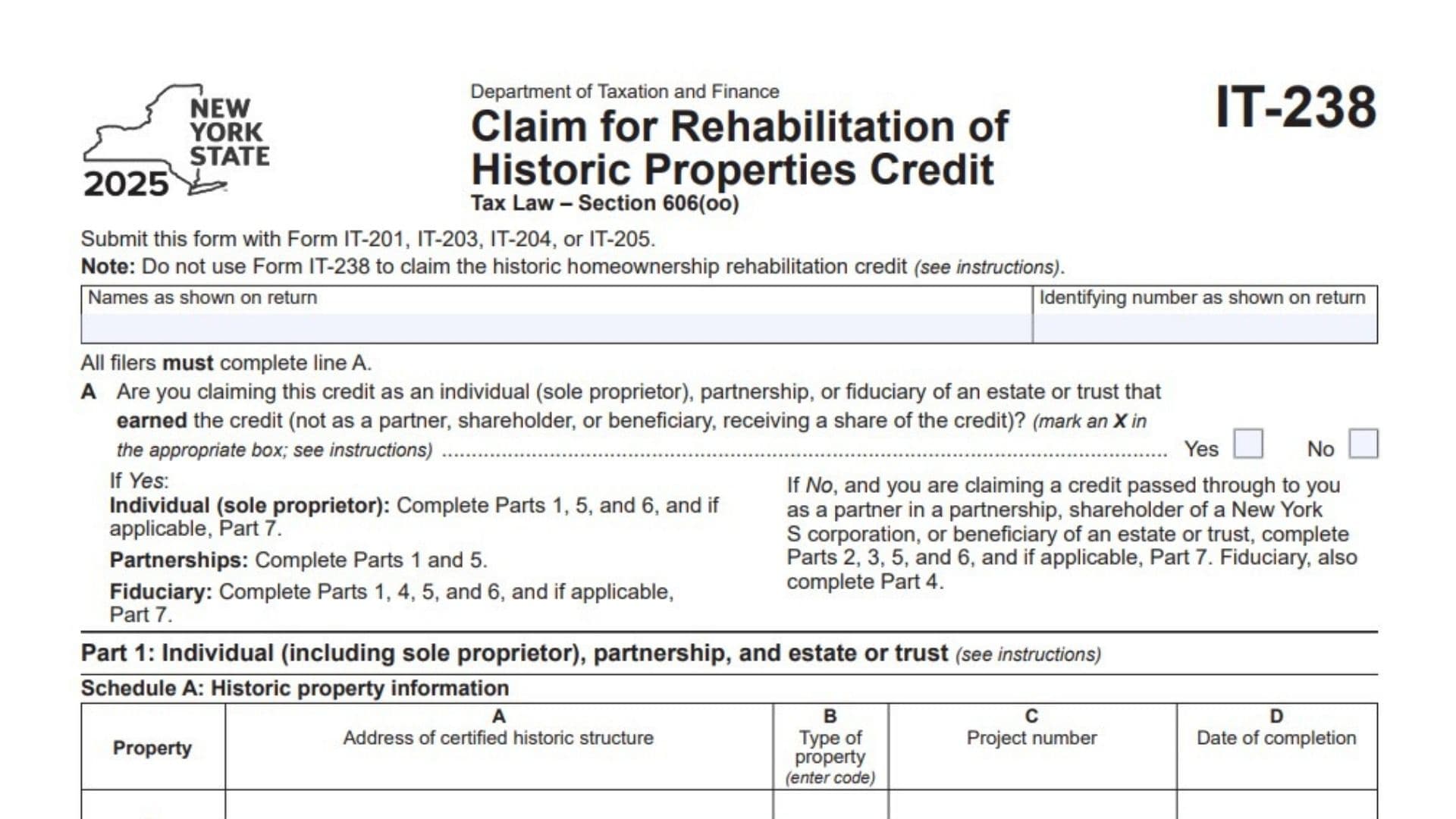
New York Form IT-238, officially titled Claim for Rehabilitation of Historic Properties Credit, is a tax form used to calculate and claim the rehabilitation of historic properties credit under New York Tax Law Section 606(oo). The 2025 form is designed for eligible individuals, sole proprietors, partnerships, estates, and trusts that have earned the credit through qualifying rehabilitation work on certified historic structures. It also allows partners, shareholders of New York S corporations, and beneficiaries of estates or trusts to report their allocated share of the credit.
The primary purpose of Form IT-238 is to establish the amount of credit available for qualifying rehabilitation expenditures associated with certified historic properties. The form collects information about each historic property, including its address, property classification, project number, and completion date. It also records qualified rehabilitation expenditures and determines the allowable credit amount. For small projects, a separate calculation applies using a 150% multiplier, while the standard calculation uses 20% of the qualified rehabilitation expenditures, subject to the applicable requirements and limitations.
Form IT-238 also accommodates taxpayers who receive the credit through partnerships, New York S corporations, estates, and trusts. These taxpayers must identify the entity from which the credit was received and report their allocated share. Separate sections are provided for partners, S corporation shareholders, beneficiaries, and fiduciaries. Fiduciaries must additionally report how the credit is distributed between beneficiaries and the fiduciary.
The form is divided into seven parts. Part 1 identifies certified historic properties and calculates the allowable credit. Part 2 collects information about partnerships, New York S corporations, estates, and trusts from which the taxpayer received a credit or credit recapture allocation. Part 3 calculates the taxpayer’s allocated share of the credit. Part 4 records beneficiary and fiduciary credit allocations. Part 5 calculates the current-year credit and includes any credit carried forward from the previous year. Part 6 determines how the credit is applied against the current year’s tax liability and calculates the amount available for refund or future carryover. Part 7 calculates the recapture of previously allowed credit when applicable.
An important distinction is that Form IT-238 must not be used to claim the historic homeownership rehabilitation credit. The form specifically excludes that credit and directs taxpayers to the applicable instructions for the separate homeownership credit.
Form IT-238 is a supporting tax credit form rather than a standalone income tax return. It must be submitted with Form IT-201, IT-203, IT-204, or IT-205, depending on the taxpayer’s filing circumstances. Completing it correctly is important because the credit calculation involves qualified rehabilitation expenditures, project classifications, allocated credits, previous-year carryovers, current tax liability, and possible recapture amounts.
How To File Form IT-238
New York Form IT-238 must be submitted with the taxpayer’s applicable New York income tax return. It is not filed as an independent income tax return.
The 2025 form identifies four possible filing destinations:
- Form IT-201: For applicable New York State resident individual income tax filers.
- Form IT-203: For applicable nonresident and part-year resident individual income tax filers.
- Form IT-204: For applicable partnership filers.
- Form IT-205: For applicable fiduciary income tax filers.
Select the appropriate return based on the taxpayer’s filing status and circumstances.
Information To Prepare Before Completing Form IT-238
Gather the following information before starting:
- Taxpayer’s name as shown on the applicable income tax return.
- Taxpayer’s identifying number.
- Applicable calendar or fiscal tax year.
- Beginning and ending dates for fiscal-year filers.
- Information about each certified historic structure.
- Complete address of each historic property.
- Applicable property classification or type code.
- Historic rehabilitation project numbers.
- Project completion dates.
- Qualified rehabilitation expenditure records.
- Information identifying whether a project qualifies as a small project.
- Additional Forms IT-238, if required.
- Partnership, New York S corporation, estate, or trust names and EINs.
- Project numbers associated with allocated credits.
- Partnership, S corporation, or beneficiary credit allocation information.
- Beneficiary names and identifying numbers.
- Previous-year Form IT-238 carryover credit information.
- Current-year tax liability information.
- Information about credits applied before the historic properties credit.
- Federal rehabilitation credit recapture information, where applicable.
- Previously allowed New York rehabilitation credit information.
Important Filing Considerations
Certified Historic Structures
Part 1 requires information about certified historic structures associated with the rehabilitation project. The property address, property type, project number, and completion date must be reported.
Qualified Rehabilitation Expenditures
The credit calculation is based on qualified rehabilitation expenditures. Maintain records supporting the expenditures associated with each project.
Small Projects
The form provides a separate checkbox for identifying small projects. These projects have a different calculation in Schedule B, using a 150% multiplier on the amount calculated in column B.
Credit Received Through Another Entity
Taxpayers receiving a credit through a partnership, New York S corporation, estate, or trust must complete Parts 2 and 3.
Fiduciary Allocations
Fiduciaries must complete Part 4 to report the distribution of the credit between beneficiaries and the fiduciary.
Previous-Year Carryover
Part 5 includes a separate line for credit carried forward from the previous year’s Form IT-238. Taxpayers should review their prior-year calculations before completing this section.
Credit Recapture
Part 7 applies when a previously allowed rehabilitation credit must be recaptured. The calculation uses the federal recapture amount associated with New York property and the amount of federal and New York credit originally allowed.

How To Complete New York Form IT-238
Form IT-238 contains taxpayer identification fields, an eligibility and filing classification question, and seven parts covering historic property information, credit calculations, entity allocations, credit distributions, carryovers, tax application, and recapture.
Complete the identification section first, followed by the applicable parts based on how the taxpayer earned or received the credit.
Taxpayer Identification Information
Tax Year
The 2025 version of Form IT-238 applies to the 2025 tax year.
Calendar-year filers should use the applicable calendar year. Fiscal-year filers must enter the beginning and ending dates of their tax period in the designated spaces.
Names As Shown On Return
Enter the taxpayer’s full legal name exactly as it appears on the associated New York income tax return.
For joint returns, enter the names as shown on the main return.
Identifying Number As Shown On Return
Enter the taxpayer’s identifying number exactly as it appears on the associated income tax return.
Use the identification number associated with the taxpayer claiming the rehabilitation credit.
Filing Classification Question
All taxpayers must complete this question before proceeding to the other parts of Form IT-238.
Line A: Are You Claiming This Credit As An Individual, Partnership, Or Fiduciary That Earned The Credit?
Select Yes or No to indicate whether the taxpayer earned the rehabilitation of historic properties credit directly or is receiving an allocated share from another entity.
The question distinguishes taxpayers who earned the credit themselves from those who received it through a partnership, New York S corporation, estate, or trust.
If Yes: Individual (Sole Proprietor)
If the taxpayer is an individual, including a sole proprietor, who earned the credit directly, complete Parts 1, 5, and 6.
Complete Part 7 if applicable.
If Yes: Partnership
If the taxpayer is a partnership that earned the credit, complete Parts 1 and 5.
If Yes: Fiduciary
If the taxpayer is a fiduciary of an estate or trust that earned the credit, complete Parts 1, 4, 5, and 6.
Complete Part 7 if applicable.
If No: Partner, S Corporation Shareholder, Or Beneficiary
Select No when the taxpayer is claiming a credit passed through from another entity rather than claiming a credit earned directly.
If the taxpayer received a share of the credit as a partner, shareholder of a New York S corporation, or beneficiary of an estate or trust, complete Parts 2, 3, 5, and 6.
Complete Part 7 if applicable.
Additional Requirement For Fiduciaries
If the taxpayer is a fiduciary receiving an allocated credit from another entity, Part 4 must also be completed.
Follow the applicable instructions for the taxpayer’s classification when determining which parts of the form are required.
Part 1: Individual, Partnership, And Estate Or Trust
Part 1 calculates the rehabilitation of historic properties credit earned directly by an individual, partnership, or estate or trust.
It contains two schedules:
- Schedule A: Historic property information.
- Schedule B: Credit calculation.
Schedule A identifies the certified historic structures associated with the claim. Schedule B calculates the allowable credit based on qualified rehabilitation expenditures and the applicable small-project treatment.
Schedule A: Historic Property Information
Schedule A provides three property entries and four columns for recording information about each certified historic structure.
Complete a separate entry for each property included in the credit calculation.
Understanding The Columns In Schedule A
Column A: Address Of Certified Historic Structure
Enter the complete address of the certified historic structure associated with the rehabilitation project.
Include the street number, street name, and other relevant address details.
Make sure that the address identifies the property associated with the reported project.
Column B: Type Of Property
Enter the appropriate property type code in column B.
Use the classification applicable to the certified historic structure and follow the relevant instructions for determining the correct code.
Column C: Project Number
Enter the project number associated with the historic rehabilitation project.
Use the project number assigned to the applicable project.
This information connects the property identification details with the corresponding rehabilitation credit calculation.
Column D: Date Of Completion
Enter the date on which the rehabilitation project was completed.
Use the actual completion date associated with the certified historic rehabilitation work.
Individual Historic Property Entries
Property 1
Enter the address of the first certified historic structure in column A, the applicable property type code in column B, the project number in column C, and the completion date in column D.
Property 2
If the taxpayer has a second certified historic structure associated with the credit claim, provide its address, property classification, project number, and completion date.
Property 3
Enter the corresponding information for the third certified historic structure, if applicable.
The form provides three property entries. If additional properties need to be reported, follow the applicable additional-form instructions.
Schedule B: Credit Calculation
Schedule B determines the allowable rehabilitation credit for each historic property listed in Schedule A.
It contains four calculation columns:
- Column A: Small project designation.
- Column B: Qualified rehabilitation expenditures.
- Column C: 20% calculation.
- Column D: Small-project calculation and allowable credit amount.
The schedule provides separate calculations for up to three properties.
Understanding The Columns In Schedule B
Column A: Small Project
This column contains a checkbox for each property.
Mark the checkbox when the rehabilitation project qualifies as a small project under the applicable instructions.
The classification is important because small projects use a different calculation from other rehabilitation projects.
Do not select this checkbox unless the project meets the applicable small-project requirements.
Column B: Qualified Rehabilitation Expenditures
Enter the qualified rehabilitation expenditures associated with the corresponding historic property.
Use the eligible expenditure amount supported by the project’s financial and rehabilitation records.
Report the expenditure amount separately for each property.
Column C: Multiply Column B By 20% (0.2)
Multiply the qualified rehabilitation expenditures in column B by 20%, or 0.2.
The calculation is:
\[ \text{Column C}=\text{Column B}\times 0.20 \]
Enter the resulting amount in column C.
This calculation establishes the standard 20% credit amount before applying the small-project calculation or other applicable requirements.
Column D: Small Projects Only — Multiply Column B By 150% (1.5)
For projects identified as small projects, multiply the qualified rehabilitation expenditures in column B by 150%, or 1.5.
The calculation is:
\[ \text{Small Project Amount}=\text{Column B}\times 1.50 \]
This calculation applies only to projects that qualify as small projects.
The form separately identifies column D as the allowable credit amount, subject to the applicable instructions.
Individual Property Credit Calculations
Property 1
Enter the qualified rehabilitation expenditures for the first property in column B.
Calculate 20% of the expenditures in column C.
If the project qualifies as a small project, mark the checkbox in column A and complete the applicable 150% calculation.
Enter the allowable credit amount in column D according to the applicable instructions.
Property 2
Enter the qualified rehabilitation expenditures for the second property.
Calculate the standard 20% amount and complete the small-project calculation if the project qualifies.
Report the allowable credit amount in column D.
Property 3
Complete the same calculation for the third historic property, if applicable.
Verify that the expenditure amount and project classification correspond to the property reported in Schedule A.
Part 1: Total Credit Calculation
Line 1: Total Of Column D Amounts From Any Additional Forms IT-238
If additional Forms IT-238 have been completed, enter the combined column D amounts from those additional forms on line 1.
This line allows the taxpayer to include qualifying rehabilitation projects that exceed the three property entries available on the main form.
If no additional Forms IT-238 are being used, no additional-form amount needs to be included.
Line 2: Total Of All Column D Amounts
Add all column D amounts from the current form and include the amount reported on line 1, if applicable.
The calculation is:
\[ \text{Line 2}= \text{Current Form Column D Total}+\text{Line 1} \]
Enter the combined amount on line 2.
This represents the total rehabilitation of historic properties credit calculated from the properties reported in Part 1 and any additional forms.
The form provides different transfer instructions depending on the taxpayer’s classification:
- Fiduciaries: Include the line 2 amount on the Total line of Part 4, column C.
- All Others: Enter the line 2 amount, or the taxpayer’s share of the line 2 amount, on Part 5, line 7.
Part 2: Partnership, New York S Corporation, Estate, And Trust Information
Part 2 identifies the entities from which a taxpayer received a share of the rehabilitation of historic properties credit or a share of credit recapture.
Complete this section when the taxpayer is a partner, shareholder of a New York S corporation, or beneficiary of an estate or trust receiving an allocated credit or recapture amount.
The form contains four columns for reporting the relevant entity information.
Understanding The Columns In Part 2
Column A: Name Of Entity
Enter the full legal name of the partnership, New York S corporation, estate, or trust from which the taxpayer received the rehabilitation credit or recapture allocation.
Use the entity name shown in the applicable tax documentation.
Column B: Type
Enter the applicable entity classification using the codes specified on the form:
- P: Partnership.
- S: New York S corporation.
- ET: Estate or trust.
Select the correct code for each entity.
Column C: Project Number
Enter the project number associated with the historic rehabilitation credit or recapture allocation.
Use the project number provided by the entity distributing the credit.
This field helps identify the rehabilitation project associated with the allocated amount.
Column D: Employer Identification Number
Enter the federal Employer Identification Number (EIN) of the partnership, S corporation, estate, or trust.
Verify the EIN against the entity’s tax documentation.
Reporting Multiple Entities
Partnership Entry
If the taxpayer received a credit from a partnership, enter its legal name, use P in column B, provide the project number in column C, and enter its EIN in column D.
New York S Corporation Entry
If the taxpayer received a credit from a New York S corporation, enter its legal name, use S as the entity type, and provide the associated project number and EIN.
Estate Or Trust Entry
If the taxpayer received the credit as a beneficiary of an estate or trust, enter the entity’s name, use ET, and provide the relevant project number and EIN.
Additional Entity Entries
Repeat the process for each applicable partnership, New York S corporation, estate, or trust.
Ensure that the project numbers and identification details agree with the credit allocation or recapture information received from each entity.
Part 3 calculates the taxpayer’s allocated share of the rehabilitation of historic properties credit received through another entity.
The section contains four numbered lines covering partnership, S corporation, and estate or trust allocations.
Complete the lines applicable to the taxpayer’s circumstances.
Line 3: Enter Your Share Of The Credit From Your Partnership
Partners must enter their allocated share of the rehabilitation of historic properties credit received from a partnership.
Use the amount allocated to the taxpayer by the partnership.
If credit was received from multiple partnerships, combine the applicable amounts and report the total on this line.
Line 4: Enter Your Share Of The Credit From Your S Corporation
Shareholders of New York S corporations must enter their allocated share of the rehabilitation of historic properties credit.
Use the amount reported in the relevant S corporation credit allocation documentation.
If more than one S corporation allocated credit to the taxpayer, combine the applicable amounts and enter the total.
Line 5: Enter Your Share Of The Credit From The Estate Or Trust
Beneficiaries must enter the rehabilitation credit allocated to them by an estate or trust.
Use the amount assigned to the beneficiary in the applicable fiduciary credit allocation records.
Line 6: Total
Add lines 3, 4, and 5.
The calculation is:
\[ \text{Line 6}=\text{Line 3}+\text{Line 4}+\text{Line 5} \]
Enter the combined amount on line 6.
This represents the total rehabilitation of historic properties credit received through partnerships, S corporations, estates, and trusts.
The form provides different transfer instructions:
- Fiduciaries: Include the line 6 amount on the Total line of Part 4, column C.
- All Others: Enter the line 6 amount on Part 5, line 8.
Part 4 is used by fiduciaries to report how the rehabilitation of historic properties credit is allocated between beneficiaries and the fiduciary.
It contains three columns:
- Column A: Beneficiary’s name.
- Column B: Identifying number.
- Column C: Share of rehabilitation of historic properties credit.
Complete this section when an estate or trust must report the distribution of its rehabilitation credit among beneficiaries and the fiduciary.
Understanding The Columns In Part 4
Column A: Beneficiary’s Name
Enter the beneficiary’s name exactly as it appears on Form IT-205, Schedule C.
Use the same name reported on the associated fiduciary income tax return.
Column B: Identifying Number
Enter the beneficiary’s identifying number.
Verify that the number corresponds to the beneficiary identified in column A.
Column C: Share Of Rehabilitation Of Historic Properties Credit
Enter the amount of rehabilitation credit allocated to the beneficiary.
Use the applicable fiduciary allocation information to determine each beneficiary’s share.
Part 4: Credit Allocation Entries
Total: Fiduciaries, Enter The Amount From Line 2 Plus The Amount From Line 6
The Total line combines the rehabilitation credit earned directly through Part 1 with any allocated credit received through Part 3.
Add:
- Part 1, line 2.
- Part 3, line 6.
The calculation is:
\[ \text{Part 4 Total}=\text{Line 2}+\text{Line 6} \]
Enter the combined amount in column C of the Total line.
This represents the total credit available for the fiduciary’s allocation process.
Beneficiary Entry 1
Enter the first beneficiary’s name in column A, identifying number in column B, and allocated rehabilitation credit in column C.
Beneficiary Entry 2
If another beneficiary receives a share of the credit, enter that beneficiary’s name, identifying number, and allocated amount.
Additional Beneficiary Entries
Use the remaining rows to report other beneficiaries receiving an allocation.
Ensure that each amount agrees with the relevant fiduciary allocation records.
Fiduciary: Share Of Credit
Enter the portion of the rehabilitation credit allocated to the fiduciary in the Fiduciary line of column C.
This amount is transferred to Part 5, line 9.
The form does not provide a separate formula for determining beneficiary allocation percentages. Use the applicable fiduciary allocation records when determining the amounts assigned to beneficiaries and the fiduciary.
Part 5: Calculation Of Credit
Part 5 determines the total rehabilitation of historic properties credit available for the current year.
It combines the credit earned directly, allocated credit received through another entity, the fiduciary’s share, and any credit carried forward from the previous year.
This section contains lines 7 through 12.
Current-Year Credit Calculation
Line 7: Individual (Including Sole Proprietor) And Partnership
Individuals, including sole proprietors, and partnerships must enter the amount or their share of the amount from Part 1, line 2.
This represents the rehabilitation credit calculated directly from the historic properties reported in Part 1.
Use the applicable amount based on the taxpayer’s classification.
Line 8: Partner, S Corporation Shareholder, Beneficiary
Partners, New York S corporation shareholders, and beneficiaries must enter the amount from Part 3, line 6.
This represents the combined credit allocated to the taxpayer through partnerships, S corporations, estates, and trusts.
Line 9: Fiduciary
Fiduciaries must enter the amount from the Fiduciary line of Part 4, column C.
This represents the rehabilitation credit allocated to the fiduciary after reporting the beneficiary and fiduciary distributions.
Line 10: Current Year Credit
Add lines 7, 8, and 9.
The calculation is:
\[ \text{Line 10}=\text{Line 7}+\text{Line 8}+\text{Line 9} \]
Enter the resulting amount on line 10.
This represents the total rehabilitation of historic properties credit available for the current tax year before including any previous-year carryover.
Previous-Year Carryover
Line 11: Enter The Carryover Credit From Last Year’s Form IT-238
Enter the unused rehabilitation credit carried forward from the previous year’s Form IT-238.
Use the carryover amount reported on the prior-year form.
Verify that the amount agrees with the previous year’s credit calculation and carryover records.
Line 12: Total Credit
Add line 10 and line 11.
The calculation is:
\[ \text{Line 12}=\text{Line 10}+\text{Line 11} \]
Enter the resulting amount on line 12.
This represents the total rehabilitation of historic properties credit available for application during the current tax year, including the current-year credit and previous-year carryover.
Part 6: Application Of Credit And Calculation Of Carryover
Part 6 determines how much of the available rehabilitation credit can be applied against the current year’s tax liability.
It also calculates the amount that may be refunded and the amount that can be carried forward to the following tax year.
The section contains lines 13 through 23.
Total Credit And Recapture Adjustments
Line 13: Total Credit
Enter the total amount from Part 5, line 12.
This represents the combined current-year credit and previous-year carryover available before the calculations in Part 6.
Line 14: New York Recapture Amount
Enter the New York recapture amount from line 28 of Part 7.
This amount represents the rehabilitation credit recapture calculated using the federal and New York credit information.
If no recapture calculation applies, follow the applicable instructions for this line.
Line 15: Total Rehabilitation Of Historic Properties Credit
Calculate the total rehabilitation of historic properties credit by subtracting line 14 from line 13.
The calculation is:
\[ \text{Line 15}=\text{Line 13}-\text{Line 14} \]
Enter the resulting amount.
This represents the credit remaining after accounting for the New York recapture amount.
Line 16: Net Recapture Of Rehabilitation Of Historic Properties Credit
Enter the applicable net recapture amount determined under the instructions for this line.
This line is part of the overall credit application calculation and should be completed using the applicable New York recapture instructions.
Do not assume that line 16 is automatically identical to line 14. The form lists them as separate calculations.
Tax Liability Calculation
Line 17: Tax Due Before Credits
Enter the taxpayer’s tax due before applying credits.
Use the applicable amount determined from the taxpayer’s New York income tax return and the instructions for this line.
This amount establishes the tax liability against which available credits may be applied.
Line 18: Credits Applied Against The Tax Before This Credit
Enter the total amount of other credits already applied against the taxpayer’s tax liability before applying the rehabilitation of historic properties credit.
Use the applicable credit information from the main income tax return.
Line 19: Net Tax
Subtract line 18 from line 17.
The calculation is:
\[ \text{Line 19}=\text{Line 17}-\text{Line 18} \]
Enter the resulting amount.
This represents the remaining tax liability after accounting for credits applied before the historic properties credit.
Credit Applied Against Current-Year Tax
Line 20: Amount Applied Against This Year’s Tax
Enter the smaller of the amount on line 15 or line 19.
The calculation is:
\[ \text{Line 20}=\min(\text{Line 15},\text{Line 19}) \]
This limits the amount of rehabilitation credit applied against the current year’s tax to the available credit or the remaining net tax liability, whichever is lower.
Line 21: Unused Credit
Subtract line 20 from line 15.
The calculation is:
\[ \text{Line 21}=\text{Line 15}-\text{Line 20} \]
Enter the resulting amount.
This represents the portion of the rehabilitation credit that remains unused after applying the amount permitted against the current year’s tax.
Refund And Carryover Calculation
Line 22: Amount Of Credit To Be Refunded
Enter the smaller of the amount on line 10 or line 21.
The calculation is:
\[ \text{Line 22}=\min(\text{Line 10},\text{Line 21}) \]
This determines the portion of unused credit that qualifies for a refund under the form’s calculation.
The line specifically compares the current-year credit on line 10 with the unused credit on line 21.
Line 23: Amount Of Credit Available For Carryover To Next Year
Subtract line 22 from line 21.
The calculation is:
\[ \text{Line 23}=\text{Line 21}-\text{Line 22} \]
Enter the resulting amount.
This represents the remaining rehabilitation credit available to carry forward to the next tax year.
The amount should be retained for the following year’s Form IT-238, subject to the applicable carryover requirements.
Part 7: Calculation Of Credit Recapture
Part 7 calculates the New York rehabilitation credit recapture when a federal recapture amount applies to property located in New York.
The calculation uses the federal recapture amount, the original federal credit allowed on the New York property, and the original New York credit allowed.
The section contains lines 24 through 28.
Complete this part when applicable under the relevant recapture requirements.
Line 24: Federal Recapture Amount On New York Property
Enter the federal recapture amount associated with the New York property.
Use the applicable federal rehabilitation credit recapture calculation and supporting records.
The amount should relate to the property located in New York.
Line 25: Amount Of Federal Credit On New York Property Originally Allowed
Enter the amount of federal rehabilitation credit originally allowed for the New York property.
Use the original federal credit calculation and supporting documentation.
This amount is used as the denominator in the calculation on line 26.
Line 26: Divide Line 24 By Line 25
Divide the federal recapture amount on line 24 by the original federal credit allowed on line 25.
The calculation is:
\[ \text{Line 26}=\frac{\text{Line 24}}{\text{Line 25}} \]
Enter the resulting ratio.
This calculation establishes the proportion of the original federal credit being recaptured.
Line 27: Amount Of New York Credit Originally Allowed
Enter the amount of New York rehabilitation of historic properties credit originally allowed for the property.
Use the original New York credit calculation and supporting records.
This amount is used to determine the corresponding New York recapture.
Line 28: New York Recapture Amount
Multiply line 26 by line 27.
The calculation is:
\[ \text{Line 28}=\text{Line 26}\times\text{Line 27} \]
Enter the resulting New York recapture amount.
The form instructs taxpayers to enter this amount on line 14 of Part 6 as well.
This ensures that the recaptured amount is included in the calculation of the total rehabilitation credit available for the current year.
Final Review Before Filing
Before submitting New York Form IT-238, review all seven parts and verify that the historic property information, qualified rehabilitation expenditures, allocated credit amounts, previous-year carryovers, tax calculations, and recapture information are accurate.
Use the following checklist to conduct a final review.
Taxpayer Identification And Filing Classification
- Confirm the correct 2025 calendar or fiscal tax year.
- Enter the beginning and ending dates for fiscal-year filers.
- Verify the taxpayer’s name as shown on the main return.
- Check the taxpayer’s identifying number.
- Complete filing classification question A.
- Select Yes or No according to whether the taxpayer earned the credit directly or received an allocated share.
- Confirm that all parts required for the taxpayer’s classification are completed.
- Ensure that Form IT-238 is not being used to claim the historic homeownership rehabilitation credit.
Part 1: Historic Property Information And Credit Calculation
- List each certified historic structure in Schedule A.
- Verify each property address.
- Enter the correct property type code.
- Confirm each project number.
- Enter the applicable project completion date.
- Verify qualified rehabilitation expenditures in Schedule B, column B.
- Mark the small-project checkbox only when applicable.
- Calculate 20% of qualified rehabilitation expenditures in column C.
- Complete the 150% small-project calculation when applicable.
- Verify the allowable credit amounts in column D.
- Include additional Forms IT-238 on line 1, where applicable.
- Recalculate the total credit on line 2.
- Transfer the line 2 amount to the correct destination.
Part 2: Entity Information
- List every partnership that allocated a credit or recapture amount.
- List every New York S corporation involved.
- Include applicable estates and trusts.
- Verify each entity’s legal name.
- Enter P for partnerships.
- Enter S for New York S corporations.
- Enter ET for estates or trusts.
- Verify project numbers.
- Check each entity’s EIN.
Part 3: Allocated Credit
- Verify partnership credit on line 3.
- Confirm S corporation credit on line 4.
- Check estate or trust credit on line 5.
- Recalculate the combined amount on line 6.
- Confirm the correct transfer destination for fiduciaries and other taxpayers.
Part 4: Beneficiary And Fiduciary Allocation
- Verify beneficiary names against Form IT-205, Schedule C.
- Confirm beneficiary identifying numbers.
- Check the credit allocated to each beneficiary.
- Add Part 1, line 2, and Part 3, line 6, on the Total line.
- Verify the fiduciary’s share of credit.
- Reconcile beneficiary and fiduciary allocations with supporting records.
Part 5: Calculation Of Credit
- Confirm line 7 agrees with the applicable amount from Part 1, line 2.
- Verify line 8 against Part 3, line 6.
- Check line 9 against Part 4, Fiduciary line, column C.
- Recalculate current-year credit on line 10.
- Verify the previous-year carryover on line 11.
- Recalculate total credit on line 12.
Part 6: Application Of Credit And Carryover
- Confirm line 13 agrees with Part 5, line 12.
- Verify the New York recapture amount on line 14.
- Recalculate total rehabilitation credit on line 15.
- Complete the net recapture calculation on line 16 as instructed.
- Verify tax due before credits on line 17.
- Confirm credits applied before this credit on line 18.
- Recalculate net tax on line 19.
- Enter the smaller of lines 15 and 19 on line 20.
- Calculate unused credit on line 21.
- Determine the refundable credit on line 22.
- Calculate the carryover amount on line 23.
- Retain the carryover information for the next tax year.
Part 7: Credit Recapture
- Verify the federal recapture amount on line 24.
- Confirm the original federal credit on line 25.
- Recalculate the ratio on line 26.
- Verify the original New York credit on line 27.
- Calculate the New York recapture amount on line 28.
- Transfer the amount from line 28 to Part 6, line 14, as instructed.
Final Filing Checks
- Ensure all applicable sections are complete.
- Reconcile rehabilitation expenditures with supporting project records.
- Verify all certified historic property details.
- Confirm that the small-project classification is correct.
- Check all allocated credit amounts against entity documentation.
- Verify previous-year carryover information.
- Confirm the tax liability and credit application calculations.
- Attach Form IT-238 to Form IT-201, IT-203, IT-204, or IT-205, as applicable.
- Retain copies of the completed form and supporting rehabilitation records.
Important Filing Reminder
New York Form IT-238 is used to calculate and claim the Rehabilitation of Historic Properties Credit under Tax Law Section 606(oo). It provides a structured process for identifying certified historic structures, reporting qualified rehabilitation expenditures, calculating allowable credits, and determining how those credits are applied against the taxpayer’s tax liability.
The most important calculations occur in Schedule B and Parts 5 and 6. Schedule B determines the allowable credit for each historic property. Part 5 combines current-year credit amounts with previous-year carryovers. Part 6 determines the amount applied against current-year tax, the refundable portion, and the amount available for future carryover. Part 7 calculates the New York recapture amount when applicable.
Accurate reporting of certified historic properties, qualified rehabilitation expenditures, project classifications, credit allocations, carryovers, and recapture amounts is essential for correctly claiming the New York Rehabilitation of Historic Properties Credit for the 2025 tax year.