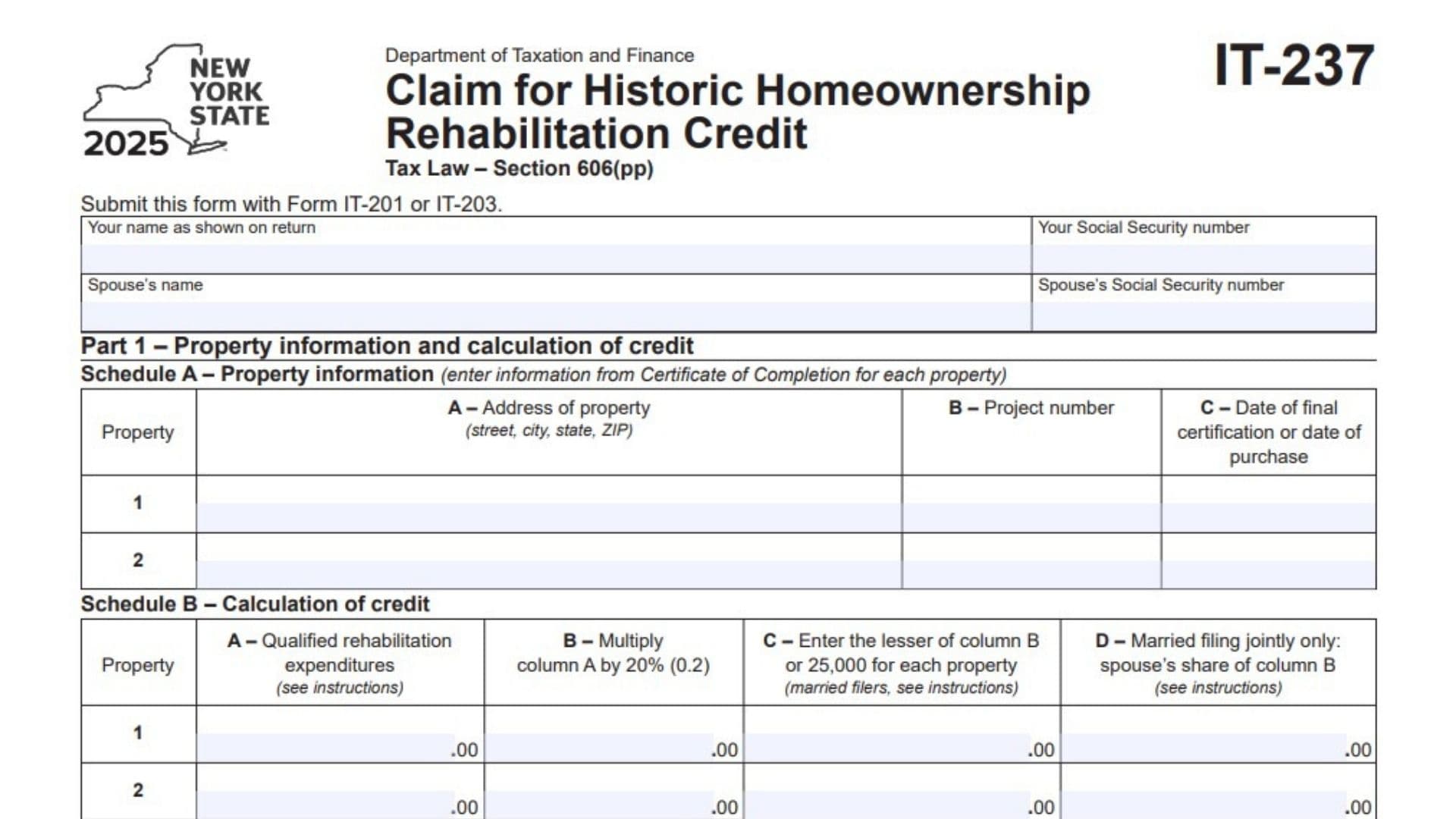
Form IT-237, officially known as the Claim for Historic Homeownership Rehabilitation Credit, is a New York State tax form used by eligible homeowners to claim a tax credit for qualifying rehabilitation expenditures on historic residential properties. The credit is established under Section 606(pp) of the New York State Tax Law. Its purpose is to provide a tax benefit to qualifying homeowners who undertake eligible rehabilitation work on historic homes. The form collects information about the property, its project identification number, the date of final certification or purchase, and the amount spent on qualifying rehabilitation activities. It also calculates the available credit, accounts for applicable credit limitations, and determines whether any unused credit can be carried forward to a subsequent tax year. For married taxpayers filing jointly, the form includes a separate calculation for the spouse’s share of the credit. Additionally, homeowners may need to complete a recapture calculation if the property no longer satisfies the applicable credit requirements during the specified period. Form IT-237 contains three main parts: property information and credit calculation, application of the credit and carryover calculation, and New York State credit recapture. Completing the form correctly is important because the qualified expenditure amount, applicable credit percentage, per-property limitation, taxpayer credit limitation, and any recapture amount directly affect the final credit available. The completed form must be submitted with the taxpayer’s New York State income tax return, Form IT-201 or Form IT-203.
How To File Form IT-237
Form IT-237 must be submitted with your New York State income tax return. It is a supporting tax form used to calculate and report the Historic Homeownership Rehabilitation Credit rather than a standalone income tax return.
Attach the completed form to one of the following:
- Form IT-201: New York State Resident Income Tax Return.
- Form IT-203: New York State Nonresident and Part-Year Resident Income Tax Return.
Choose the appropriate return based on your New York State residency and filing circumstances.
Information To Prepare Before Completing The Form
Gather the following information before beginning:
- Your name as it appears on your New York State income tax return.
- Your Social Security number.
- Your spouse’s name and Social Security number, if applicable.
- The address of each historic property included in the claim.
- The project number assigned to each property.
- The date of final certification or the date of purchase for each property.
- The Certificate of Completion for each property.
- Details of qualified rehabilitation expenditures.
- Information needed to calculate the 20% rehabilitation credit.
- The applicable credit amount and any spouse’s share if filing jointly.
- Your previous year’s Form IT-237, if you have an unused credit carryover.
- Your tax liability before applying the credit.
- Details of other credits applied before the Historic Homeownership Rehabilitation Credit.
- Information about the property’s qualification period if a credit recapture calculation is required.
Important Filing Considerations
Maximum Credit Limitation
The form includes a credit limitation of $25,000 per taxpayer. It also applies a separate calculation for each property, limiting the amount in Column C to the lesser of the calculated 20% credit or $25,000 per property, subject to the applicable instructions.
Married Taxpayers Filing Jointly
Married taxpayers filing jointly have an additional column in Schedule B for the spouse’s share of the credit. The spouse’s share must be calculated using the applicable instructions.
Credit Carryforward
If the available credit exceeds the amount that can be applied against the current year’s tax liability, the unused portion is calculated on line 14 for potential use in the following tax year.
Credit Recapture
Certain circumstances may require a previously allowed credit to be recaptured. Part 3 provides the calculation for determining the amount that must be added back.

How To Complete Form IT237
Form IT-237 contains three parts and two schedules. Complete the applicable sections carefully, using the information from your property certification documents and New York State tax return.
Part 1: Property Information and Calculation of Credit
Part 1 identifies the historic property or properties included in the credit claim and calculates the available rehabilitation credit.
This part contains two schedules:
- Schedule A: Property Information.
- Schedule B: Calculation of Credit.
Schedule A: Property Information
Schedule A collects identifying details for each property included in the Historic Homeownership Rehabilitation Credit claim.
The form provides space to report information for two properties. Use the information shown on the Certificate of Completion for each property.
Property 1: First Qualifying Property
Enter the information for your first property included in the rehabilitation credit claim. Complete Columns A, B, and C using the applicable property documentation.
Property 2: Second Qualifying Property
If you are claiming the credit for a second property, enter its information separately. Make sure the project number, address, and relevant date correspond to the correct property.
Column A: Property Address
Enter the complete address of the property, including:
- Street address.
- City.
- State.
- ZIP code.
Use the property’s address as shown in the relevant certification documentation.
Column B: Project Number
Enter the project identification number assigned to the rehabilitation project.
Use the project number shown on the Certificate of Completion. This information helps identify the specific rehabilitation project associated with the credit claim.
Column C: Final Certification Date or Purchase Date
Enter the applicable date for the property.
Use either the date of final certification or the date of purchase, as appropriate to the circumstances and the form instructions.
Ensure that the date corresponds to the property listed in the same row.
Schedule B: Calculation of Credit
Schedule B calculates the Historic Homeownership Rehabilitation Credit based on qualifying rehabilitation expenditures.
It contains four columns:
- Column A: Qualified rehabilitation expenditures.
- Column B: Credit calculated at 20%.
- Column C: Credit amount subject to the per-property limitation.
- Column D: Spouse’s share for married taxpayers filing jointly.
Complete a separate calculation for each property listed in Schedule A.
Property 1: First Property Credit Calculation
Use the qualified rehabilitation expenditures for the first property to calculate its credit. Transfer the appropriate expenditure and credit amounts into Columns A through D.
Property 2: Second Property Credit Calculation
If a second property is included, calculate its credit separately using the corresponding qualified rehabilitation expenditures.
Do not combine the expenditures of different properties before completing their individual calculations.
Column A: Qualified Rehabilitation Expenditures
Enter the total expenditures that qualify for the historic home rehabilitation credit for the particular property.
Only include expenditures that meet the applicable qualification requirements. Use the relevant instructions to determine which rehabilitation costs are eligible.
Column B: Credit at 20%
Multiply the qualified rehabilitation expenditures reported in Column A by 20%.
Calculation:
Column B = Column A × 0.20.
For example, if qualified rehabilitation expenditures are $50,000, the preliminary credit calculation is:
$50,000 × 0.20 = $10,000.
Enter the calculated amount in Column B.
Column C: Credit After Per-Property Limitation
Enter the smaller of the amount calculated in Column B or $25,000 for each property, subject to the applicable married-filing-jointly instructions.
Calculation:
Column C = Lesser of Column B or $25,000.
This calculation ensures that the credit claimed for an individual property does not exceed the stated per-property limitation.
Column D: Spouse’s Share of the Credit
This column applies only to married taxpayers filing jointly.
Enter the spouse’s share of the amount reported in Column B using the applicable instructions.
The spouse’s share is included in the separate credit calculation to determine the amount available to each taxpayer.
Credit Calculation Lines
Line 1: Total Property Credit Amounts
Calculate the total of the amounts reported in Column C and the total of the amounts reported in Column D.
Add the Column C amounts for all properties and enter the combined result in the Column C section.
Separately add the Column D amounts and enter the total in the Column D section.
Line 2: Credit Limitation Per Taxpayer
Enter the maximum credit limitation applicable to each taxpayer.
The form provides a limitation of $25,000.
For married taxpayers filing jointly, the form provides separate $25,000 limitations in the respective Column C and Column D calculations.
Line 3: Allowable Credit After Taxpayer Limitation
Compare the amount reported on line 1 with the credit limitation on line 2.
Enter the smaller of these two amounts.
Calculation:
Line 3 = Lesser of Line 1 or Line 2.
Perform this calculation separately for the Column C and Column D amounts, where applicable.
Line 4: Current Year Historic Homeownership Rehabilitation Credit
Add the allowable credit amounts from line 3, Column C, and line 3, Column D.
Calculation:
Line 4 = Line 3, Column C + Line 3, Column D.
Enter the combined amount as your current-year Historic Homeownership Rehabilitation Credit.
Line 5: Previous Year Credit Carryover
Enter the unused credit carried forward from the previous tax year.
Use the amount reported on line 14 of your previous year’s Form IT-237.
If you do not have a credit carryover from the previous year, enter zero.
Line 6: Total Credit Available Before Recapture
Add the current-year credit on line 4 and the previous-year carryover on line 5.
Calculation:
Line 6 = Line 4 + Line 5.
This represents the total credit available before accounting for any recapture amount.
Line 7: Credit Recapture Amount
Enter the recapture amount calculated on line 15 in Part 3.
This amount represents the credit that must be recaptured under the applicable requirements.
If no recapture applies, enter zero.
Line 8: Total Credit After Recapture
Compare the amount on line 7 with the amount on line 6.
If line 7 is less than line 6, subtract line 7 from line 6.
Calculation:
Line 8 = Line 6 − Line 7.
Enter the resulting amount and continue to Part 2.
If line 7 is greater than line 6, do not enter an amount on line 8. Instead, proceed to line 9 to calculate the remaining recapture amount.
Line 9: Net Recapture Amount
This line applies when the recapture amount on line 7 exceeds the available credit on line 6.
Subtract line 6 from line 7.
Calculation:
Line 9 = Line 7 − Line 6.
Enter the resulting net recapture amount using the applicable instructions.
Part 2: Application of Credit and Calculation of Carryover
Part 2 determines how much of the available Historic Homeownership Rehabilitation Credit can be applied against your current-year tax liability.
It also calculates the unused credit that may be carried forward to the next tax year.
Complete this section using the amount available on line 8 in Part 1.
Line 10: Tax Due Before Credits
Enter your tax liability before applying the Historic Homeownership Rehabilitation Credit.
Determine this amount using the applicable instructions and your New York State income tax return.
This amount establishes how much tax is available against which the rehabilitation credit can be applied.
Line 11: Other Credits Applied Before This Credit
Enter the total amount of other tax credits that you applied before claiming the Historic Homeownership Rehabilitation Credit.
Include the applicable credits that reduce your tax liability before this particular credit is used.
Line 12: Tax Remaining After Other Credits
Subtract the amount reported on line 11 from the amount reported on line 10.
Calculation:
Line 12 = Line 10 − Line 11.
This calculation determines the remaining tax liability available for the Historic Homeownership Rehabilitation Credit.
Line 13: Credit Applied to Current-Year Tax Liability
Compare the credit available on line 8 with the remaining tax liability on line 12.
Enter the smaller of the two amounts.
Calculation:
Line 13 = Lesser of Line 8 or Line 12.
This is the amount of the rehabilitation credit applied against your current-year tax liability.
Line 14: Credit Available for Carryover to the Next Year
Subtract the credit applied on line 13 from the total credit available on line 8.
Calculation:
Line 14 = Line 8 − Line 13.
Enter the remaining amount as the credit available for carryover to the following tax year.
This amount should be used as the previous-year carryover when completing line 5 of Form IT-237 in the next applicable tax year.
Part 3: New York State Recapture of Credit
Part 3 calculates the amount of previously allowed Historic Homeownership Rehabilitation Credit that may need to be recaptured.
The form indicates that this section should be completed only when required under the applicable instructions.
The calculation uses the project’s identification number, the number of months the home qualified for the credit, and the credit amount allowed.
The schedule contains six columns.
Recapture Calculation Columns
Column A: Project Number
Enter the identification number of the rehabilitation project for which a credit recapture calculation is required.
Use the project number associated with the relevant property and its Certificate of Completion.
Column B: Number of Months the Home Qualified for the Credit
Enter the number of months during which the home qualified for the credit.
Use the applicable qualification period and instructions to determine the correct number of months.
Column C: Remaining Months
Subtract the number of months entered in Column B from 24.
Calculation:
Column C = 24 − Column B.
This determines the remaining months in the 24-month period used in the recapture calculation.
Column D: Recapture Percentage
Divide the amount in Column C by 24.
Calculation:
Column D = Column C ÷ 24.
The resulting figure represents the percentage used to calculate the recapture amount.
Column E: Credit Amount Allowed
Enter the amount of credit allowed for the applicable rehabilitation project.
Use the credit amount determined under the relevant instructions.
Column F: Recapture Amount
Multiply the percentage in Column D by the credit amount in Column E.
Calculation:
Column F = Column D × Column E.
Enter the resulting recapture amount for the applicable project.
If more than one project requires recapture, perform the calculation separately for each project.
Line 15: Total Amount to Be Recaptured
Enter the total recapture amount calculated in Column F.
This amount represents the credit that must be recaptured.
Transfer the amount from line 15 to line 7 in Part 1.
The amount entered on line 15 must agree with the total of the applicable recapture amounts calculated in Column F.
Final Review Before Filing
Before submitting Form IT-237 with your New York State income tax return, review the following checklist to ensure that all property details, credit calculations, and supporting information are accurate.
Taxpayer Information
- Your name matches the name shown on your New York State income tax return.
- Your Social Security number is entered correctly.
- Your spouse’s name and Social Security number are included, if applicable.
- You have selected the appropriate New York State income tax return.
Property Information
- Each property included in the credit claim is identified separately.
- The complete property address is entered.
- The correct project number is provided.
- The final certification date or purchase date is entered correctly.
- The information agrees with the applicable Certificate of Completion.
Credit Calculation
- Qualified rehabilitation expenditures are entered correctly.
- The 20% credit calculation is accurate.
- The per-property $25,000 limitation has been applied.
- The $25,000 credit limitation per taxpayer has been considered.
- The spouse’s share is calculated correctly if filing jointly.
- Line 1 includes the correct totals for Columns C and D.
- Lines 2 and 3 reflect the applicable credit limitations.
- Line 4 correctly combines the allowable current-year credit amounts.
- Any previous-year carryover is entered correctly on line 5.
- Lines 6 through 9 reflect the correct credit and recapture calculations.
Credit Application and Carryover
- The tax liability before credits is entered on line 10.
- Other credits applied before this credit are included on line 11.
- Line 12 is calculated correctly.
- The credit applied to current-year tax is entered on line 13.
- Any unused credit available for carryover is calculated on line 14.
Credit Recapture
- You have determined whether Part 3 must be completed.
- The correct project number is entered in Column A.
- The number of qualifying months is entered in Column B.
- Column C is calculated using 24 minus Column B.
- Column D is calculated by dividing Column C by 24.
- The applicable credit amount is entered in Column E.
- Column F reflects the correct recapture calculation.
- The total recapture amount is entered on line 15.
- The amount from line 15 agrees with line 7 in Part 1.
Final Submission
- All applicable sections and calculations have been reviewed.
- Supporting property certification and expenditure information is available.
- Previous-year Form IT-237 has been reviewed if a credit carryover is claimed.
- The completed Form IT-237 is attached to Form IT-201 or Form IT-203.
- All amounts transferred to the main tax return agree with the completed credit calculation.
Final Reminder: Form IT-237 is used to calculate and claim the New York State Historic Homeownership Rehabilitation Credit. Pay particular attention to qualified rehabilitation expenditures, the 20% credit calculation, the $25,000 limitations, married-filing-jointly calculations, and any applicable recapture requirements. Use the official form instructions to verify expenditure eligibility, spouse allocation, tax liability calculations, and recapture eligibility before submitting your tax return.