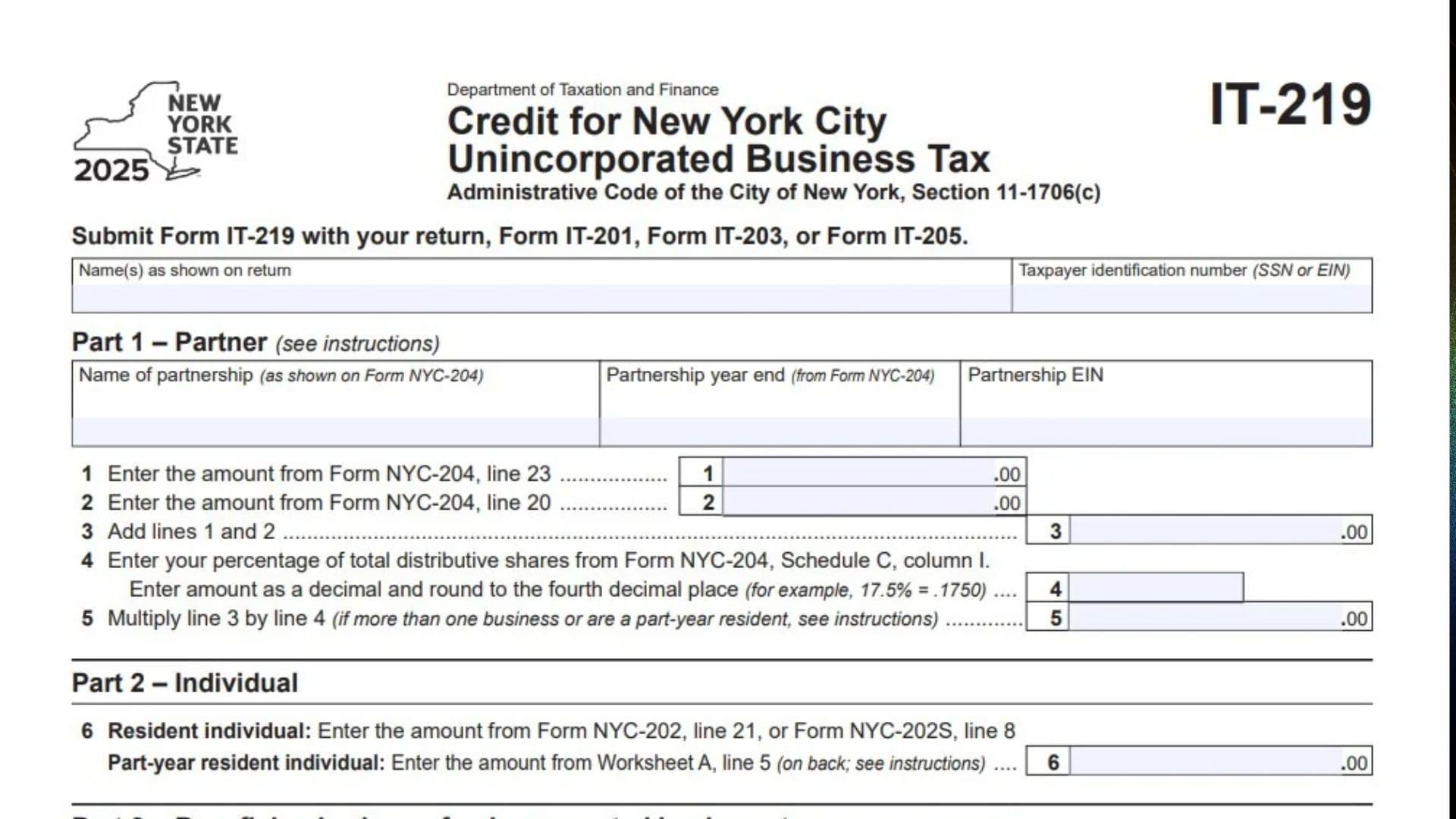
Form IT-219, Credit for New York City Unincorporated Business Tax, is a New York State tax form used to calculate a credit for certain taxes imposed on unincorporated business income in New York City. The credit is provided under Section 11-1706(c) of the New York City Administrative Code. It helps eligible taxpayers account for their share of New York City unincorporated business taxes when calculating their New York State income tax liability.
The form is used by individuals, partners, beneficiaries, estates, and trusts, depending on their circumstances. It collects information about partnership income, business tax payments, individual shares of unincorporated business taxes, taxable income, and applicable tax credits. The calculations differ depending on whether the taxpayer is a partner in a partnership, an individual with business income, or a beneficiary receiving a share of business taxes through an estate or trust. Form IT-219 contains four main parts, two worksheets, and a separate Schedule A for estates and trusts. Part 1 calculates a partner’s share of qualifying business taxes, Part 2 addresses individual taxpayers, Part 3 reports a beneficiary’s share of business taxes, and Part 4 determines the allowable credit. Worksheet A helps part-year residents calculate their applicable share of business taxes, while Worksheet B determines the percentage used to calculate the credit for taxpayers whose taxable income falls within a specified range. Schedule A is used by estates and trusts to allocate eligible business taxes among beneficiaries and the fiduciary. Completing the form correctly is important because the taxpayer’s residency status, business income allocation, taxable income, and applicable tax payments affect the final credit amount. The calculated credit must also be transferred to the correct line of the applicable New York State tax return.
How To File Form IT-219
Form IT-219 must be submitted with the applicable New York State income tax return. It is not filed as a separate standalone return.
Attach the completed form to one of the following returns, depending on your filing situation:
- Form IT-201: New York State resident income tax return.
- Form IT-203: New York State nonresident and part-year resident income tax return.
- Form IT-205: New York State fiduciary income tax return.
Before completing the form, prepare the following information:
- Your legal name as shown on your tax return.
- Your Social Security number (SSN) or Employer Identification Number (EIN).
- Partnership information from Form NYC-204, if applicable.
- The partnership’s year-end date and EIN.
- Your share of partnership income, gains, losses, and deductions.
- Your percentage of total distributive shares.
- Information from Form NYC-202, NYC-202EIN, or NYC-202S, where applicable.
- Your New York State and New York City residency information.
- Your taxable income from the applicable New York State tax return.
- Information about unincorporated business taxes imposed on an estate or trust, if applicable.
- Information about any relevant payments and credits reported on other tax forms.
Review the applicable partnership, individual, or fiduciary tax records before entering amounts. The form contains calculations that depend on information reported on other New York City and New York State tax forms.

How To Complete Form IT-219
Taxpayer Identification Information
At the top of page 1, enter the taxpayer’s identification details.
Name(s) as Shown on Return
Enter the taxpayer’s name exactly as it appears on the New York State income tax return. If the return includes multiple taxpayers, provide the applicable names.
Taxpayer Identification Number (SSN or EIN)
Enter the Social Security number or Employer Identification Number associated with the tax return. Make sure the identification number matches the information on the main return.
Part 1: Partner
Part 1 is for partners who need to calculate their share of New York City unincorporated business taxes. It uses information from Form NYC-204 to determine the portion of business income and deductions attributable to the partner.
Complete the partnership identification fields before calculating lines 1 through 5.
Name of Partnership
Enter the legal name of the partnership exactly as reported on Form NYC-204. Use the partnership name associated with the unincorporated business tax return.
Partnership Year End
Enter the partnership’s tax year-end date shown on Form NYC-204. Make sure the date corresponds to the partnership return used for the calculations.
Partnership EIN
Enter the partnership’s Employer Identification Number. Use the same EIN associated with Form NYC-204.
Line 1: Partnership Income From Form NYC-204
Enter the amount reported on Form NYC-204, line 23. Use the exact figure from the partnership’s unincorporated business tax return.
Line 2: Partnership Amount From Form NYC-204
Enter the amount reported on Form NYC-204, line 20. Transfer the figure without making an additional adjustment.
Line 3: Combined Partnership Amount
Add the amounts entered on lines 1 and 2.
Formula:
Line 1 + Line 2 = Line 3.
Enter the combined amount. This figure is used to determine the partner’s share of the applicable business tax amount.
Line 4: Partner’s Percentage of Total Distributive Shares
Enter your percentage of the partnership’s total distributive shares using Form NYC-204, Schedule C, column I.
Convert the percentage into a decimal and round it to four decimal places.
For example:
17.5% = 0.1750.
Enter the decimal amount rather than the percentage symbol.
Line 5: Partner’s Share of the Combined Amount
Multiply line 3 by line 4.
Formula:
Line 3 × Line 4 = Line 5.
Enter the result. This represents the partner’s calculated share of the combined partnership amount.
If you have more than one business or are a part-year resident, additional rules may apply. Review the applicable Form IT-219 instructions before completing this calculation.
Part 2: Individual
Part 2 is used to report the applicable individual share of New York City unincorporated business taxes. The amount entered on line 6 depends on whether the taxpayer is a full-year resident or a part-year resident.
Line 6: Individual’s Share of Unincorporated Business Taxes
Enter the applicable amount based on your residency status.
For a resident individual, use either:
- Form NYC-202, line 21.
- Form NYC-202S, line 8.
For a part-year resident individual, complete Worksheet A on the back of Form IT-219 and enter the result from Worksheet A, line 5.
Use the appropriate amount for your filing situation. Do not use the resident calculation when the part-year resident calculation applies.
Part 3 applies to beneficiaries who receive a share of New York City unincorporated business taxes imposed on an estate or trust.
Name of Estate or Trust
Enter the legal name of the estate or trust that was subject to the New York City unincorporated business tax. Make sure the name matches the relevant fiduciary tax records.
Employer Identification Number (EIN)
Enter the Employer Identification Number of the estate or trust. Use the EIN associated with the applicable tax filing.
Line 7: Beneficiary’s Share of Unincorporated Business Taxes
Enter the beneficiary’s share of the New York City unincorporated business taxes imposed on the estate or trust.
Use the applicable fiduciary allocation information to determine the amount belonging to the beneficiary. The figure should represent the beneficiary’s eligible share rather than the entire tax imposed on the estate or trust.
Part 4: Computation of Credit
Part 4 calculates the allowable New York City unincorporated business tax credit. The calculation depends on the taxpayer’s filing category, taxable income, and applicable credit percentage.
Line 8: Total Eligible Unincorporated Business Taxes
Enter the applicable amount based on your taxpayer category.
For fiduciaries, use the amount from Schedule A, Fiduciary line, column D, located on the back of the form.
For all other taxpayers, add lines 5, 6, and 7.
Formula:
Line 5 + Line 6 + Line 7 = Line 8.
Partners should follow the applicable instructions when determining the amounts included in this calculation.
Line 9: Taxable Income
Enter your taxable income from the applicable tax return based on your residency and filing category.
Use the following reporting locations:
- Full-year New York City resident individuals: Form IT-201, line 47.
- Part-year New York City resident individuals: Form IT-360.1, line 47.
- Full-year New York City resident estates or trusts: Form IT-205, line 5.
- Part-year New York City resident trusts: Form IT-205-A, line 10, column (b).
Select the amount that matches your filing status. Do not use a taxable income figure from a different return category.
Line 10: Applicable Credit Percentage
Determine the percentage to use based on the taxable income entered on line 9.
There are three income ranges:
- If line 9 is $42,000 or less, enter 1.000, representing 100%.
- If line 9 is more than $42,000 but less than $142,000, complete Worksheet B on the back of the form.
- If line 9 is $142,000 or more, enter 0.230, representing 23%.
For taxpayers within the middle income range, Worksheet B calculates the applicable percentage. Enter the resulting decimal from Worksheet B, line 7.
Line 11: Calculated Unincorporated Business Tax Credit
Multiply line 8 by line 10.
Formula:
Line 8 × Line 10 = Line 11.
The result is the calculated credit amount before applying any additional limitation required for certain full-year New York City resident individuals.
Follow the applicable instructions based on your taxpayer category:
- New York City full-year resident individuals: Continue to line 12.
- New York City part-year resident individuals: Stop here and enter the amount from line 11 on Form IT-360.1, line 54.
- Estates and trusts: Stop here and enter the amount from line 11 on Form IT-205, line 22.
New York City Full-Year Resident Individuals
The following lines apply only to full-year New York City resident individuals. They determine the maximum credit that can be claimed after considering the applicable New York City resident tax and other amounts reported on Form IT-201-ATT.
Line 12: New York City Resident Tax After Household Credit
Enter the New York City resident tax amount after subtracting the applicable New York City household credit.
Use the tax information from your New York State resident return and follow the applicable instructions to determine the correct figure.
Line 13: Amount From Form IT-201-ATT, Line 32
Enter the amount reported on Form IT-201-ATT, line 32.
Transfer the figure directly from the corresponding line of the New York State tax attachment.
Line 14: Amount From Form IT-201-ATT, Line 33
Enter the amount reported on Form IT-201-ATT, line 33.
Use the amount from the applicable tax attachment without making an additional adjustment.
Line 15: Combined New York City Tax Amounts
Add the amounts reported on lines 12, 13, and 14.
Formula:
Line 12 + Line 13 + Line 14 = Line 15.
Enter the total. This amount is used to determine the maximum credit allowed on line 16.
Line 16: Allowable New York City Unincorporated Business Tax Credit
Compare the amounts on lines 11 and 15. Enter whichever amount is smaller.
Formula:
Smaller of Line 11 or Line 15 = Line 16.
Transfer the result to Form IT-201-ATT, line 8. This is the allowable credit amount for a full-year New York City resident individual.
Worksheet A: Part-Year Resident Credit Calculation
Worksheet A is located on the back of Form IT-219. It is used by part-year resident individuals and trusts to determine the portion of New York City unincorporated business taxes attributable to the applicable New York residency period.
The worksheet uses amounts from other New York City and New York State tax forms to calculate a percentage and apply it to the relevant business tax amount.
Worksheet A, Line 1: Unincorporated Business Tax Amount
Enter the applicable amount from one of the following forms:
- Form NYC-202, line 21.
- Form NYC-202EIN, line 21.
- Form NYC-202S, line 8.
Use the amount that corresponds to the applicable business tax return.
Worksheet A, Line 2: Part-Year Residency Amount From Column B or C
Enter the amount based on whether the taxpayer is an individual or a trust.
For individuals, use Form IT-360.1, line 6, column B.
For trusts, use Form IT-205-A, Schedule 4, line 16, column C.
Select the amount applicable to the taxpayer’s filing category.
Worksheet A, Line 3: Corresponding Residency Amount From Column A
Enter the amount based on the taxpayer’s filing category.
For individuals, use Form IT-360.1, line 6, column A.
For trusts, use Form IT-205-A, Schedule 4, line 16, column A.
Make sure the amount comes from the correct column of the applicable tax form.
Worksheet A, Line 4: Part-Year Residency Percentage
Divide the amount on line 2 by the amount on line 3.
Formula:
Line 2 ÷ Line 3 = Line 4.
Round the result to four decimal places. This decimal represents the applicable proportion used in the next calculation.
Worksheet A, Line 5: Part-Year Resident Business Tax Amount
Multiply line 1 by line 4.
Formula:
Line 1 × Line 4 = Line 5.
The result represents the part-year resident tax imposed on the unincorporated business.
Transfer the result according to the taxpayer category:
- Individuals: Enter the amount on line 6 on the front page of Form IT-219.
- Estates and trusts: Include the amount in Schedule A, Totals line, column D.
Worksheet B: Credit Percentage Calculation
Worksheet B is used when the taxable income reported on line 9 is more than $42,000 but less than $142,000.
It calculates the applicable credit percentage by adjusting the base percentage of 100% according to the taxpayer’s taxable income.
Complete all seven worksheet lines in order.
Worksheet B, Line 1: Base Percentage
Enter 1.000, representing the starting percentage of 100%.
This amount is used as the starting point for calculating the applicable credit percentage.
Worksheet B, Line 2: Taxable Income
Transfer your taxable income from line 9 on the front page of Form IT-219.
Use the same amount reported on the main form.
Worksheet B, Line 3: Base Amount
Enter $42,000. This is the fixed base amount used in the credit percentage calculation.
Worksheet B, Line 4: Income Above the Base Amount
Subtract line 3 from line 2.
Formula:
Line 2 − Line 3 = Line 4.
Enter the difference. This represents the amount of taxable income above the $42,000 base.
Worksheet B, Line 5: Adjusted Income Factor
Divide the amount on line 4 by $100,000.
Formula:
Line 4 ÷ $100,000 = Line 5.
Round the result to three decimal places.
Worksheet B, Line 6: Reduction Percentage
Multiply line 5 by 0.770.
Formula:
Line 5 × 0.770 = Line 6.
Enter the calculated reduction amount.
Worksheet B, Line 7: Final Credit Percentage
Subtract line 6 from line 1.
Formula:
Line 1 − Line 6 = Line 7.
Enter the resulting decimal on line 10 of the front page of Form IT-219.
This percentage is then multiplied by the eligible unincorporated business tax amount on line 8 to calculate the credit on line 11.
Schedule A is located on the back of Form IT-219 and is specifically for estates and trusts. It is used to allocate the eligible New York City unincorporated business taxes between the beneficiaries and the fiduciary.
The schedule identifies each beneficiary, records the applicable allocation percentage, and reports the eligible business taxes assigned to each person.
Column A: Name and Address of Beneficiary
Enter the full name and mailing address of each beneficiary who receives a share of the eligible New York City unincorporated business taxes.
Use the beneficiary’s correct identifying details to ensure that the allocation is assigned to the appropriate individual.
Column B: Beneficiary’s Identifying Number
Enter the beneficiary’s applicable identifying number.
Use the correct identification information associated with the beneficiary’s tax records.
Column C: Allocation Percentage
Enter the percentage of eligible unincorporated business taxes allocated to each beneficiary.
The total allocation percentage for all beneficiaries and the fiduciary must equal 100%.
Check the allocation percentages carefully to make sure the entire eligible amount is properly distributed.
Column D: Beneficiary’s Eligible Unincorporated Business Taxes
Enter the amount of eligible New York City unincorporated business taxes allocated to each beneficiary.
Use the applicable allocation percentage and the estate’s or trust’s business tax information to determine the amount assigned to each beneficiary.
Totals: Beneficiary Allocation and Eligible Business Taxes
At the top of the allocation section, the Totals row provides the combined allocation information.
Confirm that the total allocation percentage equals 100%. Enter the applicable combined eligible business tax amount in column D.
The total should agree with the amounts allocated among the beneficiaries and the fiduciary.
Fiduciary: Remaining Eligible Unincorporated Business Taxes
Enter the portion of eligible New York City unincorporated business taxes allocated to the fiduciary in the final Fiduciary row, column D.
This represents the fiduciary’s share after accounting for the amounts allocated to the beneficiaries.
The fiduciary’s amount is used to complete line 8 of Form IT-219. Enter the figure from Schedule A, Fiduciary line, column D.
Final Review Before Filing
Before submitting Form IT-219 with your New York State income tax return, review the following checklist:
- Confirm that the taxpayer’s name matches the main tax return.
- Verify the taxpayer’s SSN or EIN.
- If completing Part 1, check the partnership’s legal name, year-end date, and EIN.
- Verify that line 1 matches Form NYC-204, line 23.
- Verify that line 2 matches Form NYC-204, line 20.
- Confirm that line 3 correctly adds lines 1 and 2.
- Check the distributive share percentage on line 4 and confirm that it is rounded to four decimal places.
- Verify the calculation on line 5.
- If completing Part 2, confirm that line 6 comes from the correct tax form or Worksheet A.
- If completing Part 3, verify the estate or trust name and EIN.
- Confirm that line 7 reflects the beneficiary’s eligible share of business taxes.
- Check that line 8 uses the correct calculation for the taxpayer category.
- Verify that line 9 comes from the correct tax return and reporting line.
- Confirm that line 10 uses the correct percentage based on taxable income.
- If taxable income is between $42,000 and $142,000, complete Worksheet B.
- Verify the calculation on line 11.
- If applicable, check the New York City resident tax amount on line 12.
- Confirm that line 13 matches Form IT-201-ATT, line 32.
- Confirm that line 14 matches Form IT-201-ATT, line 33.
- Check the total on line 15.
- Verify that line 16 contains the smaller amount from lines 11 and 15.
- If you are a part-year resident, verify all five calculations in Worksheet A.
- If you are an estate or trust, complete Schedule A and confirm that the allocation percentage totals 100%.
- Verify that beneficiary and fiduciary tax amounts are allocated correctly.
- Confirm that the final credit is transferred to the correct line of the applicable tax return.
Submission: Attach the completed Form IT-219 to Form IT-201, Form IT-203, or Form IT-205, depending on your filing category. Full-year New York City resident individuals must transfer the allowable credit from line 16 to Form IT-201-ATT, line 8. Part-year resident individuals transfer the amount from line 11 to Form IT-360.1, line 54, while estates and trusts transfer the amount from line 11 to Form IT-205, line 22.