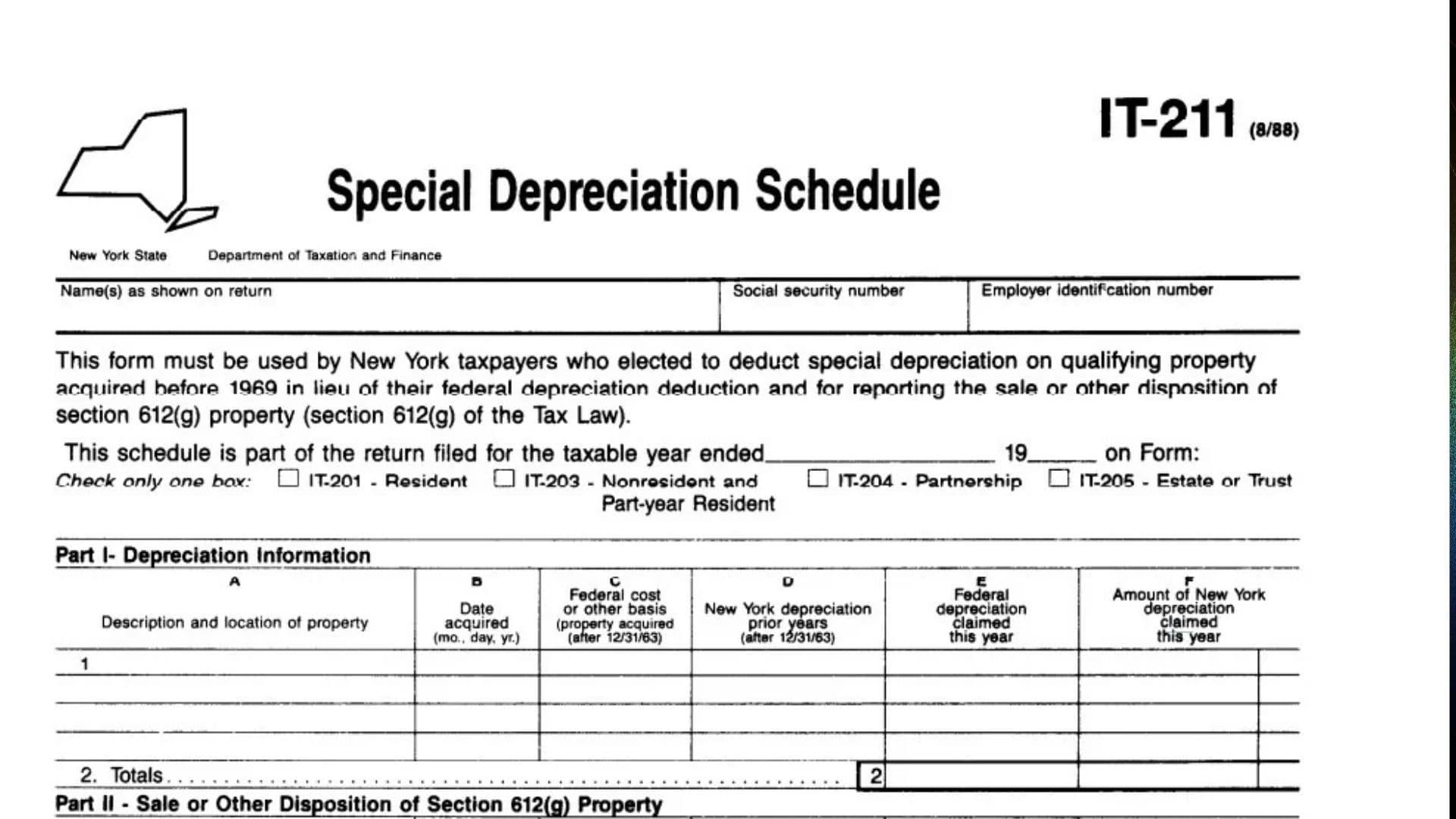
New York Form IT-211, Special Depreciation Schedule, is a tax schedule used by New York taxpayers who elected to claim special depreciation on qualifying property acquired before 1969 instead of using the federal depreciation deduction. It is also used to report the sale or other disposition of property subject to Section 612(g) of the New York Tax Law. The purpose of the schedule is to account for differences between federal and New York depreciation deductions and tax basis calculations. These differences can affect the amount of income, deductions, additions, and subtractions reported on a New York tax return. The form collects information about qualifying property, including its description, location, acquisition date, federal cost or other basis, depreciation claimed in previous years, current-year federal depreciation, and current-year New York depreciation. It also records information about property sold or otherwise disposed of, including the disposition date, manner of disposition, adjusted federal basis, New York basis, and the difference between the two amounts. The schedule contains separate reporting sections for individuals, estates, trusts, and partnerships. Individual taxpayers and fiduciaries use Part III to calculate the applicable additions and subtractions, while partnerships use Part IV to determine the net depreciation adjustments allocated to their partners. Completing Form IT-211 correctly is important because federal and New York depreciation rules may produce different tax basis amounts for the same property. These differences must be reflected in the appropriate New York income tax return to avoid reporting incorrect income or deductions. Form IT-211 is an attachment to the applicable New York tax return, rather than a standalone tax return. It can be attached to Form IT-201, Form IT-203, Form IT-204, or Form IT-205, depending on the taxpayer’s filing classification.
How To File Form IT-211
Form IT-211 must be attached to the applicable New York State income tax return for the taxable year covered by the depreciation adjustments.
The form identifies four possible tax returns:
- Form IT-201 – Resident Income Tax Return.
- Form IT-203 – Nonresident and Part-Year Resident Income Tax Return.
- Form IT-204 – Partnership Return.
- Form IT-205 – Estate or Trust Income Tax Return.
Select only one return type in the filing-status section at the top of Form IT-211.
Before completing the schedule, prepare the following information:
- Your name or the entity’s name as shown on the applicable tax return.
- Your Social Security number, if applicable.
- The Employer Identification Number (EIN), if applicable.
- The taxable year’s beginning and ending information, as required.
- A description and location of each qualifying property.
- The acquisition date of each property.
- The federal cost or other basis of qualifying property acquired after December 31, 1963.
- New York depreciation claimed in previous years after December 31, 1963.
- Federal depreciation claimed during the current tax year.
- New York depreciation claimed during the current tax year.
- Information about property sold or otherwise disposed of.
- The adjusted federal basis and New York basis at the date of disposition.
- Partner allocation information, if filing as a partnership.
Important: Form IT-211 is designed for the historical depreciation rules described in Section 612(g) of the New York Tax Law. The applicable tax return and tax year should match the period for which the depreciation adjustments are being reported.

How To Complete Form IT-211
Form IT-211 contains four main parts:
- Part I: Depreciation Information.
- Part II: Sale or Other Disposition of Section 612(g) Property.
- Part III: Summary for Individuals, Estates, and Trusts.
- Part IV: Summary for Partnerships (Partners’ Shares of Changes).
Follow the instructions below in the same order as the form.
Taxpayer and Tax Year Information
The top section identifies the taxpayer and the New York State tax return associated with the depreciation schedule.
Name(s) as Shown on Return
Enter your name exactly as it appears on the applicable New York State income tax return.
For a partnership, estate, or trust, enter the entity name as reported on its tax return.
Social Security Number
Enter the taxpayer’s Social Security number as shown on the applicable return.
This field identifies an individual taxpayer. Make sure the number is accurate.
Employer Identification Number
Enter the Employer Identification Number (EIN) when the schedule is being filed for a partnership, estate, or trust that uses an EIN.
Use the identification number associated with the entity’s tax records.
Taxable Year Ended
Enter the ending date of the taxable year for which the depreciation adjustments are being reported.
The form provides spaces for the taxable year ending date and year.
Use the same reporting period as the associated New York tax return.
Form IT-201: Resident
Mark an X in this box if Form IT-211 is being attached to a New York resident income tax return.
Form IT-203: Nonresident and Part-Year Resident
Mark an X in this box if the schedule is being attached to a nonresident or part-year resident income tax return.
Form IT-204: Partnership
Mark an X in this box if the schedule is being filed with a partnership return.
Form IT-205: Estate or Trust
Mark an X in this box if the schedule is being attached to an estate or trust income tax return.
Select only one filing-status box that corresponds to the return receiving the attachment.
Part I: Depreciation Information
Part I records depreciation information for qualifying property. It compares federal depreciation with New York depreciation to identify the adjustments required for the current tax year.
The schedule provides six columns for recording property details and depreciation amounts.
Column A: Description and Location of Property
Enter a description of each qualifying property and its location.
Identify the property clearly enough to distinguish it from other assets owned by the taxpayer.
Include the property’s location and a useful description of its type or purpose.
Column B: Date Acquired
Enter the date the property was acquired.
Use the month, day, and year format indicated on the form.
The acquisition date helps establish whether the property falls within the qualifying depreciation rules.
Column C: Federal Cost or Other Basis of Property Acquired After December 31, 1963
Enter the federal cost or other basis of qualifying property acquired after December 31, 1963.
Use the applicable federal tax basis information for the property.
The amount should reflect the cost or other basis recognized for federal tax purposes.
Column D: New York Depreciation Prior Years
Enter the amount of New York depreciation claimed in previous tax years for the property acquired after December 31, 1963.
Include depreciation claimed in prior years beginning after December 31, 1963, as specified by the form.
Use the New York depreciation records maintained for the property.
Column E: Federal Depreciation Claimed This Year
Enter the amount of federal depreciation claimed for the property during the current taxable year.
Use the depreciation deduction reported for federal income tax purposes.
If multiple qualifying properties are listed, report the applicable amount for each property.
Column F: Amount of New York Depreciation Claimed This Year
Enter the amount of New York depreciation claimed for the property during the current taxable year.
Use the New York depreciation calculation applicable to the property.
This amount is important because it is used in the additions and subtractions calculations in Part III and the partnership allocation calculations in Part IV.
Line 1: Property Depreciation Information
Use Line 1 to report the qualifying property information across Columns A through F.
Enter the description, acquisition date, federal basis, prior-year New York depreciation, current-year federal depreciation, and current-year New York depreciation for each applicable property.
The form provides multiple entry rows so that more than one property can be reported.
Make sure each property’s information is entered on the same row across all applicable columns.
Line 2: Totals
Add the applicable amounts reported in Columns E and F for all properties listed in Part I.
Enter the total federal depreciation claimed during the current year in Column E.
Enter the total New York depreciation claimed during the current year in Column F.
These totals are used in the calculations in Part III and Part IV.
Part II: Sale or Other Disposition of Section 612(g) Property
Part II is used to report the sale or other disposition of property covered by Section 612(g) of the New York Tax Law.
It records the property’s disposition date, how it was disposed of, and the difference between its federal and New York tax basis.
The schedule contains six columns.
Column A: Description of Property
Enter a description of each property sold or otherwise disposed of during the taxable year.
Identify the property clearly and make sure it corresponds to the property records maintained for depreciation purposes.
Column B: Date of Disposition
Enter the date the property was sold or otherwise disposed of.
Use the month, day, and year format indicated on the form.
The date should reflect the actual disposition date.
Column C: Manner of Disposition
Describe how the property was disposed of.
Identify the applicable transaction, such as a sale or another type of disposition.
Use a description that clearly explains how ownership or control of the property ended.
Column D: Adjusted Federal Basis at Date of Disposition
Enter the property’s adjusted federal tax basis on the date of disposition.
Use the federal basis after accounting for applicable depreciation and other basis adjustments.
The amount should reflect the property’s federal tax basis immediately before the disposition.
Column E: New York Basis at Date of Disposition
Enter the property’s New York tax basis on the date of disposition.
Calculate the basis using the applicable New York depreciation and adjustment records.
This amount may differ from the federal basis because of differences between federal and New York depreciation treatment.
Column F: Federal Basis Over New York Basis
Enter the difference between the adjusted federal basis and the New York basis at the date of disposition.
Calculate the amount using the figures reported in Columns D and E.
The calculation is:
Adjusted Federal Basis − New York Basis = Federal Basis Over New York Basis
Enter the resulting difference in Column F.
Line 3: Property Sold or Otherwise Disposed Of
Use Line 3 to report the details of each property sold or otherwise disposed of during the taxable year.
Complete Columns A through F for each applicable property.
The information must show the disposition date, manner of disposition, adjusted federal basis, New York basis, and resulting difference.
The form provides multiple rows for reporting more than one disposition.
Line 4: Total
Add the applicable amounts reported in Columns E and F for all properties listed in Part II.
Enter the total New York basis in Column E and the total federal basis over New York basis in Column F.
These totals are used in the partnership calculation in Part IV and the related depreciation adjustment reporting.
Part III: Summary for Individuals, Estates, and Trusts
Part III summarizes the depreciation adjustments for individuals, estates, and trusts.
It contains additions and subtractions that must be transferred to the appropriate New York State income tax return.
Additions
The additions section includes Lines 5 through 7.
These amounts account for the depreciation differences that must be added to income for New York tax purposes.
Line 5: Federal Depreciation Claimed This Year
Enter the amount from Part I, Line 2, Column E.
This represents the total federal depreciation claimed during the current taxable year for the qualifying properties.
Transfer the amount directly from the corresponding column.
Line 6: New York Depreciation Claimed This Year
Enter the amount from Part I, Line 2, Column F.
This represents the total New York depreciation claimed during the current taxable year.
Use the amount reported in the total row of Part I.
Line 7: Total Depreciation Addition
Add the amounts reported on Lines 5 and 6.
The calculation is:
Line 5 + Line 6 = Line 7
Enter the combined amount on Line 7.
Transfer this amount to the appropriate New York tax return:
- Form IT-201 or Form IT-203: Report the amount as an other addition.
- Form IT-205 or Form IT-205-A: Report the amount as a fiduciary addition adjustment.
Use the return that applies to your filing situation.
Subtractions
The subtraction section contains Line 8.
Line 8: New York Depreciation Claimed This Year
Enter the amount from Part I, Line 2, Column F.
This amount represents the total New York depreciation claimed during the current taxable year.
Transfer the Line 8 amount to the appropriate New York tax return:
- Form IT-201 or Form IT-203: Report it as an other subtraction.
- Form IT-205 or Form IT-205-A: Report it as a fiduciary subtraction adjustment.
Make sure the amount is transferred to the correct section of the applicable return.
Part IV applies to partnerships reporting depreciation adjustments that affect their partners’ shares of income or deductions.
This section calculates the net amount of depreciation-related changes allocated to each partner.
The schedule contains four columns and provides space for reporting multiple partners.
Partner Identification
The left-hand portion of the schedule identifies each partner associated with the depreciation adjustments.
Partner Identification
Enter the applicable partner identification information in the spaces provided.
Use the partner information associated with the partnership’s Form IT-204 filing records.
The schedule provides separate rows for multiple partners.
Additions
Columns A and B report the additions associated with the partnership’s depreciation adjustments.
Column A: Amount From Part I, Line 2, Column E
Enter the partner’s applicable share of the amount reported on Part I, Line 2, Column E.
This represents the federal depreciation amount allocated to the partner for the current taxable year.
Column B: Amount From Part II, Line 4, Column F
Enter the partner’s applicable share of the amount reported on Part II, Line 4, Column F.
This represents the federal basis over New York basis amount associated with the property dispositions.
Allocate the applicable amount to the partner using the partnership’s records.
Subtractions
Column C reports the subtraction associated with New York depreciation.
Column C: Amount From Part I, Line 2, Column F
Enter the partner’s applicable share of the amount reported on Part I, Line 2, Column F.
This represents the New York depreciation claimed during the current taxable year.
Use the amount allocated to the partner.
Net Amount
Column D calculates the partner’s net depreciation adjustment.
Column D: Net Amount
Add the amounts reported in Columns A and B, then subtract the amount reported in Column C.
The calculation is:
Column A + Column B − Column C = Column D
Enter the resulting net amount for each partner.
This amount represents the partner’s net share of the depreciation-related additions and subtractions.
Line 9(a): First Partner’s Net Depreciation Adjustment
Enter the first partner’s applicable amounts in Columns A, B, and C.
Calculate the net amount in Column D using the specified formula.
Line 9(b): Second Partner’s Net Depreciation Adjustment
Enter the second partner’s applicable depreciation adjustment amounts.
Calculate the net amount in Column D after accounting for additions and subtractions.
Line 9(c): Third Partner’s Net Depreciation Adjustment
Enter the third partner’s applicable amounts.
Use the same calculation method to determine the partner’s net adjustment.
Line 9(d): Fourth Partner’s Net Depreciation Adjustment
Enter the fourth partner’s applicable depreciation adjustment amounts.
Calculate the net amount using Columns A, B, and C.
If additional partner reporting space is needed, follow the applicable instructions for providing the required information.
Line 10: Total Partners’ Net Depreciation Adjustments
Add the applicable amounts reported for all partners in Line 9.
Calculate the totals for Columns A, B, C, and D separately.
The total in Column D represents the combined net depreciation adjustment allocated to the partners.
Make sure the total agrees with the amounts reported for the individual partners.
Attachment Instructions
At the bottom of Form IT-211, the form provides the required attachment instruction.
Attach the completed schedule to the applicable New York State tax return:
- Form IT-201.
- Form IT-203.
- Form IT-204.
- Form IT-205.
Select the appropriate return based on the taxpayer’s classification.
Final Review Before Filing
Before attaching Form IT-211 to your New York State tax return, review the following checklist to confirm that all property details, depreciation amounts, disposition information, and partner allocations are accurate.
Taxpayer and Tax Year Information
- Enter the taxpayer’s name as shown on the return.
- Verify the Social Security number, if applicable.
- Enter the Employer Identification Number, if applicable.
- Confirm the correct taxable year ending date.
- Select only one applicable tax return type.
- Make sure Form IT-211 corresponds to the tax year being reported.
Part I: Depreciation Information
- Identify each qualifying property in Column A.
- Enter the correct acquisition date in Column B.
- Verify the federal cost or other basis in Column C.
- Enter prior-year New York depreciation in Column D.
- Report current-year federal depreciation in Column E.
- Report current-year New York depreciation in Column F.
- Calculate the total federal depreciation on Line 2, Column E.
- Calculate the total New York depreciation on Line 2, Column F.
Part II: Property Dispositions
- Identify each property sold or otherwise disposed of.
- Enter the correct disposition date.
- Describe the manner of disposition.
- Verify the adjusted federal basis at the date of disposition.
- Calculate the New York basis at the date of disposition.
- Determine the federal basis over New York basis amount.
- Verify the totals reported on Line 4.
Part III: Individuals, Estates, and Trusts
- Transfer the amount from Part I, Line 2, Column E, to Line 5.
- Transfer the amount from Part I, Line 2, Column F, to Line 6.
- Add Lines 5 and 6 correctly on Line 7.
- Transfer Line 7 as an addition to the appropriate New York tax return.
- Enter the amount from Part I, Line 2, Column F, on Line 8.
- Transfer Line 8 as a subtraction to the appropriate New York tax return.
- Use the correct fiduciary adjustment treatment if filing Form IT-205 or Form IT-205-A.
Part IV: Partnership Adjustments
- Identify each applicable partner.
- Enter the appropriate federal depreciation amount in Column A.
- Enter the applicable disposition adjustment in Column B.
- Enter the New York depreciation amount in Column C.
- Calculate the net amount in Column D for each partner.
- Verify all partner calculations on Lines 9(a) through 9(d).
- Calculate the total partner adjustments on Line 10.
- Confirm that the partner allocations agree with the partnership’s records.
Final Filing Checks
- Review all property descriptions, acquisition dates, and basis amounts.
- Check that federal and New York depreciation amounts are reported in the correct columns.
- Verify all calculations and totals.
- Confirm that the correct additions and subtractions are transferred to the associated tax return.
- Attach Form IT-211 to Form IT-201, IT-203, IT-204, or IT-205, as applicable.
- Retain a copy of the completed schedule with the taxpayer’s depreciation records.
Final Filing Reminder: New York Form IT-211 is a Special Depreciation Schedule used to report differences between federal and New York depreciation treatment and to account for certain property dispositions under Section 612(g) of the New York Tax Law. Complete the applicable parts based on whether you are an individual, fiduciary, or partnership. Verify all depreciation adjustments, property basis differences, and partner allocations before attaching the schedule to the appropriate New York State tax return.