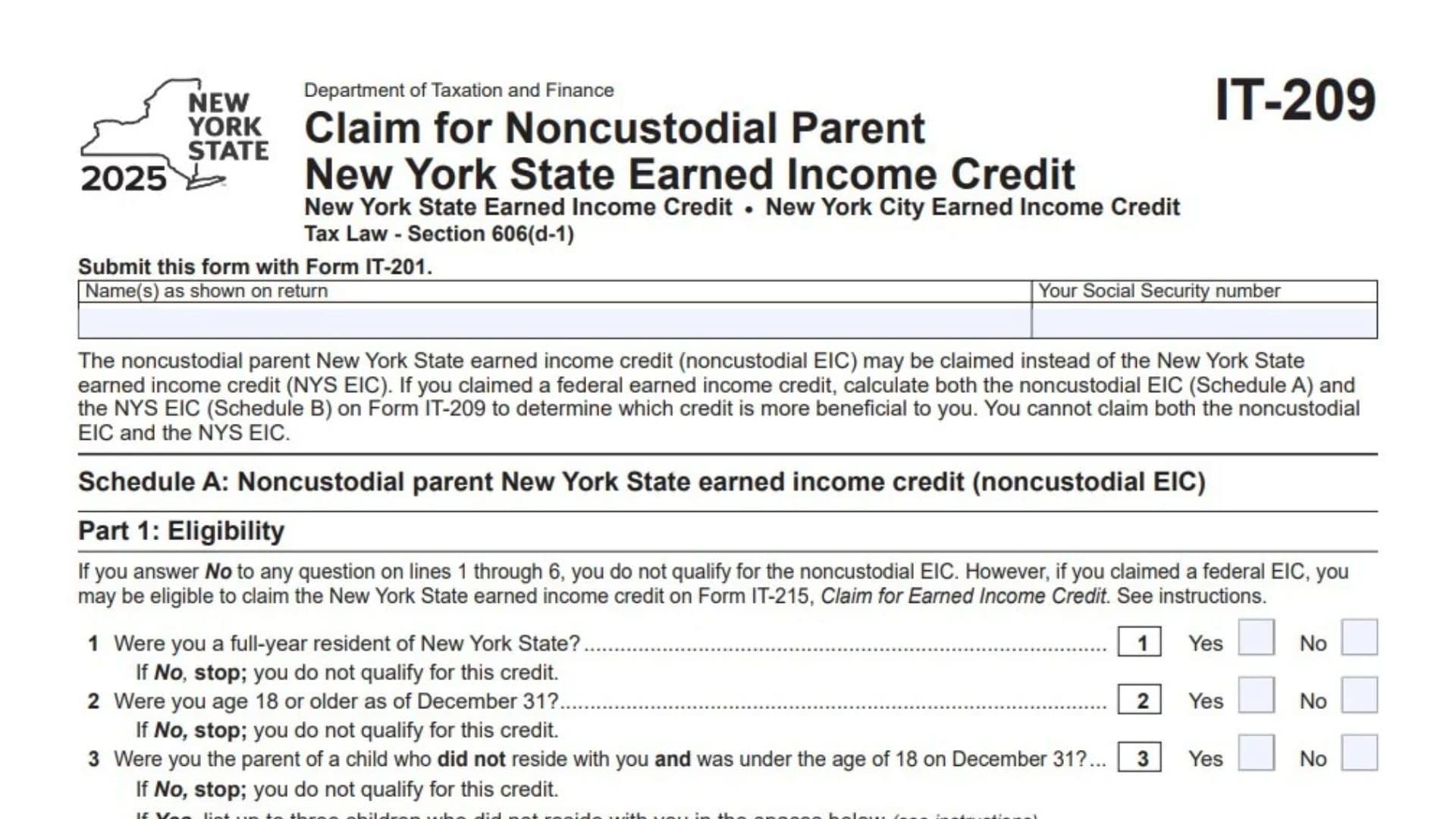
New York Form IT-209, officially titled Claim for Noncustodial Parent New York State Earned Income Credit, is a tax form issued by the New York State Department of Taxation and Finance for the 2025 tax year. It is used to determine whether eligible taxpayers can claim the noncustodial parent New York State earned income credit (Noncustodial EIC), the New York State earned income credit (NYS EIC), or the New York City earned income credit (NYC EIC). The form is particularly important for parents who do not live with their children but meet specific child support and income requirements. It allows qualifying noncustodial parents to claim a state tax credit based on their earned income and other eligibility conditions. The form also provides calculations for taxpayers who claimed the federal earned income credit and may qualify for the regular New York State or New York City earned income credits. Form IT-209 contains three schedules and several calculation sections. Schedule A determines eligibility for the noncustodial parent credit and calculates the potential credit amount. Schedule B calculates the regular New York State earned income credit using the federal earned income credit, qualifying children, and applicable New York tax information. Schedule C determines the New York City earned income credit for eligible full-year and part-year New York City residents. The form also allows taxpayers to ask the Tax Department to calculate both the noncustodial EIC and NYS EIC and provide the more beneficial credit. However, taxpayers cannot claim both the noncustodial EIC and the regular NYS EIC. The final calculation determines which credit provides the greater benefit under the applicable rules. Form IT-209 collects taxpayer identification information, residency details, child support payment history, qualifying child information, federal adjusted gross income, earned income, business income or losses, and other tax return amounts. It also includes questions about federal filing status, Social Security number eligibility, foreign earned income, and investment income. Completing the form accurately is important because eligibility depends on several specific conditions, and incorrect answers or calculations may result in an ineligible or incorrectly calculated credit. Form IT-209 must be submitted with Form IT-201, New York State Resident Income Tax Return. If the taxpayer has already filed the New York State income tax return, an amended return is required to claim the applicable credit.
Who Can Use Form IT-209?
Form IT-209 is designed for eligible New York taxpayers who want to determine whether they qualify for the noncustodial parent earned income credit, the regular New York State earned income credit, or the New York City earned income credit.
The form covers three potential credits:
- Noncustodial Parent New York State Earned Income Credit: For qualifying parents who have children who do not live with them and who satisfy the applicable child support requirements.
- New York State Earned Income Credit (NYS EIC): For eligible taxpayers who claimed the federal earned income credit and meet the applicable New York requirements.
- New York City Earned Income Credit (NYC EIC): For qualifying full-year or part-year New York City residents who claimed the federal earned income credit.
Basic Eligibility Requirements for the Noncustodial EIC
To qualify for the noncustodial parent credit, the taxpayer must satisfy the eligibility conditions in Schedule A, Part 1.
These include:
- Being a full-year resident of New York State.
- Being at least 18 years old on December 31.
- Being the parent of a child who did not live with the taxpayer and was under 18 on December 31.
- Having a child support order payable through a New York State Support Collection Unit (SCU) for at least half of the tax year.
- Paying at least the amount of child support due under every applicable child support order during the tax year.
- Having federal adjusted gross income below $50,434.
The form also includes additional eligibility questions concerning Social Security numbers, federal filing status, foreign earned income, and investment income.
Important: Answering No to any question on lines 1 through 6 means the taxpayer does not qualify for the noncustodial EIC. However, the form notes that taxpayers who claimed the federal EIC may still be eligible for the regular New York State earned income credit under the applicable rules.
How To File Form IT-209
Form IT-209 must be submitted with New York State Form IT-201.
It is not presented as a separate income tax return. Instead, it serves as a supporting calculation form for determining the earned income credits available to an eligible taxpayer.
Information To Prepare Before Completing the Form
Gather the following information before starting:
- Your full name as shown on Form IT-201.
- Your Social Security number.
- Your federal filing status.
- Your federal adjusted gross income from Form IT-201, line 19.
- Your wages, salaries, and tips.
- Your business income or loss, if applicable.
- Your business Employer Identification Number, when required.
- Information about children who do not live with you.
- Children’s Social Security numbers and dates of birth.
- Child support order information.
- Records of child support payments made during the tax year.
- Your federal earned income credit amount, if claimed.
- Information about qualifying children listed on federal Schedule EIC.
- New York State tax and credit information.
- New York City residency information, if applicable.
You may also need the official Form IT-209 instructions, Worksheet A, Worksheet B, Worksheet C, and the earned income credit tables because several calculations on the form refer to these materials.
Important Filing Requirement
If you have already filed your New York State income tax return, answer Yes to line 11.
The form specifically requires you to file an amended New York State return to claim the noncustodial EIC, NYS EIC, or NYC EIC after the original return has been submitted.

How To Complete Form IT-209
Form IT-209 contains three schedules:
- Schedule A: Noncustodial Parent New York State Earned Income Credit.
- Schedule B: New York State Earned Income Credit.
- Schedule C: New York City Earned Income Credit.
Complete the taxpayer identification information first. Then follow the eligibility questions and the instructions for the applicable credit calculations.
Taxpayer Identification Information
Names as Shown on Return
Enter your full name exactly as it appears on your New York State income tax return, Form IT-201.
If filing jointly, use the names as shown on the joint return.
Your Social Security Number
Enter your Social Security number in the designated field.
Verify that it matches the identifying number reported on Form IT-201.
Schedule A: Noncustodial Parent New York State Earned Income Credit
Schedule A calculates the noncustodial parent New York State earned income credit.
It contains three main sections:
- Part 1: Eligibility.
- Part 2: Claiming the Credit.
- Part 3: Earned Income.
- Part 4: Credit Calculation.
Part 1: Eligibility
Part 1 contains ten questions that determine whether the taxpayer meets the requirements for the noncustodial EIC and other earned income credits.
Answer each question accurately.
Line 1: Full-Year New York State Residency
Indicate whether you were a full-year resident of New York State during the tax year.
Select Yes if you maintained full-year New York State residency.
If you select No, stop the noncustodial EIC eligibility process because you do not qualify for this credit.
Line 2: Age Requirement
Indicate whether you were at least 18 years old on December 31 of the tax year.
Select Yes if you had reached age 18 by that date.
If you select No, you do not qualify for the noncustodial EIC.
Line 3: Parent of a Child Who Did Not Live With You
Indicate whether you were the parent of a child who did not reside with you and was under 18 years old on December 31.
If Yes, provide information for up to three qualifying children in the spaces provided.
The form requests:
- First name.
- Middle initial (MI).
- Last name.
- Suffix, if applicable.
- Relationship to the taxpayer.
- Social Security number.
- Date of birth in MMDDYYYY format.
List only children who meet the conditions described in the question.
If you select No, you do not qualify for the noncustodial EIC.
Line 4: Child Support Order Through a Support Collection Unit
Indicate whether you had a child support order payable through a New York State Support Collection Unit (SCU) for at least one-half of the tax year.
Select Yes if an applicable child support order was payable through the SCU for the required period.
If you select No, you do not qualify for the noncustodial EIC.
Line 5: Child Support Payments
Indicate whether you paid at least the full amount of child support due under every order requiring payments during the tax year.
Compare the payments you made with the total amounts required under all applicable child support orders.
Select Yes if you satisfied the payment requirement.
If you select No, you do not qualify for the noncustodial EIC.
Line 6: Federal Adjusted Gross Income
Indicate whether your federal adjusted gross income was less than $50,434.
Use the amount reported on Form IT-201, line 19.
Select Yes if the amount is below $50,434.
If your federal AGI is $50,434 or higher, select No. You do not qualify for the noncustodial EIC.
Line 7: Valid Social Security Number
Indicate whether you and your spouse, if filing a joint return, have Social Security numbers that permit employment or are valid for federal earned income tax purposes.
Select Yes if the applicable Social Security number requirements are satisfied.
If you select No, you do not qualify for the noncustodial EIC, NYS EIC, or NYC EIC.
Line 8: Married Filing Separately Eligibility
Indicate whether your federal filing status is Married filing separately and whether you meet the requirements to be treated as unmarried for earned income credit purposes.
Select the appropriate answer.
If you answer Yes, review the additional requirements in the official instructions before proceeding.
Line 9: Foreign Earned Income
Indicate whether you are filing federal Form 2555, which relates to foreign earned income.
If you select Yes, stop. You do not qualify for the noncustodial EIC, NYS EIC, or NYC EIC.
Line 10: Investment Income
Indicate whether your investment income exceeds $11,950.
Use the applicable investment income information and the official instructions to determine whether you exceed this threshold.
If you select Yes, stop. You do not qualify for the noncustodial EIC, NYS EIC, or NYC EIC.
Part 2: Claiming the Credit
Part 2 contains two questions that determine how the credit calculations will be completed.
Line 11: Previously Filed New York State Income Tax Return
Indicate whether you have already filed your New York State income tax return.
If Yes, you must submit an amended return to claim the noncustodial EIC, NYS EIC, or NYC EIC.
If No, continue with the applicable filing and calculation instructions.
Line 12: Request Tax Department Calculation
Indicate whether you want the New York State Tax Department to calculate both your noncustodial EIC and NYS EIC and provide the greater of the two credits.
Select Yes if you want the Tax Department to perform the comparison.
If Yes, complete:
- Lines 13 through 17.
- Lines 33 and 34 if you claimed the federal EIC.
- Lines 46 and 47 if you are a New York City part-year resident.
If No, you must calculate the credits yourself.
Complete:
- Lines 13 through 32.
- Lines 33 through 43 if you claimed the federal EIC.
- Lines 44 through 47 if you are a New York City resident or part-year resident.
Follow the applicable instructions for the credit calculation you select.
Part 3: Earned Income
Part 3 collects the information needed to calculate earned income for the noncustodial EIC.
All amounts must be entered in whole dollars.
Line 13: Wages, Salaries, Tips, Etc.
Enter the amount calculated on Worksheet A, line 5, from the official Form IT-209 instructions.
Use Worksheet A to determine the qualifying wages, salaries, tips, and other applicable earned income.
Do not substitute an unsupported estimate for the worksheet result.
Line 14: Earned Income Adjustment
Enter the earned income adjustment calculated under the applicable Form IT-209 instructions.
Use the specific adjustment calculation provided in those instructions.
Line 15: Business Income or Loss
Enter the business income or loss calculated on Worksheet B, line 4.
If this line applies, also provide the Employer Identification Number (EIN) associated with the business.
Mark an X in the appropriate box to indicate whether the amount represents:
- Profit.
- Loss.
Make sure the profit or loss classification agrees with the Worksheet B calculation.
Line 16: Total Earned Income
Calculate total earned income using the amounts reported on lines 13, 14, and 15.
The form provides different calculations depending on whether line 15 represents a profit or a loss.
If line 15 is a profit:
Subtract line 14 from line 13, then add line 15.
The calculation is:
Line 13 − Line 14 + Line 15 = Line 16
If line 15 is a loss:
Subtract line 14 from line 13, then subtract line 15, following the form’s stated calculation.
The calculation is:
Line 13 − Line 14 − Line 15 = Line 16
If line 16 is zero or less, stop. You do not qualify for the noncustodial EIC.
Line 17: Federal Adjusted Gross Income
Enter your federal adjusted gross income from Form IT-201, line 19.
Use the exact amount reported on your New York State income tax return.
This amount is used in the following credit calculations and earned income credit table comparisons.
Part 4: Noncustodial EIC Calculation
Part 4 calculates the noncustodial EIC using two methods.
The first calculation is based on 20% of the federal earned income credit amount associated with one qualifying child.
The second calculation uses 2.5 times the applicable federal earned income credit table amount for taxpayers without a qualifying child.
The form ultimately uses the greater of the two calculated amounts.
Credit Calculation at 20% of Federal EIC With One Qualifying Child
Line 18: Earned Income Credit Table Amount
Find the total earned income reported on line 16 in the earned income credit tables included in the Form IT-209 instructions.
Enter the amount from column A of the applicable table.
Line 19: Comparison of Earned Income and Federal AGI
Indicate whether the amounts on lines 16 and 17 are equal.
If Yes, skip lines 20 and 21 and enter the amount from line 18 on line 22.
If No, continue to line 20.
Line 20: Federal AGI Below $23,350
Indicate whether the federal adjusted gross income on line 17 is less than $23,350.
If Yes, skip line 21 and enter the amount from line 18 on line 22.
If No, continue to line 21.
Line 21: Earned Income Credit Table Amount Based on Federal AGI
Find the federal adjusted gross income reported on line 17 in the earned income credit tables included in the instructions.
Enter the amount from column A.
Line 22: Smaller Credit Table Amount
Compare the amounts on lines 18 and 21.
Enter whichever amount is smaller.
If the instructions on lines 19 or 20 direct you to skip line 21, use the amount from line 18 as directed.
Line 23: Noncustodial EIC Rate
The applicable noncustodial EIC rate is 20%, or 0.20.
Use the rate shown on the form.
Line 24: Noncustodial EIC Calculation
Multiply line 22 by the 20% rate on line 23.
The calculation is:
Line 22 × 0.20 = Line 24
Enter the resulting amount.
Credit Calculation at 2.5 Times Federal EIC Without a Qualifying Child
Line 25: Earned Income Credit Table Amount
Find the earned income reported on line 16 in the earned income credit tables included in the instructions.
Select the correct table column based on your New York State filing status:
- If your filing status is Married filing joint return, use column C.
- For all other filing statuses, use column B.
Enter the applicable amount.
Line 26: Comparison of Earned Income and Federal AGI
Indicate whether the amounts on lines 16 and 17 are equal.
If Yes, skip lines 27 and 28 and enter the amount from line 25 on line 29.
If No, continue to line 27.
Line 27: Federal AGI Income Threshold
Indicate whether the amount on line 17 is less than the applicable threshold:
- $10,650 for filing statuses other than Married filing jointly.
- $17,750 for Married filing jointly.
If Yes, skip line 28 and enter the amount from line 25 on line 29.
If No, continue to line 28.
Line 28: Earned Income Credit Table Amount Based on Federal AGI
Find the federal adjusted gross income from line 17 in the earned income credit tables.
Use the appropriate column:
- Column C for Married filing joint return.
- Column B for all other filing statuses.
Enter the applicable amount.
Line 29: Smaller Credit Table Amount
Compare lines 25 and 28.
Enter whichever amount is smaller.
If the instructions on line 26 or line 27 direct you to skip line 28, enter the amount from line 25.
Line 30: Noncustodial EIC Factor
The noncustodial EIC factor is 2.5.
Use the factor shown on the form.
Line 31: Noncustodial EIC Calculation
Multiply line 29 by the factor of 2.5 reported on line 30.
The calculation is:
Line 29 × 2.5 = Line 31
Enter the resulting amount.
Line 32: Final Noncustodial EIC
Compare the amounts on lines 24 and 31.
Enter whichever amount is greater.
The calculation is:
Greater of Line 24 or Line 31 = Line 32
This is the noncustodial EIC amount used in the comparison with the regular New York State earned income credit.
Schedule B: New York State Earned Income Credit (NYS EIC)
Schedule B calculates the regular New York State earned income credit.
It uses the federal earned income credit amount, qualifying children, and applicable New York tax information.
Federal Earned Income Credit Eligibility
Line 33: Federal Earned Income Credit
Indicate whether you claimed the federal earned income credit.
If No, stop the NYS EIC calculation because you do not qualify for the regular New York State earned income credit.
If Yes, continue to line 34.
Line 34: Qualifying Children on Federal Schedule EIC
Indicate whether you claimed qualifying children on your federal Schedule EIC.
If No, continue to line 35.
If Yes, list up to three of the same qualifying children reported on your federal Schedule EIC.
Do not list the same children that you entered on line 3 of page 1.
For each child, complete the following information:
- First name.
- Middle initial.
- Last name.
- Suffix, if applicable.
- Relationship.
- Number of months the child lived with you.
- Full-time student checkbox.
- Person with disability checkbox.
- Social Security number.
- Date of birth in MMDDYYYY format.
Full-Time Student and Disability Checkboxes
Mark these boxes only if you answered Yes to the corresponding questions on your federal Schedule EIC.
The form specifically refers to boxes 4a and 4b of the federal Schedule EIC.
Do not mark these boxes based on assumptions or information that does not match the federal schedule.
Line 35: Federal Earned Income Credit Amount
Enter the amount of federal earned income credit claimed on your federal Form 1040, line 27a.
Use the amount reported on the federal return.
Line 36: New York State EIC Rate
The New York State earned income credit rate is 30%, or 0.30.
Use the rate shown on the form.
Line 37: Tentative New York State EIC
Multiply line 35 by the 30% rate on line 36.
The calculation is:
Line 35 × 0.30 = Line 37
Enter the resulting tentative New York State earned income credit.
New York State Credit Adjustments
Line 38: Adjusted Amount for Credit Calculation
Complete lines 38a through 38e.
After calculating line 38e, enter that amount on line 38.
The individual calculations are explained below.
Line 38a: New York State Tax Amount
Enter the amount reported on Form IT-201, line 39.
Use the amount from the applicable New York State income tax return.
Line 38b: Resident Credit
Enter the applicable New York State resident credit amount.
Use the amount determined under the resident credit calculation and the applicable instructions.
Line 38c: Accumulation Distribution Credit
Enter the applicable accumulation distribution credit.
Use the amount supported by the corresponding tax calculation.
Line 38d: Total of Other Credits
Add the amounts reported on lines 38b and 38c.
The calculation is:
Line 38b + Line 38c = Line 38d
Enter the total.
Line 38e: Remaining Amount
Subtract line 38d from line 38a.
The calculation is:
Line 38a − Line 38d = Line 38e
If line 38d is greater than line 38a, enter zero instead.
The amount calculated on line 38e must also be entered on line 38 above.
Line 39: Amount From Line 38
Enter the amount reported on line 38.
Use the final amount calculated after completing lines 38a through 38e.
Line 40: New York State Household Credit
Enter the New York State household credit reported on Form IT-201, line 40.
Use the amount from the applicable New York State return.
Line 41: Smaller Credit Amount
Compare the amounts on lines 39 and 40.
Enter whichever amount is smaller.
The calculation is:
Smaller of Line 39 or Line 40 = Line 41
Line 42: Allowable New York State Earned Income Credit
Subtract line 41 from line 37.
The calculation is:
Line 37 − Line 41 = Line 42
Enter the resulting allowable NYS EIC.
Line 43: Noncustodial Parent Earned Income Credit
Enter the noncustodial EIC calculated on line 32.
This amount is used to compare the noncustodial credit with the regular New York State earned income credit.
Choosing Between the Two New York State Credits
You cannot claim both the regular NYS EIC and the noncustodial EIC.
Compare line 42 with line 43.
- If line 42 is greater than line 43, enter the line 42 amount on Form IT-201, line 65.
- If line 43 is greater than line 42, enter the line 43 amount on Form IT-201, line 66.
Claim only the applicable credit.
If the two amounts are equal, consult the official Form IT-209 instructions for the applicable reporting treatment.
Schedule C: New York City Earned Income Credit (NYC EIC)
Schedule C calculates the New York City earned income credit for eligible full-year and part-year New York City residents.
To qualify for this credit, you must satisfy both conditions stated on the form:
- You must be a full-year or part-year resident of New York City.
- You must have claimed the federal earned income credit.
Line-By-Line Instructions for Schedule C
Line 44: New York City Residency
Indicate whether you were a resident of New York City during the tax year.
The schedule applies to both full-year and part-year New York City residents.
If you select No, stop. You do not qualify for the NYC EIC.
If Yes, continue to line 45.
Line 45: New York City Earned Income Credit
Enter the New York City earned income credit calculated on Worksheet C in the official Form IT-209 instructions.
Also enter this amount on Form IT-201, line 70.
If you are a part-year New York City resident, you must also complete lines 46 and 47.
Line 46: Part-Year New York City Adjusted Gross Income
Enter the amount calculated on Worksheet C, line 7.
Use the specific amount from the worksheet rather than calculating it independently.
Line 47: Part-Year New York City Adjusted Gross Income
Enter the amount calculated on Worksheet C, line 6.
Use the amount from the corresponding worksheet line.
Complete both lines when required for a part-year New York City resident.
Important Filing and Calculation Considerations
You Cannot Claim Both New York State Credits
The noncustodial parent EIC and regular New York State EIC are mutually exclusive.
Form IT-209 compares the two amounts to determine which one provides the greater benefit.
Use the appropriate result from line 42 or line 43 when completing Form IT-201.
Use the Correct Earned Income Credit Tables
Several calculations in Part 4 require amounts from the earned income credit tables included in the Form IT-209 instructions.
These include:
- Line 18: Earned income from line 16, column A.
- Line 21: Federal AGI from line 17, column A.
- Line 25: Earned income from line 16, column B or C.
- Line 28: Federal AGI from line 17, column B or C.
Select the correct column based on the filing status and the specific line instructions.
Do not substitute figures from a different tax year.
Use the Required Worksheets
The form references three worksheets:
- Worksheet A: Used to calculate the wages, salaries, tips, and other applicable earned income reported on line 13.
- Worksheet B: Used to calculate business income or loss reported on line 15.
- Worksheet C: Used to calculate the New York City earned income credit and applicable part-year resident amounts reported on lines 45 through 47.
The worksheets are included in the separate Form IT-209 instructions, not on the four-page tax form itself.
Understand the Difference Between Full-Year and Part-Year NYC Residency
Schedule C applies to both full-year and part-year New York City residents who claimed the federal EIC.
However, part-year residents must also complete lines 46 and 47 using Worksheet C.
Make sure you follow the additional instructions for part-year residency when calculating the NYC EIC.
Filing an Amended Return
If you already filed Form IT-201 before claiming the credit, line 11 requires you to file an amended New York State return.
Follow the applicable amended return instructions when reporting the additional credit.
Final Review Before Filing
Before submitting New York Form IT-209, review the following checklist to ensure that every eligibility question, calculation, and supporting amount is correct.
Taxpayer Information
- Enter your name exactly as shown on Form IT-201.
- Enter your correct Social Security number.
- Confirm that your identifying information matches your New York State income tax return.
Schedule A: Eligibility
- Confirm full-year New York State residency.
- Verify that you were at least 18 years old on December 31.
- Confirm that you were the parent of a child who did not live with you and was under 18.
- Enter the required information for up to three children on line 3.
- Verify the child support order payable through the New York State SCU.
- Confirm that all required child support payments were made.
- Check federal AGI against the $50,434 eligibility threshold.
- Verify the applicable Social Security number requirements.
- Answer the Married filing separately eligibility question correctly.
- Confirm whether federal Form 2555 was filed.
- Check investment income against the $11,950 threshold.
Part 2: Claiming the Credit
- Answer whether you already filed your New York State income tax return on line 11.
- If already filed, prepare to submit an amended return.
- Select the appropriate Tax Department calculation option on line 12.
- Follow the correct line completion instructions based on your selection.
Part 3: Earned Income
- Enter the amount from Worksheet A on line 13.
- Enter the applicable earned income adjustment on line 14.
- Enter the business income or loss from Worksheet B on line 15.
- Provide the business EIN when applicable.
- Mark the correct profit or loss checkbox.
- Calculate total earned income on line 16.
- Stop the noncustodial EIC calculation if line 16 is zero or less.
- Enter federal AGI from Form IT-201, line 19, on line 17.
Part 4: Noncustodial EIC Calculation
- Find the correct earned income table amount for line 18.
- Answer the comparison question on line 19.
- Complete line 20 when required.
- Enter the applicable table amount on line 21 when required.
- Calculate the smaller amount on line 22.
- Apply the 20% rate on line 23.
- Calculate line 24.
- Find the correct table amount on line 25.
- Complete the comparison on line 26.
- Apply the appropriate income threshold on line 27.
- Enter the applicable table amount on line 28 when required.
- Calculate the smaller amount on line 29.
- Apply the 2.5 factor on line 30.
- Calculate line 31.
- Enter the greater amount from lines 24 and 31 on line 32.
Schedule B: New York State EIC
- Confirm whether you claimed the federal EIC on line 33.
- Answer the qualifying child question on line 34.
- List up to three qualifying children when applicable.
- Do not repeat the children listed on line 3 of page 1.
- Enter the number of months each child lived with you.
- Mark the student and disability boxes only when supported by federal Schedule EIC.
- Enter the federal EIC from Form 1040, line 27a, on line 35.
- Apply the 30% rate on line 36.
- Calculate tentative NYS EIC on line 37.
- Complete lines 38a through 38e.
- Enter the calculated amount on line 38.
- Complete lines 39 through 41.
- Calculate allowable NYS EIC on line 42.
- Enter the noncustodial EIC from line 32 on line 43.
- Compare lines 42 and 43.
- Claim only one of the two New York State credits.
- Transfer the selected amount to the appropriate line of Form IT-201.
Schedule C: New York City EIC
- Confirm full-year or part-year New York City residency.
- Verify that you claimed the federal EIC.
- Answer the residency question on line 44.
- Enter the amount from Worksheet C on line 45.
- Transfer the applicable amount to Form IT-201, line 70.
- If a part-year resident, complete line 46 using Worksheet C, line 7.
- Complete line 47 using Worksheet C, line 6.
Final Submission Checks
- Verify that all calculations use the correct 2025 earned income credit tables.
- Check all income amounts against the applicable tax records.
- Verify child support information and qualifying child details.
- Confirm that the correct calculation method was selected on line 12.
- Make sure the noncustodial EIC and NYS EIC are not both claimed.
- Attach Form IT-209 to Form IT-201.
- If the original return was already filed, follow the amended return requirement.
- Retain a copy of the completed form and supporting tax records.
Correctly completing New York Form IT-209 helps eligible taxpayers determine which earned income credit provides the greatest tax benefit. Carefully review the child support requirements, residency conditions, federal income information, qualifying children, and applicable credit calculations before submitting the form with your New York State income tax return.