A New York State S corporation may file a group return on behalf of qualified nonresident shareholders who elect to participate.
The group return is generally available when the S corporation has New York-source income and at least 11 qualified nonresident shareholders who:
- Elect to participate in the group return.
- Have the same accounting period.
- Meet the applicable nonresident shareholder requirements.
The S corporation must receive prior approval from the New York State Department of Taxation and Finance before filing a group return.
To request approval, the corporation must submit Form TR-99, Application for Permission to File a Group Return. Once approved, the department assigns the corporation a special New York State identification number for group return filing.
A qualified nonresident shareholder must generally be a New York nonresident for the entire tax year, must not maintain a permanent place of abode in New York State, and must satisfy the other eligibility conditions. A shareholder who is a trust does not qualify under this definition.
Shareholders participating in the group return generally do not need to file a separate New York State nonresident individual income tax return for that tax year. However, participating shareholders must accept the applicable restrictions on personal deductions, credits, and loss carryovers.
The S corporation must maintain the required shareholder elections and supporting authorizations. It must also appoint a group agent who is authorized to act on behalf of the participating shareholders, sign the group return, and receive communications from the Tax Department.

How To Complete Form IT-203-S-ATT
Form IT-203-S-ATT contains three pages. Each page continues the shareholder information and calculations started on the previous page.
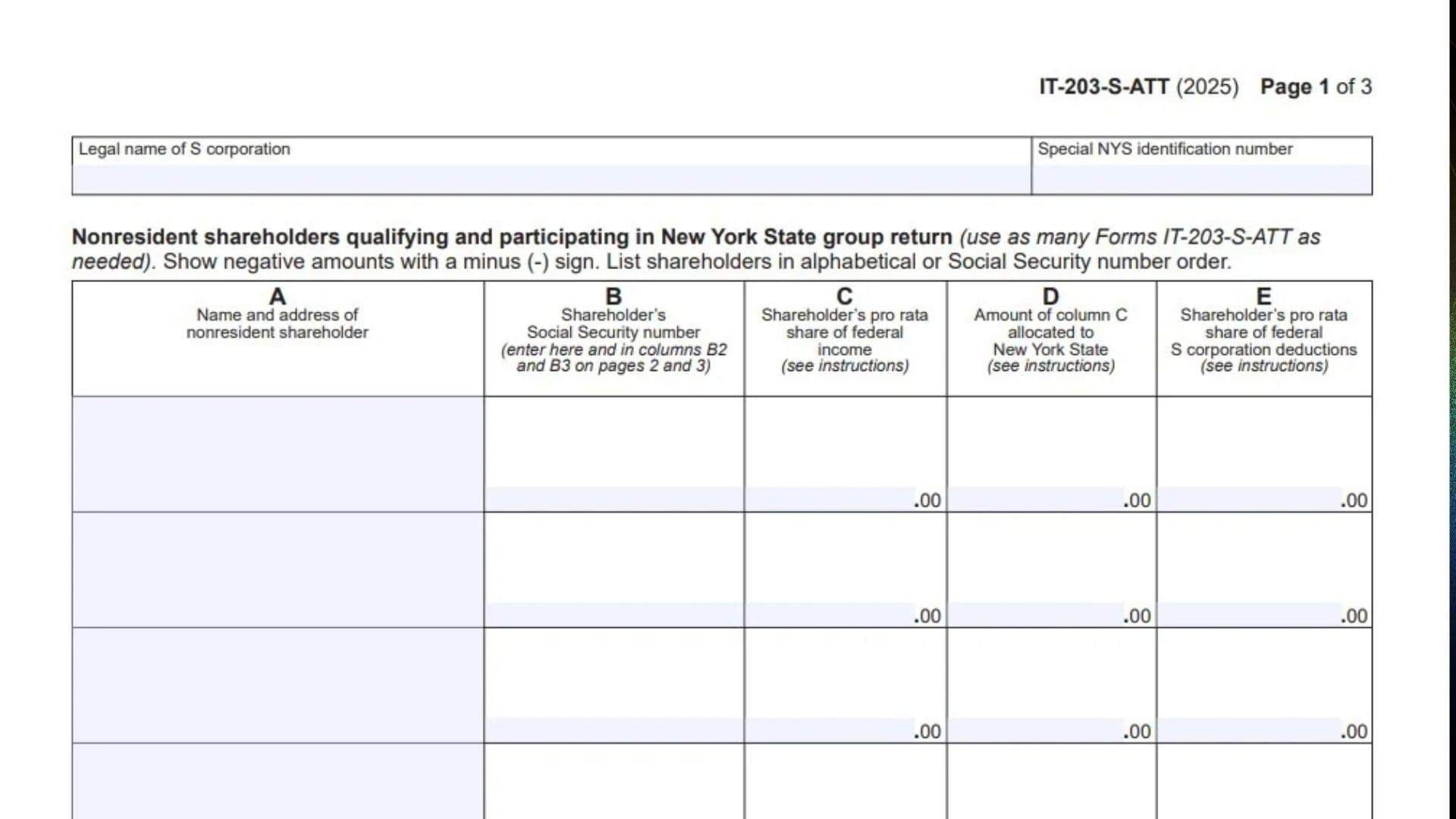
The form uses the following column structure:
| Page | Columns | Information collected |
|---|---|---|
| Page 1 | A–E | Shareholder identification, federal income, New York allocation, and federal deductions |
| Page 2 | B2, F–I | New York deductions, adjustments, taxable income, and tax |
| Page 3 | B3, J–M | Estimated payments, balance due, overpayment, and other group returns |
Before completing the columns, enter the corporation’s identification information at the top of each page.
S Corporation Identification Information
Legal Name Of S Corporation
Enter the complete legal name of the S corporation filing the group return.
Use the same legal name reported on the corporation’s New York State S corporation tax return.
If the corporation has a different trade name, follow the applicable identification instructions for the main return.
Special NYS Identification Number
Enter the special New York State identification number assigned to the S corporation after the Tax Department approves its group return application.
This number is also called the Group ID.
Use the same identification number on all pages of Form IT-203-S-ATT and the accompanying Form IT-203-S.
Page 1 identifies the qualified nonresident shareholders participating in the New York State group return.
The form provides space for nine shareholders per page.
You may use additional Forms IT-203-S-ATT when more than nine shareholders participate.
List shareholders in alphabetical order or Social Security number order. Maintain the same shareholder order on all three pages.
Show negative amounts using a minus (-) sign.
Enter the full name and complete mailing address of each qualified nonresident shareholder participating in the group return.
Include:
- Shareholder’s full legal name.
- Street address.
- City.
- State.
- ZIP code or applicable postal code.
Make sure the shareholder’s information matches the supporting tax records.
List all participating shareholders in alphabetical or Social Security number order.
Enter the shareholder’s complete Social Security number (SSN).
Use the same SSN when completing the corresponding fields on Pages 2 and 3.
The form specifically requires the shareholder’s SSN to be repeated in:
- Column B on Page 1.
- Column B2 on Page 2.
- Column B3 on Page 3.
Make sure the same shareholder’s SSN appears on the corresponding row throughout all three pages.
Enter each shareholder’s pro rata share of the federal income reported on the S corporation’s federal Schedule K-1.
Use the applicable federal Schedule K-1 amounts from Lines 1 through 10.
The amount should represent the shareholder’s allocated share of the corporation’s federal income, gain, loss, and other applicable items.
Calculate the shareholder’s share using the applicable ownership and allocation information.
If the shareholder has a negative amount, enter it with a minus (-) sign.
Column D: Amount Of Column C Allocated To New York State
Enter the portion of the amount reported in Column C that is allocated to New York State.
Determine the allocation using the S corporation’s business apportionment factor under Article 9-A.
Apply the applicable apportionment factor to the shareholder’s federal income allocation to determine the New York State portion.
The amount in this column represents the shareholder’s share of federal income allocated to New York State.
Do not automatically copy the full amount from Column C unless the applicable allocation calculation supports that result.
Enter the shareholder’s pro rata share of federal S corporation deductions reported in Boxes 11 and 12 of federal Schedule K-1.
Include deductions that are not allowed when calculating the amount reported in Column D.
Do not include deductions that must be treated as itemized deductions on the shareholder’s federal income tax return.
Use the shareholder’s applicable federal Schedule K-1 information to determine the correct amount.
If a deduction is not allowed in calculating the New York allocation reported in Column D, include the applicable amount in Column E.
Page 2: New York State Income And Tax Calculations
Page 2 continues the shareholder information from Page 1.
It uses the same shareholder order and includes columns for the Social Security number, New York-allocated deductions, state additions and subtractions, taxable income, and New York State tax.
Repeat the shareholder’s Social Security number from Column B on Page 1.
Enter each shareholder’s SSN on the same corresponding row.
Do not change the shareholder order between pages.
Column F: Amount Of Column E Allocated To New York State
Enter the portion of the deductions reported in Column E that is allocated to New York State.
Allocate these deductions in the same manner as the related federal income, gain, or loss item.
If a deduction in Column E does not relate to a particular federal income item, use the percentage of total federal S corporation income, gain, or loss allocated to New York State to determine its allocation.
For example, if a deduction relates to a particular income item, use the same New York allocation method applied to that income item.
If the deduction does not relate to a specific item, use the applicable percentage of total federal S corporation income, gain, or loss allocated to New York State.
Column G: Net Amount Of New York Additions And Subtractions Allocated To New York State
Enter the net amount of New York State additions and subtractions allocated to the shareholder.
Use the applicable amounts reported on Form CT-34-SH, New York S Corporation Shareholders’ Information Schedule, Lines 1 through 5.
Allocate the additions and subtractions to New York State in the same manner as the related federal income, gain, or loss items.
Combine the applicable additions and subtractions and enter the resulting net amount.
If the result is negative, use a minus (-) sign.
Column H: New York Taxable Income
Calculate the shareholder’s New York taxable income using Columns D, F, and G.
The calculation is:
Column D − Column F + or − Column G = Column H.
In other words:
- Start with the New York-allocated federal income from Column D.
- Subtract the New York-allocated deductions from Column F.
- Add or subtract the net New York additions and subtractions from Column G.
Enter the resulting New York taxable income.
Pay attention to negative amounts in Column G when completing the calculation.
Column I: New York State Tax
Multiply the amount in Column H by 0.1090 (10.90%).
The calculation is:
Column H × 0.1090 = Column I.
Enter the resulting New York State tax for each shareholder.
Use the amount calculated for the corresponding shareholder.
Totals Section: Page 2
The bottom of Page 2 contains a totals section.
If you are submitting multiple Forms IT-203-S-ATT, combine the applicable amounts from all forms and enter the grand totals on the last Form IT-203-S-ATT.
Leave the corresponding total boxes blank on the other forms.
The totals section includes the applicable amounts from Columns F, G, H, and I.
Transfer the totals to the appropriate lines on Form IT-203-S.
Submit all completed Forms IT-203-S-ATT with Form IT-203-S.
Page 3: Payments, Balance Due, And Overpayment
Page 3 continues the shareholder information and calculates the estimated payments, remaining balance due, or overpayment for each shareholder.
Maintain the same shareholder order used on Pages 1 and 2.
Enter the shareholder’s complete Social Security number.
Use the same SSN reported in Columns B and B2 on the preceding pages.
Make sure each shareholder’s information remains on the correct corresponding row.
Column J: New York State Estimated Income Tax Paid / Amount Paid With Form IT-370
Enter the amount of New York State estimated income tax paid on behalf of each shareholder.
Also include any amount paid with Form IT-370, Application for Automatic Six-Month Extension of Time to File for Individuals.
You may include:
- Estimated income tax payments made for the shareholder.
- Payments made with Form IT-370.
- Both types of payments, when applicable.
- Any overpayment from the 2024 group return that was applied toward the shareholder’s estimated income tax.
Use the corporation’s payment records to determine the amount attributable to each shareholder.
The group agent must maintain records showing how the total estimated tax payments are allocated among participating shareholders.
Column K: Balance Due
Subtract Column J from Column I.
The calculation is:
Column I − Column J = Column K.
Enter the resulting balance due for each shareholder.
This column identifies the remaining New York State tax after accounting for the estimated payments and applicable extension payments reported in Column J.
If the amount in Column J is greater than the amount in Column I, the calculation does not produce a positive balance due. Report the overpayment separately in Column L.
Column L: Overpayment
Subtract Column I from Column J.
The calculation is:
Column J − Column I = Column L.
Enter the resulting overpayment for each shareholder when estimated payments exceed the New York State tax calculated in Column I.
If Column I is greater than Column J, use Column K to report the balance due instead.
Column M: Other Group Returns
Check the box or mark an X in this column if the shareholder is participating in another group return.
This column identifies shareholders who are also included in another qualifying group filing.
If the shareholder does not participate in another group return, leave the column unmarked.
The form’s instructions specifically require an X when the shareholder participates in another group return.
Additional Forms IT-203-S-ATT
The form provides space for nine shareholders on each page.
If more than nine qualified nonresident shareholders are participating in the group return, complete additional Forms IT-203-S-ATT.
Follow these requirements:
- Use as many additional forms as necessary.
- Include every qualified nonresident shareholder participating in the group return.
- Maintain alphabetical or Social Security number order.
- Keep the shareholder order consistent across Pages 1, 2, and 3.
- Repeat the corporation’s legal name on every additional form.
- Repeat the special New York State identification number on every additional form.
- Complete the corresponding shareholder information on all three pages.
- Enter the grand totals from all Forms IT-203-S-ATT on the last form.
- Leave the totals boxes blank on the other forms.
- Submit all completed Forms IT-203-S-ATT with Form IT-203-S.
If you create your own version of the attachment instead of using the official form, it must follow the same format and use an easily readable font of at least 12 points.
How To File Form IT-203-S-ATT
Form IT-203-S-ATT must be submitted with Form IT-203-S, Group Return for Nonresident Shareholders of New York S Corporations.
It should not be filed as an independent individual income tax return.
Step 1: Obtain Approval To File A Group Return
Before submitting the group return, make sure the S corporation has received approval from the New York State Department of Taxation and Finance.
Complete Form TR-99, Application for Permission to File a Group Return, and submit it according to the department’s instructions.
The application must generally be submitted no later than 30 days after the close of the initial tax year for which group filing is requested.
The S corporation must appoint a group agent.
The group agent must obtain the required powers of attorney or other acceptable authorization documents for the participating shareholders.
The group agent is responsible for representing the shareholders in matters related to the group return.
Step 3: Complete Form IT-203-S-ATT
Prepare the attachment using the shareholder information and calculations described in this guide.
Complete all three pages for each group of shareholders.
Make sure the shareholder information is consistent across the pages.
Step 4: Complete Form IT-203-S
Use the totals from Form IT-203-S-ATT to complete the corresponding lines of the main group return.
The attachment must be completed before completing Lines 1 through 5 of Form IT-203-S.
Step 5: Attach Supporting Documents
Include the required shareholder authorizations and any other supporting documentation applicable to the group return.
Retain records supporting the federal income allocations, New York apportionment calculations, deductions, additions, subtractions, and estimated tax payments.
Step 6: Submit The Group Return
Mail the completed Form IT-203-S together with all Forms IT-203-S-ATT to:
New York State Income Tax
W A Harriman Campus
Albany, NY 12227-0866
Use an approved private delivery service if you choose not to use the U.S. Postal Service.
Filing Deadline
For the 2025 tax year, Form IT-203-S may be filed beginning January 1, 2026, through April 15, 2026.
If additional time is needed, the S corporation may request an automatic six-month filing extension using Form IT-370.
The extension application must include the corporation’s special New York State identification number and a shareholder list containing each participating shareholder’s name, address, and SSN.
An extension to file does not eliminate the requirement to pay applicable tax when due.
Amending A Previously Filed Form IT-203-S-ATT
If the S corporation needs to correct a previously filed group return, it must prepare a new Form IT-203-S using the corrected information.
The corporation must also complete a new Form IT-203-S-ATT.
An amended group return is required when:
- The S corporation files an amended federal return.
- A federal audit changes income, gain, loss, or deduction items previously reported on the original group return.
The amended group return must generally be filed within 90 days after the amended federal return is filed or within 90 days after the final determination of the federal audit changes.
When the amendment results from a federal audit, include:
- A copy of the federal report of examination changes.
- A signed statement from the group agent indicating whether the S corporation agrees with the federal audit changes.
- If the corporation does not agree, a signed statement explaining why it does not concede the changes.
Common Mistakes To Avoid When Completing Form IT-203-S-ATT
Review these common errors before submitting the attachment:
- Using the wrong corporation name: Use the legal name reported on the S corporation’s New York tax return.
- Entering an incorrect Group ID: Verify the special New York State identification number issued by the Tax Department.
- Including ineligible shareholders: Only qualified nonresident shareholders who have elected to participate should be included.
- Failing to obtain group return approval: The S corporation must receive prior approval before filing a group return.
- Listing shareholders in inconsistent orders: Maintain the same alphabetical or SSN order across all three pages.
- Entering incorrect Social Security numbers: Verify the SSN in Columns B, B2, and B3.
- Entering incorrect federal income: Use the shareholder’s applicable federal Schedule K-1 amounts from Lines 1 through 10 for Column C.
- Using the wrong apportionment factor: Calculate Column D using the applicable business apportionment factor under Article 9-A.
- Including prohibited deductions: Do not include itemized deductions in Column E when they are required to be treated as itemized deductions on the shareholder’s federal return.
- Allocating deductions incorrectly: Use the allocation method described for Column F.
- Omitting New York additions and subtractions: Review Form CT-34-SH, Lines 1 through 5, when calculating Column G.
- Incorrectly calculating New York taxable income: Verify the formula for Column H.
- Using the wrong tax rate: Column I must use 0.1090.
- Forgetting estimated payments: Include applicable estimated tax payments and Form IT-370 payments in Column J.
- Ignoring previous-year overpayments: Include applicable 2024 group return overpayments applied toward estimated tax.
- Calculating the balance due incorrectly: Subtract Column J from Column I for Column K.
- Failing to report overpayments: Subtract Column I from Column J for Column L when payments exceed tax.
- Forgetting other group return participation: Mark an X in Column M when a shareholder participates in another group return.
- Entering totals on multiple forms: Enter the grand totals on the last Form IT-203-S-ATT only.
- Failing to attach all three pages: Submit all completed pages and additional forms with the main group return.
Final Review Before Filing
Before submitting Form IT-203-S-ATT, use the following checklist to verify the shareholder information and calculations.
Corporation Identification
- The legal name of the S corporation is correct.
- The special New York State identification number is correct.
- The same identification information appears on all pages.
- The corporation has received approval to file a group return.
- Every qualified participating nonresident shareholder is listed.
- Shareholders are listed alphabetically or in SSN order.
- Column A contains complete shareholder names and addresses.
- Column B contains the correct Social Security numbers.
- Column C contains the correct federal income allocations.
- Column D contains the New York State allocations using the appropriate apportionment factor.
- Column E contains the applicable federal S corporation deductions.
- Negative amounts are identified with minus signs.
Page 2: New York Income And Tax
- Column B2 matches Column B on Page 1.
- Column F contains the correct New York-allocated deductions.
- Column G includes the applicable New York additions and subtractions.
- Column H correctly calculates New York taxable income.
- Column I uses the 10.90% tax rate.
- The grand totals from all attachment forms are entered on the last form only.
- The appropriate totals are transferred to Form IT-203-S.
Page 3: Payments And Other Group Returns
- Column B3 matches the shareholder SSN on Pages 1 and 2.
- Column J includes applicable estimated tax payments.
- Form IT-370 payments are included when applicable.
- Applicable prior-year overpayments are included.
- Column K correctly calculates the balance due.
- Column L correctly calculates the overpayment.
- Column M is marked with an X when the shareholder participates in another group return.
Final Submission
- All three pages are complete.
- Additional attachment forms are included when necessary.
- Shareholder authorizations are available.
- The totals are entered on the last attachment form.
- Form IT-203-S is completed using the attachment information.
- All Forms IT-203-S-ATT are submitted with Form IT-203-S.
- The correct mailing address is used.
- The filing deadline or approved extension requirements have been reviewed.
Final Reminder: New York Form IT-203-S-ATT is an essential attachment for an S corporation filing a group return on behalf of qualified nonresident shareholders. Complete all three pages, maintain consistent shareholder information, calculate New York allocations accurately, and report estimated payments and other group return participation correctly. Remember that the S corporation must have prior approval to file a group return, and all completed attachment forms must be submitted with Form IT-203-S.