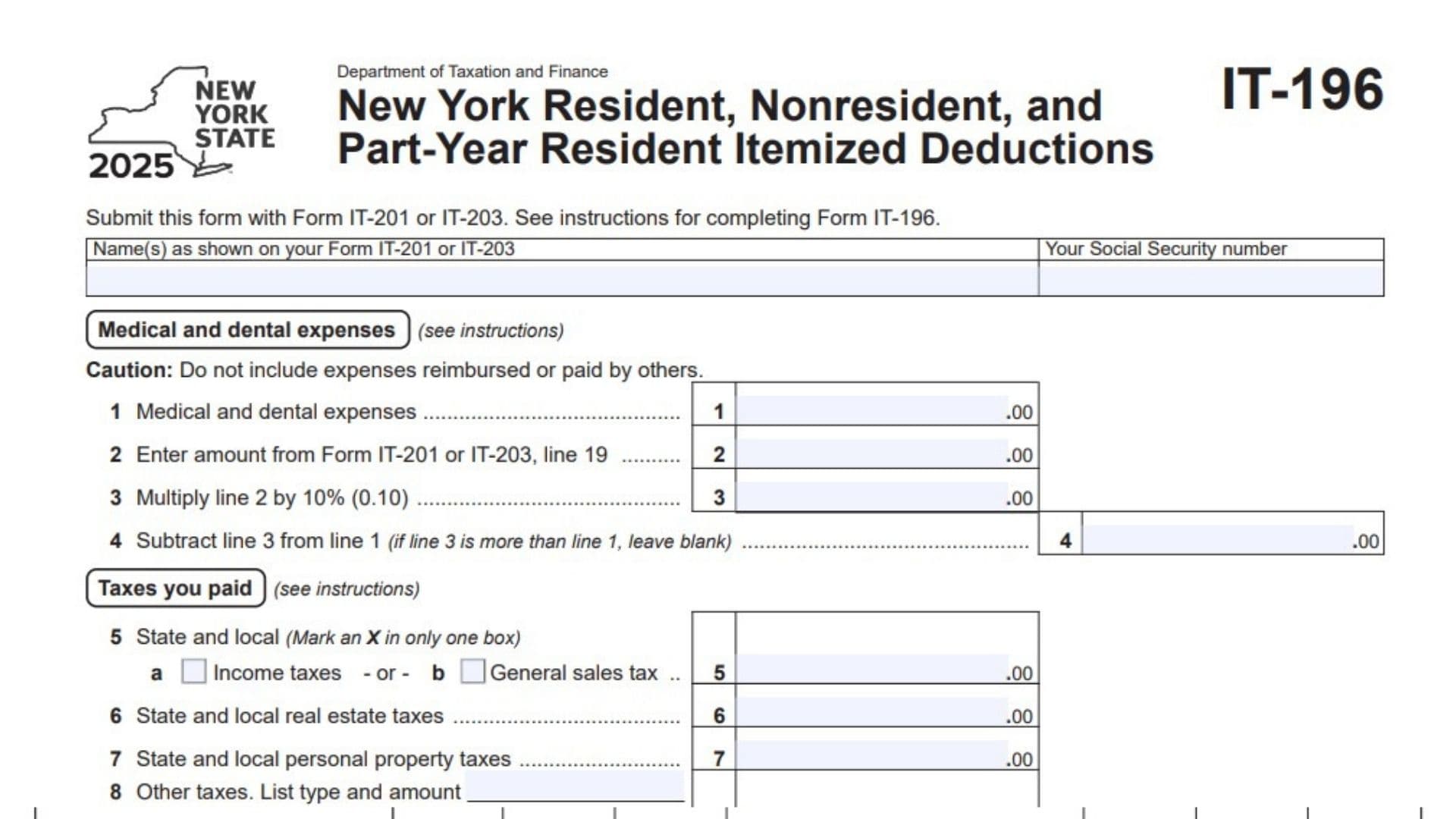
New York Form IT-196 is an itemized deduction worksheet used by individuals to calculate deductions when filing their New York State income tax returns. Officially titled the New York Resident, Nonresident, and Part-Year Resident Itemized Deductions form, it helps taxpayers determine which qualifying expenses and financial contributions can be included in their New York itemized deduction calculation. The form is designed for individuals filing either Form IT-201, the New York resident income tax return, or Form IT-203, the nonresident and part-year resident income tax return. It collects information about medical and dental expenses, state and local taxes, mortgage interest, charitable contributions, casualty and theft losses, employee-related expenses, and other eligible deductions. It also includes adjustments that may change the final deduction amount before it is transferred to the applicable New York income tax return. Completing Form IT-196 correctly is important because not every expense qualifies for an itemized deduction, and certain amounts are subject to income-based limitations or special calculation rules. The form contains 49 numbered lines across three pages, covering different deduction categories and adjustment calculations. By working through each section, taxpayers can organize their eligible expenses, calculate their total itemized deductions, and determine the amount that can be reported on their New York State income tax return.
Who Should Use Form IT-196?
Form IT-196 is intended for taxpayers who want to calculate New York State itemized deductions when filing an individual income tax return.
It applies to the following groups:
- New York Residents: Individuals filing Form IT-201 who choose to calculate their eligible itemized deductions.
- Nonresidents: Individuals filing Form IT-203 who need to determine their applicable New York itemized deductions.
- Part-Year Residents: Individuals who lived in New York for only part of the tax year and file Form IT-203.
The form calculates deductions that are subsequently transferred to the appropriate line of Form IT-201 or IT-203.
How To File Form IT-196
Form IT-196 must be submitted with your applicable New York individual income tax return.
- If you are a New York resident, submit it with Form IT-201.
- If you are a nonresident or part-year resident, submit it with Form IT-203.
Before completing the form, gather the following information:
- Your name and Social Security number.
- Your completed federal income tax information.
- Your federal adjusted gross income.
- Medical and dental expense records.
- State and local income tax or general sales tax information.
- Real estate and personal property tax records.
- Mortgage interest statements, including Form 1098.
- Records of charitable donations and contributions.
- Information about casualty or theft losses.
- Eligible employee and job-related expense records.
- Investment interest information.
- Records of other qualifying itemized deductions.
- Previous-year deduction carryover information, if applicable.
- College tuition deduction information, if applicable.
Important: Some deductions require additional calculations or supporting information. Review the applicable instructions for Form IT-196 before entering amounts. The form should be completed in conjunction with your Form IT-201 or IT-203.

How To Complete Form IT-196
Form IT-196 is divided into several deduction categories. The following instructions explain the information required for every numbered line, including the calculations and special conditions identified on the form.
Taxpayer Identification Information
At the top of Page 1, enter the information needed to identify your New York income tax return.
Name(s) As Shown On Form IT-201 Or IT-203
Enter your name exactly as it appears on your corresponding New York individual income tax return.
If you are filing jointly, provide the applicable taxpayer names as shown on the return.
Social Security Number
Enter your complete Social Security number. Make sure it matches the number reported on Form IT-201 or IT-203.
The form also provides Social Security number fields at the top of Pages 2 and 3. Complete the requested identification information consistently.
Medical And Dental Expenses
This section calculates the portion of your medical and dental expenses that may qualify for an itemized deduction.
The form specifically warns taxpayers not to include expenses that were reimbursed or paid by someone else.
Line 1: Medical And Dental Expenses
Enter your qualifying medical and dental expenses for the applicable tax year.
Include eligible expenses that you personally paid and that meet the applicable deduction requirements.
Do not include amounts reimbursed by insurance, employers, or other individuals.
Line 2: Federal Adjusted Gross Income
Enter the amount reported on Line 19 of your New York Form IT-201 or IT-203.
Use the amount from the corresponding New York return rather than entering a separate estimate.
Line 3: 10% Of Adjusted Gross Income
Multiply the amount on Line 2 by 10%.
Calculation:
Line 2 × 0.10 = Line 3
This amount establishes the income-based threshold used to calculate the allowable medical and dental expense deduction.
Line 4: Deductible Medical And Dental Expenses
Subtract Line 3 from Line 1.
Calculation:
Line 1 – Line 3 = Line 4
If Line 3 is greater than Line 1, leave Line 4 blank as directed by the form.
The resulting amount represents the medical and dental expenses remaining after applying the 10% threshold.
Taxes You Paid
This section records qualifying state, local, real estate, personal property, and other tax payments.
Line 5: State And Local Taxes
Choose only one of the two available options:
- Line 5a: Income Taxes: Select this option if you are reporting qualifying state and local income taxes.
- Line 5b: General Sales Tax: Select this option if you are reporting qualifying general sales taxes instead.
Mark an X in only one box. Enter the applicable tax amount on Line 5.
Line 6: State And Local Real Estate Taxes
Enter the qualifying real estate taxes you paid to state and local governments.
Use your property tax statements or payment records to determine the amount.
Line 7: State And Local Personal Property Taxes
Enter qualifying personal property taxes paid to state or local authorities.
Use the applicable tax payment records to calculate the amount.
Line 8: Other Taxes
Enter any other qualifying taxes that may be included in your itemized deductions.
The form provides space to identify the type of tax and its corresponding amount.
List the tax category clearly and enter the applicable total.
Line 9: Total Taxes Paid
Add the amounts reported on Lines 5, 6, 7, and 8.
Calculation:
Line 5 + Line 6 + Line 7 + Line 8 = Line 9
This represents the total taxes reported in this section.
Interest You Paid
This section covers qualifying home mortgage interest, mortgage points, and investment interest.
Line 10: Home Mortgage Interest And Points Reported On Form 1098
Enter the qualifying home mortgage interest and points reported to you on federal Form 1098.
Use your mortgage lender’s annual statement to identify the amount applicable to this line.
Line 11: Home Mortgage Interest Not Reported On Form 1098
Enter qualifying home mortgage interest that was not reported on federal Form 1098.
For example, this may involve interest paid directly to the person from whom you purchased your home.
If the interest was paid to the home seller, provide the following additional information:
- Seller’s name.
- Seller’s identifying number.
- Seller’s address.
Enter the qualifying interest amount in the designated space.
Line 12: Points Not Reported On Form 1098
Enter eligible mortgage points that were not reported on federal Form 1098.
Use the applicable mortgage documentation to determine the amount.
Line 13: Reserved
Line 13 is reserved and does not require an amount.
Leave this line blank.
Line 14: Investment Interest
Enter qualifying investment interest expenses.
Use your investment and financial records to identify the applicable amount. Follow the relevant instructions for determining which expenses qualify.
Line 15: Total Interest Paid
Add the amounts reported on Lines 10 through 14.
Calculation:
Line 10 + Line 11 + Line 12 + Line 13 + Line 14 = Line 15
Because Line 13 is reserved, it does not contribute an amount to the calculation.
The result represents your total interest deductions reported in this section.
Gifts To Charity
This section records qualifying charitable contributions made during the tax year and eligible contribution amounts carried forward from a previous year.
Line 16: Gifts By Cash Or Check
Enter qualifying charitable contributions made through cash or check payments.
Use donation receipts, bank statements, or other relevant records to determine the total amount.
Line 16a: Qualified Contributions Included In Line 16
Enter the amount of qualified contributions already included in Line 16.
This is a breakdown of the amount reported on Line 16, not an additional amount to add when calculating Line 19.
Line 16b: Contributions To New York Charitable Gifts Trust Fund
Enter contributions made to the New York Charitable Gifts Trust Fund that are already included in Line 16a.
This line identifies a specific portion of the qualified contributions reported above.
Line 17: Contributions Other Than Cash Or Check
Enter qualifying charitable donations made using methods other than cash or check.
Examples may include eligible donated property or other noncash contributions.
Use the applicable records to determine the amount and follow the relevant deduction instructions.
Line 18: Carryover From Prior Year
Enter any eligible charitable contribution amount carried forward from a previous tax year.
Use your previous-year tax records to determine the amount that remains available.
Line 19: Total Charitable Contributions
Add the amounts reported on Lines 16, 17, and 18.
Calculation:
Line 16 + Line 17 + Line 18 = Line 19
Lines 16a and 16b are informational breakdowns of contributions already included in Line 16. Do not add them again.
Casualty And Theft Losses
This section covers certain casualty and theft losses that may qualify as itemized deductions.
Line 20: Casualty Or Theft Losses Other Than Federal Qualified Disaster Losses
Enter eligible casualty or theft losses that are not federal qualified disaster losses.
Use the applicable records to determine the deductible amount.
This line is separate from Line 37, which covers federal qualified disaster losses.
Review the instructions to determine whether your loss qualifies and how the deductible amount must be calculated.
Job Expenses And Certain Miscellaneous Deductions
This section records eligible employee-related expenses, job-related education costs, tax preparation fees, and certain other expenses.
Some amounts are subject to an income-based reduction, which is calculated using Lines 26 and 27.
Line 21: Unreimbursed Employee Expenses
Enter qualifying employee expenses that were not reimbursed by your employer.
Examples identified by the form include:
- Job-related travel expenses.
- Union dues.
- Other qualifying employee expenses.
Only include expenses that meet the applicable deduction requirements.
Line 22: Job-Related Education Expenses
Enter qualifying education expenses related to your employment.
Use your education payment records and review the instructions to determine whether the expenses are eligible.
Line 23: Tax Preparation Fees
Enter qualifying expenses paid for tax preparation services.
Use invoices or payment records to determine the applicable amount.
Line 24: Other Expenses
Enter other qualifying miscellaneous expenses that are not already reported on Lines 21 through 23.
The form provides examples such as:
- Investment-related expenses.
- Safe deposit box expenses.
- Other qualifying miscellaneous expenses.
Identify the type of expense and enter the corresponding amount in the designated space.
Line 25: Total Job Expenses And Miscellaneous Deductions
Add the amounts reported on Lines 21 through 24.
Calculation:
Line 21 + Line 22 + Line 23 + Line 24 = Line 25
This is the total amount before applying the income-based reduction.
Line 26: Federal Adjusted Gross Income
Enter the amount reported on Line 19 of your New York Form IT-201 or IT-203.
Use the same figure referenced earlier on Line 2.
Line 27: 2% Of Adjusted Gross Income
Multiply the amount on Line 26 by 2%.
Calculation:
Line 26 × 0.02 = Line 27
This amount is used to determine the deductible portion of the expenses reported in this section.
Line 28: Deductible Job Expenses And Miscellaneous Deductions
Subtract Line 27 from Line 25.
Calculation:
Line 25 – Line 27 = Line 28
If Line 27 is greater than Line 25, leave Line 28 blank as directed by the form.
The resulting amount represents the deduction remaining after applying the 2% threshold.
Other Itemized Deductions
This section includes additional types of deductions that do not fall into the previous categories.
Each line covers a particular expense or financial loss. Review the applicable instructions to determine whether the amount qualifies.
Line 29: Gambling Losses
Enter eligible gambling losses.
The deductible amount and applicable limitations must be determined using the relevant instructions.
Line 30: Casualty And Theft Losses Of Income-Producing Property
Enter qualifying casualty or theft losses involving income-producing property.
This category is separate from personal casualty and theft losses reported elsewhere on the form.
Line 31: Federal Estate Tax On Income In Respect Of A Decedent
Enter qualifying federal estate tax attributable to income in respect of a decedent.
Use the applicable estate tax and income documentation to determine the amount.
Line 32: Deduction For Amortizable Bond Premiums
Enter the eligible deduction for amortizable bond premiums.
Use your investment documentation and applicable tax calculations to determine the amount.
Line 33: Ordinary Loss From Certain Debt Instruments
Enter an eligible ordinary loss attributable to a contingent payment debt instrument or an inflation-indexed debt instrument.
Review the applicable instructions and supporting investment records before reporting the amount.
Line 34: Repayment Of Amounts Under A Claim Of Right
Enter qualifying repayments of amounts previously received under a claim of right when the repayment exceeds $3,000.
Use your payment records and applicable tax information to calculate the eligible deduction.
Line 35: Certain Unrecovered Pension Investments
Enter eligible unrecovered investments in a pension.
The deduction applies only when the relevant requirements are met. Review the instructions to determine the allowable amount.
Line 36: Impairment-Related Work Expenses Of A Disabled Person
Enter qualifying impairment-related work expenses incurred by an individual with a disability.
Use the applicable documentation to calculate the eligible expenses.
Line 37: Federal Qualified Disaster Loss
Enter the qualifying amount for federal qualified disaster losses.
This line is separate from Line 20, which covers other casualty and theft losses.
Review the applicable instructions to determine the amount that can be included.
Line 38: Other Itemized Deductions From Partnerships
Enter qualifying itemized deduction amounts received through partnerships.
Use the relevant partnership tax information and follow the instructions for determining the reportable amount.
Line 39: Total Other Itemized Deductions
Add the amounts reported on Lines 29 through 38.
Calculation:
Line 29 + Line 30 + Line 31 + Line 32 + Line 33 + Line 34 + Line 35 + Line 36 + Line 37 + Line 38 = Line 39
This represents the total of the other itemized deductions reported in this section.
Total Itemized Deductions
This section combines the eligible deduction amounts from the previous categories and determines whether an income-based limitation applies.
Income Threshold Question: Is Form IT-201 Or IT-203 Line 19 Greater Than $204,400?
Before calculating Line 40, compare the amount reported on Line 19 of your Form IT-201 or IT-203 with $204,400.
The form provides two choices:
- No: If the amount is not greater than $204,400, your itemized deduction is not limited under this test. Add the amounts in the far-right column for Lines 4 through 39 and enter the result on Line 40.
- Yes: If the amount is greater than $204,400, your itemized deduction may be limited. Use the Line 40 Total Itemized Deductions Worksheet in the instructions to calculate the correct amount.
Line 40: Total Itemized Deductions
Enter your total itemized deduction amount.
If your Form IT-201 or IT-203 Line 19 is not greater than $204,400, add the amounts from Lines 4 through 39.
If your income exceeds the threshold, use the worksheet provided in the official instructions to determine the allowable amount.
The result on Line 40 is used in the adjustment calculations on Page 3.
Adjustments
Page 3 contains additional calculations that modify the total itemized deduction amount.
These adjustments help determine the final New York State itemized deduction.
Line 41: State, Local, And Foreign Income Taxes Or General Sales Tax And Other Subtraction Adjustments
Enter the applicable state, local, and foreign income taxes, or general sales tax when applicable, together with other required subtraction adjustments.
Use the instructions to identify the amounts that must be subtracted from Line 40.
Line 42: Itemized Deductions After Subtraction Adjustments
Subtract Line 41 from Line 40.
Calculation:
Line 40 – Line 41 = Line 42
This amount represents the itemized deductions remaining after the applicable subtraction adjustments.
Line 43: College Tuition Itemized Deduction For Form IT-203 Filers
This line applies only to taxpayers filing Form IT-203.
Enter the college tuition itemized deduction amount from Form IT-203-B, Line 2.
If you are filing Form IT-201, leave this line blank and skip to Line 44.
Line 44: Addition Adjustments
Enter any applicable addition adjustments required by the form instructions.
Use the relevant tax information and calculations to determine the amount.
Line 45: Total After Addition Adjustments
Add the amounts reported on Lines 42, 43, and 44.
Calculation:
Line 42 + Line 43 + Line 44 = Line 45
This amount represents the total after applying the adjustments reported in this section.
Line 46: Itemized Deduction Adjustment
Enter the applicable itemized deduction adjustment calculated according to the Form IT-196 instructions.
Use the specified adjustment method to determine the amount.
Line 47: Itemized Deduction After Adjustment
Enter the itemized deduction amount after applying the adjustment from Line 46.
Follow the calculation method provided in the official instructions to determine the correct figure.
Line 48: College Tuition Itemized Deduction For Form IT-201 Filers
This line applies only to taxpayers filing Form IT-201.
Enter the qualifying college tuition itemized deduction amount as determined under Form IT-272, Claim for College Tuition Credit or Itemized Deduction.
If you are filing Form IT-203, leave this line blank and skip to Line 49.
Line 49: Final New York State Itemized Deduction
Add the amounts reported on Lines 47 and 48.
Calculation:
Line 47 + Line 48 = Line 49
This is your final New York State itemized deduction.
Transfer the amount to the appropriate line of your New York income tax return:
- Form IT-201: Enter the amount on Line 34.
- Form IT-203: Enter the amount on Line 33.
Make sure the amount transferred matches Line 49 of Form IT-196.
Final Review Before Filing
Before submitting Form IT-196 with your New York income tax return, review every section to confirm that your deductions and calculations are complete.
Use this checklist:
- Confirm that you are completing the correct 2025 Form IT-196.
- Verify that your name matches Form IT-201 or IT-203.
- Enter your correct Social Security number.
- Gather your federal and New York income tax information.
- Include eligible medical and dental expenses on Line 1.
- Verify the adjusted gross income amount on Line 2.
- Calculate the 10% threshold on Line 3.
- Calculate deductible medical and dental expenses on Line 4.
- Select only one tax option on Line 5.
- Report qualifying real estate and personal property taxes.
- Identify other eligible taxes on Line 8.
- Calculate total taxes paid on Line 9.
- Review mortgage interest and points reported on Form 1098.
- Include eligible mortgage interest not reported on Form 1098.
- Provide seller information when required for Line 11.
- Leave reserved Line 13 blank.
- Report eligible investment interest.
- Verify charitable contributions and previous-year carryovers.
- Check the informational amounts on Lines 16a and 16b.
- Review casualty and theft losses on Line 20.
- Verify employee and job-related expenses.
- Calculate the 2% threshold on Line 27.
- Determine the allowable amount on Line 28.
- Review all other itemized deductions on Lines 29 through 38.
- Calculate total other itemized deductions on Line 39.
- Check whether your Form IT-201 or IT-203 Line 19 exceeds $204,400.
- Complete the appropriate Line 40 calculation or worksheet.
- Apply the subtraction and addition adjustments on Page 3.
- Complete the correct college tuition deduction line for your filing status.
- Calculate the final itemized deduction on Line 49.
- Transfer Line 49 to Form IT-201, Line 34, or Form IT-203, Line 33.
- Attach Form IT-196 to the appropriate New York income tax return.
Completing Form IT-196 carefully can help you identify eligible itemized deductions and calculate the correct amount for your New York State income tax return. Review the applicable instructions for deductions that have special eligibility requirements, income limitations, or additional calculations before filing.