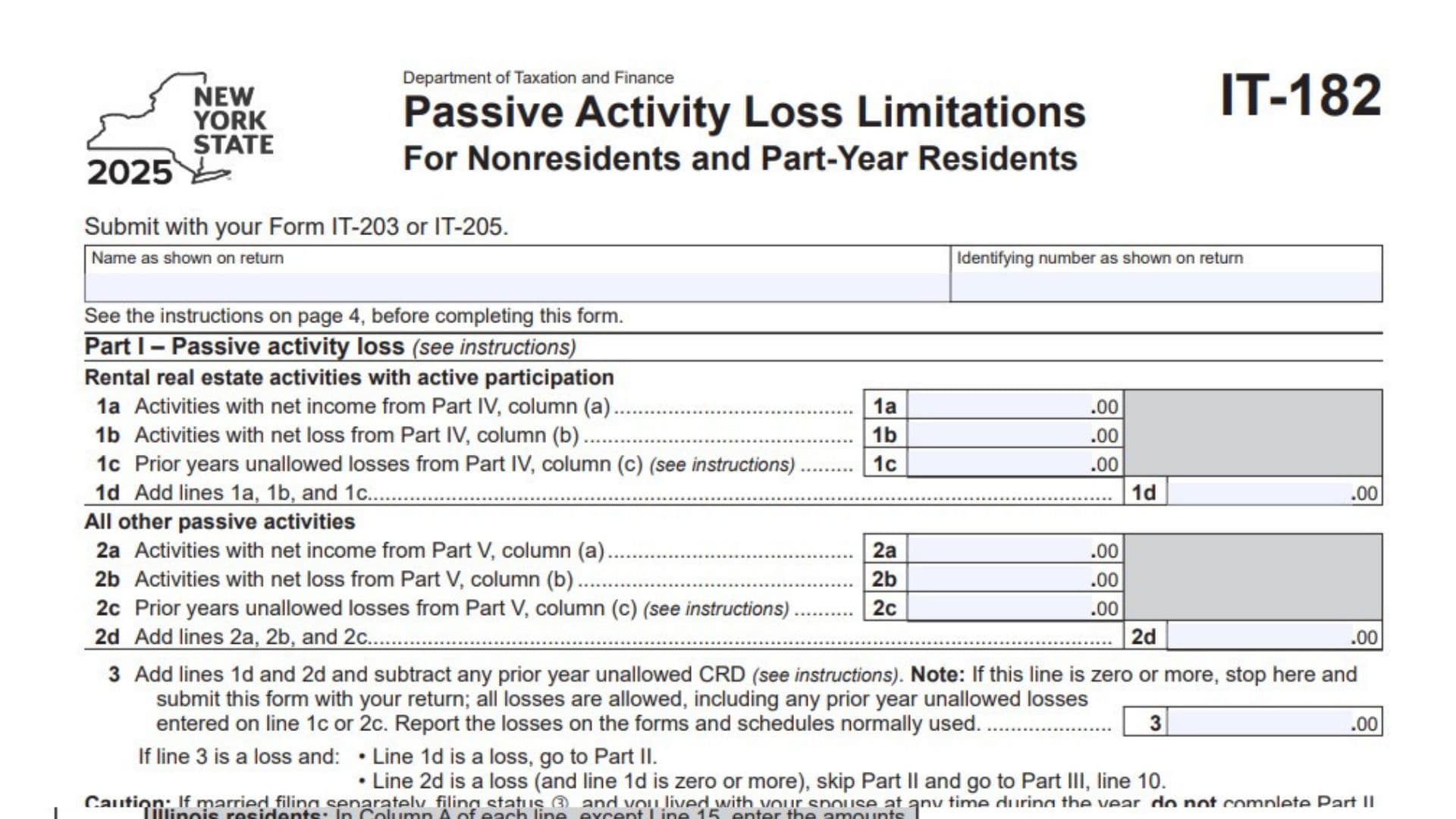
Form IT-182, titled Passive Activity Loss Limitations for Nonresidents and Part-Year Residents, is a New York State tax form used to calculate the amount of passive activity losses that nonresidents and part-year residents can deduct from income connected with New York State. It applies to individuals, estates, and trusts that have passive activity income or losses from New York sources. Although New York State generally follows federal passive activity loss (PAL) rules, nonresidents and part-year residents must recalculate their allowable losses using only income, gains, losses, and deductions derived from or connected with New York sources. As a result, the amount of passive activity loss allowed for New York State tax purposes may be different from the amount allowed on a federal income tax return. Form IT-182 helps taxpayers combine income and losses from rental real estate and other passive activities, account for losses carried forward from previous years, calculate any special allowance for qualifying rental real estate activities, and determine the final deductible and unallowed loss amounts. It also provides detailed schedules for identifying individual activities, allocating special allowances, distributing unallowed losses, and reporting activities that appear on multiple tax forms or schedules. Completing this form correctly is important because it determines how much passive activity loss can be claimed on the New York State income tax return and how much must be carried forward to a future year. Taxpayers generally submit Form IT-182 with Form IT-203 or Form IT-205, depending on whether they are filing an individual nonresident or part-year resident return or a fiduciary income tax return.
How To File Form IT-182
Form IT-182 must be submitted with the appropriate New York State income tax return. Individuals who file Form IT-203, Nonresident and Part-Year Resident Income Tax Return, must attach Form IT-182 to that return. Estates and trusts that file Form IT-205, Fiduciary Income Tax Return, must also submit this form when applicable.
Before completing Form IT-182, calculate your federal passive activity loss limitations using federal Form 8582. Then identify the activities and amounts connected with New York sources and use those figures to complete the New York State form.
Documents and Information to Prepare
Gather the following information before starting:
- Your completed or partially completed New York State Form IT-203 or IT-205.
- Your name and identifying number as shown on your tax return.
- Federal Form 8582, Passive Activity Loss Limitations.
- Records of income and losses from rental real estate activities.
- Records of income and losses from other passive activities.
- Information about passive activity losses carried forward from previous tax years.
- Details of rental properties, including property descriptions and addresses.
- Acquisition dates and sale dates for applicable rental properties.
- Federal modified adjusted gross income information.
- Records of New York source income, gains, losses, and deductions.
- Information about prior-year unallowed commercial revitalization deductions (CRD), if applicable.
- Supporting tax forms and schedules showing where each passive activity amount is reported.
Important Filing Instructions
Calculate Federal Passive Activity Loss Limitations First
Before completing Form IT-182, calculate your federal passive activity loss limitations using federal Form 8582. Use the applicable federal instructions to determine the income, losses, and other amounts for each activity.
Use Only New York Source Amounts
When completing Form IT-182, include only income, gains, losses, and deductions derived from or connected with New York sources. Do not automatically copy all federal amounts into the New York State form.
Special Instructions for Part-Year Residents
If you changed your residency status during the tax year, recalculate your passive activity loss limitations separately for your resident and nonresident periods.
For the resident period, calculate the New York passive activity loss using only the income, gains, losses, and deductions that would have been reported if a separate federal return had been filed for that period.
For the nonresident period, use only income and losses derived from or connected with New York sources.
When Federal Form 8582 Is Not Required
If you qualify for an exception that removes the federal requirement to file Form 8582, you must still complete Parts IV through IX of federal Form 8582 as though you were required to file it. Then use the applicable New York source amounts to complete Form IT-182.
Consider Other Loss Limitations First
Passive activity losses may be subject to other restrictions, including basis and at-risk limitations. These restrictions generally apply before the passive activity loss limitations. Once a loss becomes allowable under those rules, determine whether it is also restricted under the passive activity loss rules.
Federal Form 6198 and IRS Publication 925 provide additional information about at-risk limitations.
Submit With Your Tax Return
Attach Form IT-182 to your completed Form IT-203 or Form IT-205, as applicable.
Keep Supporting Records
Keep a copy of Form IT-182 used to calculate the amounts reported on Form IT-203 or Form IT-205-A. The instructions require you to retain the form for three years after the sale or disposition of all activities included on it.

How To Complete Form IT-182
Form IT-182 contains nine parts. Parts I through III calculate the total passive activity losses allowed for the current year. Parts IV through IX provide the activity-level information and allocation calculations needed to determine which losses are deductible and which must be carried forward.
Complete the applicable sections using only amounts connected with New York sources.
Taxpayer Information
Name as Shown on Return
Enter your name exactly as it appears on your New York State income tax return. If you are filing Form IT-203 or Form IT-205, use the corresponding taxpayer or entity name shown on that return.
Identifying Number as Shown on Return
Enter the identifying number used on your main tax return. Make sure the number matches the identifying information reported on Form IT-203 or Form IT-205.
Part I: Passive Activity Loss
Part I combines income and losses from rental real estate activities with active participation and all other passive activities. Its purpose is to determine whether you have a passive activity loss from New York sources for the current tax year.
Use the information from Parts IV and V to complete lines 1a through 2d.
Rental Real Estate Activities With Active Participation
This section covers qualifying rental real estate activities in which the taxpayer actively participates.
Line 1a: Rental Activities With Net Income
Enter the total net income from rental real estate activities with active participation.
Use the amounts reported in Part IV, column (a). Include only income derived from or connected with New York sources.
Line 1b: Rental Activities With Net Loss
Enter the total net loss from rental real estate activities with active participation.
Use the amounts reported in Part IV, column (b). Include the applicable current-year rental losses connected with New York sources.
Line 1c: Prior-Year Unallowed Rental Losses
Enter the total rental real estate losses from previous tax years that were not allowed as deductions and are eligible to be considered in the current year.
Use Part IV, column (c), to determine this amount. Follow the applicable passive activity loss rules when identifying prior-year losses that remain unallowed.
Line 1d: Total Rental Real Estate Activity Income and Loss
Combine the amounts reported on lines 1a, 1b, and 1c.
Calculation:
Line 1d = Line 1a + Line 1b + Line 1c
Enter the resulting net amount. If the combined amount is negative, it represents a net loss from rental real estate activities with active participation.
All Other Passive Activities
This section reports passive activities other than rental real estate activities with active participation.
Line 2a: Other Passive Activities With Net Income
Enter the total net income from all other passive activities.
Use the amounts reported in Part V, column (a). Include only income connected with New York sources.
Line 2b: Other Passive Activities With Net Loss
Enter the total net loss from all other passive activities.
Use Part V, column (b), to calculate the total current-year loss from these activities.
Line 2c: Prior-Year Unallowed Losses From Other Passive Activities
Enter the total unallowed passive activity losses carried forward from previous years for the activities reported in Part V.
Use Part V, column (c), to determine the amount. Include only losses that remain unallowed and are connected with New York sources.
Line 2d: Total Income and Loss From Other Passive Activities
Add the amounts reported on lines 2a, 2b, and 2c.
Calculation:
Line 2d = Line 2a + Line 2b + Line 2c
Enter the resulting net amount.
Line 3: Combined Net Passive Activity Income or Loss
Combine the amounts from lines 1d and 2d, then subtract any applicable prior-year unallowed commercial revitalization deduction (CRD).
Calculation:
Line 3 = Line 1d + Line 2d − Prior-Year Unallowed CRD
If you do not have a prior-year unallowed CRD, there is no CRD amount to subtract.
If line 3 is zero or greater, you do not need to continue with the passive loss limitation calculations in Parts II and III. All applicable losses are allowed, including prior-year unallowed losses entered on lines 1c and 2c. Report those losses on the tax forms and schedules normally used.
If line 3 is a loss, follow these instructions:
- If line 1d is also a loss, continue to Part II.
- If line 2d is a loss and line 1d is zero or greater, skip Part II and go directly to Part III, line 10.
Important Exception for Married Taxpayers Filing Separately
If you are married filing separately and lived with your spouse at any time during the tax year, do not complete Part II. Skip directly to Part III, line 10.
Part II: Special Allowance for Rental Real Estate Activities With Active Participation
Part II calculates the maximum rental real estate loss that may be allowed for New York State tax purposes when you actively participate in the rental activity.
Complete this part only when applicable based on the results of Part I.
Important: Enter all amounts in Part II as positive numbers greater than zero. Use the applicable federal Form 8582 instructions for additional calculation guidance.
Line 4: Smaller of the Rental Loss and Total Passive Activity Loss
Enter the smaller of the loss reported on line 1d or the loss reported on line 3.
Compare the two loss amounts and use the smaller amount as a positive figure.
Line 5: Income Threshold Amount
Enter $150,000 as the standard income threshold.
However, if you are married filing separately and lived apart from your spouse throughout the entire tax year, enter $75,000 instead.
Married taxpayers filing separately who lived with their spouses at any time during the year are not eligible for the special allowance. They must leave line 9 blank and proceed to line 10.
Line 6: Federal Modified Adjusted Gross Income
Enter your federal modified adjusted gross income, but do not enter an amount below zero.
Calculate the modified adjusted gross income using the applicable federal Form 8582 instructions. For New York State purposes, use only amounts derived from or connected with New York sources.
If line 6 equals or exceeds line 5, skip lines 7 and 8 and leave line 9 blank.
If line 6 is less than line 5, continue to line 7.
Line 7: Difference Between the Income Threshold and Modified Adjusted Gross Income
Subtract the amount on line 6 from the amount on line 5.
Calculation:
Line 7 = Line 5 − Line 6
Enter the resulting positive amount.
Line 8: Fifty Percent of the Income Difference
Multiply the amount on line 7 by 50% (0.5).
Calculation:
Line 8 = Line 7 × 50%
The amount entered on line 8 cannot exceed $25,000 under the standard rule.
If you are married filing separately and lived apart from your spouse throughout the year, do not enter more than $12,500.
Married taxpayers filing separately who lived with their spouses at any time during the year are not eligible for the special allowance. Leave line 9 blank and proceed to line 10.
Line 9: Allowable Special Rental Real Estate Loss
Enter the smaller of the amounts on line 4 or line 8.
Compare both figures and enter the lower amount.
If line 3 includes a prior-year unallowed commercial revitalization deduction (CRD), follow the applicable federal Form 8582 instructions before determining the amount.
If the special allowance is unavailable because of your filing status or circumstances, leave this line blank as instructed and proceed to line 10.
Part III: Total Losses Allowed
Part III determines the total passive activity losses allowed for the current tax year. It combines the applicable special rental real estate allowance with passive activity income.
Line 10: Total Passive Activity Income
Add the income amounts reported on lines 1a and 2a.
Calculation:
Line 10 = Line 1a + Line 2a
Enter the combined income amount on this line.
Line 11: Total Passive Activity Losses Allowed
Add the special allowance reported on line 9 to the passive activity income reported on line 10.
Calculation:
Line 11 = Line 9 + Line 10
Enter the resulting amount.
Use Parts IV through IX to determine the allowable loss for each individual activity and the amount of unallowed loss that must be carried forward.
Report the recomputed New York allowed losses in the New York State amount column of Form IT-203 or on Form IT-205-A, Fiduciary Allocation, as applicable.
Part IV: Rental Real Estate Activities With Active Participation
Part IV provides the activity-level details used to complete Part I, lines 1a, 1b, and 1c.
List each applicable rental real estate activity with active participation separately. Use only amounts derived from or connected with New York sources.
The table contains five main information columns, including property identification, acquisition and sale dates, current-year income and loss, prior-year unallowed losses, and overall gain or loss.
Name of Activity/Property Description and Address
Enter the name of the rental activity or a clear description of the rental property.
Include the property’s complete address so that each activity can be identified separately.
Date of Acquisition
Enter the date you acquired the rental property or began the applicable activity, as required.
Use the acquisition date associated with the property.
Date of Sale
Enter the date the property was sold, if applicable.
If the property was not sold during the tax year, leave this field blank.
Column (a): Net Income
Enter the current-year net income from the rental real estate activity.
These amounts are used to calculate the total reported on Part I, line 1a.
Column (b): Net Loss
Enter the current-year net loss from the rental real estate activity.
These amounts are used to calculate the total reported on Part I, line 1b.
Column (c): Unallowed Loss From Prior Years
Enter any rental activity losses carried forward from previous tax years that remain unallowed.
These amounts contribute to the total reported on Part I, line 1c.
Column (d): Overall Gain
Enter the overall gain associated with the rental real estate activity, using the applicable federal Form 8582 instructions.
Column (e): Overall Loss
Enter the overall loss associated with the rental real estate activity, using the applicable federal Form 8582 instructions.
Totals: Part IV
Add the amounts in the applicable current-year income, current-year loss, and prior-year unallowed loss columns.
Enter the column totals in the corresponding total fields.
Transfer these amounts as follows:
- Column (a) total to Part I, line 1a.
- Column (b) total to Part I, line 1b.
- Column (c) total to Part I, line 1c.
The overall gain and loss columns provide additional activity information and are not transferred to these three lines.
Part V: All Other Passive Activities
Part V reports passive activities other than rental real estate activities with active participation.
The information collected here is used to complete Part I, lines 2a, 2b, and 2c.
List each applicable passive activity separately and include only items connected with New York sources.
Name of Activity/Property Description and Address
Enter the name of the passive activity or a description of the property.
Include the complete address when the activity involves property.
Date of Acquisition
Enter the acquisition date of the applicable property or activity, where relevant.
Date of Sale
Enter the sale date if the property or activity was sold during the applicable period.
Leave this field blank when no sale occurred.
Column (a): Net Income
Enter the current-year net income from the passive activity.
Use the amount to calculate the total reported on Part I, line 2a.
Column (b): Net Loss
Enter the current-year net loss from the passive activity.
The total of these amounts is transferred to Part I, line 2b.
Column (c): Unallowed Loss From Prior Years
Enter the amount of passive activity losses from previous years that remain unallowed.
Transfer the total to Part I, line 2c.
Column (d): Overall Gain
Enter the overall gain for the activity using the applicable federal Form 8582 instructions.
Column (e): Overall Loss
Enter the overall loss for the activity using the applicable federal Form 8582 instructions.
Totals: Part V
Add the amounts in columns (a), (b), and (c).
Transfer the totals as follows:
- Column (a) total to Part I, line 2a.
- Column (b) total to Part I, line 2b.
- Column (c) total to Part I, line 2c.
Part VI: Special Allowance Allocation
Complete Part VI only if you enter an amount on Part II, line 9.
This section allocates the special allowance among the rental real estate activities that qualify for the deduction.
Each row identifies a rental activity, the form or schedule where its loss will be reported, the loss amount, the allocation ratio, the special allowance, and the remaining loss after the allowance.
Name of Activity/Property Description and Address
Enter the name of the rental real estate activity or the property’s description and complete address.
Use a separate row for each applicable activity.
Form or Schedule and Line Number to Be Reported On
Identify the tax form or schedule where the rental loss will be reported.
Include the relevant line number so the activity can be matched to the correct location on your tax return.
Column (a): Loss
Enter the loss amount associated with the rental activity.
Use the applicable New York source loss amount determined through your calculations.
Column (b): Ratio
Enter the allocation ratio used to distribute the special allowance among the qualifying activities.
Use the applicable federal Form 8582 allocation instructions to determine the correct ratio.
The total ratio for all activities must equal 1.00.
Column (c): Special Allowance
Enter the portion of the special allowance allocated to the activity.
Determine this amount using the activity’s allocation ratio and the total special allowance available.
Column (d): Remaining Loss After Special Allowance
Subtract the amount in column (c) from the loss in column (a).
Calculation:
Column (d) = Column (a) − Column (c)
Enter the remaining loss after applying the special allowance.
Totals: Part VI
Add the amounts in columns (a), (c), and (d).
The total ratio in column (b) should equal 1.00.
Check that the total special allowance allocated across the activities agrees with the amount calculated on Part II, line 9.
Part VII: Allocation of Unallowed Losses
Part VII is used to allocate passive activity losses that are not currently deductible.
This section identifies the activity, the tax form or schedule where the loss would normally be reported, the loss amount, the allocation ratio, and the resulting unallowed loss.
Name of Activity/Property Description and Address
Enter the name of each activity or the description and address of the property associated with the unallowed loss.
Use separate rows for different activities.
Form or Schedule and Line Number to Be Reported On
Identify the tax form or schedule and the specific line where the activity’s loss would normally be reported.
This information helps connect the allocated loss to the correct tax reporting location.
Column (a): Loss
Enter the loss amount associated with the passive activity.
Use the applicable amount determined through the passive activity loss calculations.
Column (b): Ratio
Enter the allocation ratio used to distribute the unallowed loss among the applicable activities.
Follow the federal Form 8582 instructions to determine the appropriate ratio.
The total ratio for all activities should equal 1.00.
Column (c): Unallowed Loss
Enter the portion of the loss that is not allowed as a deduction for the current year.
Determine the amount using the applicable allocation ratio and passive activity loss limitations.
Totals: Part VII
Add the amounts in columns (a) and (c).
Verify that the total allocation ratio in column (b) equals 1.00.
The total unallowed loss represents the amount that cannot be deducted in the current year and must be treated under the applicable carryforward rules.
Part VIII: Allowed Losses
Part VIII identifies the passive activity losses that are allowed as deductions for the current tax year.
Use this section to determine the allowed and unallowed amounts for each activity.
The information is used when reporting the recomputed New York passive activity losses on your tax return.
Name of Activity/Property Description and Address
Enter the name of the passive activity or the description and address of the associated property.
Identify each activity separately.
Form or Schedule and Line Number to Be Reported On
Enter the name of the tax form or schedule and the corresponding line number where the activity’s loss will be reported.
Use the same reporting location associated with the applicable activity on your tax return.
Column (a): Loss
Enter the total loss associated with the activity before separating the allowed and unallowed portions.
Use the relevant New York source loss amount determined through the previous calculations.
Column (b): Unallowed Loss
Enter the portion of the activity’s loss that cannot be deducted during the current tax year.
This amount remains subject to the applicable passive activity loss limitations and carryforward rules.
Column (c): Allowed Loss
Enter the portion of the loss that is deductible for the current tax year.
Calculate the allowed amount by subtracting the unallowed loss in column (b) from the total loss in column (a).
Calculation:
Column (c) = Column (a) − Column (b)
Totals: Part VIII
Add the amounts in columns (a), (b), and (c).
Check that the total allowed and unallowed losses reconcile with the applicable activity-level calculations.
Report the allowed New York State loss amounts in the appropriate New York State amount column of Form IT-203 or Form IT-205-A.
Part IX: Activities With Losses Reported on Two or More Different Forms or Schedules
Part IX is used when the same passive activity has losses reported on two or more different tax forms or schedules.
It helps determine the correct unallowed and allowed loss amounts by combining the information from the different reporting locations.
The form provides three separate activity calculation sections. Complete each applicable section for activities that have losses reported in multiple places.
Activity Identification
Name of Activity/Property Description and Address
Enter the name of the passive activity or the description and address of the associated property.
Use the same activity identification throughout the related calculations.
Form or Schedule and Line Number to Be Reported On
Identify the applicable form or schedule and the line number where the activity’s loss or income is reported.
Provide the relevant reporting information for each form or schedule associated with the activity.
First Activity Calculation
Line 1a: Net Loss Plus Prior-Year Unallowed Loss
Enter the current net loss from the applicable form or schedule, combined with any prior-year unallowed passive activity loss associated with the activity.
Calculation:
Line 1a = Current Net Loss + Prior-Year Unallowed Loss
Use the relevant amounts from the forms or schedules where the activity is reported.
Line 1b: Net Income From Form or Schedule
Enter the net income from the applicable form or schedule for the same activity.
Use the corresponding income amount from the relevant reporting location.
Line 1c: Remaining Net Loss
Subtract the net income reported on line 1b from the combined loss reported on line 1a.
Calculation:
Line 1c = Line 1a − Line 1b
If the result is zero or negative, leave this entry blank.
If the result is positive, enter the remaining loss and complete the related allocation fields.
Column (c): Ratio
Enter the allocation ratio used to distribute the remaining loss among the applicable reporting locations.
Use the federal Form 8582 instructions to determine the appropriate ratio.
Column (d): Unallowed Loss
Enter the portion of the remaining loss that cannot be deducted for the current year.
Determine this amount using the applicable passive activity loss allocation.
Column (e): Allowed Loss
Enter the portion of the remaining loss that is deductible in the current year.
Use the applicable allocation calculation to separate the allowed and unallowed portions.
Second Activity Calculation
Complete this section when another activity has losses reported on two or more different forms or schedules.
Line 1a: Net Loss Plus Prior-Year Unallowed Loss
Combine the current net loss and any applicable prior-year unallowed loss from the relevant form or schedule.
Line 1b: Net Income From Form or Schedule
Enter the net income associated with the same activity from the applicable form or schedule.
Line 1c: Remaining Net Loss
Subtract line 1b from line 1a.
If the result is zero or less, leave the entry blank. Otherwise, enter the remaining loss and complete the allocation fields.
Column (c): Ratio
Enter the applicable ratio used to allocate the remaining loss among the reporting locations.
Column (d): Unallowed Loss
Enter the portion of the remaining loss that is not deductible in the current tax year.
Column (e): Allowed Loss
Enter the portion of the remaining loss that can be deducted in the current year.
Third Activity Calculation
Use this section if a third activity has losses reported on multiple forms or schedules.
Line 1a: Net Loss Plus Prior-Year Unallowed Loss
Enter the combined current-year net loss and prior-year unallowed loss for the activity.
Line 1b: Net Income From Form or Schedule
Enter the net income associated with the same activity from the applicable form or schedule.
Line 1c: Remaining Net Loss
Subtract line 1b from line 1a.
Leave the entry blank if the result is zero or negative. Otherwise, enter the remaining loss and complete the applicable allocation calculations.
Column (c): Ratio
Enter the allocation ratio used to distribute the remaining loss.
Column (d): Unallowed Loss
Enter the portion of the remaining loss that is restricted under the passive activity loss rules.
Column (e): Allowed Loss
Enter the portion of the remaining loss that is permitted as a deduction for the current year.
Totals: Part IX
Add the amounts in the applicable columns for all completed activity calculations.
The total ratio in column (c) should equal 1.00.
Calculate the combined unallowed and allowed losses and verify that the amounts agree with the applicable activity-level calculations.
Use the allowed loss amounts when reporting the recomputed New York State passive activity deductions on the appropriate tax return.
How To Report Allowed and Unallowed Passive Activity Losses
After completing Parts IV through IX, review the activity-level calculations to determine which losses are deductible and which must be carried forward.
Allowed Losses
Report the recomputed New York State allowed loss for each activity in the New York State amount column of Form IT-203.
If you are filing a fiduciary income tax return, report the applicable amounts on Form IT-205-A, Fiduciary Allocation.
Report the losses on the same lines where the corresponding losses were reported for federal income tax purposes.
Unallowed Losses
Losses that are not deductible in the current year remain subject to the passive activity loss carryforward rules.
Keep records of these amounts so they can be considered in a future tax year when the applicable limitations permit their deduction.
Activities Reported on Multiple Forms or Schedules
Use Part IX to reconcile the income and losses reported across different forms or schedules for the same activity.
Make sure the total allowed and unallowed amounts are correctly allocated and do not result in duplicate deductions.
Special Rules for Nonresidents and Part-Year Residents
New York State follows federal passive activity loss rules but requires adjustments for nonresidents and part-year residents.
Understanding these differences is important when completing Form IT-182.
New York Source Income and Losses
Only include income, gains, losses, and deductions derived from or connected with New York sources.
A taxpayer may have a passive activity loss for New York State purposes even when no passive activity loss exists on the federal return.
Similarly, the New York passive activity loss may be larger or smaller than the corresponding federal amount.
Part-Year Resident Calculations
Part-year residents must calculate passive activity loss limitations separately for their resident and nonresident periods.
For the resident period, use the income, gains, losses, and deductions that would have been included on a separate federal return for that period.
For the nonresident period, use only amounts derived from or connected with New York sources.
This separate calculation helps determine the correct New York passive activity loss deduction for each residency period.
Married Taxpayers Filing Separately
Special rules apply to married taxpayers who file separate returns.
- The standard amount on line 5 is $150,000.
- Married taxpayers filing separately who lived apart from their spouses throughout the entire year must use $75,000 on line 5.
- The maximum amount on line 8 for married taxpayers filing separately who lived apart throughout the year is $12,500.
- Married taxpayers filing separately who lived with their spouses at any time during the year cannot claim the special rental real estate allowance. They must leave line 9 blank and proceed to line 10.
Final Review Before Filing
Before submitting Form IT-182 with your New York State tax return, review all calculations, activity details, and supporting information.
Use this checklist to verify that the form is complete:
- Taxpayer Information: Confirm that your name and identifying number match Form IT-203 or Form IT-205.
- Federal Form 8582: Make sure you have calculated the federal passive activity loss limitations before completing Form IT-182.
- New York Source Amounts: Verify that only income, gains, losses, and deductions connected with New York sources are included.
- Part-Year Resident Calculations: If you changed residency during the year, make sure the resident and nonresident periods are calculated separately.
- Part I: Check all amounts reported on lines 1a through 3.
- Rental Real Estate Activities: Verify that the rental income, current-year losses, and prior-year unallowed losses agree with Part IV.
- Other Passive Activities: Confirm that the income, losses, and carryforward amounts agree with Part V.
- Line 3: Check whether the combined passive activity result is positive, zero, or a loss and follow the applicable instructions.
- Part II: Complete the special allowance calculation only when applicable.
- Line 4: Verify that you entered the smaller applicable loss amount.
- Line 5: Check the correct income threshold based on your filing status and marital circumstances.
- Line 6: Confirm that your modified adjusted gross income includes only amounts connected with New York sources.
- Lines 7 and 8: Recheck the subtraction and 50% calculation, including the applicable maximum.
- Line 9: Confirm that the special allowance does not exceed the applicable limit.
- Part III: Verify the calculations on lines 10 and 11.
- Part IV: Check the rental property descriptions, addresses, acquisition dates, sale dates, income, and losses.
- Part V: Review all other passive activity details and corresponding amounts.
- Part VI: If line 9 contains an amount, confirm that the special allowance has been allocated correctly and the total ratio equals 1.00.
- Part VII: Verify the allocation of unallowed losses and check that the total ratio equals 1.00.
- Part VIII: Confirm that each activity’s total loss is properly divided between allowed and unallowed losses.
- Part IX: If an activity appears on multiple forms or schedules, verify that the income and losses are reconciled correctly.
- Allowed Losses: Make sure the recomputed New York State deductions are reported on the correct lines of Form IT-203 or Form IT-205-A.
- Unallowed Losses: Retain accurate records of losses carried forward to future tax years.
- Supporting Documentation: Keep the relevant federal forms, tax schedules, and activity records used to calculate the amounts.
- Filing Requirement: Submit Form IT-182 with Form IT-203 or Form IT-205, as applicable.
- Record Retention: Keep a copy of the completed form for three years after the sale or disposition of all activities included on it.
Final Reminder: Form IT-182 is designed to calculate passive activity losses specifically for New York State tax purposes. Federal and New York State deductions may differ because New York calculations use only income, gains, losses, and deductions derived from or connected with New York sources. Review the applicable federal Form 8582 instructions when completing the allocation calculations, and make sure the final allowed loss amounts are correctly reported on your New York State income tax return.