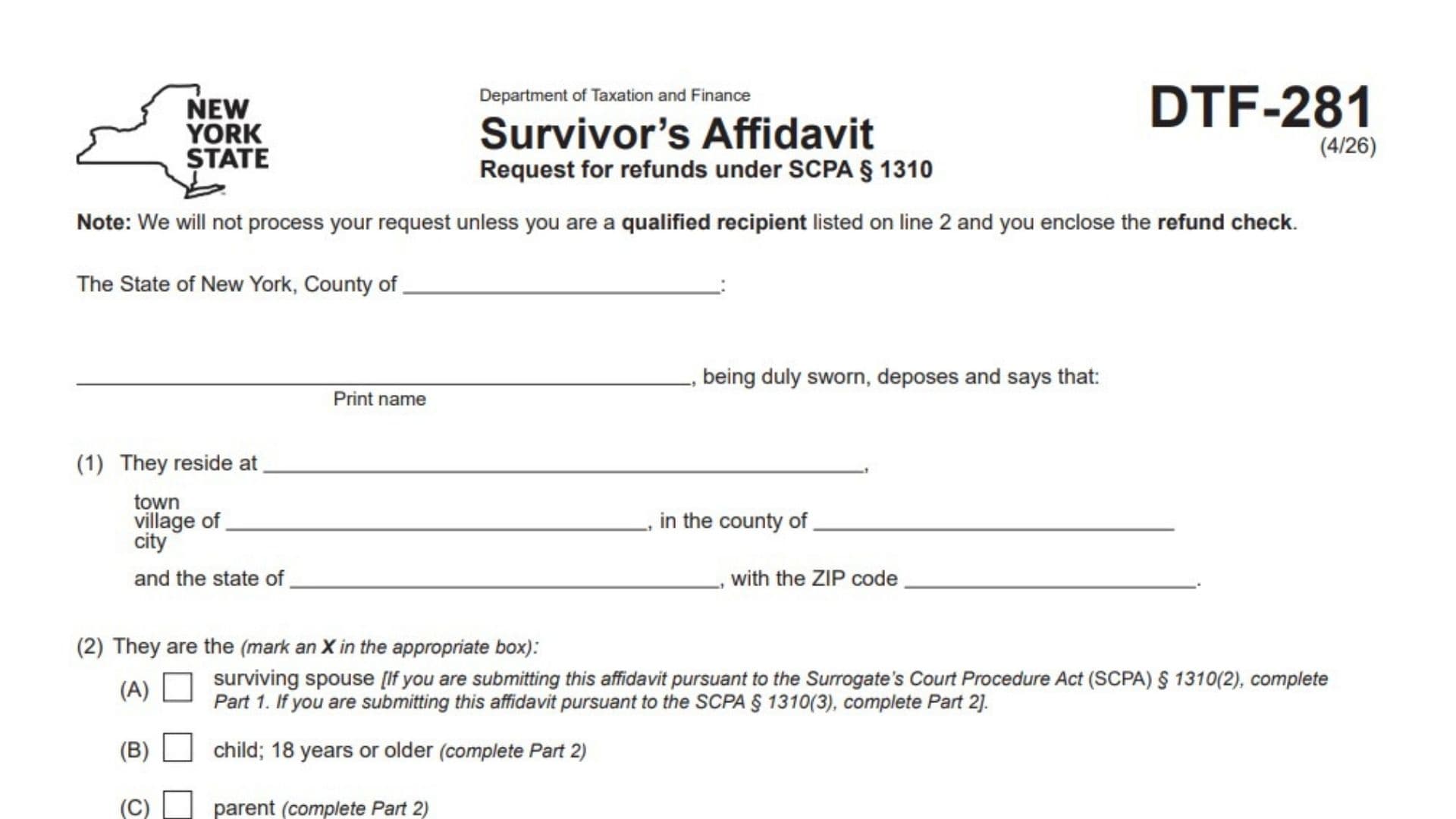
New York Form DTF-281, also known as the Survivor’s Affidavit, is a legal affidavit used to request the payment of a tax refund owed by the New York State Department of Taxation and Finance to a deceased taxpayer. The form is intended for certain surviving family members who qualify under Section 1310 of the New York Surrogate’s Court Procedure Act (SCPA). It provides a way for eligible recipients to request an outstanding refund without beginning the ordinary probate process, provided the conditions stated in the applicable section of the law are satisfied. The form collects information about the person making the request, their relationship to the deceased taxpayer, the decedent’s identifying information, the date of death, the amount of money owed by the tax department, and the amount requested for payment. It also requires the affiant to make specific sworn declarations concerning probate proceedings, the appointment of an estate fiduciary, beneficiary designations, applicable payment limits, and the distribution of the refund among eligible recipients. Depending on the applicant’s relationship to the deceased and the SCPA provision being used, either Part 1 or Part 2 must be completed. Part 1 is intended for a surviving spouse proceeding under SCPA §1310(2), while Part 2 applies to qualifying children aged 18 or older, parents, siblings, siblings’ children, and surviving spouses proceeding under SCPA §1310(3). The form also includes an indemnification agreement, a signature section, and a notarial certification. Completing Form DTF-281 correctly is important because the New York Department of Taxation and Finance will not process the refund request unless the applicant is a qualified recipient identified in the form and the original refund check is enclosed with the required supporting documents. The completed affidavit must be signed, notarized, and submitted with a copy of the decedent’s death certificate and proof of the applicant’s relationship to the deceased.
Who Can File Form DTF-281?
Form DTF-281 is intended for specific family members who qualify under the provisions identified on the form.
The applicant must select the appropriate relationship category in the relationship section.
The eligible categories are:
- Surviving Spouse: A person whose spouse has died. The applicable procedure determines whether Part 1 or Part 2 must be completed.
- Child Aged 18 Or Older: An adult child of the deceased taxpayer. Part 2 must be completed.
- Parent: A parent of the deceased taxpayer. Part 2 must be completed.
- Sibling: A brother or sister of the deceased taxpayer. Part 2 must be completed.
- Sibling’s Child: A child of the deceased taxpayer’s brother or sister. Part 2 must be completed.
The form distinguishes between two procedures:
SCPA §1310(2): A surviving spouse claiming the refund under this provision must complete Part 1.
SCPA §1310(3): A surviving spouse using this provision must complete Part 2. The other listed qualifying relatives also complete Part 2.
Applicants should carefully identify their relationship and the applicable procedure before completing the affidavit.
How To File Form DTF-281
Form DTF-281 must be completed, signed, notarized, and mailed to the New York State Department of Taxation and Finance.
The department specifies the following mailing address:
NYS TAX DEPARTMENT
REFUND ISSUING UNIT
W A HARRIMAN CAMPUS
ALBANY NY 12227-0125
The department requires the following documents to accompany the affidavit:
- Completed Survivor’s Affidavit: Fill in the applicable sections and provide all requested information.
- Copy Of The Death Certificate: Include a copy of the deceased taxpayer’s death certificate.
- Original Refund Check: Enclose the refund check issued in the deceased taxpayer’s name. The department specifically states that the request will not be processed without it.
- Proof Of Relationship: Attach documentation establishing the applicant’s relationship to the deceased taxpayer.
- Notarized Signature: Ensure the affidavit has been properly signed and notarized.
If you are completing Part 2 and need more space to identify the people receiving the refund, attach additional sheets containing the same information requested in the payment distribution table.
Private Delivery Services: If you intend to use a private delivery service instead of regular mail, consult Publication 55, Designated Private Delivery Services, for the applicable mailing instructions.

How To Complete Form DTF-281
Form DTF-281 contains identifying information, relationship selections, two alternative affidavit sections, a payment distribution table, an indemnification agreement, and a notarial certification.
Complete the following sections carefully.
Form Identification And Preliminary Notice
The document is titled Survivor’s Affidavit and carries the form number DTF-281, revision 4/26.
It is intended for refund requests under SCPA §1310.
Important Processing Notice
The form begins with an important condition: the department will not process the request unless the person applying is a qualified recipient listed in the relationship section and the refund check is enclosed.
Before proceeding, make sure you qualify under one of the listed relationship categories and have the refund check available.
Applicant And Notarial Information
State Of New York, County Of
Enter the county associated with the notarial venue where the affidavit is being sworn.
This information identifies the jurisdiction in which the affidavit is executed and notarized.
Print Name
Enter the full legal name of the person making the affidavit.
This is the applicant who is requesting payment of the deceased taxpayer’s refund.
The person named here should also be the person who signs the affidavit.
Applicant’s Residential Address
The first numbered section collects the applicant’s current residential address.
Item 1: Residential Street Address
Enter the complete street address where you currently reside.
Town, Village, Or City
Enter the name of the town, village, or city where your residence is located.
County
Enter the county in which your town, village, or city is situated.
State
Enter the state in which you currently reside.
ZIP Code
Provide the ZIP code associated with your residential address.
Make sure the complete address is accurate because it identifies the person submitting the affidavit.
Relationship To The Deceased Taxpayer
Item 2: Relationship To The Decedent
Select the appropriate relationship by marking an X in the corresponding box.
Only select the category that accurately describes your relationship to the deceased taxpayer.
Box A: Surviving Spouse
Select this option if you were legally the surviving spouse of the deceased taxpayer.
The applicable SCPA provision determines which part of the affidavit you must complete.
- If applying under SCPA §1310(2), complete Part 1.
- If applying under SCPA §1310(3), complete Part 2.
Box B: Child Aged 18 Or Older
Select this option if you are the deceased taxpayer’s child and are at least 18 years old.
Applicants selecting this category must complete Part 2.
Box C: Parent
Select this option if you are the parent of the deceased taxpayer.
Applicants selecting this category must complete Part 2.
Box D: Sibling
Select this option if you are the deceased taxpayer’s brother or sister.
Applicants selecting this category must complete Part 2.
Box E: Sibling’s Child
Select this option if you are the child of the deceased taxpayer’s brother or sister.
Applicants selecting this category must complete Part 2.
Deceased Taxpayer’s Identifying Information
After selecting the appropriate relationship, provide the identifying information of the deceased taxpayer.
Print Name Of Deceased Taxpayer
Enter the full name of the person who died.
The name should correspond to the taxpayer whose refund is being requested.
Decedent’s Social Security Number (SSN)
Enter the deceased taxpayer’s Social Security number in the space provided.
This information helps identify the taxpayer associated with the outstanding refund.
Date Of Death: Day
Enter the numerical day on which the taxpayer died.
Date Of Death: Month
Write the full name of the month in which the death occurred.
Date Of Death: Year
Enter the four-digit year of death.
Check the date carefully against the death certificate.
Part 1: Surviving Spouse Affidavit Under SCPA §1310(2)
Part 1 must be completed when the applicant selects Box A as the surviving spouse and is submitting the affidavit under SCPA §1310(2).
This section contains six declarations. By completing it, the surviving spouse makes sworn statements about their relationship, the status of the estate, beneficiary designations, the outstanding refund, and the total amount received under the applicable provision.
Part 1, Item 1: Confirmation Of Surviving Spouse Status
Confirm that you are the surviving spouse of the deceased taxpayer.
This declaration establishes the relationship on which the refund request is based.
Part 1, Item 2: Probate And Estate Fiduciary Status
Confirm that probate proceedings for the deceased taxpayer’s estate have not begun.
You must also affirm that no fiduciary of the estate has qualified or been appointed.
A fiduciary is the person formally responsible for administering the estate.
Both conditions must be true for the declaration to be accurate.
Part 1, Item 3: Beneficiary Designation
Confirm that no beneficiary designation is currently in effect.
This declaration addresses whether a beneficiary has been designated to receive the property or payment concerned.
Read the statement carefully before affirming it.
Part 1, Item 4: Amount Owed To The Deceased Taxpayer
Provide the amount that was due and payable to the deceased taxpayer by the New York State Department of Taxation and Finance at the time of death.
The form provides two spaces for the amount.
- Amount In Words: Write the total amount using words.
- Amount In Figures: Enter the same amount numerically inside the dollar field.
The form also provides a separate space for the purpose of the payment.
For
Describe what the outstanding amount relates to.
Make sure the description accurately identifies the refund or amount owed to the deceased taxpayer.
The amount entered should correspond to the outstanding obligation being claimed.
Part 1, Item 5: Amount Requested By The Surviving Spouse
Enter the amount you are requesting to receive from the outstanding debt owed to the deceased taxpayer.
The form provides separate spaces for:
- Amount In Words: Write the requested payment in words.
- Amount In Figures: Enter the requested payment numerically.
The declaration states that the payment is requested in full or partial satisfaction of the amount owed to the deceased taxpayer.
The requested amount should accurately represent the payment you are seeking.
Part 1, Item 6: Maximum Aggregate Payment Limit
Confirm that the requested payment, together with all other payments you have received under SCPA §1310(2), does not exceed $30,000 in total.
This is an aggregate limit, not simply a limit on the individual payment being requested.
Before affirming this statement, consider the other payments you have already received under the same statutory provision.
The total must not exceed thirty thousand dollars.
Part 2: Affidavit Under SCPA §1310(3)
Part 2 must be completed in either of the following situations:
- The applicant selects Box B, C, D, or E in the relationship section.
- The applicant selects Box A as the surviving spouse but submits the affidavit under SCPA §1310(3).
This section contains eight numbered declarations and a payment distribution table.
It requires information about the applicant’s relationship, the estate’s status, the amount owed, the people who will receive the payment, and the applicable aggregate payment limit.
Part 2, Item 1: Specify Relationship To The Decedent
Enter your exact relationship to the deceased taxpayer in the blank provided.
For example, identify whether you are the surviving spouse, an adult child, a parent, a sibling, or a sibling’s child.
The relationship entered should match the category selected in the earlier relationship section.
Part 2, Item 2: Probate And Fiduciary Status
Confirm that probate proceedings for the deceased taxpayer’s estate have not begun.
You must also confirm that no fiduciary of the estate has qualified or been appointed.
Both declarations must be accurate when you sign the affidavit.
Part 2, Item 3: Beneficiary Designation
Confirm that no beneficiary designation is in effect.
This statement concerns the existence of a beneficiary designation relating to the payment being requested.
Do not affirm this declaration unless it accurately reflects the circumstances.
Part 2, Item 4: Thirty-Day Waiting Period
Confirm that at least 30 days have passed since the deceased taxpayer’s date of death.
Calculate the period using the actual date of death.
The affidavit requires that 30 or more days have elapsed before proceeding under this section.
Part 2, Item 5: Amount Owed By The New York State Department Of Taxation And Finance
Enter the amount that was due and payable to the deceased taxpayer by the New York State Department of Taxation and Finance at the time of death.
Provide the amount in both written and numerical formats.
- Amount In Words: Spell out the amount in words.
- Amount In Figures: Enter the numerical amount in the dollar field.
For
Describe the purpose or nature of the outstanding amount.
The description should correspond to the refund or debt owed to the deceased taxpayer.
Part 2, Item 6: Amount Requested And Payment Distribution
Enter the total amount of the refund payment being requested.
Provide the amount in both words and figures.
The declaration states that the payment is requested in full or partial satisfaction of the outstanding debt.
Unlike Part 1, this section also requires you to identify the people who are entitled to receive the payment and the amount each person will receive.
Complete the payment distribution table carefully.
Name
Enter the full name of each person who is entitled to receive a portion of the refund payment.
List each recipient separately.
SSN
Enter the Social Security number of each person listed in the table.
Make sure the identifying information corresponds to the correct recipient.
Address Including ZIP Code
Provide the complete mailing address of each person receiving payment.
Include the street address, city or town, state, and ZIP code.
Payment Amount
Enter the amount of money that each named person will receive.
The amount assigned to each recipient should accurately reflect the intended distribution.
The form provides two recipient entries. If more space is needed, attach additional sheets containing the same information.
Make sure the additional information clearly identifies each recipient and their corresponding payment amount.
Part 2, Item 7: Maximum Aggregate Payment Limit
Confirm that the payment being requested, together with all other payments made under SCPA §1310 by all debtors known to you after diligent inquiry, does not exceed $15,000 in total.
This declaration requires consideration of more than the payment requested through the current affidavit.
You must also consider other payments made under the same statutory provision by debtors known to you after making a diligent inquiry.
The combined amount must not exceed fifteen thousand dollars.
Part 2, Item 8: Proof Of Relationship To The Decedent
The form provides a statement confirming that proof of your relationship to the deceased taxpayer has been provided and attached to the affidavit.
Enter your printed name in the blank immediately following the word “I.”
Attach the appropriate proof establishing your relationship to the deceased taxpayer.
The supporting documentation should correspond to the relationship category selected in the earlier section.
Indemnification Agreement
After the eight declarations, Part 2 includes an indemnification statement.
Agreement To Indemnify And Hold Harmless
By signing this agreement, you accept the responsibility stated in the form to indemnify and hold harmless the New York State Department of Taxation and Finance against any future claims involving any portion of the refund check.
This statement is important because other individuals may subsequently assert a claim to some or all of the refund payment.
Read the agreement carefully before signing the affidavit.
Signature And Notarization Section
The final section of Form DTF-281 must be completed after the applicable affidavit declarations have been filled in.
The applicant must sign and print their name, and the affidavit must be sworn before an authorized notary.
Applicant’s Signature
Sign your name on the designated signature line.
The signature confirms that you are making the statements contained in the affidavit.
Printed Name
Enter your full printed name beside or below the signature field, as indicated on the form.
The printed name should match the applicant’s name entered at the beginning of the affidavit.
Subscribed And Sworn To Before Me This Day
This section is completed by the notary or authorized official administering the oath.
The notary records the day on which the affidavit was sworn.
Month
The notary enters the month in which the affidavit was sworn.
Year
The notary enters the year in which the affidavit was sworn.
Notary Public, Commissioner Of Deeds
The designated area identifies the official authorized to administer the oath.
The notary or Commissioner of Deeds completes the appropriate official signature and certification section.
Make sure the notarization section is completed before mailing the affidavit to the department.
Supporting Documents Required With Form DTF-281
The affidavit is only one part of the refund request. The department also requires supporting documents to establish the circumstances of the claim.
Prepare the following documents before mailing your application.
1. Copy Of The Decedent’s Death Certificate
Include a copy of the official death certificate showing the deceased taxpayer’s identifying information and date of death.
2. Original Refund Check
Enclose the refund check issued by the New York State Department of Taxation and Finance.
The department explicitly states that it will not process the request without the refund check.
3. Proof Of Relationship
Attach documentation establishing that you belong to one of the qualifying relationship categories listed in the affidavit.
4. Additional Recipient Information, If Applicable
If you complete Part 2 and have more recipients than the available table spaces, attach additional sheets containing each recipient’s name, Social Security number, complete address, and payment amount.
5. Signed And Notarized Affidavit
Ensure the applicable part has been completed and the signature and notarization sections have been properly executed.
Understanding The Payment Limits Under Form DTF-281
One important part of Form DTF-281 is the difference between the payment limits stated in Part 1 and Part 2.
The applicable limit depends on the statutory procedure used.
| Requirement | Part 1 | Part 2 |
|---|---|---|
| Applicable provision | SCPA §1310(2) | SCPA §1310(3) |
| Eligible applicant | Surviving spouse | Surviving spouse under subsection (3), or another listed qualifying relative |
| Payment limit | $30,000 | $15,000 |
| Amount considered | Requested payment and other payments received by the applicant under subsection (2) | Requested payment and other payments made under SCPA §1310 by known debtors after diligent inquiry |
| Additional recipient distribution table | Not provided | Required |
Part 1 Limit: $30,000
The surviving spouse must affirm that the requested payment and all other payments received by them under SCPA §1310(2) do not exceed $30,000 in aggregate.
Part 2 Limit: $15,000
The applicant must affirm that the requested payment and all other payments made under SCPA §1310 by debtors known after diligent inquiry do not exceed $15,000 in aggregate.
These limits are different, so applicants should not substitute one amount for the other.
Common Mistakes To Avoid When Completing Form DTF-281
Several errors can make a refund request incomplete or prevent the department from processing it.
Pay particular attention to the following:
- Selecting The Wrong Relationship: Choose only the relationship category that accurately describes your connection to the deceased taxpayer.
- Completing The Wrong Part: Surviving spouses must distinguish between applications under SCPA §1310(2) and §1310(3).
- Incorrect Decedent Information: Check the deceased taxpayer’s full name, Social Security number, and date of death.
- Missing Payment Information: Enter the outstanding amount in both words and figures.
- Leaving The Payment Purpose Blank: Describe what the amount owed relates to.
- Ignoring The Aggregate Payment Limit: Apply the correct $30,000 or $15,000 limit.
- Incomplete Distribution Details: Part 2 requires the identifying and payment information of every named recipient.
- Missing Relationship Documentation: Attach proof of the applicant’s relationship to the deceased taxpayer.
- Missing Death Certificate: Include a copy of the death certificate.
- Forgetting The Refund Check: The department will not process the request without the check.
- Missing Notarization: The affidavit must be signed and notarized.
- Incomplete Mailing Package: Include every required document before sending the application.
Final Review Before Filing
Before mailing Form DTF-281, review the entire affidavit and supporting documents using this checklist.
Applicant Information
- Full name of the applicant is entered.
- Residential street address is complete.
- Town, village, or city is provided.
- County and state are entered.
- ZIP code is correct.
- Appropriate relationship box is marked.
- Correct section, Part 1 or Part 2, has been selected.
Deceased Taxpayer Information
- Full name of the deceased taxpayer is entered.
- Decedent’s Social Security number is provided.
- Date of death is entered correctly.
- Information matches the death certificate.
Part 1 Or Part 2 Declarations
- All applicable statements have been reviewed.
- Probate and fiduciary declarations are accurate.
- Beneficiary designation declaration is accurate.
- Outstanding refund amount is entered in words and figures.
- Purpose of the outstanding amount is described.
- Requested payment amount is entered correctly.
- Applicable aggregate payment limit is satisfied.
- Part 2 recipients and payment amounts are fully identified, if applicable.
- Additional recipient sheets are attached when needed.
- Proof of relationship is included.
- Indemnification agreement has been reviewed.
Signature And Supporting Documents
- Applicant has signed the affidavit.
- Printed name is provided.
- Notarial certification is completed.
- Copy of the death certificate is enclosed.
- Refund check is enclosed.
- Proof of relationship is attached.
- Additional payment distribution sheets are attached, if necessary.
Mailing Information
- The completed affidavit and supporting documents are addressed to:NYS TAX DEPARTMENT
REFUND ISSUING UNIT
W A HARRIMAN CAMPUS
ALBANY NY 12227-0125 - Private delivery service requirements have been checked against Publication 55, if applicable.
Final Reminder: Form DTF-281 is a sworn affidavit, not an ordinary tax refund application. Make sure every declaration is accurate, the correct statutory procedure is selected, the refund check is enclosed, and all required supporting documents are included before submitting the request.