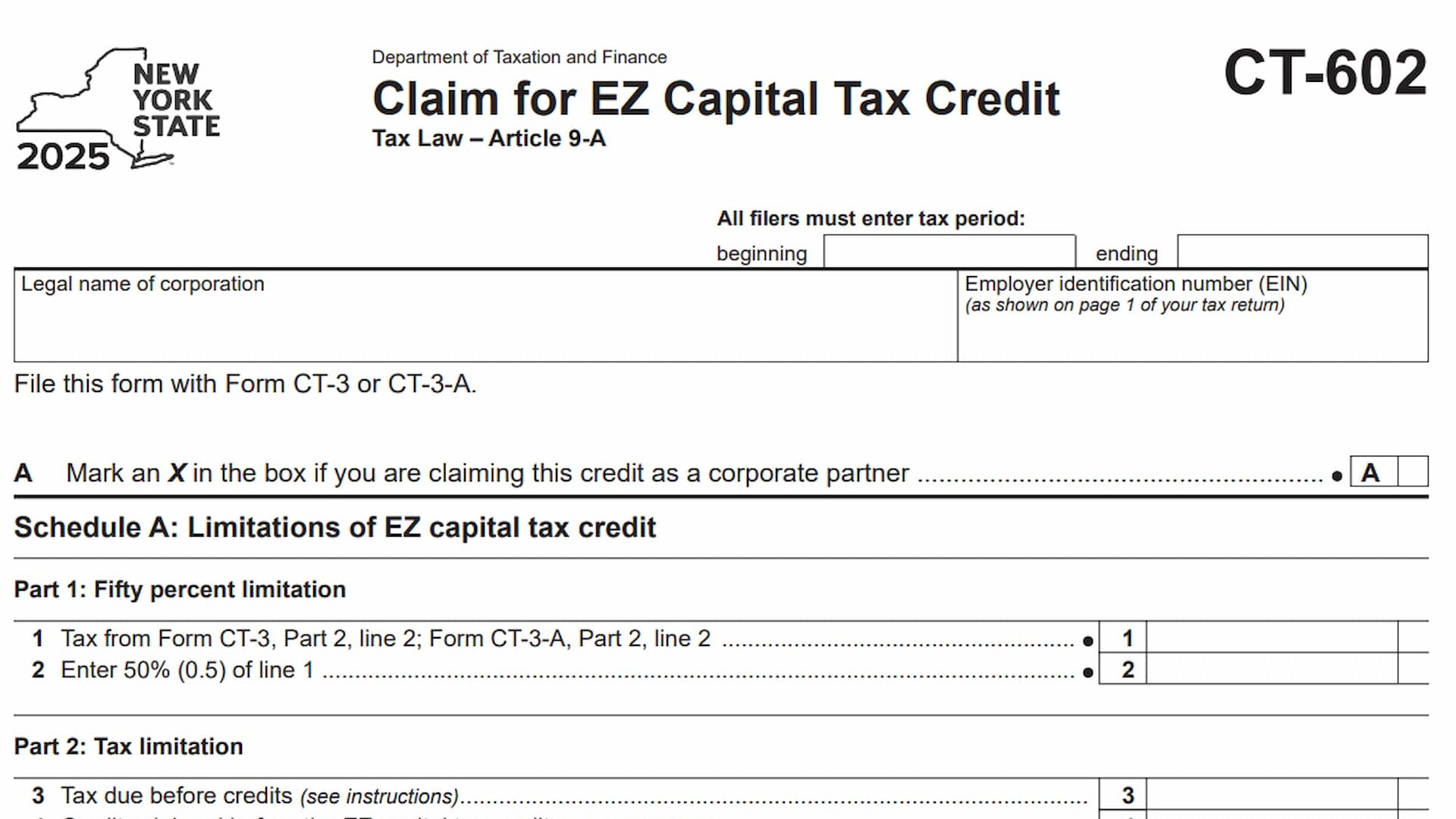
Form CT-602, Claim for EZ Capital Tax Credit, is a New York State tax form used by eligible C corporations to claim an unused Empire Zone (EZ) Capital Tax Credit carried forward from previous tax years. The credit is authorized under Article 9-A of the New York State Tax Law and is calculated against the corporation’s franchise tax liability.
The EZ Capital Tax Credit program has expired. Therefore, taxpayers cannot claim new credits under the program but may continue using eligible credit carryovers from previous years against their current tax liability.
Form CT-602 collects information about the corporation, including its legal name, Employer Identification Number (EIN), and tax period. It also determines how much of the available credit carryover can be used during the current tax year and how much must remain available for future periods.
The form contains two main schedules. Schedule A calculates the limitations applicable to the EZ Capital Tax Credit. It includes a 50% limitation and a separate tax limitation that considers the corporation’s tax due, previously claimed credits, and minimum tax. Schedule B calculates the amount of unused credit carried forward from previous periods, the amount used during the current year, and the remaining credit available for future years.
Completing Form CT-602 correctly is important because the credit cannot reduce the corporation’s tax below the applicable fixed dollar minimum tax or be applied against the Metropolitan Transportation Business Tax (MTA surcharge). The credit is also limited to 50% of the tax imposed under New York State Tax Law Section 209, without regard to any credit.
Unlike refundable credits, unused EZ Capital Tax Credit amounts cannot be requested as a refund. However, eligible unused amounts can be carried forward indefinitely to future tax years.
How To File Form CT-602
Form CT-602 must be filed with the corporation’s applicable New York franchise tax return.
The form identifies two possible returns:
- Form CT-3: General Business Corporation Franchise Tax Return.
- Form CT-3-A: General Business Corporation Combined Franchise Tax Return.
C corporations must complete Schedules A and B and include Form CT-602 with the applicable franchise tax return.
New York S corporations should not complete Form CT-602. Instead, shareholders must file Form IT-602, Claim for EZ Capital Tax Credit, to claim an eligible credit carryover on their New York State personal income tax returns.
Important Credit Eligibility Information
The EZ Capital Tax Credit program has expired. Only unused credit carryovers from previous years may be claimed.
There is also an additional eligibility restriction involving EZ retention certificates.
If your business was required to obtain an EZ retention certificate from Empire State Development but was denied one, you cannot claim the carryover attributable to investments in a certified EZ business.
However, an EZ retention certificate is not required to claim a carryover resulting from contributions to community development projects.
Before completing Form CT-602, gather the following information:
- Your applicable Form CT-3 or Form CT-3-A.
- The corporation’s legal name.
- The corporation’s Employer Identification Number (EIN).
- The beginning and ending dates of the tax period.
- The amount of unused EZ Capital Tax Credit carried forward from previous years.
- The tax amount reported on Form CT-3 or CT-3-A, Part 2, line 2.
- The amount of credits claimed before the EZ Capital Tax Credit.
- The applicable minimum tax amount.
- Supporting records for the available credit carryover.
- Any information needed to determine whether the credit is attributable to a certified EZ business or community development project.
Make sure the available credit carryover is eligible under the program’s requirements before including it in the calculation.

How To Complete Form CT-602
The 2025 Form CT-602 is a one-page tax schedule divided into two main sections: Schedule A and Schedule B.
Schedule A determines the limitations on the amount of EZ Capital Tax Credit that can be used. Schedule B calculates the credit used during the current tax year and the remaining carryforward.
Complete the corporation’s identifying information first, then follow the schedules in order.
Corporation Information
The first section identifies the corporation claiming the credit and the applicable tax period.
Tax Period Beginning
Enter the beginning date of the corporation’s tax period.
Use the date corresponding to the tax year covered by the applicable franchise tax return.
Tax Period Ending
Enter the ending date of the corporation’s tax period.
Make sure the beginning and ending dates match the reporting period shown on Form CT-3 or Form CT-3-A.
Legal Name of Corporation
Enter the corporation’s full legal name exactly as it appears on page 1 of the applicable franchise tax return.
Use the same business name reported on Form CT-3 or Form CT-3-A.
Employer Identification Number (EIN)
Enter the corporation’s nine-digit Employer Identification Number.
Make sure the EIN matches the identification information on the associated franchise tax return.
Filing Instructions
The form includes a notice stating:
File This Form with Form CT-3 or CT-3-A.
Attach the completed CT-602 to the applicable franchise tax return.
Corporate Partner Checkbox
Line A: Corporate Partner
Mark an X in this box if you are claiming the EZ Capital Tax Credit as a corporate partner.
Select this option when the corporation is claiming the credit in its capacity as a corporate partner.
Leave the box unchecked if the corporation is not claiming the credit as a corporate partner.
Schedule A: Limitations of EZ Capital Tax Credit
Schedule A determines the maximum amount of EZ Capital Tax Credit that can be applied against the corporation’s current-year tax liability.
It contains two parts:
- Part 1 calculates the 50% limitation.
- Part 2 calculates the tax limitation after accounting for previously claimed credits and the applicable minimum tax.
Both limitations are used in Schedule B to determine the amount of credit that can be claimed during the current tax year.
Part 1: Fifty Percent Limitation
Part 1 calculates the maximum credit allowed under the 50% limitation established by the form.
Line 1: Tax from Form CT-3 or Form CT-3-A, Part 2, Line 2
Enter the tax amount reported on the applicable franchise tax return.
Use one of the following sources:
- Form CT-3, Part 2, line 2.
- Form CT-3-A, Part 2, line 2.
This amount provides the starting point for calculating the 50% limitation.
Line 2: 50% of Line 1
Multiply the amount on Line 1 by 50%, or 0.5.
Enter the resulting amount on Line 2.
This represents the maximum credit allowed under the 50% limitation.
The EZ Capital Tax Credit cannot exceed 50% of the tax imposed under New York State Tax Law Section 209, without regard to any credit.
Part 2: Tax Limitation
Part 2 calculates the amount of tax available for the EZ Capital Tax Credit after accounting for other credits and the corporation’s minimum tax.
The calculation includes the tax due before credits, credits claimed before the EZ Capital Tax Credit, the remaining tax balance, and the applicable minimum tax.
Line 3: Tax Due Before Credits
Enter the corporation’s tax due before credits.
The amount depends on whether you filed Form CT-3 or Form CT-3-A.
Use the following table:
| Franchise tax return | Amount to enter on Line 3 |
|---|---|
| Form CT-3 | Part 2, Line 2 |
| Form CT-3-A | Part 2, Line 2 |
Enter the applicable amount from your franchise tax return.
Line 4: Credits Claimed Before the EZ Capital Tax Credit
Enter the total amount of tax credits claimed before applying the EZ Capital Tax Credit.
If you are claiming more than one tax credit for the current year, include the total amount of credits applied before this credit.
If you are not claiming any other credits before the EZ Capital Tax Credit, enter zero.
The form specifically instructs corporations to apply tax credits in a prescribed order. Consult Form CT-600-I, Instructions for Form CT-600, Ordering of Corporation Tax Credits, to determine the correct credit application sequence.
Line 5: Balance of Tax
Subtract the amount on Line 4 from the amount on Line 3.
Enter the resulting amount on Line 5.
This represents the corporation’s remaining tax liability after applying credits claimed before the EZ Capital Tax Credit.
Line 6: Minimum Tax
Enter the corporation’s applicable minimum tax.
The amount depends on the franchise tax return being filed.
Use the following table:
| Franchise tax return | Amount to enter on Line 6 |
|---|---|
| Form CT-3 | Part 2, Line 1c |
| Form CT-3-A | Part 2, Line 1c |
Enter the applicable minimum tax amount from the corresponding franchise tax return.
The EZ Capital Tax Credit cannot reduce the corporation’s tax liability below the fixed dollar minimum tax.
Line 7: Credit Limitation
Subtract the amount on Line 6 from the amount on Line 5.
Enter the resulting amount on Line 7.
This calculation determines the tax limitation available for the EZ Capital Tax Credit after accounting for the minimum tax.
The amount on Line 7 is used in Schedule B to determine how much of the available credit carryover can be used during the current tax year.
Schedule B: Calculation of EZ Capital Tax Credit Used and Carried Forward
Schedule B determines how much of the unused EZ Capital Tax Credit can be applied during the current tax year and how much remains available for future periods.
The calculation considers three amounts:
- The 50% limitation from Schedule A, Line 2.
- The tax limitation from Schedule A, Line 7.
- The unused EZ Capital Tax Credit carried forward from previous periods.
Credit Carryover and Current-Year Calculation
Line 8: Unused EZ Capital Tax Credit from Previous Periods
Enter the total amount of unused EZ Capital Tax Credit carried forward from previous tax periods.
Use your previous tax records to determine the remaining eligible credit balance.
Only eligible credit carryovers from previous years can be claimed because the EZ Capital Tax Credit program has expired.
Make sure the amount does not include any carryover that is ineligible under the EZ retention certificate requirements.
Line 9: EZ Capital Tax Credit Used This Year
Enter the smallest of the following three amounts:
- Schedule A, Line 2: 50% limitation.
- Schedule A, Line 7: Tax limitation.
- Schedule B, Line 8: Unused EZ Capital Tax Credit from previous periods.
Compare all three amounts and enter the lowest figure on Line 9.
This represents the amount of EZ Capital Tax Credit that can be used during the current tax year.
Transfer the amount reported on Line 9 to the applicable franchise tax return.
The amount cannot exceed the 50% limitation, the tax limitation, or the available credit carryover.
Line 10: EZ Capital Tax Credit Available for Carryforward
Subtract the amount on Line 9 from the amount on Line 8.
Enter the resulting amount on Line 10.
This represents the unused EZ Capital Tax Credit that remains available for future tax periods.
Because the credit can be carried forward indefinitely, any eligible unused balance may continue to be applied against future franchise tax liabilities, subject to the applicable limitations.
Additional Form Instructions and Important Credit Restrictions
The instructions on page 2 of Form CT-602 provide several important rules regarding eligibility, credit limitations, and the treatment of unused amounts.
Expiration of the EZ Capital Tax Credit
The Empire Zone Capital Tax Credit program has expired.
Taxpayers cannot claim new credits under the program. However, eligible unused credit carryovers from previous years may still be applied against current franchise tax liabilities.
EZ Retention Certificate Requirement
Certain businesses were required to obtain an EZ retention certificate from Empire State Development.
If a business was required to obtain this certificate but was denied one, it cannot claim the carryover attributable to investments in a certified EZ business.
However, taxpayers do not need an EZ retention certificate to claim carryovers resulting from contributions to community development projects.
Fixed Dollar Minimum Tax Limitation
The EZ Capital Tax Credit cannot be used to reduce the corporation’s tax liability below the applicable fixed dollar minimum tax.
This limitation is calculated in Schedule A, Part 2, Lines 5 through 7.
MTA Surcharge Restriction
The EZ Capital Tax Credit cannot be applied against the Metropolitan Transportation Business Tax (MTA surcharge).
It can only be used against the applicable franchise tax liability, subject to the limitations on the form.
No Refund for Unused Credits
Taxpayers cannot request a refund for any unused portion of the EZ Capital Tax Credit.
However, eligible unused amounts can be carried forward to future tax years indefinitely.
Combined Filers
Corporations filing a combined franchise tax return must account for the credits claimed by all members of the combined group.
The instructions require combined filers to include the total amount of all tax credits that they and other members of the combined group are claiming, including the EZ Capital Tax Credit claim, that they want to apply before this credit.
Make sure the amounts entered reflect the applicable combined group calculations.
New York S Corporations
New York S corporations should not complete Form CT-602.
Instead, shareholders must use Form IT-602, Claim for EZ Capital Tax Credit, to claim an eligible credit carryover on their New York State personal income tax returns.
Final Review Before Filing
Before submitting Form CT-602 with your New York franchise tax return, review the following checklist to make sure all required information and calculations are complete.
- Correct tax year: Confirm that you are using the 2025 Form CT-602.
- Tax period: Verify the beginning and ending dates of the corporation’s tax period.
- Corporate information: Make sure the legal name matches page 1 of Form CT-3 or CT-3-A.
- EIN: Confirm that the corporation’s Employer Identification Number is correct.
- Corporate partner: Mark Line A if claiming the credit as a corporate partner.
- Correct return: Confirm that Form CT-602 is being filed with Form CT-3 or Form CT-3-A.
- Eligibility: Verify that the claimed amount represents an eligible carryover from previous years.
- Expired program: Remember that new EZ Capital Tax Credits cannot be claimed under the expired program.
- EZ retention certificate: Check whether the retention certificate requirement applies to the credit carryover.
- Community development contributions: Confirm that qualifying community development project carryovers are treated according to the applicable exception.
- Schedule A, Line 1: Verify that the tax amount matches Form CT-3 or CT-3-A, Part 2, line 2.
- Line 2: Confirm that Line 1 is multiplied by 50%.
- Line 3: Enter the applicable tax due before credits.
- Line 4: Include the credits claimed before the EZ Capital Tax Credit, or enter zero if none apply.
- Line 5: Subtract Line 4 from Line 3.
- Line 6: Enter the applicable minimum tax from Form CT-3 or CT-3-A, Part 2, line 1c.
- Line 7: Subtract Line 6 from Line 5.
- Schedule B, Line 8: Verify the unused EZ Capital Tax Credit carryover from previous periods.
- Line 9: Enter the smallest of Schedule A, Line 2, Schedule A, Line 7, or Schedule B, Line 8.
- Line 10: Subtract Line 9 from Line 8 to determine the remaining credit carryforward.
- Credit ordering: Consult Form CT-600-I when determining the order in which corporation tax credits must be applied.
- MTA surcharge: Make sure the credit is not being applied against the Metropolitan Transportation Business Tax surcharge.
- Combined filers: Include the applicable credit information for all members of the combined group.
- Final review: Check all calculations, carryover amounts, eligibility requirements, and transferred figures before filing.
Review both schedules carefully before submitting Form CT-602. The amount claimed must satisfy the 50% limitation, the tax limitation, and the available credit carryover balance. Remember that unused eligible credits cannot be refunded but may be carried forward indefinitely to future tax years.