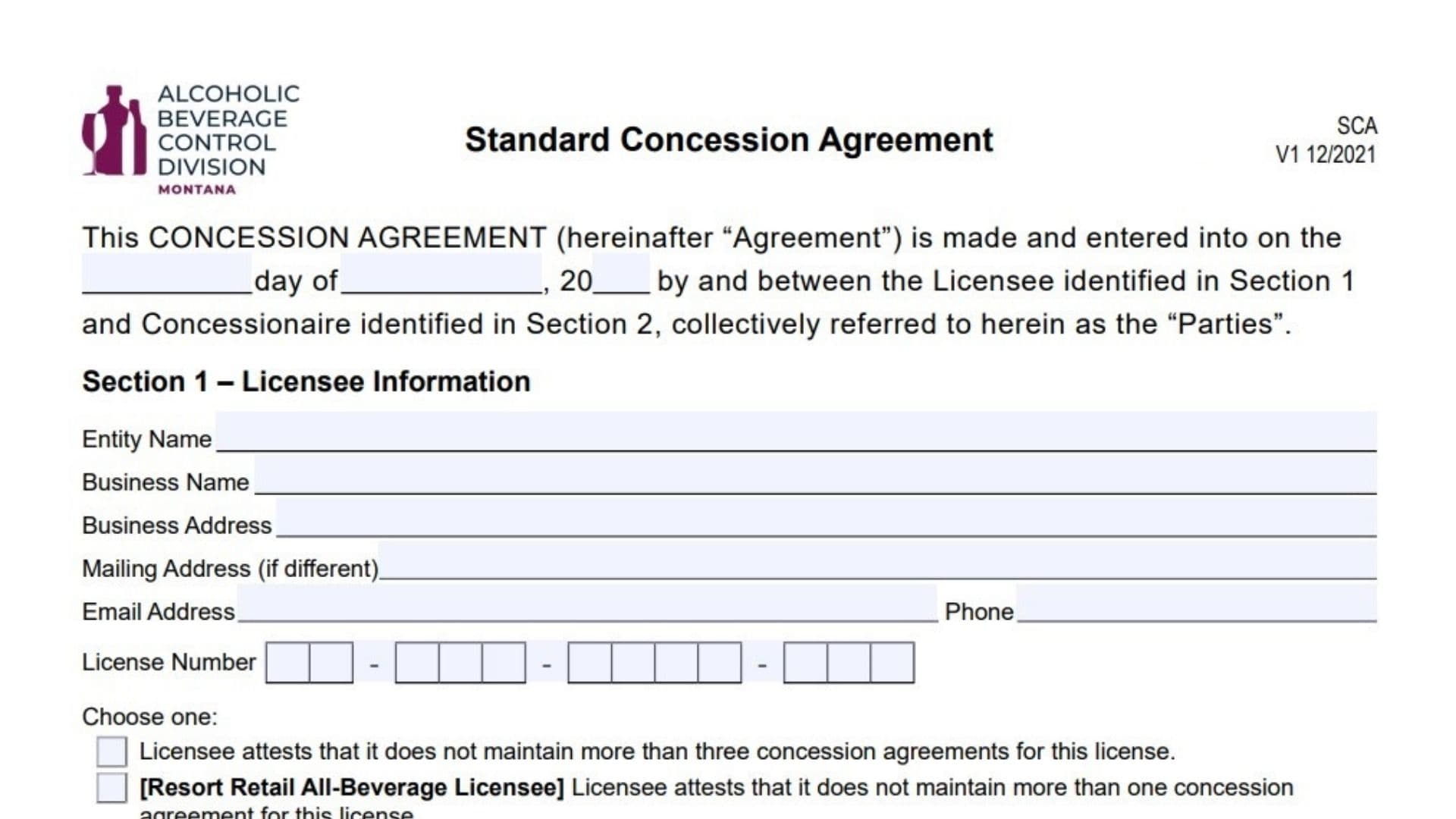
The Montana Standard Concession Agreement is a legally binding document required by the Montana Department of Revenue’s Alcoholic Beverage Control Division to formally establish and regulate a working relationship between a business holding a liquor license and an unlicensed concessionaire. This form is necessary when a licensed entity wants to allow another business to operate alongside it within the same contiguous premises—such as a restaurant serving food inside a licensed bar or hotel—while maintaining strict legal compliance with state alcohol laws. The agreement clarifies that the licensee retains absolute control over all alcohol sales, service, and gaming operations, ensuring that the concessionaire does not illegally assume ownership or unauthorized authority over the liquor license. Completing this form properly is essential for establishing the financial compensation structure, detailing the legal terms of the partnership, and preventing any violations of Title 16 of the Montana Code Annotated that could result in the revocation of the liquor license.
Establishing The Agreement Date And Parties
At the very top of the form, you must officially date the agreement. Enter the specific day, month, and year that this contract is being made and entered into. The document states that this agreement is established between the “Licensee” identified in Section 1 and the “Concessionaire” identified in Section 2.

How to Complete Montana Standard Concession Agreement Form SCA
Section 1: Licensee Information
This section requires the full identifying details of the individual or business that currently holds the Montana liquor license.
Provide the Entity Name, which is the official legal name of the business or individual owning the license. Next, write the Business Name or “Doing Business As” name. Enter the primary Business Address where operations occur, and provide a Mailing Address if it differs from the physical location. You must also supply a valid Email Address and Phone number for state communication. Enter the exact state-issued License Number. Finally, you must check one of two boxes to verify concession limits: choose the first box to attest that the licensee does not maintain more than three concession agreements for this license, or choose the second box if you are a Resort Retail All-Beverage Licensee attesting that you do not maintain more than one concession agreement.
Section 2: Concessionaire’s Information
This section identifies the secondary business or individual who will be operating alongside the licensee.
Enter the Entity Name of the concessionaire, followed by their operating Business Name. Provide the Concessionaire’s Business Address and a separate Mailing Address if necessary. You must list a specific Contact Name for the concessionaire, along with their Email Address and Phone number. Finally, enter the concessionaire’s Federal Employer Identification Number on the designated line.
Section 3: Requirements Of The Concession Agreement
This section does not require you to fill in any blank lines, but it outlines the mandatory legal stipulations required by state law that both parties are agreeing to by signing the document.
Part A affirms that the licensed premises is a contiguous space, including the area utilized by the concessionaire. Part B explicitly states that the Licensee retains ultimate control over all alcohol operations. This includes the ordering, purchasing, selling, and serving of alcohol, as well as the right to discipline any employee regarding alcohol service. It mandates that all servers employed by the concessionaire must complete a state-approved Responsible Alcohol Sales and Service Training Program. Furthermore, it requires that alcohol proceeds be reconciled at least monthly, allows the agreement to be terminated for cause, and dictates that the Licensee maintains exclusive control over all gaming activities.
Section 4: Compensation Arrangement
In this section, you must clearly define how the Licensee will compensate the Concessionaire.
You have two primary structural choices. The first option allows you to select a single compensation method: you can enter a specific percentage on the “Percentage of gross or net alcoholic beverage sales” line, enter a percentage on the “Percentage of employee overhead” line, or write in a “Fixed dollar amount.” Alternatively, if the payment structure is more complex, you can choose the “-OR- A combination of” section. Here, you can fill in multiple lines, combining a percentage of sales, a percentage of employee overhead, and a fixed dollar amount to accurately reflect your financial arrangement.
Section 5: Term
This brief section establishes the timeline for the contract. On the single blank line provided, you must insert the initial term of the agreement, such as “one year,” “five years,” or a specific date range.
Section 6: Termination And Section 7: Miscellaneous Provisions
These sections outline the legal boundaries of the contract and do not require any blank lines to be filled.
Section 6 states that the agreement can be canceled at any time for cause, which includes violations of the state code or terms of the contract. Section 7 details miscellaneous legal provisions, establishing that Montana state law governs the agreement. It clarifies that any modifications to the compensation structure must be submitted to the Department of Revenue, notes that each party is responsible for their own attorneys’ fees, and includes a severability clause ensuring that if one provision is deemed invalid, the rest of the agreement remains enforceable.
Section 8: No Ownership Interest And Final Signatures
Section 8 confirms that this contract does not create a partnership, joint venture, or any ownership interest in the liquor license for the concessionaire.
To execute the agreement, the document requires physical signatures from authorized representatives of both parties. On the left side, the Licensee must sign their name, enter the Date of the signature, clearly Print their Name, and provide their official Title. On the right side, the Concessionaire must provide their Signature, the Date, their Printed Name, and their Title. Once fully executed, the completed document must be mailed to the Department of Revenue, Alcoholic Beverage Control Division at PO Box 1712, Helena, MT 59624-1712.