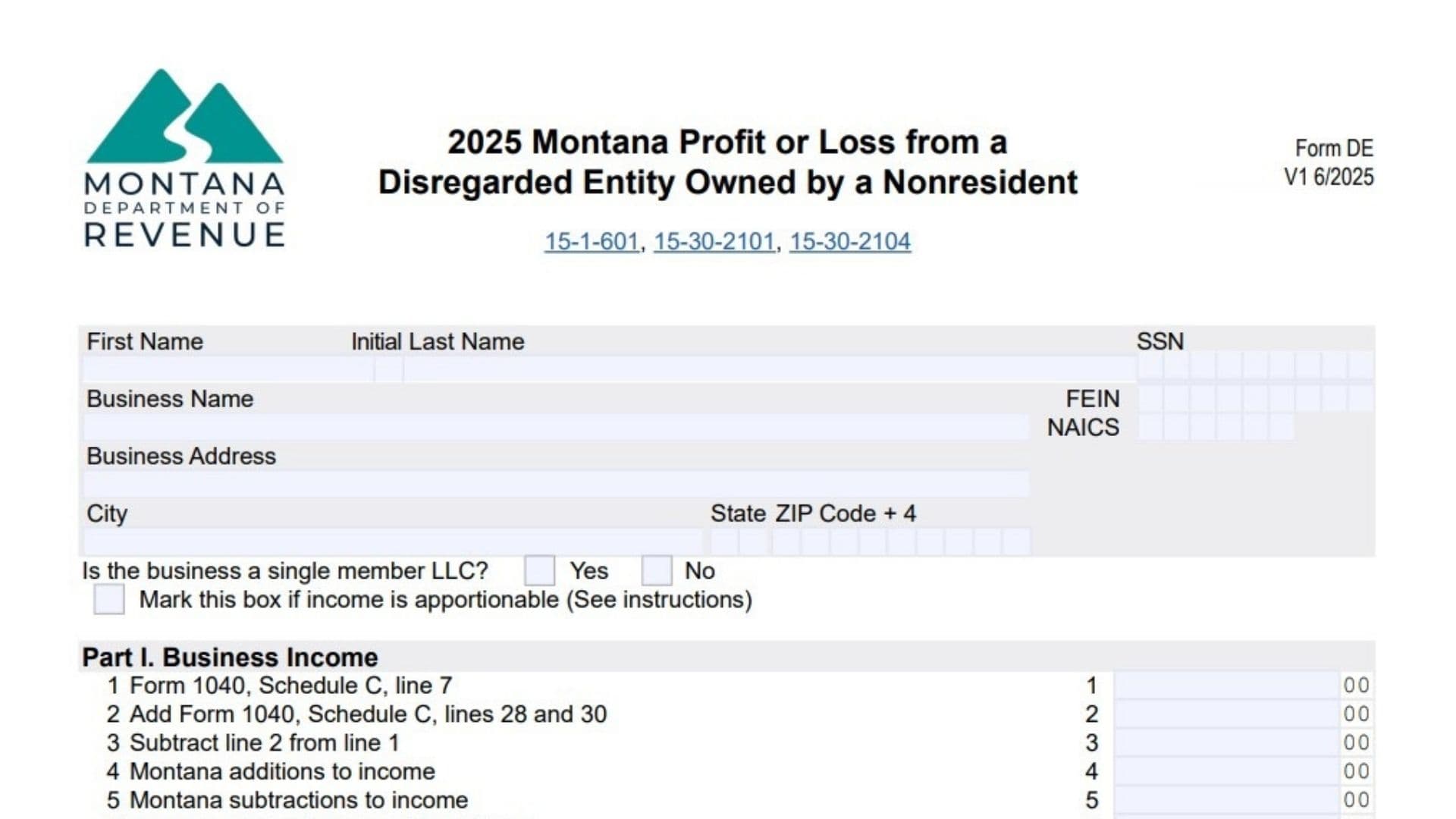
Form DE, officially titled the Montana Profit or Loss from a Disregarded Entity Owned by a Nonresident, is a tax document used by single-member limited liability companies and sole proprietorships owned by nonresident individuals, estates, and trusts. Its primary purpose is to accurately report Montana source business income and any payments received from a pass-through entity. Furthermore, the form is utilized to calculate the alternative method tax for nonresidents who meet specific eligibility criteria under Montana law. Because disregarded entities must allocate and apportion their income similarly to a pass-through entity or C corporation, this form relies heavily on the figures you have already calculated on your federal Schedule C. If your business operates in multiple states or engages in a unitary business model where operations across state lines are interdependent, this form helps determine the exact fraction of your income that is taxable within Montana.
General Information And Identification
Before calculating your income, you must provide identifying information at the top of the form. Begin by entering your First Name, Initial, Last Name, and Social Security Number. Below that, provide your exact Business Name as it appears on your federal Schedule C, along with your Federal Employer Identification Number and your North American Industry Classification System code. Fill in your complete Business Address, including the City, State, and ZIP Code. You must then check the appropriate “Yes” or “No” box to indicate whether the business is a single-member LLC. If your business earns income in more than one state, making your income apportionable, you must check the designated box indicating this status.

How to Complete Montana Form DE
Part I: Business Income
This section calculates your baseline business income using figures from your federal return.
Line 1 requires you to enter the amount found on your federal Form 1040, Schedule C, Line 7.
Line 2 asks you to add the amounts from your federal Form 1040, Schedule C, Lines 28 and 30, and enter the total here.
Line 3 is calculated by subtracting the amount on Line 2 from the amount on Line 1.
Line 4 is for Montana additions to income, where you report business income items taxed by Montana but not federally.
Line 5 is for Montana subtractions to income, where you report items taxed federally but not by Montana.
Line 6 calculates your total adjusted business income by adding Lines 3 and 4, and then subtracting Line 5. If your income is fully sourced to Montana, you stop here and report this final amount on Form 2, Schedule II, line 6a; if you conduct business in multiple states, you must proceed to Part II.
Part II: Receipts Factor For Multistate Businesses
If your business operates inside and outside of Montana, you must use a single receipts factor to determine your state-specific income.
Line 1a requires you to enter your total gross income from Form 1040, Schedule C, line 3 in Column A for “Everywhere,” and then enter only the gross income earned in Montana in Column B.
Line 1 calculates your receipts factor by dividing the Montana gross income in Column B by the total gross income in Column A, and multiplying the result by 100 to get a percentage.
Line 2 determines your Montana source business income by multiplying the receipts factor percentage from Line 1 by the total income calculated in Part I, Line 6. This final figure is then reported on Schedule II, line 6a.
Part III: Alternative Method Tax
This section is strictly for eligible nonresidents who opt to use the alternative method tax. If you qualify, mark the checkbox at the top of this section before proceeding.
Line 1 asks for the gross volume of sales made in Montana; you must not enter an amount exceeding $100,000.
Line 2 calculates your Nonresident Alternative Method Tax by multiplying the amount on Line 1 by 0.5 percent. The resulting figure must be entered here and also carried over to Form 2, page 1, line 8.
Part IV: Payments From A Pass-Through Entity
If your single-member LLC received payments or credits from a partnership or pass-through entity, you must detail them in this final section.
For each pass-through entity, you are provided with a row to enter the specific details. In Column A, write the Pass-Through Entity Name. In Column B, enter the Federal Employer Identification Number of that entity. In Column C, record any pass-through entity tax credit you received. In Column D, enter the withholding amount listed on the Montana Schedule K-1 issued to you. Finally, on Line 4, calculate the total payments received by adding the amounts in the column above and enter the final sum.