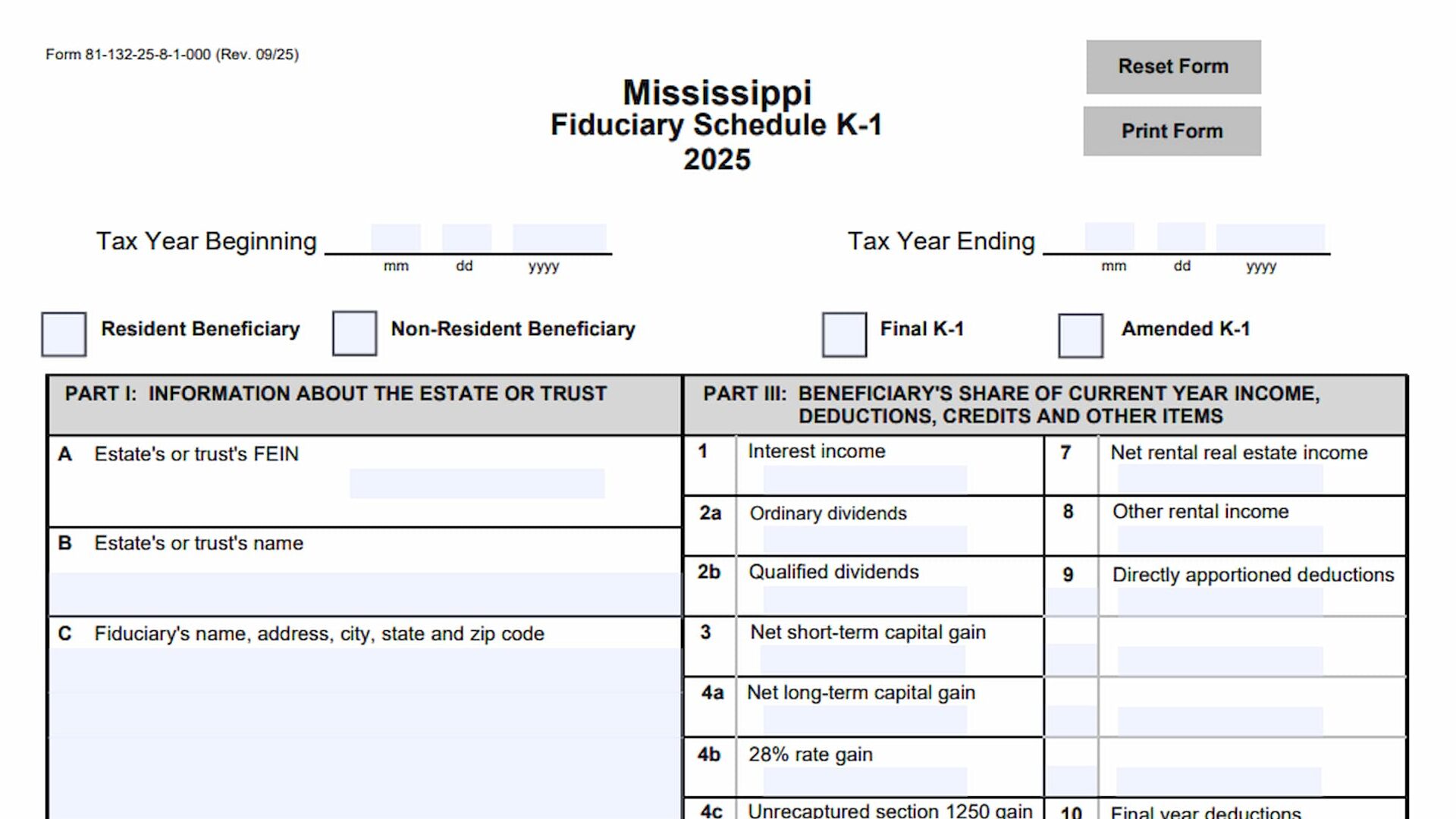
Mississippi Fiduciary Schedule K-1 is a state tax reporting document used by estates and trusts to report each beneficiary’s share of income, deductions, credits, and other tax-related items for the 2025 tax year. The form provides beneficiaries with information about the amounts allocated to them by an estate or trust so they can use the applicable figures when preparing their Mississippi income tax returns.
The schedule is divided into five parts. Part I identifies the estate or trust and provides information about the fiduciary responsible for the entity. Part II collects the beneficiary’s identifying information and other details, including estimated tax payments, the beneficiary’s ownership interest, and residency classification. Part III reports the beneficiary’s share of current-year income, deductions, and other items, including interest, dividends, capital gains, rental income, and business income. Part IV identifies Mississippi tax credits allocated to the beneficiary, while Part V reports any electing pass-through entity tax credit being passed through to the beneficiary.
The form collects important identifying and financial information, including the estate’s or trust’s Federal Employer Identification Number (FEIN), its legal name, the fiduciary’s contact information, and the beneficiary’s Social Security Number (SSN) or FEIN. It also identifies whether the beneficiary is a Mississippi resident or nonresident and whether the schedule is an original, final, or amended K-1.
Completing the schedule accurately is important because beneficiaries rely on the reported information when determining their Mississippi income, deductions, and available tax credits. The amounts shown on the schedule reflect Mississippi income or loss and related expenses. Mississippi law also conforms to the Internal Revenue Code regarding passive activity and rental real estate activity limitations, as noted on the form.
How To File Mississippi Fiduciary Schedule K-1
Mississippi Fiduciary Schedule K-1 is used to communicate an estate’s or trust’s allocated tax information to its beneficiary. The completed schedule identifies the beneficiary’s share of income, deductions, credits, and other items for the applicable tax year.
The form itself does not provide a separate mailing address or detailed instructions for submitting it with a tax return. Beneficiaries should use the information provided on the schedule when completing their applicable Mississippi tax reporting and follow the relevant filing instructions.
Before completing or reviewing the schedule, gather the following information:
- The estate’s or trust’s Federal Employer Identification Number (FEIN).
- The legal name of the estate or trust.
- The fiduciary’s full name and mailing address.
- The beneficiary’s Social Security Number (SSN) or FEIN.
- The beneficiary’s full name and mailing address.
- The beginning and ending dates of the applicable tax year.
- The beneficiary’s residency classification.
- Information about interest, dividends, capital gains, rental income, and ordinary business income allocated to the beneficiary.
- Details of directly apportioned deductions and final-year deductions.
- Mississippi tax credit codes, names, and amounts from Form 80-401.
- Information about estimated tax payments and payments made with an extension.
- The beneficiary’s percentage of interest in the entity.
- Any electing pass-through entity tax credit allocated to the beneficiary.
Make sure the information reflects the correct tax year and beneficiary. If the schedule is being amended or represents the final K-1 for the entity, select the appropriate checkbox.

How To Complete Mississippi Fiduciary Schedule K-1
The 2025 Mississippi Fiduciary Schedule K-1 contains five main parts. The first two sections identify the estate or trust and its beneficiary. Part III reports the beneficiary’s share of income and deductions, Part IV lists Mississippi tax credits, and Part V reports any allocated pass-through entity tax credit.
Tax Year Information
At the top of the form, enter the dates identifying the applicable tax period.
Tax Year Beginning
Enter the date on which the estate’s or trust’s tax year begins.
Use the designated month, day, and year fields.
Tax Year Ending
Enter the ending date of the estate’s or trust’s tax year.
Make sure the beginning and ending dates accurately reflect the reporting period covered by the K-1.
Beneficiary and K-1 Classification
The top of the schedule contains four checkboxes that identify the beneficiary’s residency status and the type of K-1 being issued.
Resident Beneficiary
Check this box if the beneficiary is classified as a resident beneficiary.
Non-Resident Beneficiary
Check this box if the beneficiary is classified as a nonresident beneficiary.
Select the residency classification applicable to the beneficiary.
Final K-1
Check this box if the schedule represents the final K-1 issued for the estate or trust.
This identifies the document as the final beneficiary schedule for the entity.
Amended K-1
Check this box if the schedule is being issued as an amended K-1.
Use this designation when the information is being corrected or updated through an amended schedule.
Part I: Information About the Estate or Trust
Part I identifies the estate or trust responsible for reporting the beneficiary’s allocated income and other tax items. It contains three fields covering the entity’s identification number, name, and fiduciary contact information.
Field A: Estate’s or Trust’s FEIN
Enter the Federal Employer Identification Number (FEIN) assigned to the estate or trust.
Use the entity’s nine-digit federal identification number rather than the beneficiary’s personal Social Security number.
Field B: Estate’s or Trust’s Name
Enter the full legal name of the estate or trust issuing the K-1.
Make sure the name is consistent with the entity’s tax and identification records.
Field C: Fiduciary’s Name, Address, City, State, and ZIP Code
Enter the fiduciary’s full name and mailing address.
Include the following information:
- Fiduciary’s name.
- Street address.
- City.
- State.
- ZIP code.
The fiduciary is the person or entity responsible for administering the estate or trust and providing the beneficiary’s tax information.
Part II: Information About the Beneficiary
Part II identifies the beneficiary receiving the income, deductions, and credits reported on the schedule. It also contains fields for estimated tax payments, the beneficiary’s percentage of interest in the entity, and residency classification.
Field D: Beneficiary’s SSN / FEIN
Enter the beneficiary’s identifying number.
Use the beneficiary’s Social Security Number (SSN) or Federal Employer Identification Number (FEIN), depending on whether the beneficiary is an individual or an entity.
Field E: Beneficiary’s Name, Address, City, State, and ZIP Code
Enter the beneficiary’s full name and mailing address.
Provide the following details:
- Beneficiary’s name.
- Street address.
- City.
- State.
- ZIP code.
Make sure the information correctly identifies the person or entity receiving the allocated tax items.
Field F: Estimated Tax Payments and/or Amount Paid with Extension
Enter the applicable estimated tax payments made on behalf of the beneficiary and/or the amount paid with an extension.
Report the amount associated with the beneficiary and the estate or trust’s tax reporting information.
The form provides a separate monetary field for this figure.
Field G: Beneficiary’s Percentage of Interest in the Entity
Enter the beneficiary’s percentage of interest in the estate or trust.
Report the applicable percentage in the designated field. This information identifies the beneficiary’s share of interest in the entity.
Field H: Beneficiary Classification
Select the checkbox identifying the beneficiary as either domestic or foreign.
Two options are available:
- Domestic beneficiary: Check this box if the beneficiary is classified as domestic.
- Foreign beneficiary: Check this box if the beneficiary is classified as foreign.
Select the applicable classification for the beneficiary.
Mississippi Tax Treatment Notice
Part II also includes an important notice about Mississippi’s treatment of passive activity and rental real estate income.
Mississippi law conforms to the Internal Revenue Code regarding passive activity and rental real estate activity limitations. The income and loss amounts and related expenses reported on the schedule reflect Mississippi tax treatment.
Beneficiaries should consider this information when reviewing the income and deduction amounts reported in Part III.
Part III reports the beneficiary’s allocated share of income, deductions, and other tax items for the current tax year.
The section contains individual reporting categories for interest income, dividends, capital gains, portfolio income, business income, rental income, and deductions.
Use the amounts allocated to the beneficiary by the estate or trust when completing each applicable line.
Line 1: Interest Income
Enter the beneficiary’s share of interest income generated by the estate or trust during the tax year.
Report the amount allocated to the beneficiary for Mississippi tax reporting.
Line 2a: Ordinary Dividends
Enter the beneficiary’s share of ordinary dividends.
Use the amount allocated by the estate or trust for the applicable tax year.
Line 2b: Qualified Dividends
Enter the beneficiary’s share of qualified dividends.
Report this amount separately from ordinary dividends on Line 2a.
Line 3: Net Short-Term Capital Gain
Enter the beneficiary’s share of net short-term capital gain.
Use the amount allocated to the beneficiary by the estate or trust.
Line 4a: Net Long-Term Capital Gain
Enter the beneficiary’s share of net long-term capital gain.
Report the allocated amount separately from short-term capital gains.
Line 4b: 28% Rate Gain
Enter the beneficiary’s share of gain subject to the 28% rate category.
Use the amount identified by the estate or trust for this specific type of gain.
Line 4c: Unrecaptured Section 1250 Gain
Enter the beneficiary’s share of unrecaptured Section 1250 gain.
Report the amount separately from the other capital gain categories listed on Lines 3 and 4a through 4b.
Line 5: Other Portfolio and Nonbusiness Income
Enter the beneficiary’s share of other portfolio income and nonbusiness income not separately identified in the preceding categories.
Use the amount allocated to the beneficiary by the estate or trust.
Line 6: Ordinary Business Income
Enter the beneficiary’s share of ordinary business income generated by the estate or trust.
Report the allocated amount for the applicable tax year.
Line 7: Net Rental Real Estate Income
Enter the beneficiary’s share of net rental real estate income.
This category covers the beneficiary’s allocated income from rental real estate activities. The amount shown reflects Mississippi income or loss and related expenses under the applicable activity limitations.
Line 8: Other Rental Income
Enter the beneficiary’s share of other rental income that is not included in the net rental real estate income category on Line 7.
Report the amount allocated by the estate or trust.
Line 9: Directly Apportioned Deductions
Enter the beneficiary’s share of directly apportioned deductions.
These amounts represent deductions allocated directly to the beneficiary through the estate or trust. Use the applicable amounts reported by the fiduciary.
Line 10: Final Year Deductions
Enter the beneficiary’s share of deductions applicable to the final year of the estate or trust.
Use the amount allocated to the beneficiary for final-year deduction reporting.
Part IV: Mississippi Tax Credits
Part IV reports Mississippi tax credits allocated to the beneficiary by the estate or trust.
The section requires three pieces of information for each applicable credit: the credit code, the credit name, and the amount.
The form specifically instructs taxpayers to obtain the credit code and name from Mississippi Form 80-401.
Credit Code
Enter the applicable credit code associated with the Mississippi tax credit.
Use the code provided in Form 80-401 for the credit being reported.
Credit Name
Enter the name of the Mississippi tax credit corresponding to the code entered in the previous field.
Make sure the credit name matches the applicable credit information.
Amount
Enter the amount of the credit allocated to the beneficiary.
Report each applicable credit amount on its corresponding row.
Additional Credit Entries
The form provides multiple rows for reporting Mississippi tax credits. Use a separate row for each applicable credit, entering its corresponding code, name, and amount.
If no Mississippi tax credits are allocated to the beneficiary, the applicable credit entries should not be populated with unsupported amounts.
Part V: Partner’s Pass-Through Entity Tax Credit
Part V reports the amount of an electing pass-through entity tax credit being passed through to the beneficiary.
This section identifies the portion of the credit associated with the beneficiary’s share of income from the entity.
Partner’s Pass-Through Entity Tax Credit
Enter the amount of the electing pass-through entity credit being passed to the beneficiary on the beneficiary’s share of income.
Use the amount allocated by the estate or trust for the applicable tax year.
Enter the amount in the designated dollar field at the bottom of the form.
Final Review Before Filing
Before using Mississippi Fiduciary Schedule K-1 for tax reporting, review the following checklist to make sure all beneficiary information and allocated tax amounts are accurate.
- Tax year: Confirm that the beginning and ending dates reflect the correct 2025 reporting period.
- Beneficiary status: Select the appropriate Resident Beneficiary or Non-Resident Beneficiary checkbox.
- K-1 classification: Verify whether the schedule is a Final K-1 or Amended K-1.
- Part I, FEIN: Confirm that the estate’s or trust’s FEIN is correct.
- Part I, entity name: Verify the legal name of the estate or trust.
- Part I, fiduciary information: Check the fiduciary’s name and complete mailing address.
- Part II, beneficiary identification: Verify the beneficiary’s SSN or FEIN.
- Part II, beneficiary address: Confirm the beneficiary’s name, address, city, state, and ZIP code.
- Line F: Review the estimated tax payments and amounts paid with an extension.
- Line G: Confirm that the beneficiary’s percentage of interest in the entity is entered correctly.
- Line H: Select the appropriate Domestic beneficiary or Foreign beneficiary classification.
- Part III, income: Review interest, ordinary dividends, qualified dividends, capital gains, portfolio income, and ordinary business income.
- Part III, rental income: Verify net rental real estate income and other rental income.
- Part III, deductions: Check directly apportioned deductions and final-year deductions.
- Part IV: Enter the applicable Mississippi tax credit codes and names using Form 80-401.
- Credit amounts: Verify that each Mississippi tax credit amount matches the allocation provided to the beneficiary.
- Part V: Confirm the amount of electing pass-through entity tax credit passed to the beneficiary.
- Mississippi tax treatment: Review the notice regarding passive activity and rental real estate activity limitations.
- Final review: Check all identifying details, allocated amounts, and applicable classifications before using the schedule for tax reporting.
Reviewing each part of Mississippi Fiduciary Schedule K-1 helps ensure that the beneficiary’s allocated income, deductions, and credits are accurately reported. Keep the completed schedule with the beneficiary’s tax records and use the reported amounts when preparing the applicable Mississippi income tax filings.