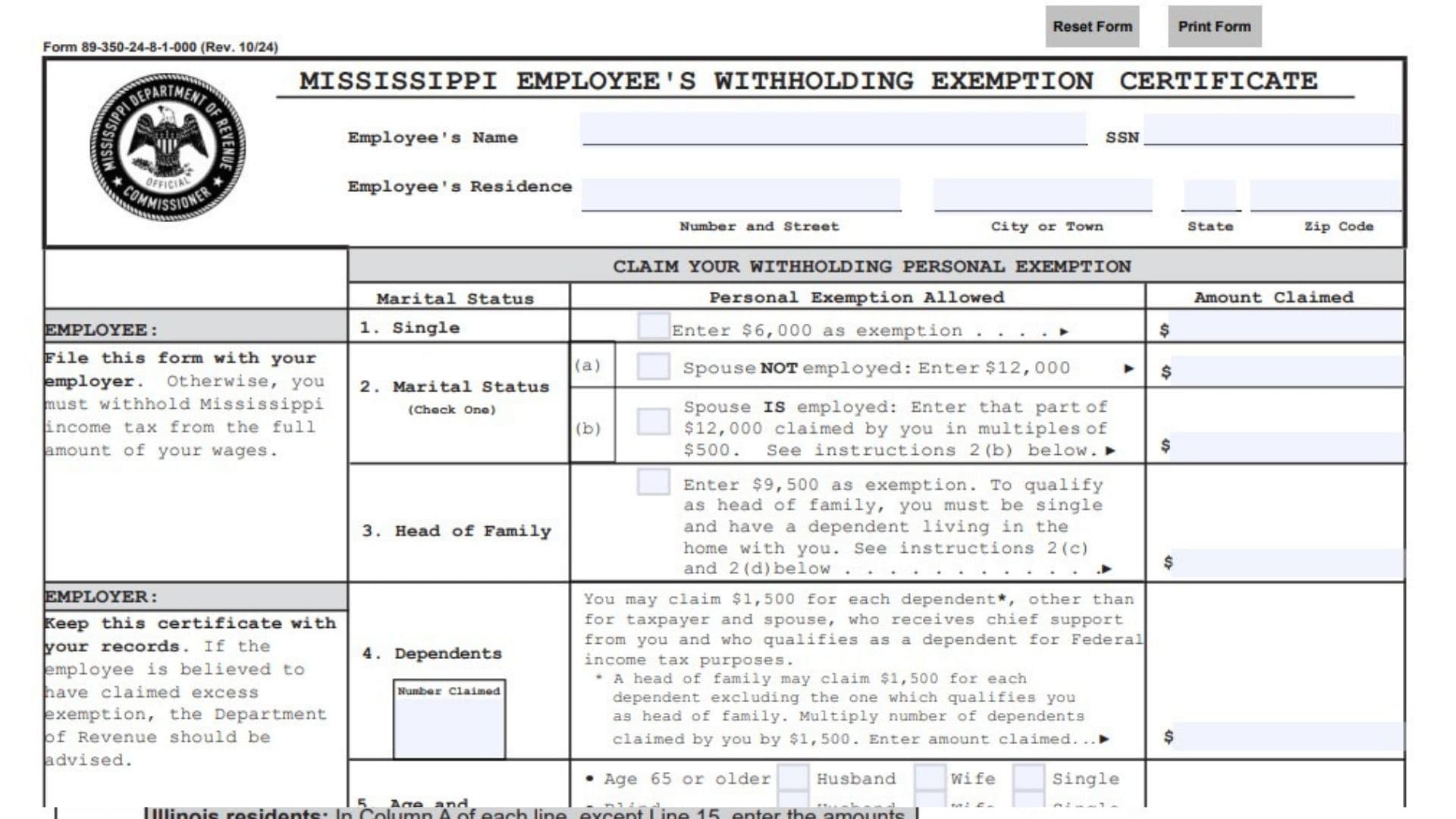
The Mississippi Employee’s Withholding Exemption Certificate is a state tax withholding form used by employees to inform their employers about the personal exemptions they are entitled to claim when calculating Mississippi income tax withholding from their wages. The form allows employees to report their marital status, qualifying dependents, age, blindness status, and other applicable exemption information. It also provides a way for eligible military spouses to claim an exemption from Mississippi income tax withholding under the Military Spouses Residency Relief Act. The Mississippi Department of Revenue uses the withholding information reported through employers to support the appropriate calculation of state income tax withholding.
The certificate is designed for Mississippi employees who want their employers to account for applicable personal exemptions when withholding state income tax from their paychecks. Depending on their circumstances, employees may claim exemptions for single filing status, married individuals, head-of-family status, qualifying dependents, age 65 or older, and blindness. The form also allows employees to request an additional fixed dollar amount of withholding per pay period if their employer agrees. Eligible military spouses who meet the applicable residency and tax liability conditions may claim exempt status by completing the designated section and providing the required supporting documents.
Completing this certificate correctly is important because the information determines how much Mississippi income tax an employer withholds from an employee’s wages. If an employee does not submit the certificate, the employer must generally withhold Mississippi income tax from the employee’s full wages without considering the personal exemptions described on the form. Employees must also ensure that their claimed exemptions do not exceed the amounts they are legally entitled to receive. A new certificate must be submitted to the employer within 30 days after a change in exemption status. Providing false information intentionally may result in penalties.
How To File the Mississippi Employee’s Withholding Exemption Certificate
The Mississippi Employee’s Withholding Exemption Certificate must be submitted directly to the employee’s employer. It is not a standalone annual income tax return and is not submitted directly to the Mississippi Department of Revenue as part of the employee’s regular tax return filing.
Employees should complete the certificate when they begin employment or when they need to update their Mississippi withholding exemption information.
Before completing the form, gather the following information:
- Full legal name.
- Social Security number.
- Complete residential address.
- Marital status.
- Information about qualifying dependents.
- Age and blindness information for the employee and spouse, when applicable.
- The applicable personal exemption amounts.
- Any additional withholding amount requested per pay period.
- Military residency documentation, if claiming the military spouse exemption.
After completing the applicable sections, sign and date the certificate before giving it to the employer.
Employee’s Filing Responsibility
Employees must provide the completed certificate to their employer. If the certificate is not submitted, the employer must withhold Mississippi income tax from the employee’s full wages without applying the personal exemptions listed on the form.
Employer’s Recordkeeping Responsibility
The employer must retain the completed certificate with its records. If the employer believes an employee has claimed more exemptions than permitted, the employer should notify the Mississippi Department of Revenue.
When to Submit a New Certificate
A new withholding exemption certificate must be provided to the employer within 30 days after any change in the employee’s exemption status. This helps ensure that withholding calculations reflect the employee’s current circumstances.

How To Complete the Mississippi Employee’s Withholding Exemption Certificate
The certificate contains eight numbered lines, along with employee identification fields, an exemption declaration, and signature information. Each section serves a different purpose in determining the employee’s Mississippi withholding exemptions.
Employee Information
Complete the identification section before claiming any exemptions.
Employee’s Name
Enter your full name as the employee. Make sure the information is accurate and consistent with your employment records.
Social Security Number (SSN)
Enter your Social Security number in the designated field. This number identifies you for tax withholding purposes.
Employee’s Residence
Provide your complete residential address. The address section includes the following fields:
- Number and Street: Enter your house or building number and street name.
- City or Town: Enter the name of your city or town.
- State: Enter your state of residence.
- ZIP Code: Provide your residential ZIP code.
Ensure that all address information is accurate and current.
Claim Your Withholding Personal Exemption
This section contains the personal exemption categories available to employees. Select the applicable marital status or exemption category and enter the corresponding amount in the Amount Claimed column.
Line 1: Single Individuals
This line is for employees who qualify as single individuals and are claiming the standard personal exemption available under this category.
Enter $6,000 in the Amount Claimed column if you qualify as single.
The form provides this exemption as the personal allowance for single individuals. Do not claim this amount under Line 1 if you are claiming the married or head-of-family exemption instead.
Line 2: Marital Status
This section is for married employees claiming the joint personal exemption. It contains two separate options depending on whether the employee’s spouse is employed.
Select the applicable option and enter the amount you are claiming.
Line 2(a): Spouse Not Employed
Use this option when your spouse is not employed.
Enter $12,000 as your personal exemption amount. This represents the full joint exemption available to married individuals when the spouse is not employed.
Line 2(b): Spouse Is Employed
Use this option when both you and your spouse are employed.
Married individuals are allowed a combined personal exemption of $12,000. However, when both spouses work, they may divide this amount between themselves in any manner they choose, provided the combined amount does not exceed $12,000.
The amount claimed must be entered in multiples of $500.
For example:
- If you claim $6,500, your spouse may claim $5,500.
- If you claim $8,000, your spouse may claim $4,000.
- If you claim $7,000, your spouse may claim $5,000.
Enter only the portion of the joint exemption you are claiming on your own certificate.
Line 3: Head of Family
This line is for single individuals who qualify as heads of family under Mississippi’s withholding exemption rules.
To qualify, you must be unmarried and maintain a home that serves as your principal residence and the principal residence of at least one qualifying dependent.
Enter $9,500 if you meet these requirements.
If you have additional qualifying dependents beyond the dependent needed to establish head-of-family status, you may also claim the applicable dependent exemptions on Line 4.
For example, if you are single and maintain a home with a qualifying dependent, you may claim the head-of-family exemption. If you have other qualifying dependents, their additional exemptions may also be included.
Line 4: Dependents
Use this line to claim additional personal exemptions for qualifying dependents.
The available exemption is $1,500 for each qualifying dependent who receives their chief support from you and meets the federal income tax requirements for dependent status.
Enter the number of dependents you are claiming in the Number Claimed box.
Then multiply the number of qualifying dependents by $1,500 and enter the resulting amount in the Amount Claimed column.
For example:
- One dependent: $1,500.
- Two dependents: $3,000.
- Three dependents: $4,500.
- Four dependents: $6,000.
A head of family may claim $1,500 for each additional qualifying dependent, but the dependent used to establish head-of-family status must be excluded from this calculation.
Married individuals may divide their qualifying dependents between themselves in any manner they choose. However, neither spouse should include themselves or their spouse as a dependent.
For example, if a married couple has three qualifying children, one spouse may claim two children while the other claims one. Alternatively, one spouse may claim all three while the other claims none. The same dependent should not be claimed by both spouses.
Line 5: Age and Blindness
This section allows an additional personal exemption for employees or spouses who meet the applicable age or blindness requirements.
The form provides two categories:
- Age 65 or older.
- Blindness.
Each qualifying individual may receive an additional exemption of $1,500.
For each category, the form provides separate checkboxes for:
- Husband.
- Wife.
- Single.
Check the applicable boxes based on your circumstances.
Age 65 or Older
An additional $1,500 exemption may be claimed if the employee or spouse reaches age 65 before the end of the taxable year.
For example:
- If a single employee qualifies based on age, check the Single box.
- If the husband qualifies, check Husband.
- If the wife qualifies, check Wife.
- If both spouses qualify, check both Husband and Wife.
Blindness
An additional $1,500 exemption may also be claimed if the employee or spouse meets the applicable blindness requirement.
Check the appropriate box for the husband, wife, or single employee, depending on who qualifies.
Calculating the Line 5 Exemption
After selecting all applicable boxes, count the total number of boxes checked across both categories.
Multiply that number by $1,500 and enter the result in the Amount Claimed column.
For example, if an employee qualifies for the age exemption and the blindness exemption, two applicable boxes may be checked. The total exemption would be $3,000.
Dependents cannot receive additional exemptions based on age or blindness under this section. These additional exemptions are available only for the taxpayer and spouse, when applicable.
Line 6: Total Amount of Exemption Claimed
This line calculates the combined personal exemption amount claimed throughout Lines 1 through 5.
Add the applicable amounts from:
- Line 1: Single exemption.
- Line 2: Married exemption.
- Line 3: Head-of-family exemption.
- Line 4: Dependent exemptions.
- Line 5: Age and blindness exemptions.
Enter the combined amount on Line 6.
For example, if you claim $6,000 for single status and $1,500 for one qualifying dependent, your total exemption would be $7,500, assuming no other exemptions apply.
The amount reported on this line is used as a basis for determining Mississippi income tax withholding under the applicable withholding tables.
Line 7: Additional Dollar Amount of Withholding Per Pay Period
This line allows an employee to request an additional fixed dollar amount of Mississippi income tax withholding from each paycheck.
If you want your employer to withhold more than the amount calculated using the applicable withholding tables, enter the additional dollar amount you would like withheld per pay period.
This additional withholding arrangement is subject to your employer’s agreement.
For example, if you want an extra $25 withheld from each paycheck, enter $25 on Line 7, provided your employer agrees to the arrangement.
This amount is separate from the personal exemptions claimed on Lines 1 through 6.
Line 8: Military Spouse Exemption From Mississippi Withholding
This line is specifically for eligible military spouses who qualify for relief under the Service Member Civil Relief Act, as amended by the Military Spouses Residency Relief Act.
You may claim an exemption from Mississippi income tax withholding if you meet the applicable conditions under these laws and have no Mississippi income tax liability.
If you qualify, write “Exempt” in the designated area for Line 8.
You must also attach the following supporting documents:
- A copy of Federal Form DD-2058.
- A copy of your Military Spouse ID Card.
These documents allow your employer to verify your military spouse exemption claim.
Do not claim exempt status under this line unless you meet the applicable residency and tax liability requirements.
Employee Declaration and Signature
After completing the applicable exemption sections, review the declaration and provide your signature and date.
Employee’s Declaration
The declaration confirms that the exemption amount claimed does not exceed the amount you are legally entitled to claim. Alternatively, it confirms that you qualify for exempt status.
By signing, you acknowledge that the information provided is subject to the penalties applicable to false reports.
Employee’s Signature
Sign the certificate in the designated space to confirm your exemption information and declaration.
Date
Enter the date you sign the certificate.
The certificate should be signed and dated before it is submitted to your employer.
Mississippi Employee’s Withholding Exemption Certificate Instructions
The form includes additional instructions explaining the available exemption amounts, eligibility requirements, and employee and employer responsibilities. These instructions are important for determining which exemptions you can claim.
Personal Exemption Amounts
The form provides the following personal exemption amounts:
| Exemption Category | Amount Allowed |
|---|---|
| Single individuals | $6,000 |
| Married individuals filing jointly | $12,000 |
| Head of family | $9,500 |
| Qualifying dependents | $1,500 each |
| Age 65 or older | $1,500 |
| Blindness | $1,500 |
These amounts establish the available withholding exemptions for the categories listed on the certificate.
Claiming Personal Exemptions
Single Individuals
Single employees should enter $6,000 on Line 1.
Married Individuals
Married employees are entitled to a combined exemption of $12,000.
If the spouse is not employed, the employee should enter the full $12,000 on Line 2(a).
If the spouse is employed, the couple may divide the $12,000 exemption between themselves in multiples of $500. The total claimed by both spouses cannot exceed $12,000.
Head of Family
A head of family must be a single individual who maintains a home that serves as the principal residence for themselves and at least one qualifying dependent.
Eligible individuals should claim $9,500 on Line 3.
If the taxpayer has more than one qualifying dependent, additional dependent exemptions may also be available.
Dependents
An additional exemption of $1,500 may generally be claimed for each qualifying dependent.
A dependent must be a relative who receives their chief support from the taxpayer and meets the federal income tax requirements for dependent status.
Individuals claiming head-of-family status may also claim exemptions for additional dependents, excluding the dependent required to establish head-of-family eligibility.
Married and single individuals may claim qualifying dependents. However, taxpayers should not include themselves or their spouses as dependents.
Married taxpayers may distribute their dependent claims between themselves in any manner they choose, provided the same dependent is not claimed twice.
Age 65 and Older
An additional exemption of $1,500 may be claimed by the taxpayer, spouse, or both if they have reached age 65 before the close of the taxable year.
This exemption is not available for dependents based on their age.
Check the appropriate boxes on Line 5 to identify the qualifying individual.
Blindness
An additional exemption of $1,500 may be claimed by the taxpayer, spouse, or both if they qualify based on blindness.
Dependents cannot receive an additional exemption based on blindness.
Select the applicable boxes on Line 5 and multiply the total number of qualifying boxes checked by $1,500.
Total Exemption Claimed
After calculating the exemptions for each applicable category, add the amounts claimed on Lines 1 through 5.
Enter the combined amount on Line 6.
This total is used as a basis for determining the amount of Mississippi income tax that should be withheld from the employee’s wages under the appropriate withholding tables.
Requirement to Submit a New Exemption Certificate
Employees must submit a new exemption certificate to their employer within 30 days after any change in their exemption status.
Changes in marital status, dependent eligibility, age-related eligibility, or other circumstances affecting the exemptions claimed may require an updated certificate.
Penalties for Providing False Information
The certificate includes a declaration subject to penalties for false reporting.
Employees must provide accurate information and claim only the exemptions they are legally entitled to receive.
Willfully supplying false information may result in penalties.
What Happens If an Employee Does Not Submit the Certificate?
If an employee fails to provide a completed exemption certificate to the employer, Mississippi income tax must be withheld from the employee’s total wages without allowing the personal exemptions covered by this form.
Employees who want their applicable exemptions considered in withholding calculations should submit the completed certificate to their employer.
Military Spouse Residency Relief Act
The form also addresses the Military Spouses Residency Relief Act, identified as Public Law 111-97, signed on November 11, 2009.
This provision allows qualifying military spouses to claim an exemption from Mississippi income tax withholding when they meet the applicable legal conditions and have no Mississippi tax liability.
Eligible employees must complete Line 8 and provide the required Federal Form DD-2058 and Military Spouse ID Card to their employer for verification.
Final Review Before Filing
Before submitting the Mississippi Employee’s Withholding Exemption Certificate to your employer, review the following checklist to ensure that all applicable information is complete and accurate.
- Enter your full legal name.
- Provide your correct Social Security number.
- Enter your complete residential address, including street, city, state, and ZIP code.
- Select the appropriate personal exemption category based on your marital status.
- Enter $6,000 on Line 1 if claiming the single exemption.
- Enter the appropriate married exemption on Line 2(a) or Line 2(b).
- Make sure the combined married exemption claimed by both spouses does not exceed $12,000.
- Enter $9,500 on Line 3 if you qualify as head of family.
- Verify that all dependents claimed on Line 4 meet the applicable requirements.
- Calculate the dependent exemption using $1,500 for each qualifying dependent.
- Exclude the dependent used to establish head-of-family status when calculating additional dependent exemptions.
- Check the appropriate age and blindness boxes on Line 5.
- Confirm that age-related exemptions apply only when the taxpayer or spouse reaches age 65 before the close of the taxable year.
- Do not claim age or blindness exemptions for dependents.
- Add the applicable amounts from Lines 1 through 5 and enter the total on Line 6.
- Enter any additional agreed withholding amount on Line 7.
- If claiming the military spouse exemption, write “Exempt” on Line 8 and attach the required supporting documents.
- Read the employee declaration carefully.
- Sign and date the certificate.
- Submit the completed certificate directly to your employer.
- Provide an updated certificate within 30 days after any change in your exemption status.
The Mississippi Employee’s Withholding Exemption Certificate helps employees establish the personal exemptions their employers should consider when calculating Mississippi income tax withholding. By selecting the correct exemption categories, calculating the applicable amounts, and providing accurate information, employees can help ensure that their paycheck withholding reflects their eligibility. Keep your exemption information current and submit an updated certificate whenever your circumstances change.